
My experience in observing and analyzing modern manufacturing processes has led me to a firm conclusion: the integration of industrial robots for grinding and finishing operations, particularly for cast iron parts, represents a fundamental shift in production philosophy. The traditional method, reliant on the skilled hands of human operators, is increasingly being supplanted by automated systems that offer superior consistency, efficiency, and safety. The journey began in the late 1950s with conceptual proposals, but the true transformation for tasks like grinding rough cast iron parts has accelerated in recent decades. This evolution is not merely a replacement of labor but a comprehensive enhancement of the entire production workflow, from initial casting to final quality assurance. The inherent challenges of manual grinding—variability, fatigue, and environmental hazards—are precisely where robotic automation delivers its most compelling advantages.
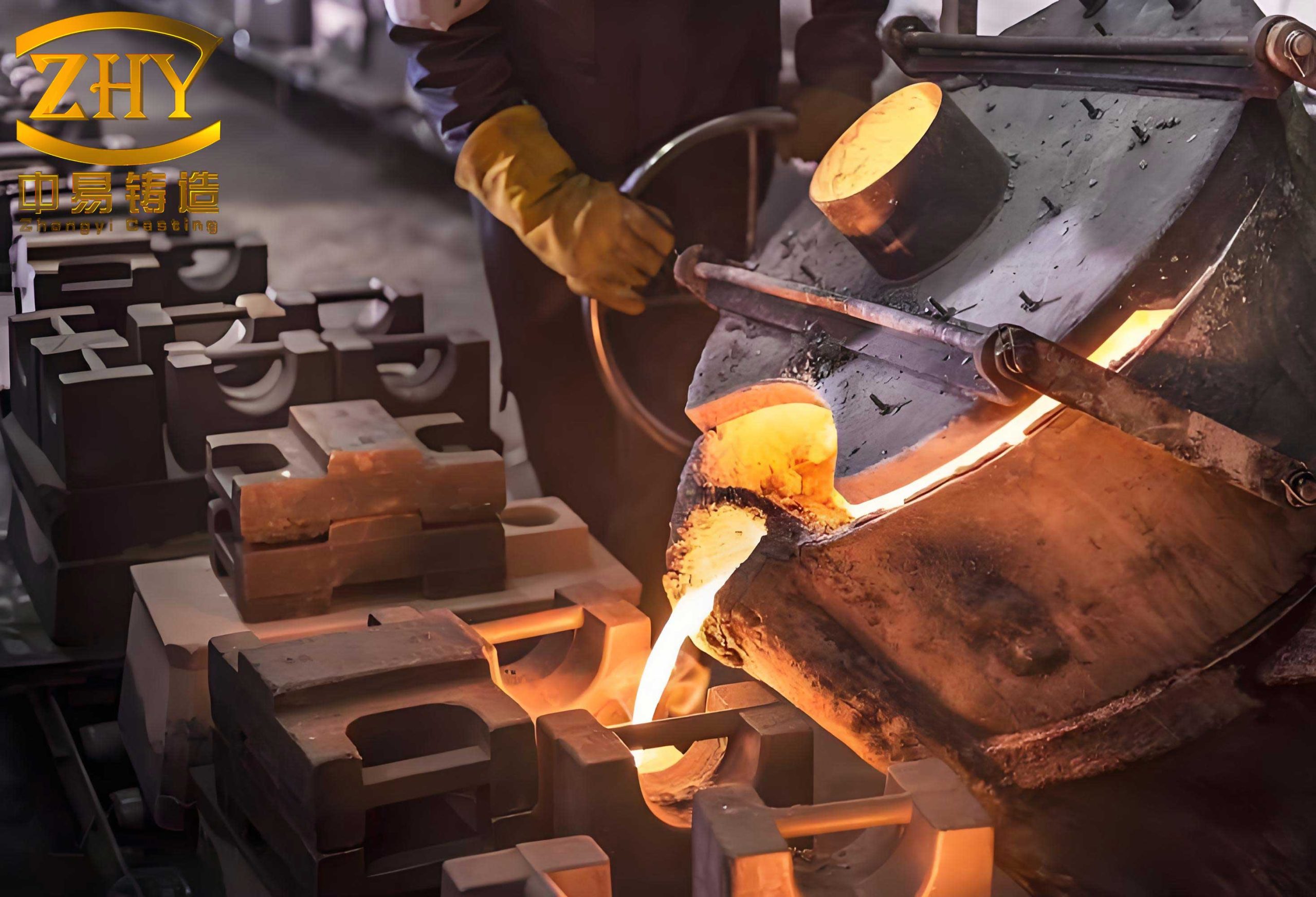
The surface of cast iron parts directly from the molding process is typically characterized by imperfections: parting lines, flash, gate residues, and a rough surface texture. Removing these defects to meet precise dimensional and surface finish specifications is a critical yet labor-intensive step. Manual grinding of these hard, abrasive cast iron parts is physically demanding, generates significant particulate matter, and depends heavily on the operator’s sustained skill and concentration. Industrial robots, programmed with precise paths and controlled forces, are uniquely suited to this repetitive and strenuous task. Their application transforms a bottleneck into a streamlined, predictable, and data-rich process.
Comparative Advantages of Robotic Grinding for Cast Iron Parts
The decision to implement robotic grinding for cast iron parts is driven by a matrix of tangible benefits that collectively improve the bottom line and working conditions. A comparative analysis reveals the scope of this improvement.
| Performance Metric | Traditional Manual Grinding | Robotic Grinding System | Key Robotic Advantage |
|---|---|---|---|
| Productivity & Output | Limited by human endurance, skill variation, and tool change downtime. | Continuous 24/7 operation possible; consistent cycle time; faster tool changes. | Predictable high-volume throughput. |
| Quality Consistency | Subject to operator experience and fatigue; higher defect rate. | Programmed repeatability ensures every cast iron part is processed identically. | Dramatically reduced scrap and rework. |
| Operational Safety | High exposure to noise, dust, flying debris, and repetitive stress injuries. | Operator removed from hazardous environment; tasks enclosed. | Elimination of direct physical hazards. |
| Lifecycle Cost | High recurring labor costs, variable consumable use, and liability costs. | High initial capital investment offset by lower long-term operational costs. | Lower total cost of ownership over time. |
| Process Control & Data | Qualitative, based on operator judgment. | Quantitative data on force, path, and time for every part. | Enables statistical process control and continuous improvement. |
1.1 Quantifiable Gains in Productivity and Efficiency
The productivity argument for robotic grinding of cast iron parts is multifaceted. Unlike a human worker, a robot does not require breaks, suffers no performance degradation over a shift, and maintains a perfectly consistent pace. The cycle time for grinding a specific cast iron part becomes a fixed, optimized parameter. Furthermore, tool management is systematized. For instance, the use of long-life diamond abrasive tools, which can withstand over 2000 grinding cycles on tough cast iron parts, minimizes changeover frequency. When a change is needed, it can be executed automatically via a tool changer, reducing non-value-added time to seconds. This allows for the creation of high-volume production cells dedicated to grinding families of cast iron parts, where the throughput, \( Q \), can be modeled as:
$$ Q = \frac{T_{avail}}{(t_{cycle} + t_{changeover}/N)} $$
where \( T_{avail} \) is available production time, \( t_{cycle} \) is the robot’s grinding cycle time per part, \( t_{changeover} \) is the time for tool or part changeover, and \( N \) is the number of parts processed between changeovers. Robotic systems maximize \( Q \) by minimizing \( t_{cycle} \) through optimized paths and maximizing \( N \) through durable tooling.
1.2 Unparalleled and Consistent Product Quality
Quality in grinding is defined by dimensional accuracy and surface finish. Manual grinding introduces inherent variability. The force applied, the path of the grinder, and the dwell time on a specific burr all fluctuate. In contrast, a robot replicates the programmed trajectory with sub-millimeter accuracy and can maintain a controlled force profile using integrated force/torque sensors. This ensures that every cast iron part in a batch receives identical treatment. The resultant surface roughness, \( R_a \), becomes a predictable function of the robotic process parameters rather than an operator-dependent variable. This consistency is crucial for downstream processes like painting or assembly, and for meeting stringent customer specifications. The relationship between applied force (\(F\)), feed rate (\(v_f\)), and material removal rate (\(MRR\)) for a cast iron part can be described as:
$$ MRR = k \cdot F \cdot v_f $$
where \( k \) is a material-dependent constant. The robot precisely controls \( F \) and \( v_f \), yielding a consistent \( MRR \) and, consequently, a uniform surface profile across all cast iron parts.
1.3 Enhanced Safety and Improved Working Environment
Grinding cast iron parts generates significant amounts of airborne particulate matter (silica dust), noise, and sharp metallic debris. Prolonged human exposure poses serious health risks, including silicosis and hearing loss. A robotic grinding cell is typically fully enclosed with safety interlocks. The operator’s role shifts from direct, hazardous manipulation to supervision, programming, and maintenance. This not only protects workers but also reduces company liability and creates a more attractive workplace. The environmental control is also more effective; centralized dust extraction systems can be directly integrated into the robotic cell’s enclosure, capturing pollutants at the source with higher efficiency than portable extractors used in manual stations.
1.4 Comprehensive Lifecycle Cost Reduction
While the initial capital expenditure for a robotic grinding system—including the robot, end-effectors, tooling, safety enclosure, and programming—is substantial, the total lifecycle cost often proves lower than manual methods. The cost model shifts from variable labor costs to fixed depreciation. Key savings areas include:
- Direct Labor: Reduced number of operators per output unit.
- Consumables: Optimized use of grinding wheels/discs due to consistent pressure and path.
- Quality Costs: Major reductions in scrap, rework, and customer returns.
- Training: Lower costs for training robot programmers versus training multiple master craftsmen.
The break-even point can be calculated by comparing the annualized cost of the robotic system (\(C_{robot}\)) with the annual cost of manual grinding (\(C_{manual}\)).
$$ C_{robot} = C_{cap} \cdot \frac{i(1+i)^n}{(1+i)^n – 1} + C_{op,robot} $$
$$ C_{manual} = (W \cdot L) + C_{op,manual} + C_{quality, manual} $$
where \( C_{cap} \) is capital cost, \( i \) is interest rate, \( n \) is payback period in years, \( C_{op} \) are annual operating costs, \( W \) is wage rate, and \( L \) is labor hours required. For high-volume production of cast iron parts, \( C_{robot} \) frequently becomes lower than \( C_{manual} \) within 2-3 years.
1.5 Reduction in Physical Labor and Ergonomic Strain
The physical demand of manually grinding heavy, stubborn cast iron parts cannot be overstated. It leads to operator fatigue, musculoskeletal disorders, and high turnover. The robot absorbs all this physical strain. The human role is elevated to tasks requiring cognitive skill: system oversight, quality inspection, process optimization, and maintenance. This represents a fundamental improvement in job quality and sustainability.
System Design and Technical Implementation for Cast Iron Grinding
Successfully deploying a robot to grind cast iron parts requires careful engineering of the entire work cell. It is a systems integration challenge, not just a matter of installing a robot.
2.1 Grinding Process Strategy and Kinematic Configuration
There are two primary kinematic strategies for robotic grinding, each with implications for programming and fixturing:
| Strategy | Description | Best For | Considerations |
|---|---|---|---|
| Robot-Held Tool | The robot manipulates the grinding tool (e.g., angle grinder, disc sander) over a fixtured, stationary cast iron part. | Large, heavy, or complex cast iron parts that are difficult to maneuver. | Requires powerful robot to handle tool weight and reaction forces; tool cabling management is critical. |
| Robot-Held Part | The robot manipulates the cast iron part against a stationary grinding tool (e.g., belt sander, grinding wheel). | Smaller to medium-sized cast iron parts where part weight is within robot payload. | Simplifies tooling; robot must be precise and rigid to control part orientation accurately. |
Hybrid systems also exist. The choice depends on part geometry, required access, and available equipment. The robot’s path for a cast iron part must be programmed to maintain optimal tool contact angle and speed. For a complex contour, the tool center point (TCP) path, \( \vec{P}(t) \), and orientation, \( \vec{O}(t) \), are critical:
$$ \vec{P}(t) = \vec{P}_{desired}(t) + \delta_{comp}(F(t)) $$
where \( \delta_{comp} \) is a real-time compensation offset based on force feedback \( F(t) \) to maintain constant engagement.
2.2 Work Cell Layout and Integration
A typical automated grinding cell for cast iron parts consists of several integrated modules:
- Industrial Robot: A 6-axis articulated robot with sufficient payload (for tool or part), reach, and rigidity. Robots with foundry protection are preferred for durability.
- Part Handling System: This could be a rotary table, a linear conveyor, a pallet shuttle system, or a part feeder that presents cast iron parts to the robot in a known orientation.
- Tooling System: The grinding tool mounted on the robot flange or in a stationary holder. This includes automatic tool changers if multiple tools are needed for different features on the same cast iron part.
- Force Control System: A force/torque sensor mounted between the robot flange and the tool or part. This is essential for compliant grinding, allowing the robot to “feel” the surface and apply a constant force, adapting to part-to-part variations in casting size.
- Dust Extraction & Enclosure: A sealed safety enclosure with integrated high-volume, low-pressure (HVLP) dust extraction points placed near the grinding contact zone.
- Control Cabinet: Housing the robot controller, PLC for cell sequencing, and safety relay system.
The layout must optimize the robot’s working envelope, minimize cycle time for part transfer, and ensure safe access for maintenance.
2.3 Fixturing and Workholding Design
Effective fixturing is paramount for quality. The fixture must locate and rigidly clamp the cast iron part to withstand grinding forces without deflection or movement. Key principles are:
- 3-2-1 Locating Principle: Use three points on the primary datum plane, two points on the secondary plane, and one point on the tertiary plane to fully constrain the part.
- Clamping Force Direction: Clamping forces should be directed into the locating points, not away from them, to prevent lifting during grinding.
- Accessibility: The fixture design must not obstruct the robot’s tool or the part itself from reaching all surfaces requiring grinding on the cast iron part.
- Durability: Fixture components exposed to dust and debris must be hardened and easy to clean.
The required clamping force, \( F_{clamp} \), must counter the grinding force, \( F_{grind} \), which has tangential (\(F_t\)) and normal (\(F_n\)) components. A simple static model ensures security:
$$ F_{clamp} \cdot \mu \cdot N_{clamps} > \sqrt{F_t^2 + F_n^2} $$
where \( \mu \) is the coefficient of friction between the clamp and the cast iron part, and \( N_{clamps} \) is the number of effective clamps resisting the force vector.
2.4 Tool Selection and Parameter Optimization
For grinding cast iron parts, diamond abrasive tools are often the optimal choice due to their exceptional wear resistance against the iron’s abrasive graphite flakes. The key parameters to program into the robotic system are:
- Spindle Speed (N): For a rotating tool. Higher speeds often produce a better surface finish but may increase heat.
- Feed Rate (v_f): The speed at which the robot moves the tool along the path.
- Applied Force (F_n): The normal force pushing the tool into the cast iron part, controlled by the force sensor.
- Step-over/Path Interval (a_e): The lateral distance between successive grinding passes.
The material removal rate and surface finish are governed by these parameters. An empirical model for surface roughness (\(R_a\)) might take the form:
$$ R_a = C \cdot v_f^{x} \cdot N^{y} \cdot F_n^{z} $$
where \( C, x, y, z \) are constants determined experimentally for a specific tool and cast iron grade. The robot’s program stores optimized parameter sets for different features (e.g., flat surfaces vs. edges) on the cast iron part.
2.5 Integrated Dust and Debris Management
A robust dust extraction system is non-negotiable. It protects the robot’s joints and electronics from abrasive dust, ensures clear camera vision if used, maintains a safe environment, and recovers valuable material. The system should be designed with an airflow velocity sufficient to capture particles at the source. The required volumetric flow rate \( Q_{air} \) can be estimated based on the hood design and particle characteristics. Furthermore, spark management is critical for safety when grinding cast iron parts. The enclosure may include spark arrestors or be constructed from non-flammable materials.
2.6 Quality Assurance and Adaptive Process Control
The final element is closing the loop on quality. While robotic consistency reduces defects, a verification system is essential. This can involve:
- In-process monitoring: Monitoring spindle power consumption or force feedback signals can indicate tool wear or an abnormal condition (e.g., a missed feature on a cast iron part).
- Post-process inspection: Using a laser scanner or vision system integrated into the cell to measure key dimensions or detect remaining flash automatically after grinding.
- Adaptive path correction: If inspection data shows a systematic error, the robot’s grinding path can be adjusted offline or, in advanced systems, via real-time feedback to a digital twin of the cast iron part.
This data-driven approach transforms the cell from a passive executor to an intelligent, self-correcting manufacturing node.
Conclusion and Future Trajectory
The application of industrial robots to the grinding of cast iron parts is a mature and proven technology that delivers unequivocal advantages. It addresses the core industrial challenges of productivity, quality, cost, and safety in a unified solution. The initial investment barrier is steadily lowering while the capabilities of the systems are increasing through better sensors, more intuitive programming software, and integration with Industrial Internet of Things (IIoT) platforms. Looking forward, the convergence of robotics with artificial intelligence and advanced metrology will push this application further. Imagine systems that can autonomously generate grinding paths from a 3D scan of an as-cast cast iron part, dynamically adapting to the unique geometry of each individual piece, or predictive maintenance algorithms that schedule tool changes before quality degrades. The trajectory is clear: the automated, intelligent, and flexible robotic grinding of cast iron parts will continue to evolve from a competitive advantage to a standard expectation in modern, responsible manufacturing. The human role will continue its essential evolution from manual executor to strategic overseer and optimizer of these sophisticated automated processes.