
In my extensive experience within the foundry industry, I have consistently observed that the pursuit of high-performance cast iron parts is fundamentally tied to the purity of the molten iron. Despite advancements in the standardization and commercialization of casting raw and auxiliary materials, the metallurgical quality of iron melt in many regions still lags behind that of developed nations. This gap manifests in several ways: even with identical chemical compositions and processing conditions, the required microstructure for cast iron parts is not achieved; or when the microstructure is similar, the mechanical properties of domestic castings are one to two grades lower; conversely, foreign-made cast iron parts often exhibit higher hardness yet superior machinability. The root cause of these discrepancies frequently lies in the presence of trace elements which compromise melt purity, thereby influencing solidification, microstructure formation, and ultimately, the service performance of cast iron parts. This article synthesizes key insights into how trace elements affect cast iron, and outlines strategies for achieving the high-purity iron melt essential for manufacturing premium cast iron parts.
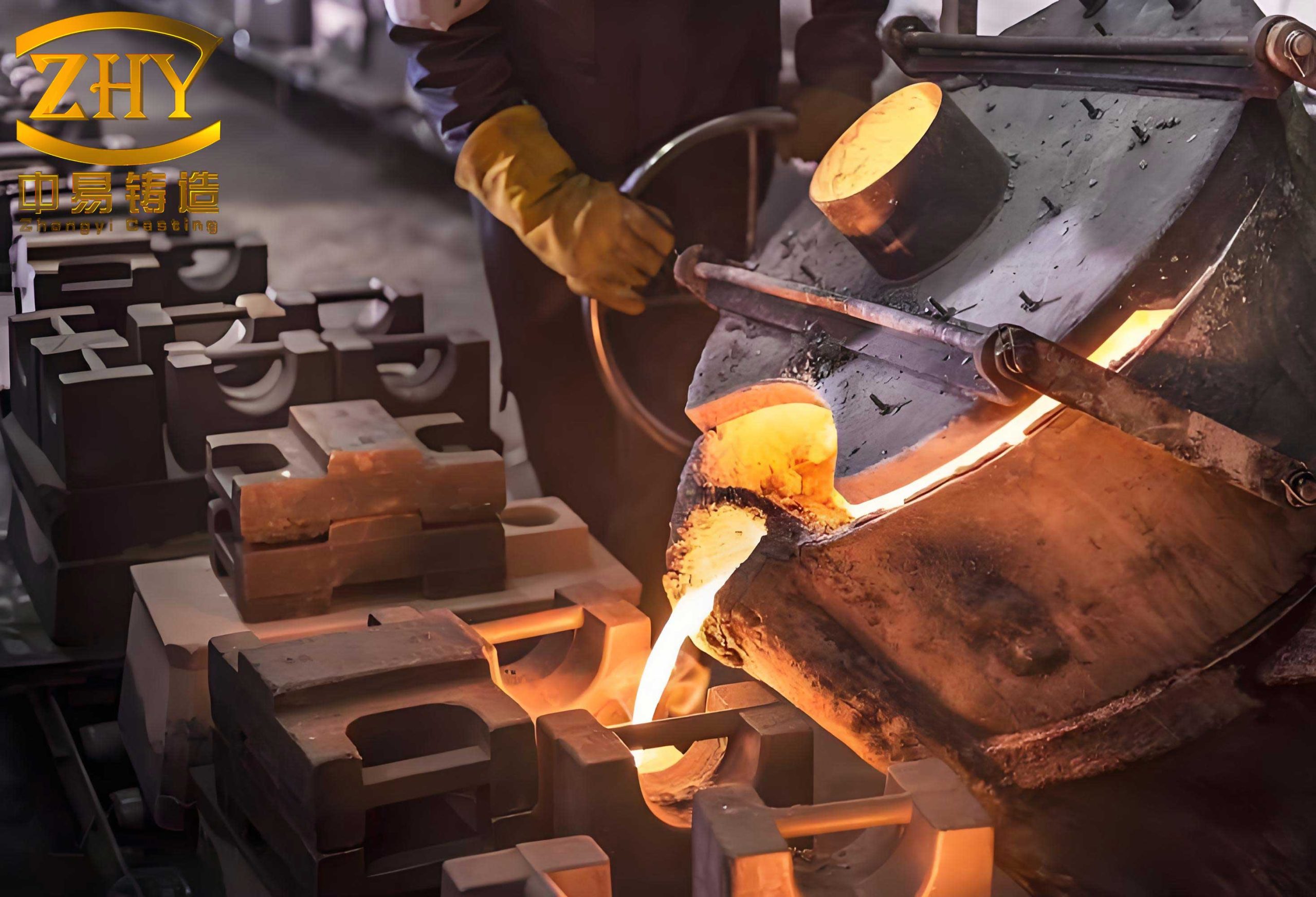
The production of reliable and high-integrity cast iron parts begins with understanding the profound impact of trace elements. Elements such as lead (Pb), tellurium (Te), arsenic (As), and titanium (Ti), often introduced via raw materials like pig iron, scrap, or alloys, can exist in parts per million (ppm) ranges yet exert disproportionate effects. Their influence varies between gray iron and ductile iron (nodular iron), each critical for different applications of cast iron parts.
Trace Element Effects on Gray Cast Iron Parts
For gray cast iron parts, the graphite morphology and matrix structure are paramount for properties like tensile strength, hardness, and machinability. Trace elements can severely disrupt these.
Lead (Pb): My investigations confirm that Pb is a potent modifier of graphite structure. At concentrations exceeding approximately 20 ppm, particularly in heavy-section cast iron parts cooled slowly, it promotes the formation of Widmanstätten graphite. This structure arises from secondary graphite precipitating along specific austenite planes, creating a “feathery” or dendritic appearance that embrittles the material. The deterioration of graphite from well-formed Type A to spiky, branched, or even closed-loop forms directly compromises mechanical integrity. The relationship between tensile strength ($\sigma_b$) and Pb content can be modeled for a given inoculation level. For instance, with a standard inoculation, the strength degradation becomes severe beyond a threshold:
$$ \sigma_b([Pb]) \approx \sigma_{b0} – k \cdot \max(0, [Pb] – [Pb]_{crit}) $$
where $\sigma_{b0}$ is the baseline strength, $k$ is a degradation constant, and $[Pb]_{crit}$ is the critical Pb concentration (e.g., 12-30 ppm depending on practice). Furthermore, Pb is a notorious contributor to micro-shrinkage and leakage defects in critical cast iron parts like engine blocks, as it segregates and alters solidification patterns.
Tellurium (Te): Te is an even stronger carbide stabilizer and undercooling agent. In gray iron, levels as low as 1 ppm can increase chill tendency. It promotes the formation of undercooled (Type D/E) graphite and degenerate forms. While it may initially increase ferrite content, higher doses lead to carbides. The effect on tensile strength is non-monotonic, often showing a decrease followed by an increase if carbides form, as summarized in the table below for typical gray iron cast iron parts.
| Element | Typical Critical Range | Primary Effect on Microstructure | Effect on Tensile Strength | Impact on Machinability |
|---|---|---|---|---|
| Pb | > 20-30 ppm | Widmanstätten graphite, spiky graphite | Sharp decrease beyond critical level | Severely degraded due to abrasive graphite |
| Te | > 1-35 ppm | Undercooled graphite, carbides | Decreases then may increase with carbide formation | Degraded due to hard phases |
| As | > 130-450 ppm | Promotes pearlite, can form carbides and undercooled graphite | Increases up to ~0.045%, then decreases | Can be negative if carbides form |
| Ti | > 0.04% (400 ppm) | Refines graphite initially, then promotes Type D graphite; forms TiC/TiN hard particles | Complex: often decreases then increases with high Ti | Significantly degraded due to abrasive TiC/TiN |
Arsenic (As): As has a dual character. At low levels (<0.013%), it can refine graphite and promote pearlite, enhancing strength. However, it strongly segregates during solidification of cast iron parts, accumulating at grain boundaries or interdendritic regions. This segregation can widen the solidification range and promote hot tearing. At higher concentrations, it leads to carbide networks and degraded properties. The quality factor $Q$ of gray iron, often defined as the ratio of measured tensile strength to that calculated from composition and cooling, can be expressed as a function of As content:
$$ Q = \frac{\sigma_{b, measured}}{\sigma_{b, calculated}} \propto \frac{1}{1 + \alpha [As]^2} \quad \text{for } [As] > [As]_{opt} $$
where $\alpha$ is a constant and $[As]_{opt}$ is the optimal arsenic content (around 0.013%).
Titanium (Ti): Perhaps the most discussed element regarding machinability of cast iron parts. Ti forms extremely hard titanium carbonitrides (TiC, TiN) with hardness exceeding 3000 HV. These particles act as abrasive sites during machining, accelerating tool wear. While small amounts (<0.03%) may reduce chilling tendency, higher levels promote undercooled graphite and directly impair machinability. The tool wear rate $W$ can be empirically related to Ti content and cutting speed $v_c$:
$$ W \approx \beta_1 [Ti] + \beta_2 v_c [Ti] $$
where $\beta_1$ and $\beta_2$ are constants. This explains why even slight increases in Ti (e.g., from 0.03% to 0.05%) can drastically reduce tool life when machining cast iron parts like cylinder blocks.
Trace Element Effects on Ductile Cast Iron Parts
The production of high-integrity ductile iron castings, such as those for wind turbine components or automotive safety parts, demands even stricter control over melt purity. Trace elements here are often termed “interfering elements” as they can impede graphite nodulization or promote detrimental phases.
The nodularity and matrix cleanliness of ductile cast iron parts are sensitive to trace residues. Elements like Pb, Bi, Sb, Te, As, and Ti can cause graphite degeneration from spherical to vermicular, exploded, or flake-like forms. Furthermore, they contribute to the formation of intergranular carbides or non-metallic inclusions, which act as stress concentrators and crack initiation sites. This is particularly critical for low-temperature impact toughness in heavy-section cast iron parts. The allowable limits for key interferents in high-grade ductile iron are stringent, as shown in the following derived specification table.
| Element Group/Element | Maximum Allowable Content (wt.%) | Primary Risk for Ductile Iron Parts |
|---|---|---|
| Ti | < 0.06 | Carbide formation, impaired nodulization |
| V | < 0.06 | Carbide formation |
| Cr | < 0.06 | Carbide formation |
| Sn, Sb | < 0.03, <0.002 | Graphite degeneration, pearlite stabilization |
| Pb + Bi + (Ti/10) | < 0.008 | Synergistic effect on graphite sphericity |
| Te, Se | < 0.02, <0.03 | Strong anti-nodulizing agents |
| P | < 0.04 | Phosphide eutectic, brittleness |
The quantitative effect on mechanical properties is significant. For instance, the elongation ($\delta$) of ductile cast iron parts is highly sensitive to minute variations in Ti, V, and P within their specified limits. Data suggests relationships such as:
$$ \delta_{Ti} \approx \delta_0 \cdot \exp(-\gamma_{Ti} [Ti]) $$
$$ \delta_{V} \approx \delta_0 \cdot (1 – \gamma_{V} [V]) $$
$$ \delta_{P} \approx \delta_0 \cdot (1 – \gamma_{P} [P]^2) $$
where $\delta_0$ is the base elongation and $\gamma$ are sensitivity coefficients. Conversely, these elements often increase tensile strength slightly while drastically reducing ductility and impact energy. The cleanliness of the base iron melt, often quantified by non-metallic inclusion counts or oxygen activity, directly correlates with the fracture toughness of cast iron parts. A cleaner melt yields a more homogeneous matrix with fewer sites for void coalescence, described by the void growth model:
$$ \frac{dR}{R} \propto \exp\left(\frac{\sigma_h}{\sigma_e}\right) d\epsilon_e $$
where $R$ is void radius, $\sigma_h$ is hydrostatic stress, $\sigma_e$ is von Mises stress, and $\epsilon_e$ is equivalent plastic strain. Inclusions from trace element reactions act as initial voids ($R_0$), lowering the strain to failure for the cast iron part.
Strategies for Achieving High-Purity Molten Iron for Superior Cast Iron Parts
Based on collective industrial and research practice, I recommend a multi-faceted approach to enhance iron melt purity, which is the cornerstone for producing reliable cast iron parts.
1. Sourcing High-Purity Base Materials: The foundation is using high-purity pig iron with low levels of S, P, and trace elements like Ti, V, As, Pb, Te. Alternatively, the “charge steel + carburizer” process using selected, clean steel scrap (e.g., automotive sheet scrap) in induction furnaces can yield very pure base iron for cast iron parts. However, scrap quality must be meticulously controlled to avoid introducing tramp elements.
2. Optimized Melting and Duplexing Practices:
– Induction Furnace Melting with Carburization: This allows precise control and avoids the genetic inheritance issues sometimes associated with pig iron. It is excellent for producing consistent base iron for high-quality cast iron parts.
– Cupola-Induction Furnace Duplex Melting: Leveraging the cupola’s efficient melting and slight refining action followed by precise superheating, composition adjustment, and holding in an induction furnace is an effective method to achieve both high throughput and purity for mass-produced cast iron parts.
3. Melt Refining and Treatment:
– Argon Purging or Flushing: Similar to steelmaking, injecting inert gas (Ar) into the iron melt in the furnace or ladle can promote flotation and removal of non-metallic inclusions, lowering oxygen and sulfur levels. This significantly improves the toughness and consistency of ductile cast iron parts.
– Use of High-Quality Additives: Employing low-magnesium oxide rare-earth magnesium master alloys for nodulization reduces slag generation. Using high-purity (>75% Si) ferrosilicon for inoculation ensures effective graphitization without introducing impurities. Alloying elements should be added via pre-made master alloys to ensure dissolution and homogeneity in the cast iron parts.
– Trace Element Neutralization: Strategic use of rare earth (RE) elements can mitigate the harmful effects of some trace elements. REs can form stable, high-melting-point compounds with elements like Pb, Bi, As, and Sb, effectively “tying them up” and preventing their interference during solidification of cast iron parts.
4. Process Control and Monitoring: Implementing rigorous charge control, frequent melt analysis for trace elements using techniques like optical emission spectrometry, and controlling superheat temperature and holding time are essential to maintain the desired purity level for each batch of cast iron parts.
The interplay between trace element content, microstructure, and mechanical properties can be summarized through a holistic quality model for cast iron parts. For a given grade, the target property $P$ (e.g., tensile strength, elongation, or impact energy) is a function of base composition $C$, trace element vector $\vec{T}$, and process parameters $\vec{\Pi}$:
$$ P = f(C, \vec{T}, \vec{\Pi}) = f_0(C, \vec{\Pi}) \cdot \prod_{i=1}^{n} g_i(T_i) $$
where $f_0$ represents the property under ideal pure conditions, and $g_i(T_i)$ are penalty functions for each trace element $i$, typically taking forms like $g_i(T_i) = 1 – \kappa_i \max(0, T_i – T_{i,crit})^{\eta_i}$. Achieving high purity minimizes the negative contributions from $g_i(T_i)$.
Conclusion
In the competitive landscape of metal casting, the ability to consistently produce high-performance cast iron parts is inseparable from the mastery of molten iron purity. The deleterious effects of trace elements—ranging from graphite distortion and carbide formation in gray iron to nodule degradation and inclusion formation in ductile iron—are well-documented and quantifiable. These effects ultimately dictate mechanical properties, machinability, and defect rates. Therefore, a systemic approach encompassing the use of purified raw materials, advanced melting duplexing techniques, active melt refining, and careful process control is not merely beneficial but essential. By prioritizing iron melt purity, foundries can overcome the historical performance gaps, produce cast iron parts that meet or exceed international standards, and secure a future in the manufacturing of high-value, critical-component castings. The journey toward excellence in cast iron parts is fundamentally a journey toward cleaner iron.