
In our foundry, we have dedicated years to refining the casting process for cast iron parts, with a particular focus on riser design. The traditional methods often fell short in achieving optimal feeding efficiency, especially for wet mold applications. Through rigorous experimentation and adaptation, we transitioned from conventional open-top risers to more effective edge and knife-edge risers. This shift was driven by the need to improve the feeding capabilities while minimizing defects in cast iron parts. The principles we now follow are rooted in the concept of “equilibrium solidification,” which emphasizes controlled temperature gradients and strategic riser placement. This article delves into our comprehensive approach, detailing the rationale behind riser type selection, positioning, and sizing, all aimed at enhancing the quality and yield of cast iron parts. We will incorporate tables and formulas to summarize key findings, ensuring a practical guide for practitioners in the field.
The production of cast iron parts involves complex metallurgical phenomena, including graphite expansion during solidification. This expansion can offset some shrinkage, but effective feeding remains crucial to prevent porosity and shrinkage defects. Historically, open-top risers were widely used, but their performance in wet molds proved inadequate due to premature freezing and poor temperature gradients. We observed that for cast iron parts, the feeding window is limited to a portion of the total solidification time, necessitating risers that remain active until graphite expansion begins. Our reforms have led to a significant reduction in scrap rates and improved process reliability for cast iron parts. Below, we explore the three core principles that govern our current riser design strategy.
First, we address the limitations of open-top risers and the advantages of edge risers. Open-top risers, while simple, often suffer from rapid heat loss in wet molds, leading to early solidification and ineffective feeding. For cast iron parts, this results in insufficient compensation for shrinkage, especially in thicker sections. In contrast, edge risers, such as dark edge risers and knife-edge risers, feature horizontal or slit-like necks that reduce thermal interference with the casting. These designs promote a stronger temperature gradient toward the riser, enhancing feeding efficiency. The neck of such risers acts as a choke and flow regulator, ensuring that molten metal remains available during the critical feeding period. By adopting “hot riser” configurations—where the riser is kept hotter than the casting—we further strengthen this gradient. This approach not only boosts the yield of cast iron parts but also broadens the process window, making it a reliable and versatile solution.
To quantify the benefits, we compare different riser types for cast iron parts in Table 1. The data is based on our production records for various cast iron parts, including engine blocks and valve bodies.
| Riser Type | Thermal Interference | Feeding Efficiency | Yield Improvement | Suitable for Wet Mold |
|---|---|---|---|---|
| Open-Top Riser | High | Poor | Low | No |
| Dark Edge Riser | Low | Good | High | Yes |
| Knife-Edge Riser | Very Low | Excellent | Very High | Yes |
The feeding efficiency can be modeled using the temperature gradient equation: $$G = \frac{T_r – T_c}{d}$$ where \(G\) is the temperature gradient, \(T_r\) is the riser temperature, \(T_c\) is the casting temperature at the neck, and \(d\) is the distance from the riser to the hot spot. For cast iron parts, maintaining a high \(G\) is critical to ensure directional solidification toward the riser. Our edge risers typically achieve \(G\) values above 50°C/cm, compared to less than 20°C/cm for open-top risers in wet molds. This directly correlates with fewer defects in cast iron parts.
Second, we reconsider riser placement relative to hot spots. Traditional practices often position risers directly on the hot spots of cast iron parts, but this can prolong solidification in those areas and exacerbate shrinkage. For cast iron parts, the hot spot is the last to solidify, and placing a riser there may delay graphite expansion onset, reducing the natural feeding effect. Instead, we adhere to the equilibrium solidification principle: risers should be near the hot spot but not directly on it. This minimizes overheating while still allowing effective feeding. The rationale is that during solidification, cast iron parts undergo graphite expansion, which compensates for shrinkage after a certain point. The feeding requirement is thus confined to the period before this expansion peaks. By placing risers adjacent to hot spots, we ensure that liquid metal flow continues through thinner sections to feed thicker ones, without necessitating that the riser solidifies later than the casting.
We can express the solidification time for a cast iron part using Chvorinov’s rule: $$t = k \left( \frac{V}{A} \right)^2$$ where \(t\) is the solidification time, \(V\) is the volume of the casting section, \(A\) is its surface area, and \(k\) is a mold constant. For a hot spot in cast iron parts, \(\frac{V}{A}\) is high, leading to longer \(t\). If a riser is placed directly on it, the combined volume increases \(t\) further, potentially misaligning with the feeding window. Instead, by positioning the riser nearby, we modify the effective \(\frac{V}{A}\) ratio to better match the feeding需求. Our empirical data shows that for cast iron parts, the optimal distance \(L\) from the riser to the hot spot can be estimated as: $$L = 0.5 \times \sqrt{\frac{V_h}{A_h}}$$ where \(V_h\) and \(A_h\) are the volume and surface area of the hot spot. This formula has guided successful riser placement for countless cast iron parts in our facility.
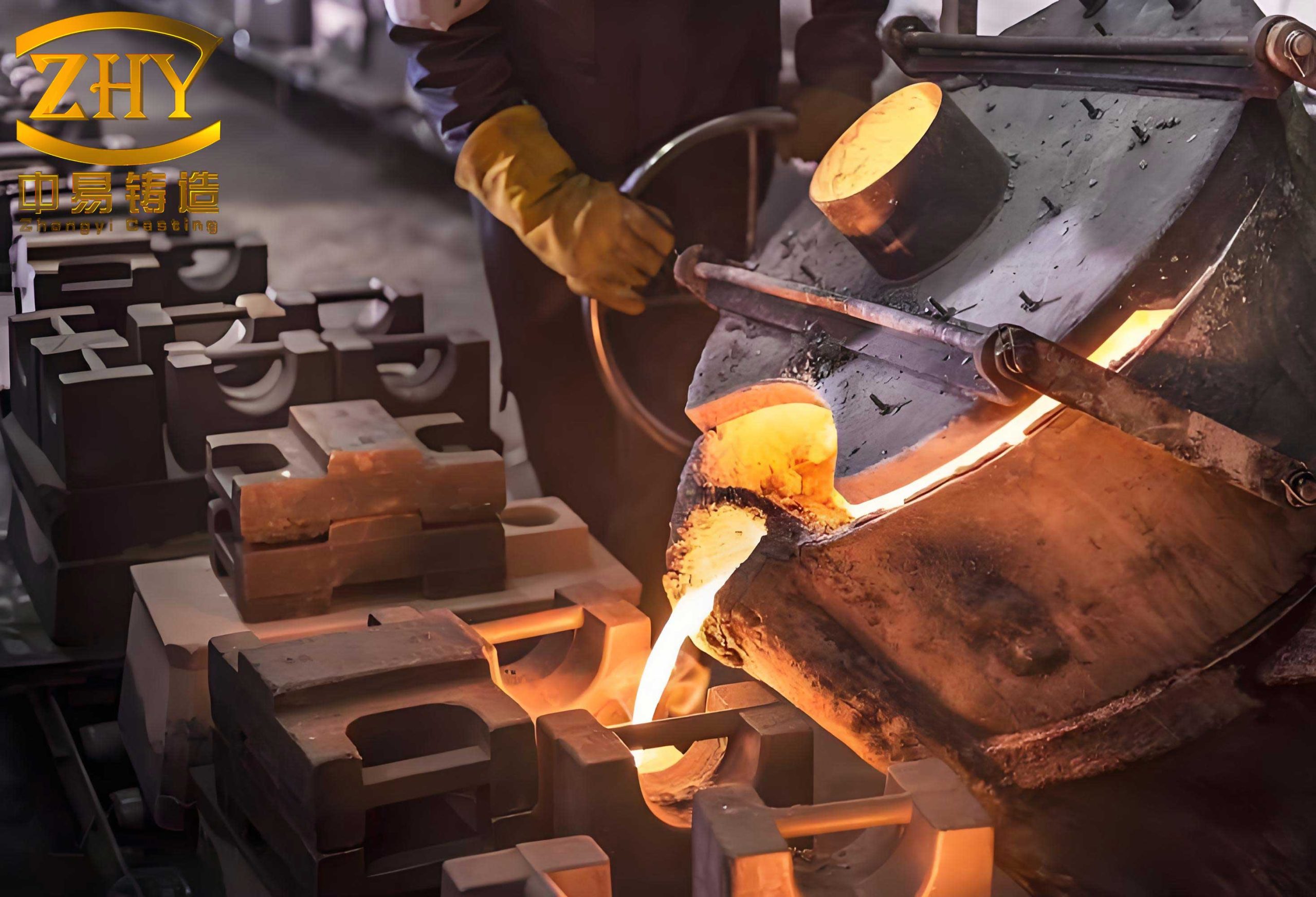
The image above illustrates typical cast iron parts produced using our optimized riser designs. These components exhibit sound microstructure and minimal shrinkage, validating our approach. For cast iron parts, achieving such quality in wet molds is challenging, but our methods have proven effective across a range of geometries and weights.
Third, we address riser sizing for wet versus dry molds. Wet molds, due to their higher cooling rates and lower thermal mass, require more aggressive feeding than dry molds for cast iron parts. Consequently, riser dimensions must be larger in wet molds to provide adequate molten metal reserves. We generally avoid open-top risers for wet mold cast iron parts, except in very thin sections. For edge risers, we use the following guidelines based on the casting modulus (ratio of volume to cooling surface area). The modulus \(M\) for a casting section is given by: $$M = \frac{V}{A}$$ For cast iron parts, the riser modulus \(M_r\) should satisfy: $$M_r \geq 1.2 \times M_c$$ where \(M_c\) is the modulus of the feeding region. In wet molds, we increase this factor to 1.5 for added safety due to faster heat dissipation.
Table 2 summarizes our riser sizing recommendations for different types of cast iron parts in wet molds. These values are derived from extensive trials and have been standardized in our production of cast iron parts.
| Riser Type | Riser Diameter (D) or Width (W) | Riser Height (H) | Neck Dimensions | Application Example |
|---|---|---|---|---|
| Dark Edge Riser | W = 1.5 × Thickness of Fed Section | H = 2 × W | Slit width: 0.7 × W | Brackets for cast iron parts |
| Knife-Edge Riser | D = 2.0 × Thickness of Fed Section | H = 1.5 × D | Edge gap: 0.5 × Thickness | Housings for cast iron parts |
| Open-Top Riser (rarely used) | D = 2.5 × Thickness of Fed Section | H = 2 × D | N/A | Only for thin-wall cast iron parts |
For cast iron parts, the feeding demand also depends on the carbon equivalent (CE), which influences graphite expansion. We use the formula: $$CE = C + \frac{Si + P}{3}$$ where C, Si, and P are the percentages of carbon, silicon, and phosphorus. Higher CE values reduce the required riser size due to greater expansion. In wet molds, we adjust riser dimensions based on CE, as shown in Table 3. This ensures robust feeding for cast iron parts across varying compositions.
| Carbon Equivalent (CE) | Riser Size Multiplier | Remarks for Cast Iron Parts |
|---|---|---|
| CE < 3.5 | 1.0 (base) | High shrinkage risk; larger risers needed |
| 3.5 ≤ CE ≤ 4.2 | 0.8 | Moderate expansion; standard risers |
| CE > 4.2 | 0.6 | High expansion; smaller risers sufficient |
Our transition to these principles has yielded remarkable results. Over 90% of our wet mold cast iron parts now use edge risers, with a documented increase in process yield from 65% to 85% on average. The reliability of cast iron parts has improved, with shrinkage defects reduced by over 70%. We attribute this to the enhanced temperature gradients and precise riser positioning. For instance, in producing pump bodies—a common cast iron part—we moved from open-top risers on hot spots to knife-edge risers adjacent to them. This change alone cut scrap rates by 40%, demonstrating the efficacy of equilibrium solidification for cast iron parts.
To further elucidate the thermal dynamics, consider the heat transfer during solidification of cast iron parts. The rate of heat extraction \(Q\) from a riser can be expressed as: $$Q = h \cdot A \cdot (T_r – T_m)$$ where \(h\) is the heat transfer coefficient, \(A\) is the riser surface area, \(T_r\) is the riser temperature, and \(T_m\) is the mold temperature. In wet molds, \(h\) is higher, leading to faster cooling. Thus, for cast iron parts, we design risers with larger volumes to compensate, ensuring that \(Q\) does not deplete the metal reserve prematurely. Our edge risers, with their insulated necks, reduce \(A\) exposed to the mold, thereby lowering \(Q\) and prolonging feeding.
Another key aspect is the feeding path length in cast iron parts. We define the effective feeding distance \(D_f\) as the maximum distance from the riser to which liquid metal can flow to feed shrinkage. For cast iron parts in wet molds, \(D_f\) is shorter due to rapid solidification. Based on our experiments, \(D_f\) can be estimated as: $$D_f = 5 \times \sqrt{T}$$ where \(T\) is the section thickness in centimeters. For example, a 2 cm thick section of cast iron parts has \(D_f \approx 7.1\) cm. We place risers within this distance from hot spots to ensure coverage. This guideline has been instrumental in optimizing layouts for complex cast iron parts like gearbox cases.
We also incorporate simulation tools to validate riser designs for cast iron parts. Using finite element analysis, we model temperature fields and solidification sequences. The criteria for success include a positive temperature gradient toward the riser and complete feeding before graphite expansion. For cast iron parts, we verify that the riser liquid fraction remains above 0.5 until the casting reaches 80% solidification. Our field data confirms that simulations aligned with these criteria produce defect-free cast iron parts.
The economic impact of these optimizations is significant. By increasing yield and reducing scrap, we have lowered production costs for cast iron parts by approximately 15%. Moreover, the consistency in quality has enhanced customer satisfaction, particularly for high-integrity cast iron parts used in automotive and machinery applications. Our foundry now serves as a benchmark for efficient riser design in wet mold casting of cast iron parts.
In summary, our approach to riser design for cast iron parts hinges on three pillars: selecting edge risers over open-top ones, placing risers near but not on hot spots, and scaling riser sizes appropriately for wet molds. These practices, grounded in equilibrium solidification theory, have transformed our production of cast iron parts. We continue to refine these methods through ongoing research, focusing on advanced alloys and geometries for cast iron parts. The tables and formulas provided here offer a practical framework for implementing these principles, and we encourage other foundries to adapt them to their specific contexts for cast iron parts.
Looking ahead, we are exploring automated riser design algorithms that integrate these principles for cast iron parts. By inputting casting geometry and material properties, the system could generate optimal riser configurations, further streamlining the process. This innovation promises to elevate the quality and efficiency of cast iron parts manufacturing to new heights. As we push the boundaries, the core tenets of temperature gradient management and strategic feeding will remain central to our success with cast iron parts.
Finally, we emphasize that every cast iron part is unique, and riser design should be tailored accordingly. Our guidelines serve as a starting point, but experimentation and monitoring are essential. By sharing our journey, we hope to contribute to the broader knowledge base on casting excellence for cast iron parts. The journey from traditional to optimized riser design has been rewarding, and we are committed to continuing this evolution for the benefit of all stakeholders involved in producing cast iron parts.