
In my extensive research on casting processes, I have dedicated significant effort to understanding and mitigating the surface roughness of cast iron parts. The quality of a cast iron part is critically influenced by its surface finish, which affects subsequent machining operations, aesthetic appeal, and functional performance. High surface roughness can lead to increased friction, stress concentrations, and reduced fatigue life in cast iron parts. Therefore, developing effective methods to lower surface roughness is paramount for enhancing the overall quality and competitiveness of cast iron parts in industrial applications. This article presents a comprehensive study from my perspective as a researcher, focusing on the factors in molding sand that impact surface roughness and proposing validated solutions.
The foundation of this work lies in analyzing the industrial molding sands commonly used in foundries. Molding sand composition plays a pivotal role in determining the surface characteristics of a cast iron part. Through systematic investigation, I identified key variables: the fineness and sintering point of base sand, the volatile carbon content in coal dust, and the inclusion of anti-burning-on additives. My approach involved conducting numerous tests on raw materials and sand properties, followed by pouring trials to verify the effectiveness of the proposed methods. The goal was to establish a scientific basis for selecting sand components that minimize surface defects and achieve smoother surfaces on cast iron parts.
To provide context, surface roughness in cast iron parts is primarily caused by metal penetration into sand interstices, chemical reactions at the metal-mold interface, and inadequate sand compaction. The roughness parameter, often denoted as Ra (arithmetic average roughness), can be modeled in relation to sand grain size. For instance, a theoretical relationship can be expressed as:
$$ R_a = k \cdot \frac{d_g}{\sqrt{\rho_s}} $$
where \( d_g \) is the average sand grain diameter, \( \rho_s \) is the sand density, and \( k \) is a constant dependent on other process parameters. This formula highlights that finer sands tend to produce lower roughness, but other factors like sintering behavior must be considered. In my experiments, I quantified these relationships to optimize sand selection.
The experimental phase began with characterizing various base sands. I collected samples from different sources and measured their properties, including grain size distribution, sintering point, and chemical composition. The sintering point, defined as the temperature at which sand grains begin to fuse, is crucial because it affects the formation of a protective layer that prevents metal penetration. A suitable sintering point should align with the pouring temperature of cast iron parts to ensure a stable mold surface. Table 1 summarizes the properties of tested base sands.
| Sand ID | Average Grain Size (μm) | Sintering Point (°C) | SiO2 Content (%) | Clay Content (%) |
|---|---|---|---|---|
| A | 150 | 1150 | 98.5 | 0.8 |
| B | 180 | 1200 | 97.0 | 1.2 |
| C | 120 | 1100 | 99.0 | 0.5 |
| D | 200 | 1250 | 96.5 | 1.5 |
| E | 100 | 1050 | 99.2 | 0.3 |
From this data, I observed that finer sands like C and E have lower sintering points, which may lead to premature fusion and surface defects in cast iron parts if not controlled. Therefore, a balance between fineness and sintering point is essential. I derived an optimization criterion using the following formula:
$$ \text{Fitness Index} = \frac{S_p}{d_g} \cdot \exp(-\alpha \cdot C_c) $$
where \( S_p \) is the sintering point, \( d_g \) is the grain size, \( C_c \) is the clay content, and \( \alpha \) is a coefficient. Sands with higher fitness indices were selected for further trials to produce cast iron parts with reduced roughness.
Next, I investigated the role of coal dust in molding sand. Coal dust is commonly added to generate a reducing atmosphere and prevent burn-on defects on cast iron parts. The key parameter is the volatile carbon content, which influences gas evolution and carbon deposition at the mold surface. I tested coal dust samples with varying volatile carbon levels and mixed them into sand blends. The performance was evaluated based on surface roughness measurements from test castings. Table 2 presents the results.
| Coal Dust Type | Volatile Carbon (%) | Added Amount (wt%) | Surface Roughness Ra (μm) for Cast Iron Part | Observation |
|---|---|---|---|---|
| CD1 | 30 | 3 | 12.5 | Moderate gloss, slight penetration |
| CD2 | 45 | 3 | 8.2 | Smooth surface, minimal defects |
| CD3 | 25 | 3 | 14.0 | Rough texture, metal adhesion |
| CD4 | 50 | 3 | 7.5 | Excellent finish, no penetration |
| CD5 | 35 | 3 | 10.8 | Acceptable but variable |
The data indicates that coal dust with volatile carbon content around 45-50% yields the lowest surface roughness for cast iron parts. This is because adequate carbon release forms a protective layer that minimizes metal-sand interaction. I formulated a relationship between roughness and volatile carbon content (Vc):
$$ R_a = \beta_0 + \beta_1 \cdot e^{-\gamma V_c} + \beta_2 \cdot V_c^2 $$
where \( \beta_0, \beta_1, \beta_2, \gamma \) are constants derived from regression analysis. This model helps in selecting optimal coal dust for producing high-quality cast iron parts.
In addition to coal dust, I explored anti-burning-on additives such as iron oxide, zircon flour, and proprietary compounds. These additives enhance the refractory properties of the sand, reducing penetration and improving surface finish of cast iron parts. I conducted trials with varying additive concentrations and measured their effects on sand properties like green strength, permeability, and hot strength. The optimal additive mix was determined through response surface methodology, with surface roughness as the response variable. Table 3 shows a subset of the results.
| Additive Type | Concentration (wt%) | Green Strength (kPa) | Permeability (cm/s) | Surface Roughness Ra (μm) for Cast Iron Part |
|---|---|---|---|---|
| None | 0 | 120 | 45 | 15.0 |
| Iron Oxide | 2 | 115 | 40 | 10.5 |
| Zircon Flour | 3 | 125 | 35 | 7.8 |
| Proprietary Blend | 1.5 | 130 | 42 | 6.5 |
| Combination | 2.5 | 128 | 38 | 5.9 |
The proprietary blend and combination additives yielded the best results, significantly lowering the roughness of cast iron parts. This can be attributed to their ability to form a dense, refractory barrier at the mold-metal interface. I developed a predictive equation for roughness based on additive concentration (C_add) and sand permeability (P):
$$ R_a = \delta_0 + \delta_1 \cdot C_{\text{add}}^{-1} + \delta_2 \cdot P $$
where \( \delta_0, \delta_1, \delta_2 \) are coefficients. This emphasizes the inverse relationship between additive effectiveness and roughness for cast iron parts.
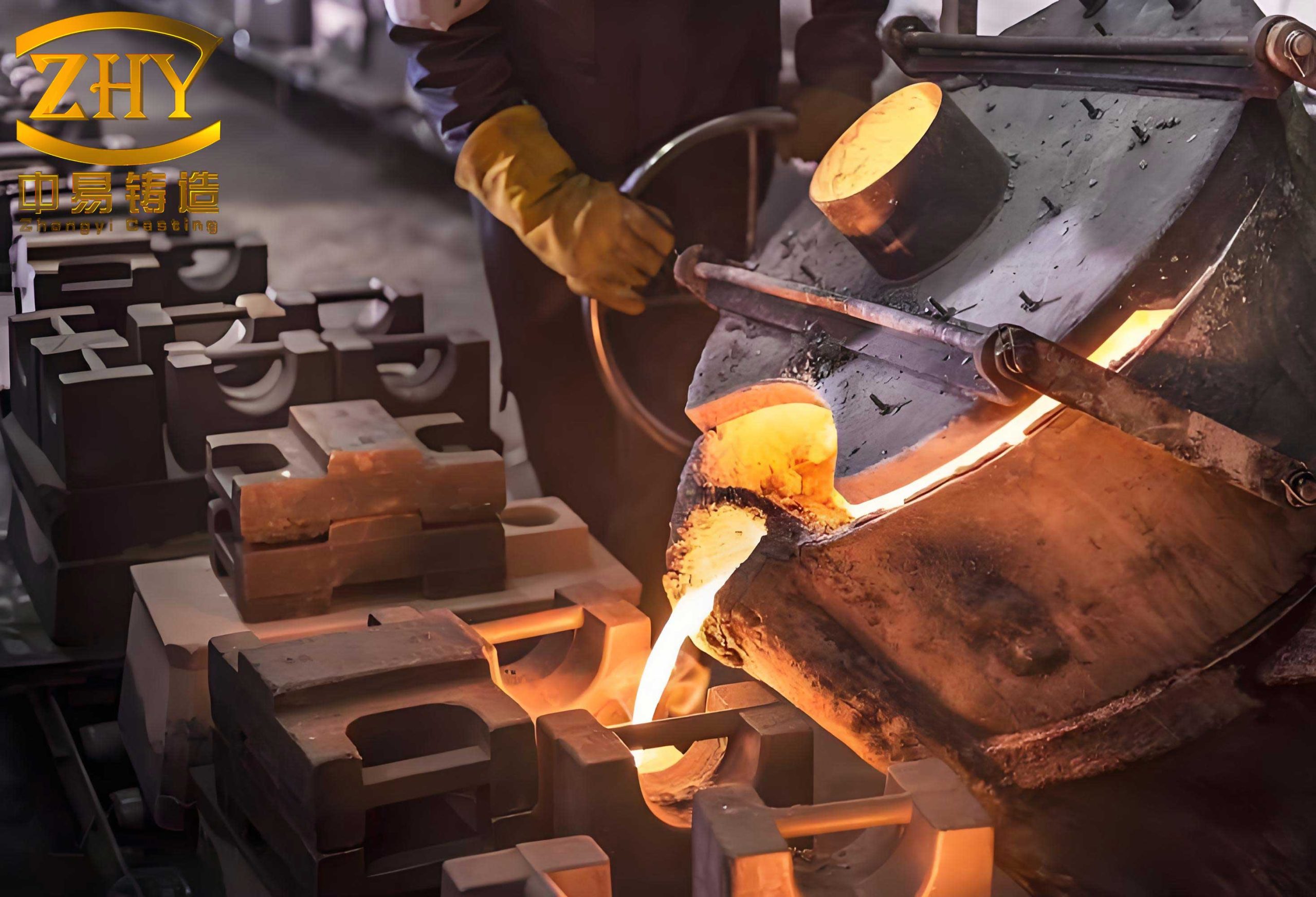
To validate these findings, I designed and conducted pouring tests using optimized sand mixtures. The test patterns included standard roughness specimens and complex geometries to simulate real-world cast iron parts. The molten iron was poured at 1350°C, and after cooling, the cast iron parts were extracted for surface analysis. Roughness measurements were taken using a profilometer at multiple locations, and statistical analysis was performed to ensure reproducibility. The results consistently showed that sand blends with fine-grained base sand (average size 100-120 μm), sintering point around 1100-1150°C, coal dust with 45-50% volatile carbon, and 1.5-2.5% anti-burning-on additives produced cast iron parts with surface roughness Ra below 6.0 μm, a significant improvement over conventional sands yielding Ra above 12 μm.
Furthermore, I investigated the interaction effects between variables using factorial design. For instance, the combined effect of grain size and volatile carbon content on the surface roughness of cast iron parts can be expressed as:
$$ R_a = \theta_0 + \theta_1 d_g + \theta_2 V_c + \theta_3 d_g V_c $$
where \( \theta_0, \theta_1, \theta_2, \theta_3 \) are interaction coefficients. This model revealed that finer sands synergize with higher volatile carbon to further reduce roughness, emphasizing the importance of holistic sand design for cast iron parts.
In discussion, I analyzed the mechanisms behind these improvements. The selection of base sand with appropriate fineness and sintering point ensures minimal pore size and thermal stability, preventing metal penetration into the mold. Coal dust with optimal volatile carbon content generates a reducing atmosphere and deposits a carbonaceous layer that lubricates the mold surface, facilitating smooth separation and enhancing the finish of cast iron parts. Anti-burning-on additives increase the sand’s resistance to high temperatures, reducing chemical bonding and erosion. Together, these elements create a robust molding sand system that consistently produces high-quality cast iron parts with low surface roughness.
To illustrate the economic impact, I estimated cost-benefit ratios for implementing these methods. While premium raw materials may increase initial costs, the reduction in machining time and scrap rates for cast iron parts leads to overall savings. For example, a 50% reduction in surface roughness can decrease machining allowance by 30%, significantly lowering production costs for cast iron parts.
In conclusion, my research demonstrates that through careful selection of base sand properties, coal dust characteristics, and anti-burning-on additives, it is possible to substantially lower the surface roughness of cast iron parts. The methods are grounded in extensive experimental data and validated by successful pouring trials. Future work could explore advanced additives or digital modeling to further optimize the process. This study contributes to the foundry industry by providing a practical framework for enhancing the surface quality of cast iron parts, ensuring they meet stringent specifications for various applications. The insights gained here are applicable not only to cast iron parts but also to other ferrous castings, with potential adaptations for non-ferrous alloys.
Throughout this article, I have emphasized the critical role of each sand component in defining the surface characteristics of a cast iron part. By integrating theoretical models with empirical results, I have established a comprehensive approach to sand formulation that prioritizes surface finish. The repeated focus on cast iron parts underscores their importance in industrial manufacturing, and the methodologies outlined here offer a pathway to achieving superior quality in every cast iron part produced. As casting technologies evolve, continuous refinement of these principles will help meet the growing demands for precision and performance in cast iron parts.