
Based on extensive experience in developing and manufacturing wear-resistant materials for coal slag systems in thermal power plants, I will discuss the production and quality control of high-chromium cast iron parts. This journey has involved evolving from basic high-chromium white iron to more advanced alloys and from simple guard plates to complex components like slurry pump impellers and casings, ultimately enabling the small-batch production of complete, high-efficiency slurry pumps. The core of successful production lies in a deep understanding of how composition and microstructure dictate performance, the relationship between heat treatment and final properties, and the interaction between abrasive wear and service conditions.
The Influence of Alloying Elements and Microstructure on Properties
High-chromium cast iron is a superior material for resisting abrasive wear, widely replacing high-manganese steel and nickel-chromium white iron. Its advantage stems from a microstructure uniquely suited to abrasive conditions. When the chromium content in the cast iron part exceeds approximately 11%, the continuous, brittle network of M3C-type carbides found in plain or low-chromium white irons is replaced by isolated, blocky M7C3-type carbides. The M7C3 carbides are significantly harder, and their discontinuous nature allows the metal matrix to remain continuous, leading to better wear resistance and toughness.
Furthermore, the matrix of a high-chromium cast iron part can be tailored via composition and heat treatment. The as-cast state can yield a mix of martensite, austenite, and pearlite, or fully austenitic structures. Through quenching, a fully martensitic matrix with high hardness—optimal for abrasion resistance—can be achieved. The addition of elements like molybdenum, copper, and nickel enhances hardenability, allowing martensite formation even under air-cooling, which simplifies heat treatment and reduces cracking risks. Finally, annealing can soften the material for machinability.
Role of the Matrix
The matrix’s primary function is to support the hard carbides. A strong, hard matrix provides excellent support. Ferrite is soft and offers poor wear resistance. Pearlite has moderate hardness but is unsuitable for severe abrasive wear, being better for adhesive wear scenarios. An austenitic matrix provides good strength and toughness, can work-harden under impact, and is suitable for gouging abrasion. However, under high-stress, low-impact grinding abrasion where work-hardening does not occur, austenite wears rapidly. A high-hardness, high-strength martensitic matrix is the most desirable base for resisting abrasive wear. The microhardness of these matrices varies depending on the dissolved carbon and alloy content.
| Matrix Phase | Approximate Microhardness (HV) |
|---|---|
| Ferrite | 70 – 200 |
| Pearlite | 250 – 400 |
| Austenite (in High-Cr Iron) | 300 – 600 |
| Martensite | 500 – 1000 |
Role of Carbides
The presence of hard alloy carbides is the primary reason for the excellent abrasion resistance of a high-chromium cast iron part. In microscopic abrasive wear, where gouging is prevalent, the abrasive particle must be harder than the metal matrix to cause damage. Common quartz abrasives have a hardness of approximately 1000-1200 HV, which is higher than most metallic matrices. Therefore, resistance relies crucially on the hard carbide phase. The type, volume, hardness, and distribution of carbides directly influence wear performance.
The type of carbide in chromium cast irons depends on the chromium content, as shown in the table below. The M7C3 carbide, predominant in high-chromium irons, offers the highest hardness.
| Carbide Type | Crystal Structure | Approx. Microhardness (HV) | Typical Cr Content (wt.%) |
|---|---|---|---|
| M3C (Fe3C) | Orthorhombic | ~840 | < 11 |
| M7C3 | Hexagonal | 1200-1800 | > 11 |
| M23C6 | FCC | ~1000 | High (>20) |
The volume fraction of carbides (Vc) is primarily determined by the carbon and chromium content. An approximate relationship can be expressed as:
$$V_c \approx 12.33(C) + 0.55(Cr) – 15.2$$
Where C and Cr are weight percentages. The Carbon-to-Chromium ratio (C/Cr) is a critical parameter affecting carbide morphology, matrix composition, and hardenability. For optimal wear resistance in a typical cast iron part, with carbide areas between 15-30%, a C/Cr ratio of 4-8 is often targeted. Excessively high carbide volume (>30%) leads to coarse, brittle carbides prone to fracture. The interplay between carbide volume and C/Cr ratio influences the overall macro-hardness, as conceptually illustrated below (where Hv is hardness).
$$H_v = f(V_c, C/Cr, \text{matrix phase})$$
Modern high-chromium cast irons typically have carbon content between 2.4-3.6% and chromium between 12-28%. The eutectic carbon content decreases with increasing chromium. To ensure a good balance of hardness and toughness, the composition is usually hypoeutectic. For instance, in producing a 15% Cr-3% Mo cast iron part, I control carbon around 2.8-3.0%, yielding a C/Cr ratio of about 0.19-0.20.
Effects of Specific Alloying Elements
Beyond chromium, other elements are added mainly to improve hardenability, which is insufficient in thick-section parts with chromium alone.
- Molybdenum (Mo): A key element that significantly suppresses pearlite formation in both as-cast and quenched states. Adding 0.5-3.0% Mo allows air-quenching of sections up to 100 mm thick. Mo works synergistically with austenite stabilizers like Cu and Ni. However, molybdenum can form hard carbides and may reduce tensile strength and fracture toughness if added in excess beyond hardenability needs.
- Copper (Cu) & Nickel (Ni): These austenite stabilizers enhance hardenability when combined with Mo. Copper also refines the structure and improves toughness. Its solubility in α-iron is limited (~1.5%), so additions are typically kept below 1.5%. Nickel has a similar effect but is more costly.
- Manganese (Mn): A potent austenite stabilizer and hardenability booster. It lowers the martensite start (Ms) temperature, increasing retained austenite. Economically, it can partially replace Mo, but its content must be carefully controlled based on service needs: kept low (<0.8%) for fully martensitic matrices to minimize retained austenite, or increased moderately for mixed matrices. For high-impact conditions promoting work-hardening, Mn can be raised to 2-6% to obtain a fully austenitic matrix for improved toughness.
The effect of molybdenum on the mechanical properties of a high-chromium cast iron part is a balance; it increases hardness and hardenability but can reduce ductility at higher levels.
Key Process Control: Melting, Casting, and Heat Treatment
Melting and Casting of High-Chromium Iron
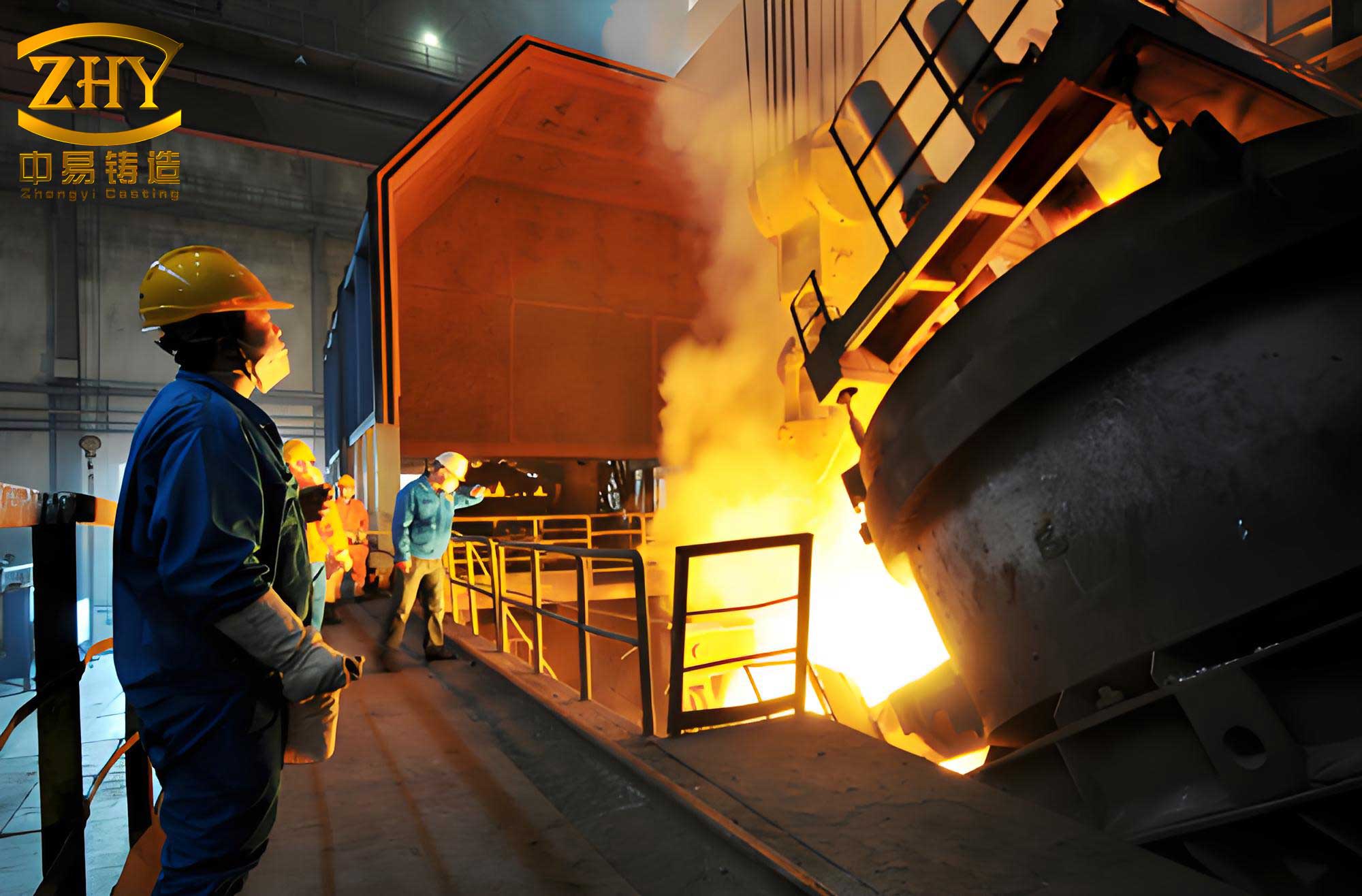
Medium-frequency induction furnaces are ideal for melting high-chromium cast iron parts due to their stirring action, precise temperature and composition control, and low alloy loss. The charge should be based on low-carbon scrap or returns. High-carbon ferrochrome is often used to adjust chromium. The melting sequence is: carbon raiser, returns, scrap steel, and finally, easily oxidizable alloys like ferrochrome. Chromium loss is typically 5-10%; Mo, Cu, Ni losses are minor. A common practice is to use 75% ferrosilicon for deoxidation when a slag film forms.
High-chromium iron has good fluidity due to a narrow freezing range. Pouring temperatures are critical: 1450-1500°C for thin sections and 1350-1400°C for thick sections. Chromium’s tendency to oxidize into Cr2O3 slag necessitates a fast, smooth pour. Gating system cross-sections should be 20-30% larger than for gray iron.
A major challenge is susceptibility to cracking and shrinkage. High modulus of elasticity, low ductility, and low thermal conductivity contribute to hot tearing. For complex, varying-section cast iron parts, a tougher grade should be selected. Shrinkage is similar to carbon steel, requiring proper risering on hot spots. Grinding of fins must avoid local overheating to prevent micro-cracking. Cutting should be avoided; removal of gates/risers is preferably done by knocking. Casting soundness is paramount; defects like gas holes, shrinkage, cracks, or inclusions act as stress concentrators, drastically reducing service life.
Heat Treatment
Heat treatment is crucial for determining the final wear resistance and mechanical properties of a cast iron part. The as-cast structure is often a mix of martensite, austenite, and pearlite with HRC 45-55, which is both difficult to machine and suboptimal for wear. Quenching is necessary to achieve a strong, hard martensitic matrix that optimally supports carbides. To prevent quench cracking, air quenching is standard for most parts, requiring adequate alloy content for through-hardening.
Austenitizing temperature depends on the alloy type, as general guidelines show:
| Typical High-Cr Iron Grade | Austenitizing Temperature Range | Holding Time (h per 25 mm section) |
|---|---|---|
| 15% Cr – 3% Mo | 950 – 980°C | ~1 |
| 20% Cr – 2% Mo – 1% Cu | 1000 – 1050°C | ~1 |
Uniform heating and cooling are vital to prevent distortion and cracking. Tempering follows quenching to stabilize the structure, relieve stresses, and reduce brittleness. Temperatures are typically 200-300°C for 15Cr-3Mo and 450-480°C for 20Cr-2Mo-1Cu types.
Annealing is performed when the cast iron part requires machining. The process involves full austenitization followed by slow, controlled furnace cooling to transform the matrix to pearlite, reducing hardness to 350-450 HB. Uniform furnace temperature and cooling rates are essential to prevent localized hardening.
Common Problems, Causes, and Solutions in Production
From production and field failure analysis, several recurring issues are identified in high-chromium cast iron parts.
| Problem | Primary Causes | Corrective Actions |
|---|---|---|
| Insufficient Hardness & Poor Wear Resistance | 1. Incorrect chemistry (low hardenability elements like Mo). 2. Excessive alloying leading to high retained austenite. 3. Improper heat treatment (low austenitizing temp, short hold time, slow cooling). |
1. Strict control of raw materials and charge calculation. 2. Optimize composition for hardenability without over-stabilizing austenite. 3. Follow correct austenitizing & quenching practice; use forced air for thick sections. |
| High Hardness After Annealing (Poor Machinability) | 1. Incomplete austenitization or transformation during annealing. 2. Non-uniform furnace temperature. 3. Too-rapid cooling after annealing. 4. Poor melt homogeneity (un-dissolved alloys). |
1. Ensure correct annealing temperature/time. 2. Use furnaces with good temperature uniformity. 3. Control cooling rate, especially for parts near the door. 4. Ensure complete melting and stirring. |
| Brittle Cracking (During casting, heat treatment, or in service) | 1. High carbon content reducing toughness. 2. Restrictive molding/cores hindering contraction. 3. Non-uniform quenching causing thermal stresses. 4. Internal defects (shrinkage, slag) acting as crack initiators. 5. Incorrect material choice for part geometry/service stress. |
1. Control carbon content for required toughness. 2. Use high-chelability molding sand. 3. Ensure uniform quenching (multiple fans). 4. Improve casting soundness (gating, risering). 5. Select tougher grades for complex/high-stress parts. |
| Rapid Wear Despite High Hardness | 1. Excessively high carbon leading to coarse, brittle carbides that spall. 2. Material mismatch to service (e.g., using non-work-hardening austenite for high-stress grinding). 3. Combined corrosive-abrasive environment (e.g., seawater). |
1. Optimize C/Cr ratio and carbide volume. 2. Match matrix type (martensitic vs. austenitic) to wear mechanism. 3. Consider corrosion-resistant alloys for corrosive media. |
Conclusion
The successful production of a high-performance high-chromium cast iron part hinges on integrated control over metallurgy and processing. First, the microstructure must be engineered by controlling the morphology, volume, and distribution of hard M7C3 carbides and by tailoring the matrix phase (preferably martensitic) to achieve optimal abrasion resistance. Second, a robust production process is built on understanding the precise relationships between chemical composition, heat treatment parameters, and the resulting microstructure and properties. The selection of alloy grade and heat treatment cycle must be directly linked to the specific service conditions, geometry, and size of the cast iron part. Third, melting and casting practices are foundational to quality, requiring disciplined charge control, melting, and pouring to produce sound castings with the specified chemistry. Finally, continuous improvement is driven by systematic failure analysis of worn or broken parts, identifying root causes whether in material selection, production, or application mismatch, thereby fostering consistent enhancement in product quality and service life.