
In my extensive research on enhancing the durability of industrial components, I have focused on the surface modification of cast iron parts through innovative casting techniques. Cast iron parts are widely used in various applications due to their excellent castability and mechanical properties, but they often suffer from wear in harsh environments. To address this, I explored the use of tungsten carbide (WC) particles composited onto cast iron parts via a cast-in-place hardfacing process, specifically employing the expendable pattern casting with vacuum (EPC-V) method. This approach aims to create a metallurgically bonded composite layer that significantly improves wear resistance. In this article, I will delve into the detailed mechanisms of wear resistance under different conditions—sliding wear, abrasive wear, and erosion wear—based on my experimental findings. I will present comprehensive analyses, supported by tables and formulas, to elucidate how the microstructure, particle size, and base material influence the performance of these composite layers. Throughout, I will emphasize the relevance to cast iron parts, as they form the core substrate for these enhancements.
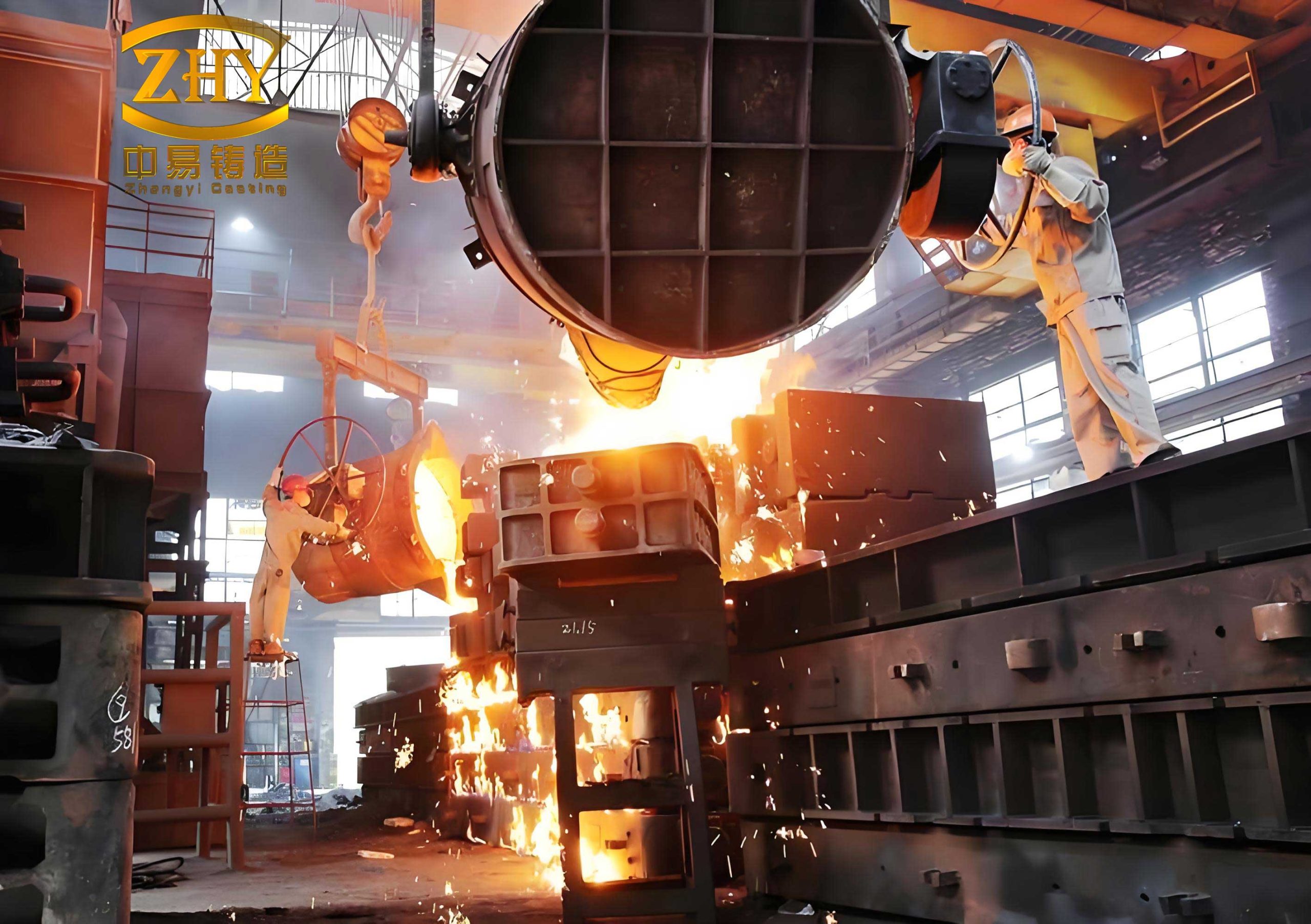
The motivation behind this study stems from the need to prolong the service life of cast iron parts in demanding operations such as mining, agriculture, and manufacturing. Wear is a primary failure mode for cast iron parts, leading to increased downtime and maintenance costs. Traditional methods like heat treatment or coating often fall short in providing long-term protection. The cast-in-place hardfacing technique, particularly with tungsten carbide, offers a promising solution by integrating hard particles directly into the surface during casting. This results in a robust composite layer that is inherently part of the cast iron part. In my work, I investigated various factors including tungsten carbide particle size, base material composition, and processing parameters to optimize the wear resistance. I conducted a series of wear tests to simulate real-world conditions, and the results revealed distinct mechanisms for each wear type. By understanding these mechanisms, we can better tailor the composite layers for specific applications involving cast iron parts.
To begin, I will outline the experimental methodology I employed. The cast iron parts used as substrates were primarily low-chromium wear-resistant cast iron, with one set using HT250 cast iron for comparison. The tungsten carbide particles were of different mesh sizes, as detailed in Table 1, which summarizes the surface compositing process for each specimen. The EPC-V process involved coating foam patterns with a 2 mm thick layer of tungsten carbide particles, drying them, and then placing them in a sand mold under a vacuum of 0.04 MPa. The molten iron was poured at 1500°C for low-chromium cast iron and 1450°C for HT250, ensuring proper infiltration and bonding. This method is particularly effective for cast iron parts because it allows for complex geometries and uniform composite layer formation.
| Specimen ID | Reinforcement Particles | Base Material |
|---|---|---|
| 1 | 45 mesh tungsten carbide | Low-chromium wear-resistant cast iron |
| 2 | 75 mesh tungsten carbide | |
| 3 | 100 mesh tungsten carbide | |
| 4 | 150 mesh tungsten carbide | |
| 5 | 200 mesh tungsten carbide | |
| 6 | 45 mesh chromium iron + 55 mesh WC + 75 mesh WC + 150 mesh WC | HT250 cast iron |
| 7 | 75 mesh chromium iron + 55 mesh WC + 75 mesh WC + 100 mesh WC + 150 mesh WC | Low-chromium wear-resistant cast iron |
| 8 | 75 mesh chromium iron + 75 mesh WC + 100 mesh WC + 100 mesh chromium iron + 150 mesh WC | |
| 9 | High-chromium cast iron (reference) |
The microstructure of the composite layers was examined using optical and scanning electron microscopy. I observed three distinct zones from the surface to the base: the composite zone, transition zone, and base zone. In the composite zone, tungsten carbide particles are embedded in the iron matrix, showing evidence of metallurgical bonding due to erosion by the molten iron. This strong bond is crucial for the durability of cast iron parts under wear conditions. The hardness profile was measured, and Table 2 presents the microhardness values across different regions. The high hardness of tungsten carbide particles, ranging from HV 1400 to 2300, contrasts with the lower hardness of the base material, which influences the wear mechanisms.
| Region | Microhardness (HV) | Description |
|---|---|---|
| Tungsten carbide particles | 1478 – 2282 | Hard phase providing wear resistance |
| Other structures between particles | 559 – 1150 | Composite carbides from reaction |
| Transition layer | 478 – 1097 | Mixed zone with graded properties |
| Base material | 322 – 572 | Cast iron part substrate |
Wear tests were conducted using three different setups: sliding wear on an MM200 tester, abrasive wear on an MLS-3 rubber wheel dry sand tester, and erosion wear on an air-jet sandblaster. For sliding wear, the counterpart was GCr15 steel, and weight loss was measured for both the composite layer and the counterpart. Abrasive and erosion tests used 40-70 mesh quartz sand, with erosion at a 30° impact angle. The wear resistance was evaluated based on weight loss and relative wear resistance, defined as the ratio of base material loss to specimen loss. These tests simulate various service conditions for cast iron parts, allowing me to analyze failure modes systematically.
Now, I will discuss the sliding wear resistance mechanisms. The results showed that even specimen 6 with HT250 base had a relative wear resistance 6.5 times higher than high-chromium cast iron, but it also caused greater wear on the GCr15 counterpart. This indicates that while tungsten carbide composite layers enhance the durability of cast iron parts, they may not be ideal for sliding applications due to increased counterface wear. The mechanism involves adhesive wear between the composite layer and GCr15. The hard tungsten carbide particles, with hardness much higher than GCr15, reduce the depth of micro-cutting grooves formed by the counterpart on the iron matrix. Since the particles are closely spaced and well-bonded, they effectively interrupt or deflect these grooves, preventing further material removal. However, these particles also micro-cut the GCr15, leading to higher wear. This can be described using the Archard wear equation, which relates wear volume to load and hardness:
$$ V = k \frac{L \cdot s}{H} $$
where \( V \) is wear volume, \( k \) is a wear coefficient, \( L \) is load, \( s \) is sliding distance, and \( H \) is hardness. For cast iron parts with composite layers, the effective hardness \( H \) is increased due to tungsten carbide, reducing \( V \). But for the counterpart, the presence of hard particles increases \( k \), explaining the higher wear. Thus, for sliding wear on cast iron parts, careful consideration of the application is needed to avoid excessive counterface damage.
Moving to abrasive wear resistance, the results are summarized in Table 3. All tungsten carbide composite layers exhibited higher relative wear resistance than both the base material and high-chromium cast iron. The relative wear resistance increased with coarser particle sizes, as shown in Figure 3 (described later). This aligns with the hardness ratio theory by R.C.D. Richardson, which states that when the ratio of material hardness \( H_m \) to abrasive hardness \( H_a \) exceeds 0.8, wear rate decreases sharply. For quartz sand, \( H_a \) is approximately HV 1000-1100. The base material of cast iron parts has \( H_m \) up to HV 572, giving \( H_m/H_a \approx 0.52-0.57 \), hence poor abrasion resistance. High-chromium cast iron has martensite hardness of HV 706-771 and \( M_7C_3 \) carbides, but \( H_m/H_a < 0.8 \), and the carbides are unevenly distributed. In contrast, tungsten carbide particles have \( H_m/H_a = 1.9-2.1 > 0.8 \), and their close spacing provides effective shielding. The wear mechanism is based on the “shadow effect,” where hard particles protect the underlying material. As the softer matrix wears away, particles protrude and shield adjacent areas, reducing further wear. The failure mode involves flaky spalling of tungsten carbide particles due to fatigue of the WC-W\(_2\)C eutectic structure.
| Specimen ID | 10 N Load | 20 N Load | 30 N Load | |||
|---|---|---|---|---|---|---|
| Weight Loss | Relative Wear Resistance | Weight Loss | Relative Wear Resistance | Weight Loss | Relative Wear Resistance | |
| 1 | 60.3 | 1.74 | 56.1 | 3.51 | 67.6 | 3.84 |
| 2 | 74.2 | 1.42 | 66.8 | 2.95 | 80.1 | 3.24 |
| 3 | 80.3 | 1.31 | 84.4 | 2.33 | 98.1 | 2.65 |
| 4 | 92.9 | 1.13 | 108.9 | 1.81 | 113.5 | 2.29 |
| 5 | 99.1 | 1.06 | 120.6 | 1.64 | 130.7 | 1.99 |
| 9 (High-Cr) | 111.4 | 0.94 | 186.4 | 1.06 | 257.4 | 1.01 |
| Base Material | 105.0 | 1.00 | 197.2 | 1.00 | 259.6 | 1.00 |
The relationship between relative wear resistance and particle size can be modeled empirically. Let \( R \) be relative wear resistance and \( d \) be particle diameter (inversely related to mesh size). Based on my data, I propose a power-law relationship:
$$ R = A \cdot d^n $$
where \( A \) and \( n \) are constants. For coarser particles, \( d \) is larger, leading to higher \( R \). This is because coarser particles cover a larger area fraction, enhancing the shadow effect. In practical terms, for cast iron parts subjected to abrasive wear, using coarse tungsten carbide particles is advantageous. The shadow effect can be quantified by the shielding factor \( S \), defined as the ratio of protected area to total area. Assuming spherical particles of diameter \( d \) spaced at distance \( s \), \( S \) can be approximated as:
$$ S = \frac{\pi d^2}{4s^2} $$
For higher \( S \), wear resistance improves. In my specimens, coarser particles resulted in smaller \( s \) due to better packing, increasing \( S \). This explains why specimen 1 with 45 mesh particles performed best. The failure mode was observed via SEM, showing spalling of particles after extensive testing, which confirms fatigue as the dominant failure mechanism in abrasive conditions for cast iron parts.
Regarding erosion wear resistance, Table 4 presents the results. All tungsten carbide composite layers showed higher erosion resistance than high-chromium cast iron and the base material. Particle size had minimal impact, but base material hardness was critical. Specimens with chromium iron additions performed worse, indicating that pure tungsten carbide composites on hard base materials are optimal. The mechanism again involves the shadow effect, but under erosive conditions at a 30° impact angle, the softer matrix is selectively removed first, leaving protruding particles that shield the underlying material. The failure mode is particle spalling due to over-protrusion after the matrix is worn away. The erosion rate \( E \) can be described by the following formula, considering particle impact:
$$ E = k \cdot v^p \cdot \sin^q(\alpha) $$
where \( v \) is impact velocity, \( \alpha \) is impact angle, and \( k, p, q \) are material-dependent constants. For ductile materials like cast iron, \( q \) is typically around 2 for low angles. With tungsten carbide particles, the effective \( k \) is reduced due to shielding. In my tests, the relative erosion resistance was calculated as the inverse of weight loss relative to the base material. For specimen 1, it was 7.89, meaning it withstands erosion much better than untreated cast iron parts. The two-stage erosion test (pre-erosion and main erosion) accelerated the selective removal process, but once particles were exposed, their spacing ensured continued protection regardless of size. This highlights that for erosion-prone applications, cast iron parts benefit from a high-hardness base combined with pure tungsten carbide particles, without brittle additives like chromium iron that can initiate cracks.
| Specimen ID | Relative Erosion Resistance | Notes |
|---|---|---|
| 1 | 7.89 | Coarse WC on hard base |
| 4 | 8.08 | Fine WC on hard base |
| 6 | 1.70 | Mixed particles on HT250 base |
| 7 | 2.68 | With chromium iron additions |
| 8 | 5.55 | With chromium iron additions |
| 9 (High-Cr) | 1.25 | Reference material |
| Base Material | 1.00 | Baseline for cast iron part |
To further analyze the wear mechanisms, I consider the composite layer as a two-phase material. The wear resistance \( W \) can be expressed as a function of volume fraction \( f \) of hard particles and their properties. For abrasive wear, a modified model based on the Rabinowicz equation can be used:
$$ W = \frac{1}{k_a \cdot (1 – f) \cdot H_m + k_b \cdot f \cdot H_p} $$
where \( H_m \) and \( H_p \) are hardness of matrix and particles, and \( k_a, k_b \) are constants. For cast iron parts with tungsten carbide, \( H_p \gg H_m \), so \( W \) increases with \( f \). In my experiments, coarser particles allowed higher \( f \) due to better infiltration, enhancing \( W \). For sliding wear, the model must account for counterface wear, introducing a term for particle-induced abrasion on the counterpart. For erosion, the shadow effect modifies the impact energy distribution. These models help in designing composite layers for specific cast iron parts based on expected wear conditions.
In practical applications, the choice of particle size and base material for cast iron parts depends on the dominant wear mode. For instance, in mining equipment where abrasive wear is common, coarse tungsten carbide particles are recommended. For pump components facing erosion, a hard base material like low-chromium cast iron with pure tungsten carbide is ideal. For sliding contacts, alternative solutions might be needed to avoid excessive counterface wear. The EPC-V process offers flexibility in tailoring these parameters during the casting of cast iron parts, enabling cost-effective production of durable components.
In conclusion, my research demonstrates that tungsten carbide composite layers on cast iron parts significantly enhance wear resistance through distinct mechanisms. For sliding wear, particles reduce micro-cutting but increase counterface wear. For abrasive wear, the shadow effect with coarse particles provides optimal protection. For erosion wear, a hard base with pure tungsten carbide yields the best performance. These findings guide the selection and design of cast-in-place hardfacing processes for cast iron parts in various industrial settings. Future work could explore other particle materials or hybrid composites to further improve the longevity of cast iron parts under combined wear conditions.
To summarize key formulas and relationships, I present the following: the hardness ratio criterion \( H_m/H_a \geq 0.8 \) for low wear, the shadow effect shielding factor \( S = \pi d^2/(4s^2) \), and the wear rate models for different conditions. These tools assist engineers in optimizing cast iron parts for wear resistance. Ultimately, the integration of tungsten carbide via cast-in-place hardfacing is a powerful method to extend the life of cast iron parts, reducing maintenance and improving efficiency in numerous applications.