
In the field of steel rolling, the demand for durable and high-performance rolls has always been a critical factor in improving productivity and product quality. Traditional roll materials, such as cast alloy steels and adamite rolls, have been widely used in section mills and large bar mills. However, these materials often face challenges like steel sticking, thermal cracking, and insufficient wear resistance, which limit their efficiency and lifespan. Our research and development efforts have focused on advancing ductile cast iron rolls, leveraging their inherent properties to overcome these limitations. By optimizing the composition and implementing specialized heat treatments, we have developed large-scale high-strength ductile cast iron rolls that exhibit superior mechanical properties, including enhanced strength, wear resistance, and thermal crack resistance. This article details our comprehensive approach to the development and application of these rolls, highlighting their advantages over conventional materials.
The core innovation lies in harnessing the heat-treatability of medium-alloy ductile cast iron. Through a high-temperature recrystallization heating process followed by rapid cooling and tempering, we significantly improve the strength of the ductile cast iron rolls. This allows them to replace cast alloy steel and adamite rolls in most stands of section and bar mills. The presence of eutectic carbides and spherical graphite in the microstructure imparts unique benefits: high wear resistance, excellent thermal crack resistance, and minimal hardness gradient. These characteristics break through traditional limitations and greatly expand the application range of ductile cast iron rolls. In service, they reduce adverse phenomena such as steel sticking and thermal cracking, increase the rolling capacity per groove, and improve the surface quality and dimensional accuracy of rolled products. Successful implementations in both domestic and international mills have yielded outstanding results.
The advantages of high-strength ductile cast iron rolls are multifaceted and stem from their tailored microstructure and processing. First, their high strength is achieved through alloying and heat treatment, with tensile strengths exceeding 600 MPa at the roll neck and over 700 MPa in the roll body, surpassing many adamite rolls and offering a 50% improvement over conventional alloy cast iron rolls. Impact energy is also enhanced, often above 2.5 J. Second, the hardness uniformity within the roll grooves is exceptional, with minimal gradient due to pre-machining and controlled heat treatment, ensuring consistent performance during rolling. Third, the anti-thermal cracking property is superior, attributed to the spherical graphite that provides thermal conductivity and lubrication, making these rolls ideal for complex grooves and poor cooling conditions. Fourth, high wear resistance results from a microstructure comprising fine eutectic carbides and secondary carbides distributed in a bainitic or troostitic matrix. These benefits are summarized in the table below, comparing key properties with traditional materials.
| Property | High-Strength Ductile Cast Iron | Cast Alloy Steel | Adamite Rolls |
|---|---|---|---|
| Tensile Strength (MPa) | >700 (roll body) | 500-600 | 600-700 |
| Impact Energy (J) | >2.5 | 10-20 | 2-3 |
| Hardness Gradient (HSD/100 mm) | <5 | 10-15 | 5-10 |
| Wear Resistance | High (due to carbides) | Moderate | High |
| Thermal Crack Resistance | Excellent (graphite effect) | Good | Moderate |
To quantify the wear resistance, we can relate it to the carbide volume fraction and hardness. A simplified model for wear rate \( W \) might be expressed as:
$$ W = k \cdot \frac{P}{H} \cdot \frac{1}{V_c} $$
where \( k \) is a constant, \( P \) is the applied pressure, \( H \) is the hardness, and \( V_c \) is the volume fraction of carbides. For ductile cast iron, the high \( V_c \) and \( H \) contribute to low \( W \). Similarly, thermal stress resistance can be approximated by:
$$ R_{thermal} = \frac{\sigma_{TS} \cdot \kappa}{\alpha \cdot E} $$
where \( \sigma_{TS} \) is tensile strength, \( \kappa \) is thermal conductivity, \( \alpha \) is thermal expansion coefficient, and \( E \) is Young’s modulus. The spherical graphite in ductile cast iron enhances \( \kappa \), improving \( R_{thermal} \).
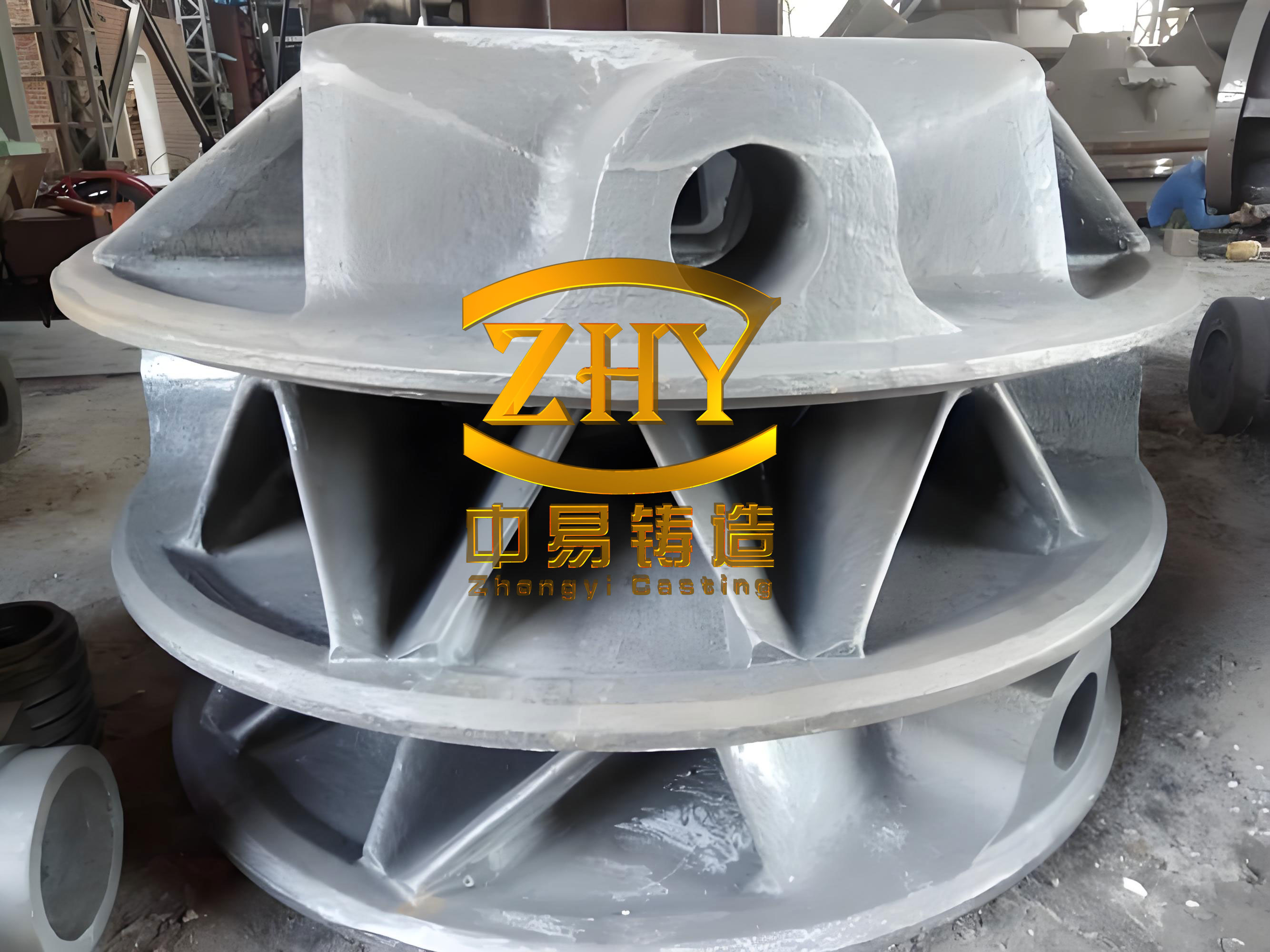
Our production practice for high-strength ductile cast iron rolls involves meticulous control over casting, composition, and heat treatment. The casting process follows conventional static casting methods for iron rolls. The roll body is produced using either metal chill molds or metal-lined sand molds, depending on the desired carbide content. For final microstructures with less than 5% carbides, metal-lined sand molds are employed to achieve lower surface hardness and more uniform organization. For carbide contents above 5%, metal chill molds are used to promote finer carbides. The ductile cast iron’s mushy solidification characteristic ensures that rolls from sand-lined molds have a more gradual hardness gradient. A typical roll, such as one for a 60E1 section mill stand, is illustrated below, showcasing its complex groove design.
Chemical composition is tailored based on the mill stand, product groove design, steel grade, rolling force, and required tonnage. We optimize within the ranges specified in standards like GB/T1504 and YB/T4906, but with personalized adjustments. Key elements include carbon, silicon, manganese, chromium, molybdenum, and nickel, with magnesium for nodularization. The composition influences hardenability, strength, and carbide formation. For instance, carbon content affects graphite nodule count and carbide precipitation, while alloying elements like chromium and molybdenum enhance hardenability and wear resistance. The table below provides typical composition ranges for different stands in a section mill.
| Mill Stand | Surface Hardness (HSD) | C (%) | Si (%) | Mn (%) | Cr (%) | Mo (%) | Ni (%) | Roll Body Strength (MPa) |
|---|---|---|---|---|---|---|---|---|
| BD1 (Roughing) | 45-51 | 3.10-3.40 | 1.70-2.10 | 0.50-0.70 | ≤0.30 | 0.40-0.70 | 2.50-3.50 | >800 |
| BD2 (Intermediate) | 52-58 | 3.20-3.50 | 1.50-2.00 | 0.60-0.90 | 0.30-0.80 | 0.40-0.80 | 2.00-3.00 | >750 |
| E (Edging) | 57-63 | 3.20-3.50 | 1.50-2.00 | 0.60-0.90 | 0.50-1.00 | 0.40-0.80 | 2.00-3.00 | >550 |
| H/V (Universal Mill Rings) | 55-70 | 3.20-3.50 | 1.30-1.80 | 0.60-0.90 | 0.50-1.00 | 0.40-0.80 | 2.50-3.50 | >650 |
The relationship between composition and hardness can be approximated using empirical formulas. For example, the hardness contribution from alloying elements in ductile cast iron might be modeled as:
$$ H = H_0 + k_{C} \cdot C + k_{Si} \cdot Si + k_{Mn} \cdot Mn + k_{Cr} \cdot Cr + k_{Mo} \cdot Mo + k_{Ni} \cdot Ni $$
where \( H_0 \) is the base hardness and \( k_i \) are coefficients derived from regression analysis. In our practice, we fine-tune these based on desired outcomes.
Heat treatment is crucial for achieving the desired microstructure and properties. The rolls are pre-machined to their groove profiles before heat treatment to ensure hardness uniformity. The heat treatment cycle involves high-temperature heating for recrystallization, followed by rapid cooling and tempering. Key parameters include temperatures (T1, T2, T3, T4) and holding times (h1, h2, h3, h4), as shown in the table below. T1 and T2, along with the quenching medium (water, air, or forced air), primarily determine final hardness, microstructure, and tensile strength. The high-temperature phase transformation allows refinement of the matrix structure.
| Step | Temperature | Holding Time | Purpose |
|---|---|---|---|
| Preheating | 560°C | 6-8 hours | Stress relief and homogenization |
| Austenitization | A1 + 160-220°C (e.g., ~900-950°C) | Diameter/40 hours | Complete austenitization and dissolution of carbides |
| Quenching | Rapid cooling (medium dependent) | Variable | Form bainite/troostite |
| Tempering (Stage 1) | 450-520°C | 3-5 hours | Relieve stresses and stabilize structure |
| Tempering (Stage 2) | 480-600°C | Diameter/25 hours | Further tempering for toughness |
The kinetics of phase transformation during heat treatment can be described using the Avrami equation for bainite formation:
$$ f = 1 – \exp(-k t^n) $$
where \( f \) is the transformed fraction, \( k \) is a rate constant dependent on temperature and composition, \( t \) is time, and \( n \) is an exponent. For ductile cast iron, the presence of graphite nodules influences nucleation sites, altering \( k \). The cooling rate \( \dot{T} \) affects the final hardness, often related by empirical equations like:
$$ H = A + B \log(\dot{T}) $$
where \( A \) and \( B \) are material constants.
Performance testing of our high-strength ductile cast iron rolls involves extensive sampling and analysis. We select roll body slices from different products for evaluation. For instance, from a roll body slice taken 40 mm thick from the lower end, we conduct chemical analysis, macro-examination, hardness testing, tensile and impact tests, and metallography. Chemical compositions typically match the designed ranges, as shown below for four different rolls.
| Sample | C (%) | Mn (%) | Si (%) | P (%) | S (%) | Cr (%) | Mo (%) | Ni (%) | Mg (%) |
|---|---|---|---|---|---|---|---|---|---|
| a | 3.31 | 0.67 | 1.78 | 0.051 | 0.008 | 0.15 | 0.51 | 2.92 | 0.052 |
| b | 3.29 | 0.70 | 1.80 | 0.030 | 0.003 | 0.52 | 0.46 | 2.45 | 0.040 |
| c | 3.32 | 0.78 | 1.55 | 0.044 | 0.008 | 0.78 | 0.41 | 2.23 | 0.071 |
| d | 3.28 | 0.72 | 1.45 | 0.032 | 0.005 | 0.98 | 0.55 | 2.63 | 0.068 |
Macro-examination after deep etching in 50% hydrochloric acid reveals a columnar structure without cracks or slag inclusions, indicating sound casting and heat treatment. Hardness measurements across the slice show a gentle decline with radial depth. For sample b, the hardness values are:
| Distance from Surface (mm) | 5 | 15 | 25 | 35 | 45 | 55 | 65 | 75 | 85 | 95 |
|---|---|---|---|---|---|---|---|---|---|---|
| Hardness (HSD) | 61.3 | 61.3 | 61.8 | 60.8 | 60.0 | 58.9 | 58.8 | 58.3 | 58.6 | 57.8 |
The hardness gradient over 100 mm depth is only 4 HSD, calculated as:
$$ \Delta H = H_{surface} – H_{100mm} $$
In this case, \( \Delta H \approx 61.3 – 57.8 = 3.5 \), confirming minimal落差. Tensile strength tests at 30 mm and 60 mm depths yield values of 730 MPa and 760 MPa, respectively, exceeding standard requirements for ductile cast iron grades like QT-700. Impact energy, measured at depths of 15 mm, 35 mm, 55 mm, and 75 mm, ranges from 2.9 to 3.4 J/cm², showing consistency regardless of position. This can be expressed as:
$$ E_{impact} = 3.1 \pm 0.3 \, \text{J/cm}^2 $$
Metallographic analysis reveals well-formed spherical graphite nodules, with average sizes increasing from 40 µm at 10 mm depth to 80 µm at 70 mm depth. The nodule count decreases with depth, but nodularity remains high. After etching with 4% nitric alcohol, the microstructure shows a columnar arrangement near the surface, consisting of carbide particles in a troostitic matrix. The carbides are predominantly blocky or skeletal, transitioning to ledeburite at greater depths. The matrix changes from troostite to sorbitte and pearlite with increasing depth, due to variations in cooling rates during solidification and heat treatment. The volume fraction of carbides \( V_c \) can be estimated from image analysis, typically around 5-20% depending on composition and processing. The relationship between microstructure and properties can be summarized by equations like:
$$ \sigma_{TS} = \sigma_0 + k_\lambda \lambda^{-1/2} $$
where \( \sigma_0 \) is a constant, \( k_\lambda \) is the Hall-Petch coefficient, and \( \lambda \) is the inter-carbide spacing. For ductile cast iron, the graphite nodules also affect toughness, with impact energy related to nodule count \( N \) and size \( d \):
$$ E_{impact} \propto \frac{N}{d} $$
Application practices of our high-strength ductile cast iron rolls across various mills demonstrate their superior performance. In section mills, such as those producing 60E1 rails, rolls in BD2 stands have achieved rolling capacities of up to 15,000 tons per groove, compared to 8,000 tons with conventional alloy ductile iron rolls. In large bar mills, roughing stands (R1) using these rolls have reached 30,000 tons per campaign with minimal surface defects. For universal mill rings, which traditionally use high-carbon adamite, the ductile cast iron version reduces steel sticking and increases rolling capacity. For example, in a R60 rail mill, horizontal rings achieved 8,000 tons without sticking, and vertical rings improved tonnage per millimeter from 1,300 to 1,900 tons after further alloying with vanadium. The table below summarizes some key application results.
| Application | Roll Type | Specifications (mm) | Performance | Improvement Over Previous |
|---|---|---|---|---|
| 60E1 Z1 Stand | Section Roll | 1137×2400 | 8,240 tons, even groove wear | N/A (baseline) |
| Large Bar R1 Stand | Bar Roll | 740×1000 | 30,000 tons, no fatigue cracks | Reduced downtime |
| High-Speed Wire Rod Mill | Intermediate Stand | 480×815 | 50% higher wear resistance | Avoided roll breakage |
| Universal Mill Horizontal Ring | Roll Ring | 1200/566×340 | 8,000 tons, no sticking | Better surface quality |
| Universal Mill Vertical Ring | Roll Ring | 690/406×240 | 1,900 tons/mm | ~50% increase |
The success in these applications stems from the unique properties of ductile cast iron. For instance, in poor cooling conditions, the thermal conductivity provided by graphite helps dissipate heat, reducing thermal stresses. The wear resistance can be quantified by the specific wear rate \( w_s \), defined as volume loss per unit sliding distance. For our rolls, \( w_s \) is significantly lower than for adamite rolls, often by a factor of 2 or more. This is due to the combined effect of hard carbides and a tough matrix. The rolling force \( F \) in a mill stand can be related to roll material properties by:
$$ F = \frac{\sigma_y \cdot A}{\mu} $$
where \( \sigma_y \) is the yield strength of the roll material, \( A \) is the contact area, and \( \mu \) is the friction coefficient. High-strength ductile cast iron allows higher \( \sigma_y \), enabling stable rolling under heavy loads.
In conclusion, our development of high-strength ductile cast iron rolls represents a significant advancement in roll technology. By optimizing alloy composition and employing specialized high-temperature heat treatments, we have achieved rolls with exceptional strength, hardness uniformity, thermal crack resistance, and wear resistance. These rolls effectively replace traditional materials like cast alloy steel and adamite in most stands of section and bar mills, expanding the application scope of ductile cast iron. The microstructural features, including eutectic carbides and spherical graphite, underpin these benefits, providing a balance of hardness and toughness. Ongoing improvements in alloy design, such as adding vanadium or other carbide formers, further enhance performance. The successful implementations in various mills worldwide confirm the reliability and cost-effectiveness of these rolls. Future work will focus on refining predictive models for property optimization and exploring new alloy systems to push the boundaries of ductile cast iron roll performance. Ultimately, the integration of advanced ductile cast iron rolls into rolling operations contributes to higher productivity, improved product quality, and reduced maintenance costs, solidifying their role in modern steelmaking.
The engineering principles behind these rolls can be encapsulated in key formulas. For example, the overall performance index \( PI \) might be defined as a weighted sum of properties:
$$ PI = w_1 \cdot \sigma_{TS} + w_2 \cdot H + w_3 \cdot E_{impact} + w_4 \cdot R_{thermal} $$
where \( w_i \) are weights based on application requirements. For high-strength ductile cast iron, \( PI \) consistently outperforms other materials. Additionally, the life prediction model for rolls can incorporate fatigue and wear mechanisms, expressed as:
$$ L = \int_0^{N} \frac{dN}{f(\Delta \sigma, \Delta \epsilon)} + \int_0^{S} \frac{dS}{w_s} $$
where \( L \) is total life, \( N \) is cycles, \( S \) is sliding distance, \( \Delta \sigma \) and \( \Delta \epsilon \) are stress and strain ranges, and \( f \) is a fatigue function. The superior properties of ductile cast iron extend both terms, leading to longer service life.
In summary, the journey from traditional rolls to high-strength ductile cast iron rolls involves a deep understanding of metallurgy, heat treatment, and application demands. Our continuous research and development efforts ensure that these rolls meet the evolving challenges of the steel industry, providing sustainable solutions for efficient rolling operations. The versatility and robustness of ductile cast iron make it a material of choice for future innovations in roll design, promising even greater achievements in years to come.