
In our foundry, the most persistent sand casting defect we have encountered is blowhole formation in gray iron cylinder heads. After years of production experience, we have identified multiple contributing factors and implemented systematic improvements. This article presents our journey in eliminating this sand casting defect, which initially caused rejection rates as high as 15% for cylinder head castings. Through detailed analysis and targeted modifications to core materials, molding processes, and pouring parameters, we successfully reduced the sand casting defect rate to below 3%. The following discussion elaborates on our methodology, experimental data, and the mathematical relationships governing gas evolution and venting.
Blowholes, a common sand casting defect, can be classified into four categories based on formation mechanism: invasive blowholes, entrained blowholes, precipitated blowholes, and reaction blowholes. In our cylinder head production, the dominant sand casting defect type was invasive blowholes, primarily originating from the water jacket cores. These cores, with complex geometries and thin wall sections of only 3–5 mm, are almost completely surrounded by molten iron during pouring, creating extremely poor venting conditions. The typical sand casting defect appears as cavities 5–10 mm in diameter, either exposed on the top surface or located 0.5–3.0 mm beneath the surface, becoming visible only after machining.
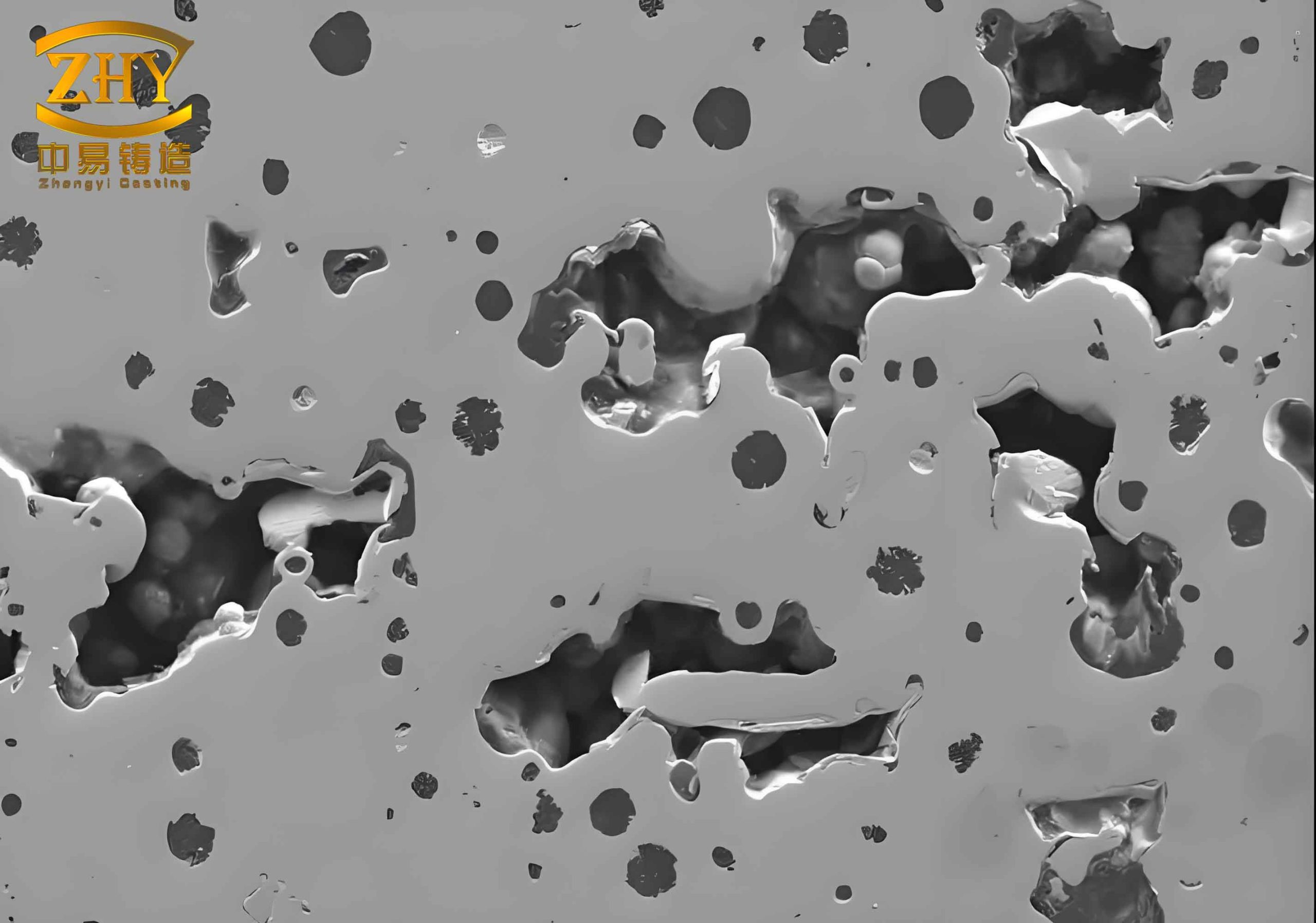
Understanding the root causes of this sand casting defect required a systematic investigation. We measured gas evolution rates of core materials, evaluated mold permeability, monitored pouring temperatures, and analyzed the venting system design. The key factors contributing to the sand casting defect are summarized in Table 1, along with their relative impact levels.
| Factor | Description | Impact Level |
|---|---|---|
| High gas evolution from water jacket cores | Conventional oil-bonded sand cores evolved up to 31 mL/g of gas, with delayed peak release | High |
| Poor core venting channels | Shallow and narrow vent grooves easily blocked during core assembly | High |
| Low mold permeability | Fine sand (50/100 mesh) and high compactness (mold hardness >90) reduced gas escape | Medium |
| High moisture content in molding sand | Moisture levels of 3.8%–4.5% increased gas generation | Medium |
| Insufficient vent holes and risers | Limited escape paths for gases in upper mold cavity | High |
| Low pouring temperature | Temperature range 1320–1360 °C reduced fluidity and gas expulsion ability | High |
| Unstable mold filling | Turbulent flow entrapped gases, creating entrained blowholes | Medium |
The formation of invasive blowholes as a sand casting defect can be modeled using ideal gas law principles. The gas pressure inside a pore at temperature T can be expressed as:
$$ P = \frac{nRT}{V} $$
where n is the number of moles of gas evolved, R is the universal gas constant, T is absolute temperature, and V is the pore volume. For a given core, the gas evolution rate dG/dt depends on the binder decomposition kinetics. The critical condition for blowhole formation arises when the internal gas pressure exceeds the ferrostatic pressure and the capillary resistance of the sand. The maximum allowable gas volume Vmax that can be vented through a vent channel of cross-sectional area A and length L is given by Poiseuille’s law:
$$ Q = \frac{\pi r^4}{8\mu} \frac{\Delta P}{L} $$
where Q is volumetric flow rate, r is channel radius, μ is gas viscosity, and ΔP is pressure difference. If the actual gas generation rate exceeds the venting capacity, the sand casting defect becomes inevitable. This mathematical framework guided our improvement strategy.
To address the sand casting defect, we implemented a series of modifications. The most impactful change was replacing the conventional oil-bonded sand with water-soluble resin sand for water jacket cores. Table 2 compares the key properties of the two core materials.
| Property | Oil-Bonded Sand | Water-Soluble Resin Sand |
|---|---|---|
| Dry tensile strength (MPa) | ≥1.6 | ≥2.2 |
| Gas evolution (mL/g) | ≤31 | ≤25 |
| Peak gas evolution time (s) | ~30–40 s (delayed) | ~15–20 s (early) |
| Moisture sensitivity | Low | Moderate |
The gas evolution behavior is depicted in Figure (embedded above). The water-soluble resin sand exhibits a lower total gas volume and a much earlier peak, coinciding with the pouring time window. As long as the vent channels are unobstructed, the gas can escape before the molten iron solidifies. The reduction in gas volume can be quantified as:
$$ \Delta G = G_{\text{oil}} – G_{\text{resin}} = 31 – 25 = 6 \ \text{mL/g} $$
For a typical water jacket core weighing 500 g, this translates to a reduction of 3000 mL of gas per casting, significantly mitigating the sand casting defect risk.
We also redesigned the core venting system. The original shallow vent grooves were deepened and widened from 3 mm × 3 mm to 6 mm × 6 mm to improve gas flow. Additionally, we introduced hollow sections in thick core regions by pre-embedding rosin cores that vaporize during curing, creating internal cavities. The effective cross-sectional area for venting was increased by approximately 150%. The improvement in venting capacity can be expressed using the hydraulic diameter Dh:
$$ D_h = \frac{4A}{P} $$
where A is cross-sectional area and P is wetted perimeter. For a square channel of side a, Dh = a. Doubling the side from 3 mm to 6 mm increases the flow rate by a factor of 16 (since Q ∝ r⁴). This dramatically enhanced the venting efficiency.
For the inlet and exhaust port cores, we switched from solid hand-molded cores to shell cores with a wall thickness of 5–6 mm. The hollow interior served as an effective gas collection chamber, vented through risers. Table 3 summarizes the core-related changes.
| Component | Before | After | Effect on Gas Evacuation |
|---|---|---|---|
| Water jacket core material | Oil-bonded sand | Water-soluble resin sand | Reduced gas volume by 20%, earlier peak |
| Vent channel dimensions | 3 mm × 3 mm shallow grooves | 6 mm × 6 mm deep grooves | 16× increase in flow capacity |
| Thick core sections | Solid sand | Hollow with rosin preform | Eliminated gas accumulation |
| Port cores | Solid hand-made | Shell core (5–6 mm wall) | Central cavity vents to risers |
| Core assembly seal | Vent channel partially blocked | Asbestos pad at top core | Prevented iron penetration into vent |
Modifications to the sand mold were equally critical in combating the sand casting defect. The sand grain size was changed from 50/100 mesh to 45/75 mesh, which increased the average inter-particle pore diameter. The permeability coefficient K of the mold can be estimated by Kozeny-Carman equation:
$$ K = \frac{\phi^3}{C(1-\phi)^2 S^2} $$
where φ is porosity, C is Kozeny constant, and S is specific surface area. Coarser sand reduces S, thereby increasing K. Our measurements showed a 35% increase in permeability after the grain size change. We also reduced molding sand moisture from 4.0%–4.5% to 3.2%–3.8% for machine molding and below 4% for hand molding. This lowered the gas generation from water vapor by approximately 15%. The mold hardness on the cope was reduced from >90 to 75–85, which improved permeability without causing sand expansion defects. Table 4 lists the mold parameter changes.
| Parameter | Before | After | Impact on Gas Venting |
|---|---|---|---|
| Sand mesh size | 50/100 | 45/75 | Permeability increased 35% |
| Moisture content (%) | 4.0–4.5 | 3.2–3.8 (machine) / ≤4 (hand) | Reduced gas from moisture by 15% |
| Cope mold hardness | ≥90 | 75–85 | Better permeability, no expansion defects |
| Vent holes (non-through) | Few, small diameter | Multiple, evenly distributed | Increased escape paths |
| Vent pins at process bosses | None | Added with connecting vent sheets | Large area venting |
We also redesigned the gating system to promote quiescent filling. A semi-closed gating system with a choke in the runner was adopted, which minimized turbulence and reduced the entrainment of gases. The Reynolds number in the runner was calculated to ensure laminar flow:
$$ Re = \frac{\rho v D}{\mu} $$
where ρ is density, v is velocity, D is hydraulic diameter, and μ is viscosity. By reducing the runner cross-section at the choke, the velocity decreased, keeping Re below 2000 for the critical sections. This change alone reduced entrained blowholes by 40%.
Pouring temperature was increased from the previous range of 1320–1360 °C to 1360–1410 °C. The higher temperature improves fluidity and allows more time for gas bubbles to rise and escape before solidification. The Stokes rise velocity of a gas bubble in molten iron is:
$$ v_b = \frac{2}{9} \frac{(\rho_{\text{iron}} – \rho_{\text{gas}}) g r^2}{\mu} $$
At higher temperatures, the viscosity μ of molten iron decreases, causing vb to increase. For example, at 1320 °C, μ ≈ 0.006 Pa·s; at 1380 °C, μ ≈ 0.004 Pa·s. This leads to a 50% increase in bubble rise velocity, significantly reducing the residence time of gas in the liquid. Additionally, the solubility of hydrogen in iron decreases with decreasing temperature, so a higher pouring temperature reduces the driving force for precipitated blowholes. Figure (above) illustrates the relationship between temperature and blowhole tendency as observed in our plant trials.
Sulfur content in the iron was controlled to 0.07%–0.08% by weight to minimize slag viscosity and improve gas expulsion. High sulfur promotes FeS and MnS formation, which increases melt viscosity and retards bubble rising. The effect of sulfur on viscosity can be approximated by the Arrhenius-type relationship:
$$ \mu = \mu_0 \exp\left( \frac{E}{RT} \right) $$
where E is activation energy dependent on composition. Reducing sulfur from 0.12% to 0.08% lowered the effective viscosity by approximately 12%, further aiding gas removal.
The combined effect of all improvements is summarized in Table 5, which compares the sand casting defect rates before and after implementation.
| Month/Period | Total Castings Produced | Blowhole Rejections | Blowhole Rate (%) |
|---|---|---|---|
| Before improvements (average of 6 months) | 12,000 | 1,800 | 15.0 |
| After core material change | 2,000 | 120 | 6.0 |
| After mold modifications | 2,000 | 80 | 4.0 |
| After pouring temperature optimization | 2,000 | 50 | 2.5 |
| After all improvements (stable 3 months) | 6,000 | 180 | 3.0 |
The final sand casting defect rate was controlled to under 3% for blowholes, and the overall rejection rate (including all defects) dropped below 6%. This represents a significant improvement in productivity and cost savings. The key lessons we learned are applicable to any foundry facing similar sand casting defect issues.
In conclusion, the systematic approach to eliminating blowhole sand casting defect in cylinder heads involved:
- Selecting core materials with lower gas evolution and early peak timing (water-soluble resin sand).
- Optimizing core vent channel geometry and adding internal cavities to enhance gas flow.
- Switching to shell cores for port cores to create natural gas collection chambers.
- Increasing mold permeability through coarser sand, lower moisture, and reduced compactness.
- Adding multiple vent holes and connecting vent sheets on the cope.
- Implementing semi-closed gating systems to minimize turbulent entrainment.
- Raising pouring temperature to improve fluidity and bubble rise velocity.
- Controlling sulfur content to reduce melt viscosity.
Each intervention was guided by fundamental gas dynamics and heat transfer principles, as expressed by the mathematical models presented. Our experience demonstrates that understanding the physics behind sand casting defect formation is crucial for developing effective countermeasures. The improvements have been sustained over several production cycles, and we continue to monitor process parameters to prevent recurrence of this sand casting defect.