
In my extensive experience within the foundry industry, specializing in cast iron materials and processes, I have dedicated significant effort to mastering the production of high-integrity ductile cast iron components. Among the most demanding applications are wind power castings, such as hubs and base frames. These components are critical for wind turbines operating in harsh environments—coastal areas, mountains, and deserts—where they endure low temperatures, cyclic loads, impact stresses, humidity, and salt spray corrosion. The stability and reliability of these turbines depend heavily on the quality of these large-scale ductile cast iron castings. This article, drawing from my firsthand knowledge and practical insights, delves into the technical pathways and control points essential for consistently producing premium ductile cast iron for wind energy. The focus is on overcoming the inherent challenges of thick-section castings to achieve superior mechanical properties, particularly low-temperature impact toughness, while meeting stringent non-destructive testing standards like ultrasonic (UT) and magnetic particle (MT) inspection.
The production of wind power ductile cast iron castings presents unique difficulties due to their substantial mass and thick cross-sections, often exceeding 100 mm. These dimensions result in a high thermal capacity during solidification, leading to slow cooling rates. This slow cooling is a double-edged sword: while it reduces thermal stresses, it significantly increases the risk of graphite degeneration and inoculation fading. In the core and hot spots of thick sections, the prolonged solidification time promotes the formation of coarse graphite nodules, a reduced nodule count, and various degenerate graphite forms like vermicular, flake, or the particularly troublesome chunky graphite. Furthermore, elemental segregation becomes pronounced due to solute redistribution during slow cooling, leading to intercellular carbides, shrinkage porosity, and micro-shrinkage. These microstructural imperfections drastically degrade mechanical performance, especially elongation and low-temperature impact toughness, which are paramount for wind turbine components subjected to dynamic loads in frigid conditions. Therefore, stabilizing the production process to mitigate these effects is not merely beneficial but necessary for operational safety and longevity.
To combat these challenges, the entire production chain must be meticulously controlled, starting with the fundamental building block: the base iron melt. The journey toward a high-quality melt begins with the careful selection of raw materials. For ductile cast iron intended for low-temperature service, the choice of pig iron is crucial. It must be sourced to have minimal levels of phosphorus, sulfur, and trace elements. Phosphorus and sulfur are particularly detrimental; phosphorus forms brittle phosphide eutectics at grain boundaries, severely impairing toughness and raising the ductile-to-brittle transition temperature. Sulfur consumes valuable nodularizing elements like magnesium and rare earths during treatment. Trace elements such as titanium, chromium, vanadium, lead, antimony, tin, and boron, often termed “tramp elements,” can interfere with graphite nodulization or promote carbides and must be kept at very low levels. A typical specification for pig iron used in wind power ductile cast iron is summarized in the table below.
| Element Type | Element | Content Requirement (wt.%) |
|---|---|---|
| Conventional Elements | P | < 0.04 |
| S | < 0.025 | |
| Mn | < 0.10 | |
| Ti | < 0.030 | |
| Trace Elements | Cr | < 0.05 |
| V | < 0.03 | |
| Mo | < 0.01 | |
| Sn | < 0.02 | |
| Sb | < 0.002 | |
| Pb | < 0.002 | |
| Bi | < 0.001 | |
| As | < 0.02 | |
| B | < 0.002 | |
| Al | < 0.02 | |
| Te | < 0.003 |
Scrap steel, another primary charge material, must be high-quality, low-nitrogen carbon steel, free from heavy rust, oil, and paint. It is imperative to control the introduction of undesirable trace elements through scrap. The overall sum of trace elements in the final ductile cast iron should ideally not exceed 0.06% to ensure graphite stability and avoid embrittlement.
Following raw material selection, the chemical composition of the ductile cast iron must be optimized with precision. Each element plays a specific role, and its concentration must be balanced against the requirements of thick-section casting.
Carbon and silicon are primary graphitizers. A high carbon equivalent improves fluidity and feeding characteristics but risks graphite flotation in heavy sections. Conversely, a low carbon equivalent can lead to shrinkage defects and carbides. For these large castings, the carbon content is typically maintained between 3.6% and 3.9%, with the carbon equivalent aimed near the eutectic point. Silicon is a potent ferrite stabilizer and strengthens the matrix through solid solution hardening. However, in thick-section ductile cast iron, silicon is a sensitive element. Excessive silicon is a known contributor to the formation of chunky graphite. More critically, it elevates the brittle transition temperature; empirical observations indicate that for every 1% increase in silicon content, the ductile-to-brittle transition temperature rises by approximately 5.5 to 6.0 °C. This relationship can be expressed as:
$$ \Delta T_{b} \approx k \cdot \Delta \text{Si} $$
where $k$ ranges from 5.5 to 6.0 °C/wt.% Si. Therefore, while silicon is needed for strength in ferritic grades like QT400-18AL and QT350-22AL, its content must be judiciously limited. In practice, the final silicon content is kept between 1.8% and 2.2%, with the higher end used for QT400-18AL and the lower end for QT350-22AL to prioritize toughness.
The interplay between silicon content and mechanical properties in thick sections is critical. Data from attached test blocks (70 mm thick) for 1.5 MW hub castings (with manganese around 0.26%) clearly illustrates this. As the final silicon content increases within the specified range, tensile strength shows a slight upward trend, while the impact toughness at -20°C exhibits a gradual decline. This underscores the delicate balance required in alloy design for ductile cast iron.
Manganese, phosphorus, and sulfur require stringent control. Manganese segregates to cell boundaries and stabilizes pearlite, but its most significant drawback for low-temperature ductile cast iron is its strong effect on the transition temperature. An increase of 0.1% Mn can raise the transition temperature by 10–12 °C. Hence, for the most demanding QT350-22AL grade, manganese is often held below 0.15%. For QT400-18AL, where some economic consideration for using returns is acceptable, it may be relaxed to around 0.25%. Phosphorus, as mentioned, is severely limited via pig iron selection, aiming for levels below 0.04%. Sulfur control is vital for successful nodularization. The base iron sulfur level before treatment should ideally be between 0.005% and 0.015%. Too high sulfur consumes excessive nodulizer; too low sulfur can impair graphite nucleation due to a lack of sulfide sites, potentially increasing carbides.
The heart of ductile cast iron production lies in the nodularizing and inoculating treatments. Magnesium is the primary nodulizing agent, offering excellent graphite spheroidization but with drawbacks like slag formation, shrinkage tendency, and sensitivity to trace elements. Rare earth (RE) elements, primarily cerium and lanthanum, have weaker nodulizing power but stronger deoxidizing and desulfurizing capabilities and better resistance to interfering elements. For wind power ductile cast iron produced from high-purity base iron, the residual levels of these elements should be minimized to avoid promoting carbide formation, excessive contraction, or degenerate graphite. A typical target is a residual magnesium (Mg_res) of 0.030–0.050% and residual rare earth (RE_res) of 0.010–0.015%. The efficiency of the treatment and the resultant nodule count can be described by factors related to the fading kinetics, but a key goal is to achieve a high and stable nodule count quickly.
Certain trace elements, when added in controlled, minute quantities, can be beneficial rather than detrimental. Antimony (Sb) and bismuth (Bi) are prime examples. Antimony adsorbs at the graphite/liquid iron interface, reducing interfacial energy and thereby increasing the nucleation rate and growth speed of graphite nodules. It also forms stable compounds with rare earths, acting as long-lasting heterogeneous nuclei. Crucially, a mutual cancellation effect exists between antimony and cerium; excess cerium-induced graphite degeneration can be counteracted by antimony, and vice versa. An optimal Sb/Ce ratio is often sought, typically around (1.2–1.5):1. The addition of a mere 0.003% Sb has been shown to significantly improve nodularity and increase nodule count in the heavy sections of hub castings, effectively suppressing chunky graphite. This microstructural refinement directly translates to enhanced mechanical properties. Bismuth exhibits similar interface-modifying and nucleating effects. When coupled with sufficient rare earth, bismuth helps prevent degenerate graphite in thick sections, increases nodule count, and promotes a higher ferrite fraction.
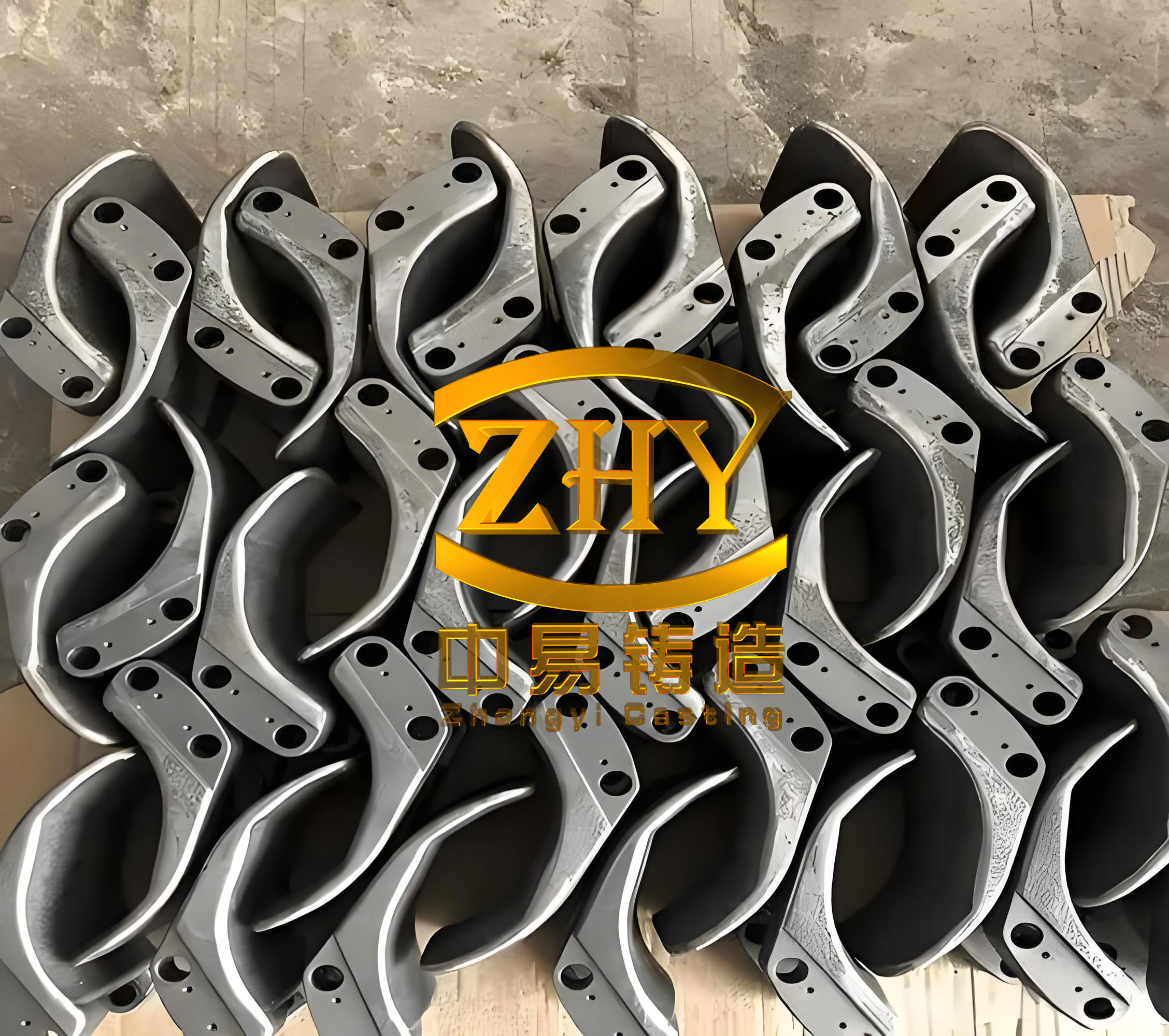
The visual representation of a well-produced ductile cast iron component underscores the importance of achieving sound internal integrity. Beyond composition and treatment, process control is paramount. Pre-treatment of the base iron melt before nodularization is a powerful technique. This involves adding small amounts of specific inoculants or graphitizers to condition the melt, creating a larger population of potential nucleation sites. This pre-inoculation step makes the subsequent final inoculation more effective, leading to a finer and more uniform graphite structure throughout the heavy section, mitigating the centerline degradation issues. The effectiveness of such a two-stage inoculation process can be conceptualized in terms of increasing the nucleation potential $N_p$ of the melt:
$$ N_p = N_0 + \Delta N_{\text{pre}} + \Delta N_{\text{post}} $$
where $N_0$ is the innate nucleation potential, $\Delta N_{\text{pre}}$ is the increase from pre-treatment, and $\Delta N_{\text{post}}$ is the increase from the final inoculation. A higher $N_p$ directly correlates with a higher final nodule count $N_f$, which is critical for properties:
$$ N_f \propto f(N_p, \text{Cooling Rate}) $$
In thick sections where the cooling rate is low, maximizing $N_p$ through pre-treatment is essential to achieve a satisfactory $N_f$.
Melting practice itself must be controlled to avoid excessive superheating, which can destroy nucleation sites, and to prevent holding the molten ductile cast iron for too long after treatment, which leads to fading. Pouring temperature should be optimized—high enough for proper filling but low enough to minimize shrinkage and segregation. Gating and risering design for these large castings must facilitate directional solidification toward feed metal to eliminate shrinkage cavities. Chills are often employed at strategic locations to locally increase the cooling rate, refining the structure in critical areas.
On the foundry floor, real-time control is key. This includes rapid thermal analysis of the base iron to predict its graphitization potential, precise weighing and reliable addition of nodulizing and inoculating alloys (often via tundish cover or in-mold processes for large castings), and strict control of processing times. The quality of ductile cast iron is frequently monitored using tell-tale samples like wedges or step blocks to assess graphite structure and chill tendency before pouring the actual casting.
The target microstructure for wind power ductile cast iron is a predominantly ferritic matrix (over 90% for grades like QT350-22AL and QT400-18AL) with a high density of small, well-formed, and evenly distributed graphite spheroids. The nodule count should be as high as possible, ideally exceeding 100 nodules/mm² even in slow-cooled sections. The following table contrasts the results from a production trial on a 2 MW hub main flange, highlighting the effect of a controlled antimony addition on the casting’s body properties and microstructure.
| Condition | Chemical Composition (wt.%) | Metallurgical Structure | |||
|---|---|---|---|---|---|
| Si | Mn | Nodularity (%) | Nodule Count (nodules/mm²) | Ferrite Fraction (%) | |
| Without Sb Addition | 2.02 | 0.18 | 93.41 | ~98 | >95 |
| With 0.003% Sb Addition | 1.99 | 0.20 | >95 | >95 | >95 |
The data clearly shows that the addition of a trace amount of antimony improved both nodularity and nodule count in the body of the heavy casting, moving it closer to the ideal microstructure. The absence of chunky graphite in the Sb-treated sample is a significant achievement.
In conclusion, the stable batch production of qualified low-temperature impact ductile cast iron for wind power applications is a multifaceted engineering challenge. It demands an integrated approach starting from high-purity raw materials, extending through precise chemical composition design with tight control over silicon, manganese, phosphorus, and sulfur, and culminating in advanced melting, treatment, and casting processes. The judicious use of nodulizers, inoculants, and beneficial trace elements like antimony, combined with techniques such as base iron pre-treatment, are powerful tools to enhance graphite nucleation and combat the degenerative tendencies inherent in thick sections. Every step—from charge make-up to final pouring—must be executed with discipline and monitored with rigor. The goal is to consistently produce ductile cast iron with a robust, ferritic matrix populated by a high density of spherical graphite nodules, ensuring the castings meet the stringent mechanical property requirements, especially superior low-temperature impact toughness, that are non-negotiable for the safe and reliable operation of wind turbines in the world’s most demanding environments. The continuous refinement of these techniques is what allows the foundry industry to supply the backbone of renewable energy infrastructure with confidence.
Further considerations involve the interplay of multiple factors. For instance, the effect of cooling rate on the final microstructure can be modeled. The secondary dendrite arm spacing (SDAS), $\lambda_2$, which influences microsegregation, is related to the local solidification time $t_f$ by a relationship like:
$$ \lambda_2 = A \cdot (t_f)^n $$
where $A$ and $n$ are material constants. In thick-section ductile cast iron, $t_f$ is large, leading to a coarse $\lambda_2$ and pronounced segregation. Techniques to locally modify cooling, like chills, effectively reduce $t_f$ in specific zones, refining $\lambda_2$ and reducing segregation. The success of inoculation can also be tied to the undercooling during solidification. Effective inoculation reduces the undercooling $\Delta T$ needed for graphite nucleation, promoting a more eutectic-like solidification with a finer structure. The relationship between nodule count $N_v$ and undercooling can be complex, but generally, higher inoculation efficacy leads to nucleation at lower undercooling and a higher $N_v$. Managing these solidification dynamics is central to producing sound, heavy-section ductile cast iron.
Finally, the economic aspect cannot be ignored. While using ultra-pure materials and multiple treatment steps increases cost, the consequence of failure in a wind turbine component is far more significant. Therefore, the technical essentials outlined here form the foundation for a cost-effective strategy in the long run, minimizing scrap, rework, and field failures. The production of high-performance ductile cast iron is as much a science as it is an art, requiring deep understanding, constant vigilance, and a commitment to quality at every stage of the process.