
In the realm of metal casting, ductile cast iron stands out due to its exceptional mechanical properties, such as high strength, toughness, and wear resistance, which are derived from its unique graphite nodule structure. However, the production of high-quality ductile cast iron components is often hampered by various casting defects, among which slag inclusions are particularly prevalent and detrimental. These inclusions can severely compromise the integrity, machinability, and fatigue life of cast parts. In my extensive involvement with ductile cast iron foundry operations, I have frequently encountered and addressed slag inclusion issues. This article delves deep into the nature, origins, and, most importantly, the practical solutions for slag inclusion defects in ductile cast iron, drawing from a detailed case study and broader industrial experience. The term ‘ductile cast iron’ will be reiterated throughout to emphasize the material context, as understanding its specific behavior is crucial for effective defect control.
Slag inclusions in ductile cast iron are non-metallic compounds entrapped within the metal matrix or on the casting surface. They primarily originate from oxidation products, slag, dross, or undissolved additives from the melting and treatment processes. Based on their formation stage, they are broadly classified into two categories: primary slag inclusions and secondary slag inclusions.
| Feature | Primary Slag Inclusions | Secondary Slag Inclusions |
|---|---|---|
| Formation Stage | During melting, spheroidization, or before pouring | During mold filling (after pouring) |
| Typical Location | Subsurface or near the casting surface | Internal regions of the casting |
| Main Causes | Inadequate slag removal, oxides/sulfides from treatment | Turbulent flow, re-oxidation of iron during filling |
| Particle Size | Generally larger, macroscopic | Often finer, more dispersed |
| Key Influencing Factors | Slag skimming practice, furnace atmosphere, treatment reagents | Gating system design, pouring temperature/speed, mold atmosphere |
The formation mechanisms can be conceptually modeled. For primary inclusions, the amount of slag generated during melting and treatment ($S_{primary}$) can be related to the reactivity of elements like Mg and Si:
$$ S_{primary} \propto \Delta[O] \cdot [Mg]_{added} + \Delta[S] \cdot [Mg]_{added} + f(Reactivity_{SiC, Slaggers}) $$
where $\Delta[O]$ and $\Delta[S]$ represent the decrease in oxygen and sulfur content due to treatment, and $[Mg]_{added}$ is the amount of magnesium added. Secondary inclusions are strongly tied to fluid dynamics. The tendency for re-oxidation ($\dot{O}_{reox}$) during filling can be expressed as:
$$ \dot{O}_{reox} = k \cdot A_{interface} \cdot (C_{O_2}^{mold} – C_{O}^{metal}) \cdot v_{turbulence}^n $$
Here, $k$ is a rate constant, $A_{interface}$ is the gas-metal interface area, $C$ denotes concentrations, $v_{turbulence}$ is a measure of turbulent flow velocity, and $n$ is an exponent (often >1). A smooth, laminar flow minimizes $v_{turbulence}$ and thus $\dot{O}_{reox}$.
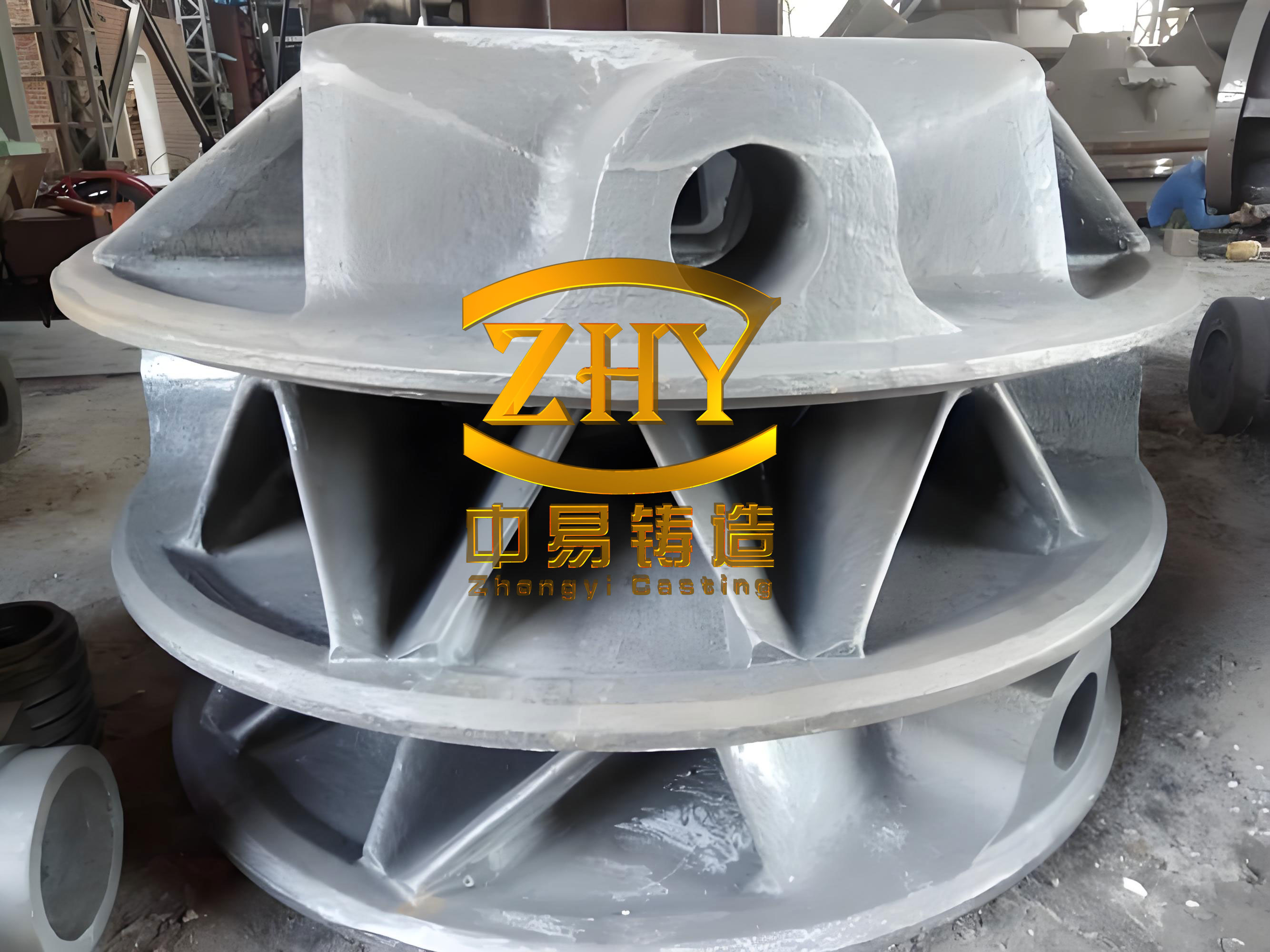
A critical case involved a safety-critical bearing housing casting for railway applications, made from ductile cast iron grade QT400-18. The required properties were stringent: full ferritic matrix, high ductility (≥18% elongation), and impeccable internal soundness per high-level ultrasonic and radiographic standards. Despite controlled melting and processing, a high rejection rate exceeding 50% was observed due to black spot defects on machined surfaces of inner bore holes. Initial visual inspection revealed subsurface imperfections that appeared as dark, irregular patches.
To diagnose this, we conducted a metallurgical investigation. A sample from the defective zone was sectioned, polished, and examined under scanning electron microscopy (SEM) coupled with energy dispersive spectroscopy (EDS). The microstructure around the defect showed clear discontinuities. EDS analysis provided quantitative elemental data, which we summarize below:
| Element | Spectrum 1 (Inclusion Core) | Spectrum 2 (Interface) | Potential Source |
|---|---|---|---|
| O | 45.2 | 32.1 | Oxidation |
| Si | 18.5 | 25.4 | Silicate, SiC, Sand |
| Mg | 9.8 | 5.2 | Spheroidization Slag |
| Al | 7.1 | 3.0 | Deoxidation, Alloying |
| Ca | 5.5 | 2.1 | Inoculant, Slag Modifier |
| Cl, Na, K | Totaling ~8.0 | Totaling ~1.5 | Slag Conditioner, Coating |
| Fe | 5.9 | 30.7 | Matrix |
The high concentrations of Si, Mg, Al, Ca, and O confirmed the defect as a complex silicate-based slag inclusion. The presence of Cl, Na, and K was particularly telling; these elements are uncommon in standard ductile cast iron metallurgy and pointed towards exogenous sources like slag conditioners (used for slag coagulation and removal) or even mold coatings. Crucially, the detection of residual Si and Mg in oxidized form suggested possible incomplete dissolution or reaction of additives, specifically silicon carbide (SiC) used for preconditioning and magnesium from the spheroidizer. The overall chemical signature indicated contributions from both primary (inadequate slag removal) and secondary (re-oxidation) mechanisms. For ductile cast iron, such inclusions are especially problematic as they can act as stress raisers, impairing the ductility and fatigue performance that define this material.
The original process for this ductile cast iron component employed a furan no-bake sand mold, with a single casting per pattern. The gating system used a combination of top and bottom gates, featuring four ingates and two ceramic tubes (ø25 mm). The melting was done in a medium-frequency induction furnace, with a charge mix of 40% pig iron, 40% steel scrap, and 20% returns. Key treatment parameters included a 1.0% addition of rare-earth containing spheroidizer in a covered ladle process, a 0.2% addition of SiC (90% purity, 2-9 mm grain size) for preconditioning, and inoculation with silicon-barium-calcium and sulfur-oxygen inoculants. Pouring temperature was maintained between 1350-1380°C.
| Process Parameter | Original Process | Optimized Process (Step 1: Gating) | Optimized Process (Step 2: Preconditioning) |
|---|---|---|---|
| Gating System | 4 top ingates + 2 ø25 mm bottom tubes | 4 ø25 mm bottom tubes only (pure bottom gating) | 4 ø25 mm bottom tubes only (pure bottom gating) |
| Filter Placement | Vertical placement in runner | Horizontal placement, dual filters + slag trap | Horizontal placement, dual filters + slag trap |
| Overflow/Riser | Standard feeding risers | Addition of a long, flat overflow at runner end | Addition of a long, flat overflow at runner end |
| SiC Preconditioning | 0.2%, 2-9 mm grain size | 0.2%, 2-9 mm grain size | 0.1-0.15%, 1-3 mm grain size |
| Pouring Temp. Range | 1350-1380°C | 1350-1380°C | 1350-1380°C |
| Theoretical Filling Behavior | Turbulent, splashing likely | Laminar, calm rise | Laminar, calm rise |
Our first hypothesis centered on the filling dynamics. The original gating likely caused turbulent entry, promoting re-oxidation and dross formation. The vertical filter placement was also inefficient for slag interception. We redesigned the system to be a purely bottom-gated one, using four ø25 mm ceramic tubes. This ensures the molten ductile cast iron enters the mold cavity at the bottom and rises steadily, minimizing agitation. The filters were placed horizontally in enlarged runner sections on both sides of the sprue, with a slag trap at the runner’s far end. An overflow was added opposite the ingates to collect the first, potentially slag-laden metal front. The filling velocity ($v_fill$) and Reynolds number ($Re$) are critical for assessing turbulence. For a bottom-gated system with a constant head, the average filling velocity can be approximated by Torricelli’s law adjusted for friction: $v_{fill} \approx \sqrt{2gh}$, where $g$ is gravity and $h$ is the metallostatic head. The Reynolds number is $Re = \frac{\rho v D}{\mu}$, where $\rho$ is density, $v$ is velocity, $D$ is hydraulic diameter, and $\mu$ is viscosity. A purely bottom-gated design reduces $v$ at the ingates and increases $D$ (using tubes), effectively lowering $Re$ below the turbulent threshold, which for ductile cast iron in gating systems is typically above 2000-4000. The transition to laminar flow ($Re < 2000$) drastically reduces the rate of oxide film entrainment, a key source of secondary slag in ductile cast iron.
Implementing this gating modification on 25 castings (5 heats) yielded a noticeable improvement, but the rejection rate remained unacceptably high at around 30%. This clearly indicated that while filling turbulence was a contributing factor, it was not the root cause of the primary slag problem in this specific case of ductile cast iron production.
We then turned our focus to the preconditioning stage using SiC. Silicon carbide is a potent tool for improving the metallurgical quality of ductile cast iron; it increases nucleation sites, reduces undercooling, and helps control oxide content. However, its effectiveness hinges on complete dissolution and reaction within the molten iron. The original practice used coarse granules (2-9 mm) at 0.2% addition. The fundamental kinetics of SiC dissolution can be described by a shrinking core model. The time ($t_d$) required for complete dissolution of a spherical particle of radius $r$ is approximately: $$ t_d \propto \frac{\rho_{SiC} r^2}{D_{eff} (C_s – C_b)} $$ where $\rho_{SiC}$ is the density of SiC, $D_{eff}$ is the effective diffusion coefficient in the iron melt, $C_s$ is the silicon concentration at the particle surface (saturation), and $C_b$ is the bulk silicon concentration. This relationship shows that dissolution time increases with the square of the particle radius. Therefore, larger particles (e.g., 4.5 mm average radius) may not fully dissolve within the limited time between addition and pouring, especially if the temperature or agitation is suboptimal. Undissolved SiC particles, along with their associated reaction layers (rich in SiO2, Al2O3, etc.), can then be carried into the mold as primary slag inclusions.
We hypothesized that by reducing the particle size, we could drastically reduce $t_d$, ensuring complete assimilation. We therefore switched to a finer, screened SiC with a controlled grain size of 1-3 mm and reduced the addition rate to 0.1-0.15%. The finer size provides a much larger total surface area ($A_{total}$) for a given mass ($m$): $A_{total} = \frac{3m}{\rho r}$. This accelerates the dissolution and reaction kinetics. Furthermore, the lower addition rate meant less total material to dissolve, reducing the burden on the system while still achieving the desired preconditioning effect for the ductile cast iron. Combined with the already-optimized bottom-pouring gating system, this change was implemented.
The results were definitive. A batch of 20 castings produced with the refined SiC practice showed zero slag inclusion defects upon machining. Subsequent production runs consistently confirmed this outcome, effectively eliminating the defect and bringing the rejection rate for this issue to zero. The improvement can be quantified by considering the defect probability ($P_{defect}$) as a function of multiple factors. Empirically, we can model: $$ P_{defect} = K \cdot (S_{undissolved} + E_{entrained}) $$ where $K$ is a constant, $S_{undissolved}$ represents the mass fraction of undissolved/foreign particles, and $E_{entrained}$ represents the volume fraction of re-oxidized dross entrained. The gating optimization primarily reduced $E_{entrained}$, while the SiC optimization drove $S_{undissolved}$ to near zero.
The journey to solve this slag inclusion problem in ductile cast iron underscores several universal principles in foundry engineering. First, defect analysis must be systematic, combining visual inspection, microscopic examination, and chemical analysis to pinpoint the exact nature and source of inclusions. Second, process parameters are deeply interconnected. While fluid flow control is paramount for preventing secondary defects, the quality of the molten ductile cast iron before it even enters the mold is equally critical for preventing primary defects. The use of additives like SiC requires careful specification of both particle size and quantity; the common “more is better” approach can be counterproductive. The optimal size ensures complete dissolution within the process time window, governed by kinetic principles. For ductile cast iron, which undergoes vigorous treatment reactions, this attention to detail in preconditioning is non-negotiable for achieving clean metal.
In conclusion, the persistent slag inclusion defect in the ductile cast iron bearing housing was successfully eradicated through a two-stage optimization. Initially, modifying the gating system to a pure bottom-fed design with proper filtration and overflows mitigated turbulent re-oxidation, reducing secondary slag. However, the core issue was identified as incomplete dissolution of coarse silicon carbide preconditioner, leading to primary slag entrapment. By refining the SiC grain size to 1-3 mm and adjusting the addition rate to 0.1-0.15%, we ensured its complete assimilation into the molten ductile cast iron, thereby eliminating the source of exogenous inclusions. This case exemplifies that robust ductile cast iron production requires holistic control over both liquid metal treatment and mold filling dynamics. Future work could involve modeling the dissolution kinetics of SiC in ductile cast iron melts more precisely under various temperature and stirring conditions to further optimize preconditioning practices, and exploring the interaction between slag composition and filter efficiency to enhance inclusion removal across different grades of ductile cast iron.