
In the evolving landscape of foundry technology, the demand for advanced cast materials with superior mechanical properties has driven significant innovation. My research focuses on the development of high silicon ductile cast iron grades, specifically QT500-14 and QT600-10, which aim to overcome the limitations of traditional grades like QT500-7 and QT600-3. These conventional ductile cast iron materials often exhibit low yield strength, inadequate elongation, and non-uniform hardness, leading to poor machinability due to their mixed ferritic-pearlitic matrix. By leveraging the solid solution strengthening effect of silicon, this study explores a novel approach to produce fully ferritic matrix ductile cast iron that meets the stringent requirements of EN 1563:2012. The ductile cast iron industry has long sought materials that balance high tensile strength with excellent ductility and machining performance, and this work presents a viable pathway through controlled silicon alloying.
The core principle behind this investigation is solid solution strengthening, a mechanism where solute atoms, such as silicon, dissolve in the iron matrix to induce lattice distortion. This distortion increases resistance to dislocation movement, thereby enhancing strength and hardness. For ductile cast iron, silicon serves as a potent solid solution strengthener, but its concentration must be carefully optimized to avoid brittleness. The relationship between silicon content and tensile strength can be approximated by a linear model: $$ R_m = \alpha + \beta \cdot [Si] $$ where \( R_m \) is the tensile strength in MPa, \( [Si] \) is the silicon content in weight percent, and \( \alpha \) and \( \beta \) are material constants derived from experimental data. Similarly, elongation tends to decrease with increasing silicon, as described by: $$ A = \gamma – \delta \cdot [Si] $$ where \( A \) is the elongation in percent, and \( \gamma \) and \( \delta \) are constants. These relationships guided the chemical composition design, ensuring that the ductile cast iron achieves target properties without compromising ductility.
The selection of chemical composition is critical for producing high-quality ductile cast iron. Based on extensive experimentation and prior knowledge, the following compositional ranges were established to achieve the desired fully ferritic matrix in QT500-14 and QT600-10 ductile cast iron. The carbon equivalent (CE) plays a key role in fluidity and castability; it is controlled between 4.45% and 4.55% to optimize mold filling and shrinkage compensation. Silicon, the primary strengthening element, is maintained at 3.3% to 4.3% for QT500-14 and 3.8% to 4.3% for QT600-10, balancing strength and elongation. Manganese, a pearlite promoter, is kept below 0.2% to prevent pearlite formation. Phosphorus, a harmful element that leads to phosphide eutectic formation, is restricted to less than 0.04%. Copper, another pearlite stabilizer, is limited to under 0.1%. Sulfur, essential for nodulization but detrimental in excess, is controlled between 0.006% and 0.012%. Magnesium, crucial for graphite nodularization, is set at 0.045% to 0.065% to counteract the potential negative effects of high silicon on graphite morphology. The summary of compositional ranges is presented in Table 1.
| Element | QT500-14 | QT600-10 | Role and Rationale |
|---|---|---|---|
| Carbon Equivalent (CE) | 4.45–4.55 | 4.45–4.55 | Enhances fluidity and reduces shrinkage defects in ductile cast iron. |
| Silicon (Si) | 3.3–3.8 | 3.8–4.3 | Solid solution strengthener; increases strength but must be limited to preserve ductility in ductile cast iron. |
| Manganese (Mn) | <0.2 | <0.2 | Minimized to avoid pearlite formation and ensure fully ferritic matrix in ductile cast iron. |
| Phosphorus (P) | <0.04 | <0.04 | Reduced to prevent phosphide eutectic and improve toughness of ductile cast iron. |
| Copper (Cu) | <0.1 | <0.1 | Limited to inhibit pearlite formation in ductile cast iron. |
| Sulfur (S) | 0.006–0.012 | 0.006–0.012 | Controlled for effective nodulization in ductile cast iron. |
| Magnesium (Mg) | 0.045–0.065 | 0.045–0.065 | Ensures spherical graphite formation in high silicon ductile cast iron. |
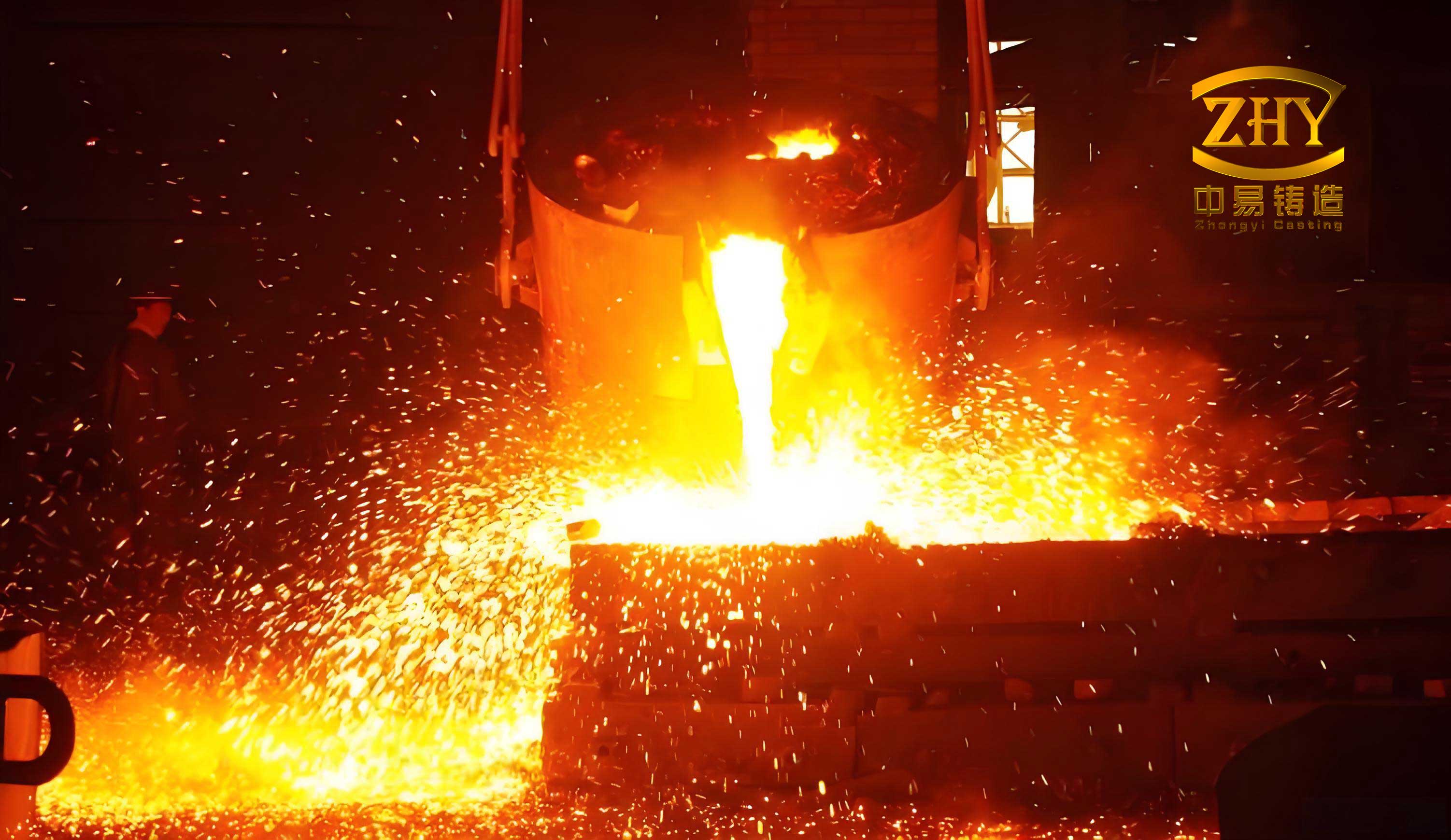
Melting and processing techniques are pivotal to realizing the target microstructure and properties in ductile cast iron. The charge materials consisted of high-purity pig iron, steel scrap, and returns, blended according to the proportions in Table 2 to achieve the desired chemistry. This blend minimizes deleterious elements and ensures consistent quality in ductile cast iron production. Melting was conducted in a medium-frequency induction furnace, with careful temperature control: the melting temperature was maintained at approximately 1,500°C, followed by superheating to 1,520–1,550°C to promote homogeneity and reduce gas content. The process was streamlined to avoid bridging or overheating, which could degrade the ductile cast iron quality.
| Material | Proportion (Weight %) | Purpose |
|---|---|---|
| Pig Iron | 30–50 | Provides high carbon and silicon base for ductile cast iron. |
| Steel Scrap | 10–30 | Adjusts carbon content and adds purity to ductile cast iron. |
| Returns | 30–50 | Enhances cost-effectiveness and recycling in ductile cast iron melting. |
Nodulization and inoculation are critical steps in producing ductile cast iron with spherical graphite. For this study, FeSiMg alloy (4–6% Mg, 40–45% Si) was used as the nodulizer, added at 0.9–1.2% via the sandwich method in the pouring ladle. The treatment began when over 70% of the iron was tapped to ensure vigorous reaction and minimize oxidation. Inoculation was performed with BaSi inoculant (70–75% Si, 4–6% Ba) at 0.8–1.0% addition, using a fine grain size to promote uniform graphite nucleation in the ductile cast iron. The inoculation enhances graphite count and refines the matrix, contributing to the mechanical performance of ductile cast iron. The overall process flow can be summarized as: $$ \text{Melting} \rightarrow \text{Nodulization} \rightarrow \text{Inoculation} \rightarrow \text{Pouring} \rightarrow \text{Solidification} $$ This sequence ensures optimal microstructure development in high silicon ductile cast iron.
The experimental phase involved three iterative stages to refine the process for QT500-14 and QT600-10 ductile cast iron. Initially, mechanical properties and microstructure fell short of EN 1563:2012 requirements due to low silicon content and poor nodularity. Adjustments included increasing silicon within the specified range and optimizing nodulizer addition to counteract silicon’s adverse effects on graphite shape. In the second stage, higher nodulizer dosages improved graphite sphericity, achieving nodularity above 90%. Finally, systematic trials were conducted by casting standard test bars (Y25, U40, U70 corresponding to wall thicknesses ≤30 mm, 30–60 mm, and 60–200 mm, respectively) to evaluate properties. The results, summarized in Tables 3–8, demonstrate that both ductile cast iron grades meet or exceed the EN 1563:2012 specifications for tensile strength, yield strength, elongation, and ferritic content. For instance, QT600-10 exhibited tensile strengths of 580–628 MPa, yield strengths of 481–510 MPa, and elongations of 12–19%, with ferritic matrix exceeding 95%. Similarly, QT500-14 showed tensile strengths of 520–551 MPa, yield strengths of 433–459 MPa, and elongations of 14–17%, also with over 95% ferrite. These data underscore the efficacy of silicon solid solution strengthening in ductile cast iron.
| Trial | C (%) | Si (%) | Nodularity (%) | Rm (MPa) | Rp0.2 (MPa) | A (%) | Ferrite (%) |
|---|---|---|---|---|---|---|---|
| 1 | 3.18 | 3.95 | 91 | 617 | 500 | 19 | >95 |
| 2 | 3.11 | 3.89 | 93 | 612 | 499 | 17 | >95 |
| 3 | 3.15 | 3.94 | 95 | 610 | 493 | 18 | >95 |
| 4 | 3.17 | 3.98 | 89 | 619 | 491 | 15 | >95 |
| 5 | 3.09 | 4.10 | 97 | 628 | 510 | 16 | >95 |
| Trial | C (%) | Si (%) | Nodularity (%) | Rm (MPa) | Rp0.2 (MPa) | A (%) | Ferrite (%) |
|---|---|---|---|---|---|---|---|
| 1 | 3.18 | 3.95 | 92 | 597 | 490 | 15 | >95 |
| 2 | 3.11 | 3.89 | 90 | 594 | 482 | 16 | >95 |
| 3 | 3.15 | 3.94 | 91 | 588 | 485 | 13 | >95 |
| 4 | 3.17 | 3.98 | 91 | 601 | 493 | 14 | >95 |
| 5 | 3.09 | 4.10 | 90 | 611 | 502 | 17 | >95 |
| Trial | C (%) | Si (%) | Nodularity (%) | Rm (MPa) | Rp0.2 (MPa) | A (%) | Ferrite (%) |
|---|---|---|---|---|---|---|---|
| 1 | 3.18 | 3.95 | 92 | 589 | 487 | 16 | >95 |
| 2 | 3.11 | 3.89 | 93 | 590 | 485 | 14 | >95 |
| 3 | 3.15 | 3.94 | 94 | 580 | 483 | 12 | >95 |
| 4 | 3.17 | 3.98 | 90 | 579 | 481 | 13 | >95 |
| 5 | 3.09 | 4.10 | 93 | 586 | 493 | 15 | >95 |
| Trial | C (%) | Si (%) | Nodularity (%) | Rm (MPa) | Rp0.2 (MPa) | A (%) | Ferrite (%) |
|---|---|---|---|---|---|---|---|
| 1 | 3.23 | 3.65 | 93 | 542 | 450 | 15 | >95 |
| 2 | 3.19 | 3.71 | 95 | 551 | 452 | 16 | >95 |
| 3 | 3.24 | 3.64 | 95 | 536 | 459 | 17 | >95 |
| 4 | 3.30 | 3.68 | 90 | 521 | 443 | 15 | >95 |
| 5 | 3.25 | 3.75 | 91 | 549 | 451 | 14 | >95 |
| Trial | C (%) | Si (%) | Nodularity (%) | Rm (MPa) | Rp0.2 (MPa) | A (%) | Ferrite (%) |
|---|---|---|---|---|---|---|---|
| 1 | 3.23 | 3.65 | 91 | 533 | 448 | 15 | >95 |
| 2 | 3.19 | 3.71 | 92 | 546 | 453 | 17 | >95 |
| 3 | 3.24 | 3.64 | 90 | 535 | 455 | 15 | >95 |
| 4 | 3.30 | 3.68 | 95 | 522 | 443 | 16 | >95 |
| 5 | 3.25 | 3.75 | 96 | 541 | 441 | 15 | >95 |
| Trial | C (%) | Si (%) | Nodularity (%) | Rm (MPa) | Rp0.2 (MPa) | A (%) | Ferrite (%) |
|---|---|---|---|---|---|---|---|
| 1 | 3.23 | 3.65 | 90 | 529 | 438 | 14 | >95 |
| 2 | 3.19 | 3.71 | 91 | 537 | 446 | 15 | >95 |
| 3 | 3.24 | 3.64 | 92 | 525 | 437 | 15 | >95 |
| 4 | 3.30 | 3.68 | 99 | 520 | 433 | 14 | >95 |
| 5 | 3.25 | 3.75 | 87 | 530 | 441 | 15 | >95 |
Microstructural analysis reveals the fully ferritic matrix with well-dispersed spherical graphite, key to the performance of this ductile cast iron. The graphite nodules are predominantly spherical, with nodularity ratings consistently above 85%, as required for high-quality ductile cast iron. The ferritic content exceeds 95%, ensuring excellent ductility and machinability. This microstructure is achieved through precise control of silicon content and processing parameters, highlighting the success of solid solution strengthening in ductile cast iron. The relationship between microstructure and properties can be expressed as: $$ R_m = f(V_f, d_g, [Si]) $$ where \( V_f \) is the ferrite volume fraction, \( d_g \) is the graphite nodule diameter, and \( [Si] \) is the silicon content. For the developed ductile cast iron, high \( V_f \) and fine \( d_g \) contribute to balanced strength and elongation.
The advantages of high silicon ductile cast iron over traditional alloyed grades are multifaceted. Compared to copper- or tin-alloyed ductile cast iron with mixed ferritic-pearlitic matrices, this material offers higher tensile and yield strengths coupled with superior elongation, enabling weight reduction in castings through thinner sections. The hardness distribution is more uniform across castings, improving machining performance and extending tool life—a significant cost benefit in manufacturing ductile cast iron components. Additionally, the high silicon content allows greater tolerance for pearlite-stabilizing elements, facilitating the use of more steel scrap and lowering raw material costs. However, there are drawbacks: the production window for QT600-10 ductile cast iron is narrow, requiring strict silicon control below 4.3%. Surface treatments like quenching are not feasible due to silicon’s influence, and weldability is poor, limiting repair options for ductile cast iron castings. These factors must be considered in applications involving high silicon ductile cast iron.
The impact performance of high silicon ductile cast iron varies with temperature, influencing its suitability for different environments. As shown in Table 9, the Charpy V-notch impact energy for QT500-14 ductile cast iron increases from about 4 J at -20°C to 21 J at 180°C, indicating enhanced toughness at elevated temperatures. This trend is consistent across other ductile cast iron grades, as summarized in Table 10. At low temperatures, high silicon ductile cast iron exhibits lower impact energy compared to conventional grades like QT400-18, but at temperatures above 140°C, the values converge, making high silicon ductile cast iron a viable replacement for mixed-matrix grades in high-temperature service. This behavior can be modeled using an Arrhenius-type equation: $$ E = E_0 \exp\left(-\frac{Q}{RT}\right) $$ where \( E \) is impact energy, \( E_0 \) is a pre-exponential factor, \( Q \) is activation energy, \( R \) is the gas constant, and \( T \) is temperature in Kelvin. For ductile cast iron, silicon content affects \( Q \), altering temperature dependence.
| Test Bar Type | Temperature (°C) | Impact Energy (J) – Trial 1 | Impact Energy (J) – Trial 2 | Impact Energy (J) – Trial 3 | Average Impact Energy (J) |
|---|---|---|---|---|---|
| Y25 | -20 | 4 | 4 | 4 | 4 |
| Y25 | 20 | 5 | 5 | 5 | 5 |
| Y25 | 140 | 19 | 20 | 21 | 20 |
| Y25 | 180 | 20 | 21 | 22 | 21 |
| Ductile Cast Iron Grade | Test Bar Type | Impact Energy at -20°C (J) | Impact Energy at 20°C (J) | Impact Energy at 140°C (J) | Impact Energy at 180°C (J) |
|---|---|---|---|---|---|
| QT600-10 | Y25 | 3 | 4 | 18 | 20 |
| QT500-14 | Y25 | 4 | 5 | 20 | 21 |
| QT500-7 | Y25 | 4 | 5 | 18 | 20 |
| QT450-18 | Y25 | 7 | 17 | 22 | 24 |
| QT450-10 | Y25 | 6 | 7 | 18 | 22 |
| QT400-18 | Y25 | 8 | 18 | 22 | 23 |
In conclusion, this research demonstrates that high silicon ductile cast iron grades QT500-14 and QT600-10 can be successfully produced using FeSiMg nodulizer and BaSi inoculant, with silicon content optimized for solid solution strengthening. The mechanical properties and microstructure comply with EN 1563:2012, offering a compelling alternative to traditional ductile cast iron for applications where high strength, good ductility, and excellent machinability are required. However, the low-temperature impact resistance of this ductile cast iron necessitates caution in cryogenic environments, whereas its high-temperature performance makes it suitable for elevated-temperature service. Future work could explore alloy modifications to improve low-temperature toughness or expand the processing window for high silicon ductile cast iron. Overall, the development of QT500-14 and QT600-10 represents a significant advancement in ductile cast iron technology, paving the way for more efficient and cost-effective casting solutions.