
As an observer deeply immersed in the field of advanced manufacturing, I have witnessed remarkable transformations in recent years. The integration of novel techniques like micro-casting-forging and the persistent challenges in producing large-scale components, especially those involving nodular cast iron, have reshaped industrial practices. In this article, I will delve into these developments, sharing insights from my experiences and research. The focus will be on how technologies such as metal 3D printing micro-casting-forging are revolutionizing applications like blast furnace tuyeres, and the complexities surrounding massive nodular cast iron structures for nuclear waste transport. Throughout, I will emphasize the critical role of nodular cast iron, a material prized for its ductility and strength, and its evolving applications in demanding environments.
The advent of micro-casting-forging technology represents a paradigm shift in manufacturing. Traditionally, the production of large forgings involved a multi-step process: casting, forging, heat treatment, and machining, which was not only lengthy and resource-intensive but also limited by the size of forging equipment. This often necessitated segmental fabrication and welding, compromising integrity. In contrast, additive manufacturing or 3D printing offered a streamlined approach but typically lacked the forging step, resulting in components with inferior fatigue resistance compared to forged parts. The breakthrough came with the development of micro-casting-forging, which synergistically combines casting and forging into a single, continuous operation. This technique enables localized forging during the printing process, enhancing the microstructure and mechanical properties. From my analysis, the key advantage lies in its ability to produce parts with superior strength, toughness, and fatigue life, all while reducing environmental impact through shorter processes.
In practical terms, the application of micro-casting-forging in blast furnace tuyeres has been groundbreaking. Tuyeres are critical components in metallurgical furnaces, exposed to extreme thermal cycling and abrasive conditions. Conventional methods, such as plasma spraying, often led to short service lives—averaging around six months—due to inadequate wear resistance and thermal shock tolerance. By employing micro-casting-forging to deposit a gradient functional composite layer on the inner wall, the hardness and thermal shock resistance are significantly improved. I have seen reports indicating that this innovation extends service life by over five times, reducing downtime and boosting productivity. The underlying principle can be summarized through material performance metrics. For instance, the wear resistance improvement can be modeled using the Archard wear equation:
$$ W = k \frac{F_n \cdot s}{H} $$
where \( W \) is the wear volume, \( k \) is the wear coefficient, \( F_n \) is the normal load, \( s \) is the sliding distance, and \( H \) is the hardness. By increasing hardness \( H \) through the gradient layer, wear \( W \) is drastically reduced. Similarly, thermal shock resistance relates to the material’s thermal conductivity and fracture toughness, often expressed as:
$$ R = \frac{\sigma_f (1 – \nu)}{\alpha E} $$
where \( R \) is the thermal shock resistance parameter, \( \sigma_f \) is the fracture strength, \( \nu \) is Poisson’s ratio, \( \alpha \) is the coefficient of thermal expansion, and \( E \) is Young’s modulus. The micro-casting-forging process optimizes these parameters by refining the microstructure. To illustrate the contrast, consider the following table comparing traditional and micro-casting-forging approaches for tuyere manufacturing:
| Aspect | Traditional Plasma Spraying | Micro-Casting-Forging |
|---|---|---|
| Process Steps | Multiple: coating application, post-treatment | Single integrated process |
| Hardness Improvement | Moderate, surface-only | High, with gradient depth |
| Thermal Shock Resistance | Limited, prone to delamination | Superior, due to forged integrity |
| Service Life | ~6 months | >30 months (5x improvement) |
| Environmental Impact | Higher energy and waste | Lower, via streamlined process |
Transitioning to another significant area, the production of large-scale nodular cast iron components presents unique challenges. Nodular cast iron, also known as ductile iron, is favored for its excellent castability, machinability, and mechanical properties, particularly in applications requiring durability under stress. Recently, I followed a project involving the development of a hundred-ton-class nodular cast iron cylinder for spent nuclear fuel transport containers. This endeavor highlights the intricacies of working with thick-section nodular cast iron, where issues like chunk graphite formation can degrade performance. The primary hurdles included controlling cooling rates to minimize defects, ensuring material homogeneity under low-temperature and multi-load conditions, achieving high density for deep internal machining, and establishing non-destructive testing standards for such massive castings.
The successful pouring of this cylinder was a milestone, but it required meticulous planning. For example, the cooling process is critical to prevent structural anomalies. The heat transfer during solidification can be described by Fourier’s law and the heat equation:
$$ \frac{\partial T}{\partial t} = \alpha \nabla^2 T $$
where \( T \) is temperature, \( t \) is time, and \( \alpha \) is thermal diffusivity. In thick sections, the cooling time \( t_c \) for a region of thickness \( L \) scales as:
$$ t_c \propto \frac{L^2}{\alpha} $$
Thus, for large \( L \), cooling must be actively managed to avoid prolonged stays in critical temperature ranges that promote chunk graphite. Additionally, the mechanical properties of nodular cast iron depend on the nodule count and matrix structure. The yield strength \( \sigma_y \) can be related to the nodularity and graphite dispersion, often empirically modeled as:
$$ \sigma_y = \sigma_0 + k \cdot N^{-1/2} $$
where \( \sigma_0 \) is the base strength, \( k \) is a material constant, and \( N \) is the nodule count per unit area. Achieving uniform \( N \) across massive sections is vital for consistent performance. Below is a table summarizing the key challenges and strategies in producing the nodular cast iron cylinder:
| Challenge | Description | Mitigation Strategy |
|---|---|---|
| Chunk Graphite Formation | Occurs in thermal centers due to slow cooling, reducing ductility | Controlled cooling via chills or optimized molding |
| Material Homogeneity | Variations in properties across thick sections | Stirring during pouring, alloy modification |
| Density for Deep Holes | Porosity risks in internal machined features | High-pressure molding, vacuum assist |
| Testing Standards | Lack of codes for ultra-thick nodular cast iron | Develop new protocols based on dissection data |
| Logistical Constraints | Need for large cranes, tall foundries, deep pits | Specialized facility design and planning |
It is worth noting that nodular cast iron’s versatility makes it indispensable for such heavy-duty applications. The ongoing research into its behavior under extreme conditions continues to push boundaries. For instance, the fracture toughness \( K_{IC} \) of nodular cast iron is a key parameter for container integrity, often expressed as:
$$ K_{IC} = Y \sigma \sqrt{\pi a} $$
where \( Y \) is a geometry factor, \( \sigma \) is applied stress, and \( a \) is crack length. Enhancing \( K_{IC} \) through microstructural control is a focal point in these projects. As I reflect on these advancements, the importance of collaborative knowledge-sharing becomes evident. Industry forums play a crucial role in disseminating insights, such as those on green technologies and quality assurance in casting. Discussions often revolve around optimizing raw materials, like binders and sands, for both traditional and innovative processes, including 3D printing. The emphasis on sustainability aligns with the broader trend towards eco-friendly manufacturing, where nodular cast iron recycling and energy-efficient practices are gaining traction.
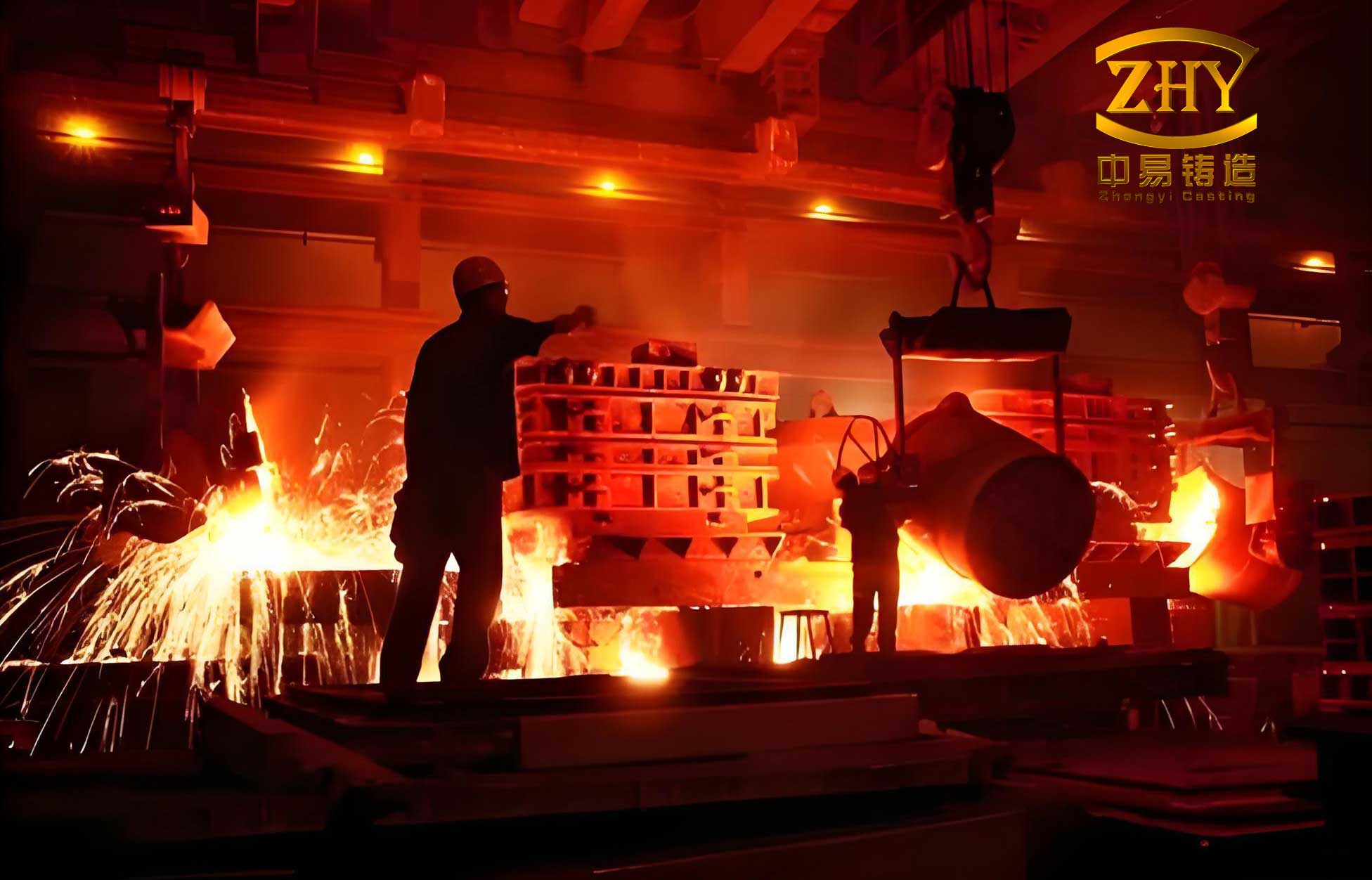
Looking ahead, the convergence of technologies like micro-casting-forging and the enduring relevance of nodular cast iron heralds a new era in manufacturing. From my perspective, the ability to produce complex, high-performance components with reduced environmental footprint is transformative. For nodular cast iron, ongoing innovations in processing—such as improved inoculation techniques and real-time monitoring—will further expand its applications. In nuclear transport, for example, the success of the hundred-ton cylinder paves the way for safer and more efficient solutions. Similarly, the adoption of micro-casting-forging in sectors beyond metallurgy, such as aerospace and energy, promises enhanced reliability and cost savings. As these technologies mature, I anticipate a shift towards more integrated digital manufacturing platforms, where simulation and data analytics optimize every stage from design to production.
In conclusion, the journey through these technological landscapes reinforces the value of continuous innovation. The synergy between traditional materials like nodular cast iron and cutting-edge processes like micro-casting-forging demonstrates that progress often lies at the intersection of old and new. By embracing these advances, manufacturers can overcome longstanding limitations, achieving superior performance and sustainability. As I continue to explore these fields, I am optimistic about the future, where challenges like those in thick-section nodular cast iron casting will be met with ever more sophisticated solutions, driving industry forward in a globally competitive environment.