
The production of high-integrity, dimensionally critical castings represents a core challenge in advanced manufacturing. In this context, professional sand casting services must evolve beyond traditional methods to meet stringent aerospace and defense specifications. This detailed account explores the systematic development of a complex aircraft pylon casting, highlighting how the integration of low-pressure casting with precision sand mold technology can overcome significant material and geometric hurdles. The success of such projects underscores the capability of advanced sand casting services to deliver components where performance is non-negotiable.
The component in question was a large structural skeleton (“pylon”) for a specialized product. The primary challenges were multifaceted, demanding a holistic approach from the sand casting services team.
- Material: ZL205A (a high-strength aluminum-copper alloy). While offering excellent mechanical properties, its wide solidification range and poor fluidity make it prone to shrinkage porosity, hot tearing, and micro-porosity under conventional gravity pouring.
- Geometry: The part was approximately 1400 mm long, 300 mm tall, and 90 mm wide, with a complex internal labyrinth of thin ribs and partitions (8-13 mm wall thickness). Two large, 1400 mm x 300 mm side walls required single-sided machining to a final thickness tolerance of just ±1 mm.
- Quality Standards: The casting was to be inspected as a Class II casting per HB5480-91, requiring 100% X-ray inspection (HBZ60-81) and 100% fluorescent penetrant inspection.
- Core Challenges: The intricate internal cavity, with few small windows, complicated core-making, venting, and cleaning. The large, flat areas were susceptible to warping. Isolated heavy sections created pronounced hot spots.
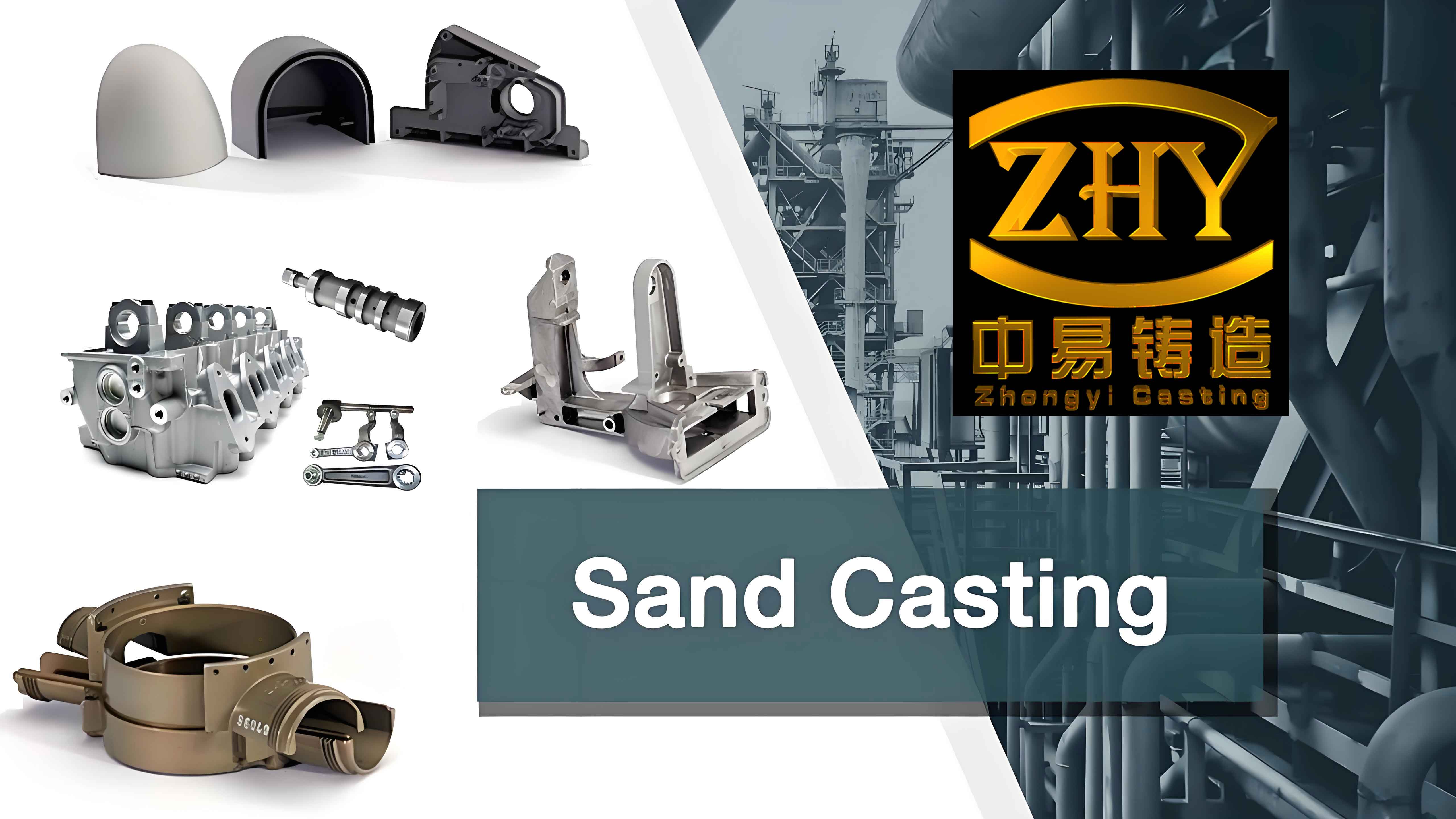
To address these challenges, a low-pressure sand casting process was selected. This process offers distinct advantages for professional sand casting services: controlled, pressurized filling from below reduces turbulence and oxide formation, while the pressure assists in feeding shrinkage throughout the prolonged solidification of ZL205A. The mold was built using resin-bonded sand cores assembled within a steel frame for rigidity. To ensure dimensional accuracy, metal core boxes were used for the main cavity cores. A rigorous inspection protocol was implemented for each core, involving precise measurement and hand-finishing of the coating surface with 200-grit sandpaper to achieve superior as-cast finish.
The gating and feeding system was designed as a combined bottom-filling and slot-gate system to ensure tranquil filling. Symmetrical placement of feeders was critical to minimize stress and potential distortion. Chills were strategically employed: thin facing chills on the large side walls to promote directional solidification and prevent surface shrinkage, and steel chills on top heavy sections. Venting was a primary concern; numerous vents and排气槽 (exhaust channels) were incorporated into the mold and cores. The process parameters for low-pressure filling are governed by fundamental fluid dynamics and heat transfer principles. The pressure required to raise the metal to the top of the sprue is given by:
$$ P = \rho g h $$
where $P$ is the applied pressure at the furnace, $\rho$ is the molten metal density, $g$ is gravity, and $h$ is the total height from the metal bath to the top of the casting cavity. However, to control the fill velocity, the pressure rise must be carefully profiled over time. A simplified model for the fill rate considers the pressure differential:
$$ \frac{dV}{dt} = A \cdot v = A \cdot \sqrt{\frac{2(P_{applied} – \rho g h_{current})}{\rho}} $$
where $dV/dt$ is the volumetric flow rate, $A$ is the cross-sectional area of the riser tube, and $v$ is the instantaneous metal velocity at the tube exit.
| Process Stage | Target Pressure (kPa) | Time (s) | Objective |
|---|---|---|---|
| Furnace Pressurization | 5-10 | 5 | Lift metal into sprue base |
| Fill Stage 1 (0-50% height) | 15-20 | ~30 | Slow, controlled cavity filling |
| Fill Stage 2 (50-100% height) | 25-30 | ~25 | Complete fill, minimize turbulence at top |
| Intensification / Solidification | 35-40 | 180-240 | Maintain pressure for feeding |
| Pressure Release | 0 | – | After complete solidification |
Initial trial production of three castings revealed several critical issues that required immediate attention from the sand casting services team, demonstrating the iterative nature of process refinement.
| Defect Observed | Location | Hypothesized Root Cause |
|---|---|---|
| Large Blowholes | “Nose” area and top surfaces | 1. Excessive fill velocity trapping air. 2. Inadequate core/mold venting in enclosed upper sections. |
| Localized Wall Thickness Increase & High Roughness | Non-machined side walls | Insufficient core sand compaction in complex areas, leading to local core erosion/deformation under heat and pressure. |
| Internal Cavity Dimensions (Height) Undersize | Entire cavity height | 1. Incorrect pattern shrinkage allowance (initially 1.2%). 2. Inconsistent coating thickness on hard-to-reach core surfaces. |
| Core Distortion (~0.5 mm) | Large core assembly | 1. Premature demolding due to high humidity slowing resin cure. 2. Lack of flatness in core-setting fixture. |
A comprehensive corrective action plan was implemented, showcasing the problem-solving capabilities essential for high-end sand casting services.
- Process Parameter Optimization: The fill pressure ramp was significantly slowed, particularly in the initial stage, to allow air more time to escape through the vents. The fill time was increased by approximately 20%.
- Enhanced Venting: Additional 6 mm wide exhaust channels were cut into the mold at the top and in the problematic “nose” area. The area covered by top chills was reduced to allow for more vent holes. Rope made of natural fiber was embedded within the core, channeled to exterior vents, to provide a passive outgassing path for core gases during pouring.
- Core Process Control: The resin and catalyst addition rates were fine-tuned. Sand for critical cavity cores was hand-sieved three times for better mixing. Removable blocks were added to the metal core boxes to improve accessibility for uniform ramming.
- Dimensional Correction: The pattern shrinkage allowance was increased to 1.3%. The coating application for recessed core surfaces was switched from spraying to careful brushing to ensure a uniform, adequate layer.
- Production Environment Control: A strict protocol was enforced: demolding time was extended by 1 hour when ambient humidity exceeded 70%; cores had to be poured within 24 hours of making; and a precision-machined flat plate was used for all core handling and storage.
Subsequent production of seven castings showed marked improvement. However, two castings exhibited minor subsurface porosity on the top surface after rough machining, located near chills. This was traced to moisture adsorption on insufficiently dried chills. The final corrective measures involved extending mold drying times, reducing the number of top chills slightly, and adding more venting around remaining chills. This eliminated the defect in later batches.
The solidification dynamics in such a complex casting are critical. The Chvorinov’s rule can be adapted to estimate the solidification time of different sections, guiding the placement of chills and feeders:
$$ t = B \cdot \left( \frac{V}{A} \right)^n $$
where $t$ is the solidification time, $V$ is the volume of the section, $A$ is its cooling surface area, $B$ is the mold constant, and $n$ is an exponent (typically ~1.5-2 for sand molds). For a riser to effectively feed a section, its solidification time must be greater:
$$ t_{riser} > t_{casting\;section} $$
The use of chills effectively reduces the mold constant $B$ for that local area, accelerating solidification and promoting directional solidification towards the feeder.
Dimensional accuracy is paramount. The final achieved tolerance of ±1 mm on a large, thin-wall casting corresponds to a remarkable dimensional capability. The total potential dimensional error $\Delta D_{total}$ can be expressed as a root sum square (RSS) of contributing factors:
$$ \Delta D_{total} = \sqrt{(\Delta D_{pattern})^2 + (\Delta D_{core})^2 + (\Delta D_{metal\;shrink})^2 + (\Delta D_{warp})^2} $$
Where:
- $\Delta D_{pattern}$: Error in pattern making (minimized by metal core boxes).
- $\Delta D_{core}$: Core distortion & coating variation (controlled via process protocols).
- $\Delta D_{metal\;shrink}$: Uncertainty in shrinkage (compensated by empirical 1.3% allowance).
- $\Delta D_{warp}$: Distortion from stress (mitigated by symmetrical gating and controlled solidification).
The systematic control of each variable is what allows premium sand casting services to achieve such precision.
| Aspect | Parameter/Standard | Value/Description | Purpose |
|---|---|---|---|
| Mold Material | Resin-Bonded Sand | Furan or phenolic resin, selected for strength & collapsibility | Dimensional stability, complex core shapes, good finish |
| Core Accuracy | Core Dimensional Tolerance | ≤ ±0.3 mm pre-pour (via inspection & hand-finishing) | Ensure final casting wall thickness tolerance |
| Pouring Method | Low-Pressure Casting | Controlled pressure profile, 40-60 s fill time | Turbulence-free filling, enhanced feeding |
| Feeding Design | Modulus Ratio $M_{riser}/M_{casting}$ | > 1.2 (using insulating sleeves) | Ensure riser solidifies last for effective shrinkage compensation |
| Cooling Control | Chill Design | Facing chills (walls), steel chills (hot spots) | Control solidification sequence, prevent shrinkage defects |
| Venting | Vent Area / Cavity Volume Ratio | > 0.5% (via channels, vents, rope) | Evacuate air and core gases to prevent blows/porosity |
| Process Control | Core-to-Pour Delay | < 24 hours in controlled humidity | Prevent core strength degradation or distortion |
From a materials engineering perspective, managing the ZL205A alloy’s behavior was crucial. The alloy’s tendency for inverse segregation (copper and titanium migration) is mitigated by the symmetrical, rapid filling and controlled solidification provided by low-pressure casting. The local solidification time $t_f$ at a point influences the secondary dendrite arm spacing (SDAS), $\lambda_2$, which in turn affects mechanical properties:
$$ \lambda_2 = k \cdot (t_f)^m $$
where $k$ and $m$ are material constants. Faster cooling (shorter $t_f$), promoted by chills, yields a finer $\lambda_2$, improving tensile strength and ductility. This is a critical consideration for sand casting services aiming to maximize the inherent properties of premium alloys.
The interaction between the molten metal and the sand core is a complex transient heat transfer problem. The temperature field $T(x,y,z,t)$ can be described by the heat conduction equation for the casting and the mold/core:
$$ \rho_c C_{p,c} \frac{\partial T}{\partial t} = \nabla \cdot (k_c \nabla T) + \dot{q}_{latent} \quad \text{(Casting)} $$
$$ \rho_m C_{p,m} \frac{\partial T}{\partial t} = \nabla \cdot (k_m \nabla T) \quad \text{(Mold/Core)} $$
with conjugate boundary conditions at the metal-mold interface. The low thermal conductivity of sand ($k_m$) relative to metal ($k_c$) leads to steep thermal gradients in the metal but slow heat extraction overall. This justifies the use of metallic chills, which locally increase the effective $k_m$ at the interface, altering the gradient and the solidification front morphology to be more planar, thereby reducing interdendritic shrinkage.
Quality assurance in such a rigorous application is systematic. Beyond NDT, statistical process control (SPC) for critical parameters like fill time, peak pressure, and metal temperature is essential for reproducible results in sand casting services. The capability index $C_{pk}$ for critical dimensions can be calculated to quantify process performance:
$$ C_{pk} = \min\left( \frac{USL – \mu}{3\sigma}, \frac{\mu – LSL}{3\sigma} \right) $$
where $USL/LSL$ are the ±1 mm thickness limits, $\mu$ is the process mean, and $\sigma$ is the process standard deviation. A $C_{pk}$ ≥ 1.33 is typically targeted for robust processes.
| Validation Method | Criteria / Standard | Result for Qualified Process | Implication |
|---|---|---|---|
| Dimensional Inspection | Wall Thickness Tolerance | All points within ±1.0 mm (Achieved CT9~10) | Process capable of high precision for large, thin-wall structures. |
| Radiographic Inspection (X-ray) | HBZ60-81 Class II | No major shrinkage or gas porosity detected in critical sections. | Internal soundness achieved through controlled feeding and venting. |
| Fluorescent Penetrant Inspection | Surface Break Defects | No cracks or surface-connected porosity. | Effective control of filling turbulence and solidification stresses. |
| Mechanical Properties (Coupons) | Alloy Specification for ZL205A-T6 | Tensile, yield, and elongation met required minima. | Thermal management (chills, cooling rate) preserved alloy potential. |
| Process Repeatability | Statistical Control of Key Parameters | Fill time and pressure curves within control limits for batch production. | Validated the stability and robustness of the developed low-pressure sand casting process. |
In conclusion, the successful production of this demanding aircraft pylon casting demonstrates a powerful synergy of technologies. By marrying the flexibility and precision of advanced resin sand molds with the controlled, high-integrity filling and feeding of low-pressure casting, seemingly contradictory requirements were met: exceptional dimensional accuracy on large thin walls, sound internal quality in a difficult alloy, and geometric complexity. This case study serves as a definitive template for tackling similar high-performance components. It validates that modern, engineering-focused sand casting services, leveraging physics-based process design, rigorous procedural control, and iterative problem-solving, are fully capable of producing mission-critical castings that meet the extreme standards of aerospace and other advanced industries. The principles established—regarding controlled fill dynamics, active thermal management through chills, proactive core venting, and uncompromising dimensional control of the sand mold—are universally applicable, pushing the boundaries of what is achievable with sand casting technology.