
In the realm of metal casting, magnesium alloys present unique challenges due to their high reactivity, particularly their tendency to oxidize and combust during processing. This issue is especially pronounced in sand casting services, where traditional methods often require the addition of flame-retardant agents to the mold, which can emit toxic gases and harm both the environment and equipment. As a provider of advanced sand casting services, we have explored alternative approaches to mitigate these problems. One promising solution involves the use of graphite-silica sand molds, which allow for the production of high-quality magnesium alloy castings without the need for harmful additives. In this article, we delve into the composition and structure of the surface oxidation film that forms on magnesium alloys during graphite-sand casting, utilizing X-ray photoelectron spectroscopy (XPS) analysis to uncover the protective mechanisms at play. Our findings reveal a layered oxide film enriched with carbon, which enhances density and provides superior resistance to oxidation. This insight not only advances our understanding of magnesium alloy behavior but also informs improvements in sand casting services for a wider range of applications.
The importance of sand casting services in industrial manufacturing cannot be overstated, as they offer cost-effective and versatile solutions for producing complex metal components. However, for reactive metals like magnesium, standard sand casting processes often necessitate protective measures to prevent defects such as oxidation burns. In our research, we focus on graphite-based sand molds, which have shown potential in eliminating the need for toxic flame retardants. By examining the surface oxidation film through XPS, we aim to elucidate how this film forms and functions, ultimately contributing to safer and more efficient sand casting services. Throughout this discussion, we will emphasize the role of sand casting services in enabling innovative casting techniques, and we will integrate key concepts related to material science and surface chemistry.
To begin, let us outline the experimental setup. We employed a magnesium alloy, specifically a ZM5 variant with an aluminum content of approximately 8.3%, cast in a dry graphite-silica sand mold without any flame-retardant additives. Samples were prepared from the as-cast surface, measuring 7 mm × 7 mm × 0.5 mm, and analyzed using an XPS instrument. The XPS analysis was conducted with an Mg Kα X-ray source at 1253.6 eV, with energy calibration based on standard peaks. Surface etching was performed using Ar+ ions at 800 eV to achieve uniform depth profiling, allowing us to examine the oxidation film layer by layer. This method is crucial for understanding the film’s structure in sand casting services, as it reveals how the mold environment influences surface properties.
Our XPS results provide a detailed view of the oxidation film’s composition. The Mg 2p and O 1s spectra, as shown in the depth profiles, indicate a gradual shift in binding energy with increasing depth, suggesting a transition from oxidized to metallic states. This points to a layered structure within the film. To quantify this, we derived the molar fractions of magnesium and oxygen across different depths, accounting for background oxygen adsorption in vacuum. The data can be summarized in the following table, which highlights the distribution of key elements in the oxidation film:
| Depth (μm) | Mg Molar Fraction | O Molar Fraction (adjusted) | Oxidation State Ratio (O/Mgox) |
|---|---|---|---|
| 0 (surface) | 0.25 | 0.60 | 1.95 |
| 1 | 0.30 | 0.50 | 1.50 |
| 2 | 0.40 | 0.35 | 1.10 |
| 3 | 0.50 | 0.25 | 0.80 |
| 4 | 0.65 | 0.15 | 0.40 |
| 5 | 0.80 | 0.10 | 0.20 |
From this table, we observe that the oxygen content decreases with depth, while the magnesium content increases, reflecting the layered nature of the film. The oxidation state ratio, defined as the molar ratio of oxygen to oxidized magnesium (O/Mgox), allows us to delineate three distinct regions: the surface layer, intermediate layer, and transition layer. In the surface layer (0-2 μm), the O/Mgox ratio is close to 2, indicating the presence of magnesium hydroxide (Mg(OH)2) alongside magnesium oxide (MgO). This is supported by spectral deconvolution, which reveals peaks corresponding to M–O and M–OH bonds. The chemical shift between these peaks is approximately 2.0 eV, consistent with literature values for hydroxide species. In sand casting services, such surface layers are critical for initial protection against environmental exposure.
The intermediate layer (2-4 μm) shows an O/Mgox ratio near 1, suggesting that MgO predominates here. This layer acts as a dense barrier, further inhibiting oxidation. The transition layer (4-5 μm) marks the interface between the oxide film and the bulk alloy, characterized by a mixture of metallic magnesium and residual MgO. The presence of an oxygen “tail” in this region indicates diffusion processes through the film, with a shorter tail implying higher density and better protective qualities. This structural hierarchy can be modeled using a simple formula for layer thickness based on diffusion kinetics:
$$ \delta = \sqrt{D \cdot t} $$
where \(\delta\) is the layer thickness, \(D\) is the diffusion coefficient, and \(t\) is time. For magnesium oxidation in graphite-sand molds, we estimate \(D\) to be reduced due to carbon incorporation, leading to a thinner but denser film. This is advantageous in sand casting services, as it minimizes material loss and enhances casting integrity.
A key finding from our study is the significant carbon infiltration into the oxidation film. Electron probe analysis confirms a high carbon content, particularly in the surface and intermediate layers, as illustrated in the table below:
| Depth (μm) | Carbon Content (at.%) | Primary Phase |
|---|---|---|
| 0-1 | 15-20 | Mg(OH)2 + C |
| 1-3 | 10-15 | MgO + C |
| 3-5 | 5-10 | Mg + MgO + C |
This carbon arises from reactions between magnesium and carbon dioxide in the mold atmosphere, as described by the equation:
$$ \text{CO}_2 + 2\text{Mg} \rightarrow 2\text{MgO} + \text{C} $$
Additionally, diffusion from the graphite-sand mold contributes to carbon enrichment. The resulting MgO+C composite film exhibits enhanced density, which we attribute to carbon atoms filling interstitial sites and reducing porosity. This mechanism is vital for improving the performance of sand casting services, as it provides a self-protecting layer that reduces the need for external additives. In commercial sand casting services, such in-situ formation of protective films can lower costs and environmental impact.
To further understand the protective properties, we can consider the film’s effectiveness in terms of oxidation resistance. The Pilling-Bedworth ratio (PBR) is often used to predict whether an oxide film is protective or not. For magnesium, the PBR for MgO is approximately 0.81, indicating a tendency for cracking due to tensile stress. However, with carbon incorporation, the composite film may achieve a more favorable PBR, as carbon can act as a reinforcing agent. We propose a modified PBR formula for the MgO+C system:
$$ \text{PBR}_{\text{composite}} = \frac{V_{\text{MgO}} + \alpha V_{\text{C}}}{V_{\text{Mg}}} $$
where \(V\) denotes molar volumes, and \(\alpha\) is a factor accounting for carbon’s distribution. Our data suggest that \(\alpha > 0\) increases the PBR toward 1, promoting better adhesion and reduced cracking. This theoretical insight supports the empirical observation that graphite-sand molds yield castings with fewer surface defects, a benefit highly valued in sand casting services.
The implications of this research extend beyond laboratory settings. In industrial sand casting services, the use of graphite-based molds could revolutionize magnesium alloy processing by eliminating toxic flame retardants. For instance, in automotive and aerospace applications, where lightweight magnesium components are in high demand, enhanced surface protection can improve fatigue resistance and longevity. We envision that sand casting services will increasingly adopt such environmentally friendly methods, driven by both regulatory pressures and technological advancements. To illustrate the practical side of these services, consider the following image that highlights modern sand casting manufacturing facilities:
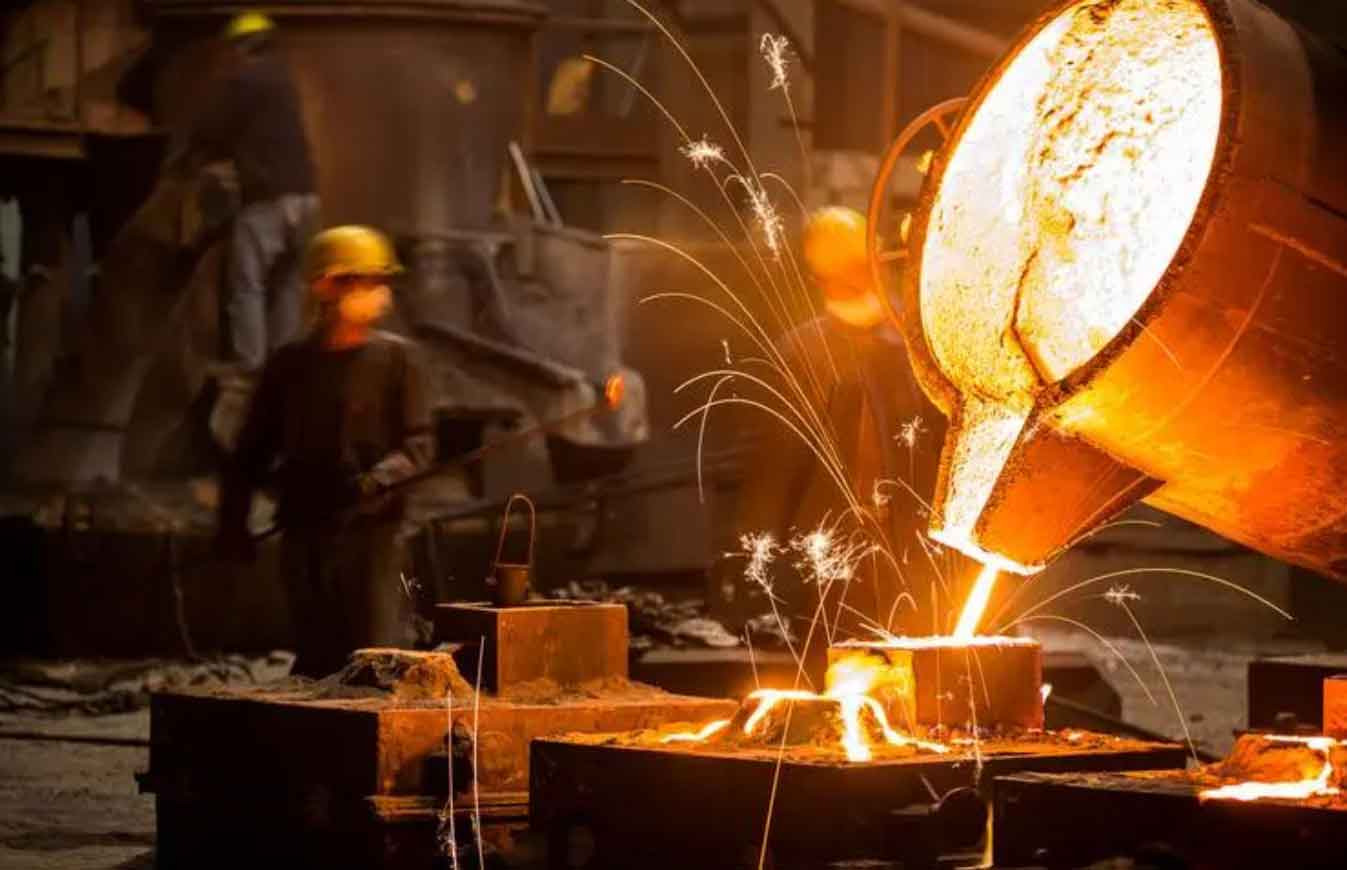
This image underscores the scale and sophistication of contemporary sand casting services, which integrate advanced materials like graphite-sand molds to achieve superior outcomes. By leveraging our findings on oxidation film structure, these services can optimize mold designs and processing parameters, leading to more efficient production cycles.
In addition to structural analysis, we explored the kinetic aspects of film formation. The rate of oxidation in magnesium alloys can be described by the parabolic rate law, which assumes diffusion-controlled growth:
$$ \frac{dx}{dt} = \frac{k_p}{x} $$
where \(x\) is the film thickness, \(t\) is time, and \(k_p\) is the parabolic rate constant. Integrating this gives:
$$ x^2 = 2k_p t + C $$
For our graphite-sand system, we observed a lower \(k_p\) compared to conventional sand casting, indicating slower oxidation due to carbon’s barrier effect. This aligns with the enhanced protective performance noted earlier. In sand casting services, controlling oxidation kinetics is essential for maintaining dimensional accuracy and surface finish, especially for intricate castings. Our research provides a framework for modeling these kinetics, enabling better process control in commercial sand casting services.
Another aspect worth discussing is the role of alloy composition. While our study focused on ZM5 magnesium alloy, other alloys may exhibit different oxidation behaviors. For example, additions of rare earth elements or zinc can alter the film’s composition and structure. In sand casting services, it is common to tailor alloy formulations to specific applications, and our findings suggest that combining such alloys with graphite-sand molds could yield synergistic effects. We plan to investigate this in future work, expanding the scope of sand casting services for diverse material systems.
To summarize the protective mechanism, the layered oxidation film in magnesium alloy graphite-sand casting comprises a surface layer rich in Mg(OH)2, an intermediate layer of MgO, and a transition layer with metallic magnesium. Carbon infiltration throughout these layers enhances density, forming a MgO+C composite that resists further oxidation. This structure is schematically represented below, along with key chemical reactions:
- Surface layer: \( \text{Mg} + 2\text{H}_2\text{O} \rightarrow \text{Mg(OH)}_2 + \text{H}_2 \) (in presence of moisture)
- Intermediate layer: \( 2\text{Mg} + \text{O}_2 \rightarrow 2\text{MgO} \) (direct oxidation)
- Carbon incorporation: \( \text{CO}_2 + 2\text{Mg} \rightarrow 2\text{MgO} + \text{C} \) (from mold atmosphere)
These reactions collectively contribute to a self-limiting oxidation process, which is highly desirable in sand casting services to minimize post-casting treatments. Moreover, the environmental benefits of avoiding toxic flame retardants align with sustainable manufacturing practices, making graphite-sand casting an attractive option for forward-thinking sand casting services.
In conclusion, our investigation into the surface oxidation film of magnesium alloys cast in graphite-sand molds reveals a complex, layered structure that offers excellent protective properties. Through XPS analysis, we have shown that the film consists primarily of MgO and Mg(OH)2, with significant carbon enrichment increasing its density and effectiveness. These insights have direct implications for sand casting services, enabling the production of high-quality magnesium castings without hazardous additives. As the demand for lightweight materials grows, sand casting services that incorporate such advanced techniques will play a pivotal role in various industries. We encourage further research to optimize these processes and expand the applications of magnesium alloys in sand casting services worldwide.
Looking ahead, there are several avenues for innovation in sand casting services based on our findings. For instance, developing hybrid molds that combine graphite with other refractory materials could further enhance oxidation resistance. Additionally, real-time monitoring of surface films during casting could improve quality control. As providers of sand casting services, we are committed to integrating scientific discoveries into practical solutions, driving progress in metal casting technology. By continuing to explore the interplay between mold materials and alloy surfaces, we can unlock new possibilities for efficient and eco-friendly sand casting services.
Finally, we acknowledge that sand casting services are evolving rapidly, with digital technologies and automation reshaping the industry. Our research contributes to this evolution by providing a deeper understanding of material interactions, which can inform the design of smart casting systems. For example, predictive models based on our oxidation film data could be used in simulation software to optimize casting parameters before physical trials, reducing waste and time-to-market. This aligns with the broader trend toward Industry 4.0 in sand casting services, where data-driven insights enhance productivity and sustainability. We believe that by embracing such interdisciplinary approaches, sand casting services will continue to thrive as a cornerstone of modern manufacturing.