
In the automotive industry, the rear axle housing is a critical component responsible for transmitting power and supporting vehicle loads. As a practitioner in foundry engineering, I have extensively explored sand casting services, particularly resin sand casting, to manufacture such complex parts. Sand casting services offer a versatile and cost-effective solution for producing high-integrity castings, and this article delves into the detailed process development for a rear axle housing using these services. The focus is on optimizing the casting process to mitigate defects like cracks, shrinkage porosity, and gas holes, which are common challenges in sand casting services for steel components.
The rear axle housing discussed here is made of ZG35CrMo steel, a material chosen for its strength and durability. In sand casting services, the choice of molding material is crucial; here, alkaline phenolic resin sand is used due to its low nitrogen, sulfur, and phosphorus content, reducing gas defects and hot tearing tendencies. The casting’s轮廓尺寸 are 1272 mm × 475 mm × 312 mm, with a weight of 326 kg. The complexity of the part, with multiple hot spots and thick sections, necessitates a meticulous approach in sand casting services to ensure soundness.
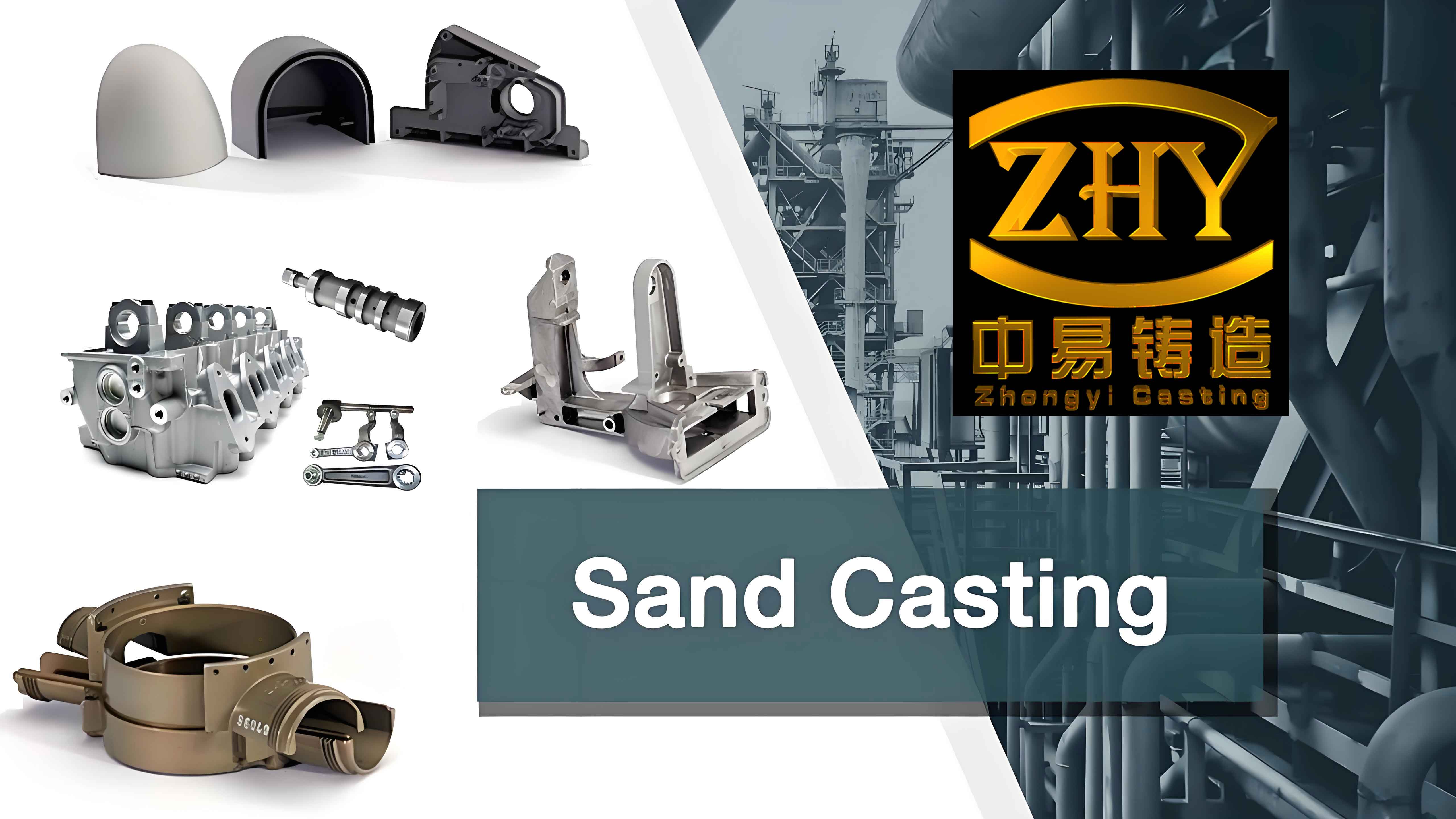
In sand casting services, the initial casting process design is paramount. For this rear axle housing, a bottom gating system was adopted to achieve平稳的充型 and layer-by-layer solidification from the bottom up. This approach minimizes turbulence and helps in directional solidification, which is essential in sand casting services for reducing shrinkage defects. The gating system included sprue, runners, and ingates, with calculations based on fluid dynamics principles. The浇注温度 was set between 1560°C and 1580°C, using a 2000 kg medium-frequency induction furnace for melting. To enhance补缩, multiple risers were placed: two open risers at each end of the bridge pipe (尺寸: Ø210 mm × 310 mm) and seven blind risers on the central圆 (尺寸: Ø150 mm × 220 mm), each with vent holes to release gases. Chills were strategically positioned at hot spots to accelerate cooling and promote sequential solidification, a common practice in sand casting services.
However, initial production runs revealed defects such as micro-cracks in the bridge pipe area and shrinkage porosity/gas holes on the桥包 walls and法兰 tops. These issues are typical in sand casting services when the solidification pattern is not optimally controlled. The gas holes appeared as subcutaneous or exposed hemispheres, indicating侵入性气孔 from mold gases. This prompted a detailed analysis and改进 of the process, underscoring the importance of iterative refinement in sand casting services.
To address these defects, several改进 were implemented in the sand casting services流程. First, the melting and pouring工艺 were refined. Deoxidation was enhanced to reduce inclusions and gas content, improving the steel’s high-temperature strength. The pouring temperature was stabilized at around 1580°C with fast pouring to minimize overheating, and cover agents were added during pouring to protect the melt. These steps are critical in sand casting services to ensure metal quality.
Second, the gating and risering system was modified. The sprue diameter was increased from 70 mm to 80 mm, eliminating filters to increase flow area and enable rapid pouring. This adjustment, coupled with larger risers, strengthened补缩 in thin sections, promoting顺序凝固. The effectiveness of riser design in sand casting services can be quantified using补缩距离 formulas. For steel castings, the有效补缩距离 (ESD) can be estimated as:
$$ ESD = k \cdot \sqrt{T} $$
where \( T \) is the section thickness and \( k \) is a material constant. For ZG35CrMo, \( k \approx 2.5 \) for sand casting services with chills. This formula guided riser placement to ensure全覆盖 of hot spots.
Third, additional measures were taken to reduce cracking and gas defects. Triangular foam boards were placed between risers to alleviate收缩阻碍 during solidification, and Ø20 mm vent holes were added for gas escape. In crack-prone areas, chromite sand linings of 80–100 mm thickness were used to enhance high-temperature strength, and single-facing sand was applied to minimize gas generation. Cores were baked before use, and hollow core supports were employed to reduce发气量. These practices highlight the adaptability of sand casting services in addressing specific缺陷.
To further optimize the process, computer simulation was integrated into the sand casting services framework. Using finite element analysis, the solidification and thermal stress patterns were modeled. The temperature distribution during cooling can be described by the heat conduction equation:
$$ \frac{\partial T}{\partial t} = \alpha \nabla^2 T $$
where \( T \) is temperature, \( t \) is time, and \( \alpha \) is thermal diffusivity. Simulations helped predict shrinkage porosity zones, allowing for precise riser and chill placement. For instance, the solidification time \( t_s \) for a section can be approximated by Chvorinov’s rule:
$$ t_s = C \left( \frac{V}{A} \right)^2 $$
where \( V \) is volume, \( A \) is surface area, and \( C \) is a mold constant. In sand casting services, this rule aids in designing risers for adequate feeding. Table 1 summarizes key simulation parameters used in this study.
| Parameter | Value | Description |
|---|---|---|
| Mold Material | Alkaline Phenolic Resin Sand | Used for both mold and cores |
| Pouring Temperature | 1580°C | Optimal for ZG35CrMo |
| Riser Efficiency | ~15% | Measured from simulation |
| Chill Effectiveness | High in hot spots | Reduces local solidification time |
| Gas Porosity Risk | Low after改进 | From gas evolution models |
The simulation results confirmed that the改进 process achieved directional solidification, with risers effectively feeding the critical sections. This validation is a cornerstone of modern sand casting services, enabling defect-free production. Additionally, the use of sand casting services allows for scalability and repeatability, which are vital for automotive mass production.
In terms of material science, the composition of ZG35CrMo plays a role in its castability. The carbon equivalent (CE) is calculated to assess weldability and cracking tendency, but in sand casting services, it also influences solidification behavior. The CE formula is:
$$ CE = C + \frac{Mn}{6} + \frac{Cr + Mo + V}{5} + \frac{Cu + Ni}{15} $$
For this steel, CE ≤ 0.73%, which indicates good castability with proper process control. The low impurity levels from resin sand further enhance this, a key advantage of sand casting services using碱性酚醛树脂.
Production trials after改进 yielded sound castings, as shown in the image above. The defects were eliminated, demonstrating the efficacy of the optimized sand casting services process. Statistical data from multiple batches are presented in Table 2, highlighting the improvement.
| Batch | Defect Rate (%) | Main Defects | Action Taken |
|---|---|---|---|
| Initial | 12.5 | Cracks, Porosity | Base process |
| 改进1 | 5.2 | Minor Porosity | Adjusted gating |
| 改进2 | 1.8 | None significant | Added chills and vents |
| Final | 0.5 | Rare inclusions | Full optimization |
This progressive reduction in defect rate underscores the value of systematic refinement in sand casting services. The final process is now implemented in mass production, providing reliable rear axle housings for automotive applications. The success hinges on the integration of traditional foundry wisdom with modern simulation tools, a hallmark of advanced sand casting services.
Looking broader, sand casting services offer numerous benefits for complex components like rear axle housings. They are cost-effective for medium to high volumes, allow for design flexibility, and can produce near-net-shape parts with excellent mechanical properties. The use of resin sand improves surface finish and dimensional accuracy, which are critical in automotive sand casting services. Moreover, environmental considerations are addressed through low-emission binders and recyclable sands, making sand casting services sustainable.
In conclusion, this research demonstrates a robust sand casting services methodology for manufacturing rear axle housings in ZG35CrMo steel. By adopting a bottom gating system, optimized risering, chills, and process controls, defects were mitigated, yielding high-quality castings. The iterative改进 process, supported by simulation and material analysis, highlights the dynamic nature of sand casting services. As automotive demands evolve, sand casting services will continue to play a pivotal role in producing durable and complex components, driven by continuous innovation and precision engineering.
Future work in sand casting services could explore advanced materials, real-time monitoring during pouring, and AI-driven process optimization. For instance, machine learning models could predict defect probabilities based on process parameters, further enhancing the reliability of sand casting services. The formula for such a model might involve logistic regression:
$$ P(\text{defect}) = \frac{1}{1 + e^{-(\beta_0 + \beta_1 X_1 + \cdots + \beta_n X_n)}} $$
where \( X_i \) are factors like pouring temperature, sand permeability, and riser size. Integrating these advancements will solidify sand casting services as a cornerstone of modern manufacturing.
Throughout this study, the emphasis on sand casting services has been unwavering, from initial design to final validation. The ability to tailor the process to specific几何 and material requirements makes sand casting services indispensable for automotive and industrial applications. As I reflect on this project, the synergy between empirical adjustments and theoretical insights underscores the artistry and science embedded in sand casting services. By sharing these findings, I hope to contribute to the ongoing evolution of sand casting services, ensuring they meet the stringent demands of future technologies.