
In the vast landscape of sand casting services, the selection and formulation of the molding aggregate is a foundational decision that dictates the quality, efficiency, and economic viability of the final cast component. Traditionally, a variety of binder systems such as clay-bonded sand, sodium silicate sand, hot-box sand, oil sand, and resin-bonded sands have been employed. Among these, no-bake resin sands have gained widespread acceptance globally for core and mold making due to their superior characteristics. Specifically, no-bake sands offer excellent compactability, high strength, dimensional accuracy, and good collapsibility, making them particularly suitable for the single-piece and small-batch production common in jobbing foundries and for complex castings in iron, steel, and non-ferrous alloys.
The evolution of manufacturing demands, especially the need for faster product development cycles, has led to the integration of advanced technologies like rapid prototyping with traditional casting. Rapid sand casting is one such hybrid process. It utilizes a stereolithography (SLA) or similar 3D-printed pattern to create a mold cavity rapidly, dramatically shortening lead times from design to functional metal part. This methodology is a boon for sand casting services focused on prototyping and low-volume production. However, this process imposes specific demands on the molding medium: the sand must possess exceptional flowability to capture fine details from the printed pattern, it must be easily compacted around often delicate patterns, and it must have a long work time (or “bench life”) to allow for thorough mixing and mold assembly without premature hardening. For these reasons, Phenolic Urethane No-Bake (PUNB) sand, often commercially known as Pep-set sand, has emerged as the preferred material for this application.
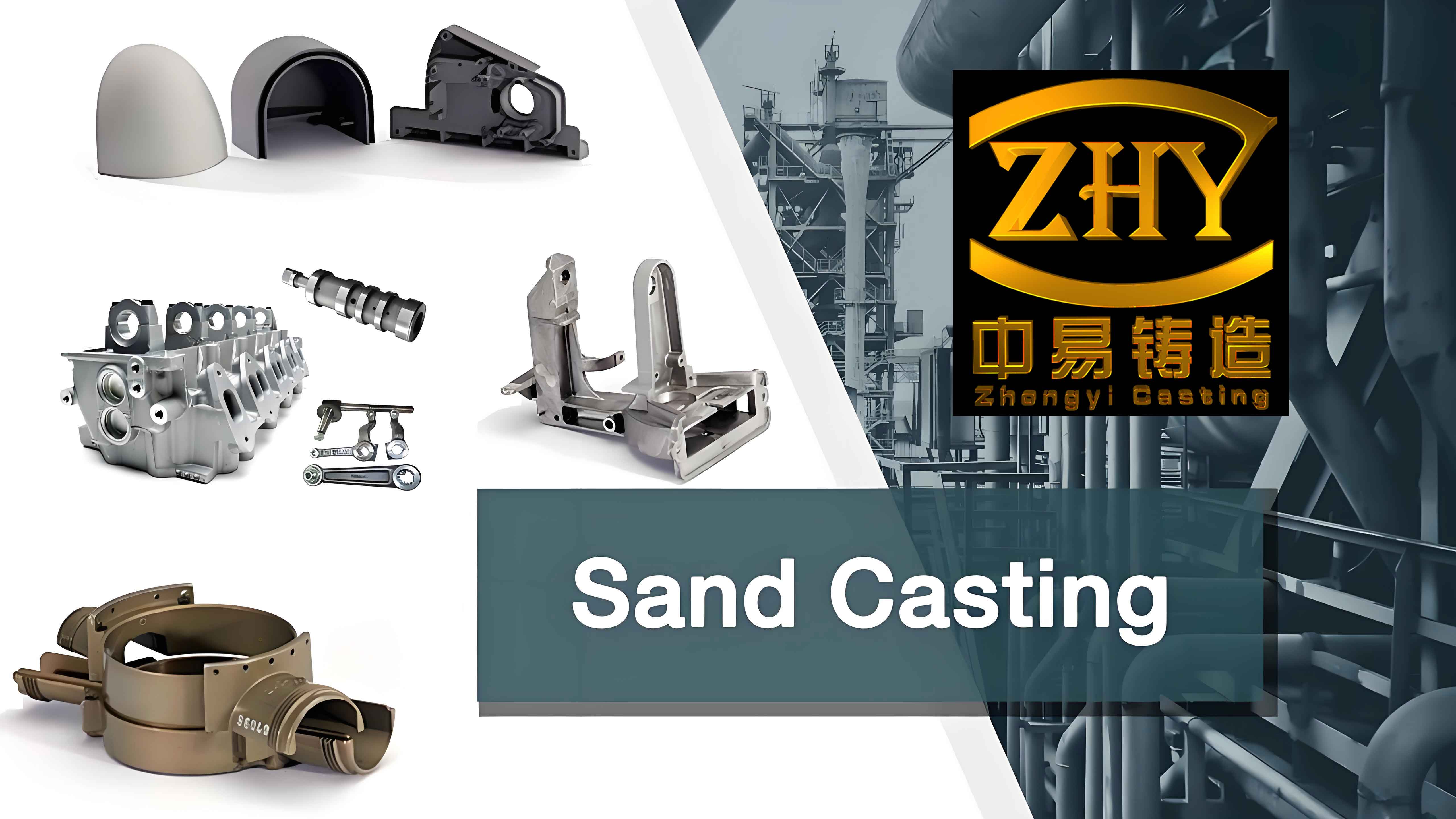
Based on extensive hands-on experience in applying this technology, particularly for casting engine components in Al-Mg alloys and gray iron, I will summarize the critical characteristics of PUNB sand and delve into a systematic investigation of its performance. The goal is to define the essential base sand properties and establish the optimal binder ratio to ensure consistent, high-quality results while preventing costly failures and material waste in sand casting services.
Characteristics of Phenolic Urethane No-Bake Binder System
The PUNB binder is a three-component system:
- Component I (Part I): A phenolic resin (alkali-catalyzed phenol-formaldehyde) characterized by the presence of hydroxyl (-OH) groups.
- Component II (Part II): A polyisocyanate, rich in reactive isocyanate (-NCO) groups.
- Component III: A liquid tertiary amine catalyst, which accelerates the curing reaction.
The curing mechanism is a polyurethane formation reaction, an addition polymerization without the production of by-products. The amine catalyst (Component III) facilitates the reaction between the -OH groups of the resin and the -NCO groups of the isocyanate, forming urethane linkages (-NH-CO-O-) that create a robust, cross-linked polymer network around the sand grains. The key advantages of this system for rapid sand casting services include:
- Long Work Time: The reaction kinetics allow for sufficient time to mix and mold the sand before handling strength develops.
- Through-Cure: The sand mass hardens uniformly from surface to core, ensuring consistent strength.
- No By-Product Generation: The absence of water vapor or other gases during curing minimizes the risk of gas-related casting defects.
- Versatility: It is suitable for a wide range of ferrous and non-ferrous alloys.
Critical Base Sand Properties for Optimal PUNB Performance
The performance of the final sand mold is not solely dependent on the binder; the base sand’s properties are equally crucial. Selecting the wrong base sand can lead to poor strength, surface finish defects, veining, and penetration. For reliable sand casting services using the PUNB process, the following base sand specifications must be meticulously controlled.
| Property | Target / Requirement | Rationale & Impact on Casting |
|---|---|---|
| 1. Chemical & Mineral Composition | High SiO₂ content: >97% (Steel), >85% (Iron), >75% (Non-ferrous). Minimal impurities (Alkalis, Fe₂O₃). | Determines refractoriness. Low SiO₂/high impurities lower sintering point, cause burn-on, and reduce sand reusability. |
| 2. Grain Shape | Angularity Factor (AF) < 1.3 (Rounded to Sub-angular grains preferred). | Rounded grains require less binder, offer better flowability and higher compacted strength. Angular grains increase binder demand, reduce permeability. |
| 3. Grain Size (Distribution) | Concentrated distribution in the 40-70 mesh (212-300 µm) range. Minimal fines (<140 mesh). | Optimizes surface finish vs. permeability. Too coarse: poor finish, low strength. Too fine: high binder demand, low permeability, risk of “necking” with excessive fines. |
| 4. Grain Fineness Number (GFN) | GFN tailored to alloy and section thickness. Typically 50-70 for general purpose. | Measures average grain size distribution. Higher GFN (finer average) gives better finish but can hurt permeability. Needs balancing. |
| 5. Moisture Content | < 0.2% (ideally < 0.1%) | Water reacts with isocyanate (Part II), consuming binder, retarding cure, reducing final strength, and promoting gas (CO₂) defects. |
| 6. Clay & Fines Content | < 0.5% (material < 20 µm). | |
| 7. Sand Temperature | Controlled between 20°C and 35°C (68°F – 95°F). | Fines have enormous surface area, absorbing binder and creating weak points. Hinder sand reclamation. Critical for consistent work/strip times. Rule of thumb: ΔT of +10°C halves strip time; -10°C doubles it. |
1. Chemical & Mineral Composition: The primary mineral is quartz (SiO₂). Its high melting point (1713°C) provides the necessary refractoriness. The required SiO₂ level scales with the pouring temperature of the alloy. Impurities like feldspars or iron oxides act as fluxes, lowering the sand’s sintering point and promoting metal penetration and burn-on defects, a critical concern in high-quality sand casting services.
2. Grain Shape: This is quantified by the Angularity Factor (AF). Rounded grains, such as those from natural wind-blown deposits, have an AF close to 1.1. They pack more efficiently, requiring less binder to coat their lower surface area and resulting in higher strength and better flowability—a key for replicating intricate SLA pattern details. Angular sands increase binder demand, reduce strength for a given binder level, and can impede flow into fine cavities.
3. & 4. Grain Size and Fineness: These interrelated properties are vital. A tight distribution (e.g., 40-70 mesh) is preferred over a wide graded sand. The presence of excessive fine grains (<140 mesh or 106 µm) is particularly detrimental. These “micro-fines” create “necking” between larger grains, forming fragile bridges that drastically weaken the mold. The Grain Fineness Number (GFN) provides a single value representing the average coarseness/fineness of the sand, calculated as:
$$GFN = \frac{\sum (p_n \cdot x_n)}{\sum p_n}$$
Where \(p_n\) is the percentage of sand retained on sieve \(n\), and \(x_n\) is the corresponding sieve multiplier factor (e.g., 3 for a #6 sieve, 5 for #12, …, 300 for the pan). A higher GFN indicates a finer sand. While a fine sand (high GFN) improves casting surface finish, it can compromise permeability. Therefore, selecting the optimal GFN is a compromise based on the alloy and casting geometry.
5. Moisture Content: This is perhaps the most critical process control parameter. The isocyanate component is highly reactive with water:
$$R-NCO + H_2O \rightarrow R-NH_2 + CO_2 \uparrow$$
This side reaction 1) wastes expensive binder, 2) produces gaseous CO₂ which can cause pinhole porosity in the casting, and 3) slows down the primary urethane-forming reaction. For consistent and reliable sand casting services, oven-drying silica sand to below 0.2% moisture is standard practice.
6. Clay & Fines Content: The clay fraction (<20 µm) has an exponentially high specific surface area. These particles act like sponges, absorbing resin without contributing to bond strength at grain contacts, leading to weak, friable molds. They also severely hinder the effectiveness of mechanical sand reclamation systems.
7. Sand Temperature: The phenolic urethane reaction is highly temperature-sensitive. Consistent sand temperature is essential for predictable work and strip times. In a foundry environment, sand temperature should be stabilized, often using sand coolers or heaters, to maintain it within the 20-35°C window for process control.
Experimental Determination of Optimal Binder Ratio
Even with ideal base sand, an incorrect ratio of Component I to Component II leads to sub-optimal strength and potential molding failure. To establish the minimum effective dosage and the optimal ratio for the rapid sand casting services context—where sufficient strength must be balanced against cost and ease of knockout—a designed experiment was conducted.
Experimental Conditions & Method:
- Base Sand: 40-70 mesh washed and dried silica sand, AF ~1.2, moisture <0.1%.
- Batch Size: 400g sand per mix.
- Mixing: Laboratory-scale paddle mixer, 2-minute mix time.
- Environment: Ambient temperature stabilized at ~20°C.
- Test Specimens: Standard “dog-bone” tensile specimens (e.g., AFS standard) were prepared.
- Cure Time: Strip time fixed at 40 minutes.
- Measurement: Tensile strength measured on a universal sand strength machine.
A two-factor, four-level full factorial design was employed to map the response surface. The factors and levels were:
| Factor | Level 1 | Level 2 | Level 3 | Level 4 |
|---|---|---|---|---|
| Component I (% of sand weight) | 0.625 | 1.25 | 1.875 | 2.50 |
| Component II (% of sand weight) | 0.625 | 1.25 | 1.875 | 2.50 |
Results & Analysis:
1. Minimum Binder Level Threshold: The experiment revealed a clear threshold effect. If either Component I or II was below approximately 0.8% by sand weight, even with an excess of the other component, the developed tensile strength after 40 minutes was critically low (<0.3 MPa), resulting in a mold that could not be handled or stripped without breaking. This indicates that a stoichiometric balance is required to form an adequate polymer network; a deficiency in one reactant cannot be fully compensated by an excess of the other.
2. Strength vs. Binder Addition Curves: The tensile strength data was plotted against the addition level of each component, holding the other at various constant levels. The trends were clear and consistent. The strength increases with binder addition but follows a law of diminishing returns. The initial slope of the curve is steep, indicating high efficiency of added binder at low levels. The slope flattens significantly after a certain point, meaning additional binder yields minimal strength gains. This point of inflection is key for economic and practical sand casting services.
- For Component I, the curve inflection occurs around 1.0% – 1.2% addition.
- For Component II, the curve inflection occurs around 1.1% – 1.3% addition.
This suggests that additions beyond these ranges are economically inefficient. Furthermore, for rapid prototyping work where the molds are often destroyed to remove the casting, excessively high strength (e.g., >1.8 MPa tensile) is counterproductive, making knockout difficult and unnecessarily increasing binder cost.
3. Optimal Ratio for Rapid Prototyping: Cross-analysis of the data matrix showed that a 1:1 ratio by weight of Component I to Component II consistently provided robust, predictable curing. At a total binder addition of 1.6% to 2.0% (i.e., 0.8% – 1.0% each of Part I and Part II), the achieved tensile strength ranged from 1.0 to 1.4 MPa. This strength level is perfectly suited for the demands of rapid sand casting services using SLA patterns: it is sufficient for handling, pouring, and resisting metal static pressure, yet it allows for relatively easy knockout and core removal after casting, minimizing effort and tool wear during finishing operations.
The relationship can be summarized by the following empirical model for strength (\(\sigma_t\)) near the optimum:
$$\sigma_t \approx k \cdot (C_I \cdot C_{II})^{0.5} \quad \text{for } C_I, C_{II} \geq 0.8\%$$
where \(C_I\) and \(C_{II}\) are the weight percentages of Component I and II, respectively, and \(k\) is a constant dependent on sand properties and curing conditions. This model highlights the multiplicative, synergistic effect of the two components.
Conclusion and Practical Implications for Sand Casting Services
The successful implementation of phenolic urethane no-bake sand in rapid prototyping and low-volume sand casting services hinges on a dual-focus approach: stringent control of base sand properties and precise optimization of the binder system.
First, the base sand is not merely an inert filler. Its chemical purity, grain shape, size distribution, moisture, fines content, and temperature are active variables that directly govern mold strength, casting surface finish, defect formation, and process stability. Investing in high-quality, consistently processed silica sand with rounded grains, low moisture, and low fines is not an expense but a necessity for reliable outcomes. It reduces binder consumption, improves casting quality, and enhances the efficiency of sand reclamation loops.
Second, the binder ratio must be engineered for the specific application. While the phenolic urethane system is forgiving, the “more is better” approach is wasteful and can be detrimental. For rapid sand casting services where the priority is a balance of speed, quality, and cost-effectiveness, the experimental evidence strongly supports a binder system addition of 1.6% to 2.0% total, applied in a 1:1 ratio by weight of Part I to Part II. This formulation reliably delivers a tensile strength in the 1.0-1.4 MPa range, which is the “sweet spot” for this application—providing ample integrity for casting while facilitating easy shakeout.
By adhering to these guidelines—meticulous sand preparation and optimized binder dosing—foundries and prototyping sand casting services can fully leverage the advantages of the PUNB process combined with rapid tooling. This synergy enables the production of high-integrity, dimensionally accurate cast prototypes and end-use parts in a fraction of the time required for conventional patternmaking, delivering a decisive competitive advantage in today’s fast-paced manufacturing environment.