
In the field of industrial manufacturing, sand casting remains a cornerstone technique for producing complex metal components due to its versatility, cost-effectiveness, and adaptability to various alloys. Among these, cast steel components, such as shells used in machinery, transportation, and heavy equipment, are critical for their strength and durability. However, the sand casting process for steel shell products often faces challenges like porosity, inclusions, incomplete filling, shrinkage cavities, and microporosity, which can compromise product quality and yield. As a practitioner and researcher in foundry technology, I have focused on optimizing the sand casting process for such components to enhance efficiency and reduce defects. In this comprehensive study, I explore the application of numerical simulation to design and refine casting processes, aiming to minimize defects in steel shell products while maintaining mechanical properties. The goal is to provide a robust framework that can be applied to similar sand casting products, thereby reducing trial-and-error cycles and improving economic outcomes. This article delves into the details of process design, simulation methodologies, parameter optimization, and validation, all from a first-person perspective as I conduct this investigation.
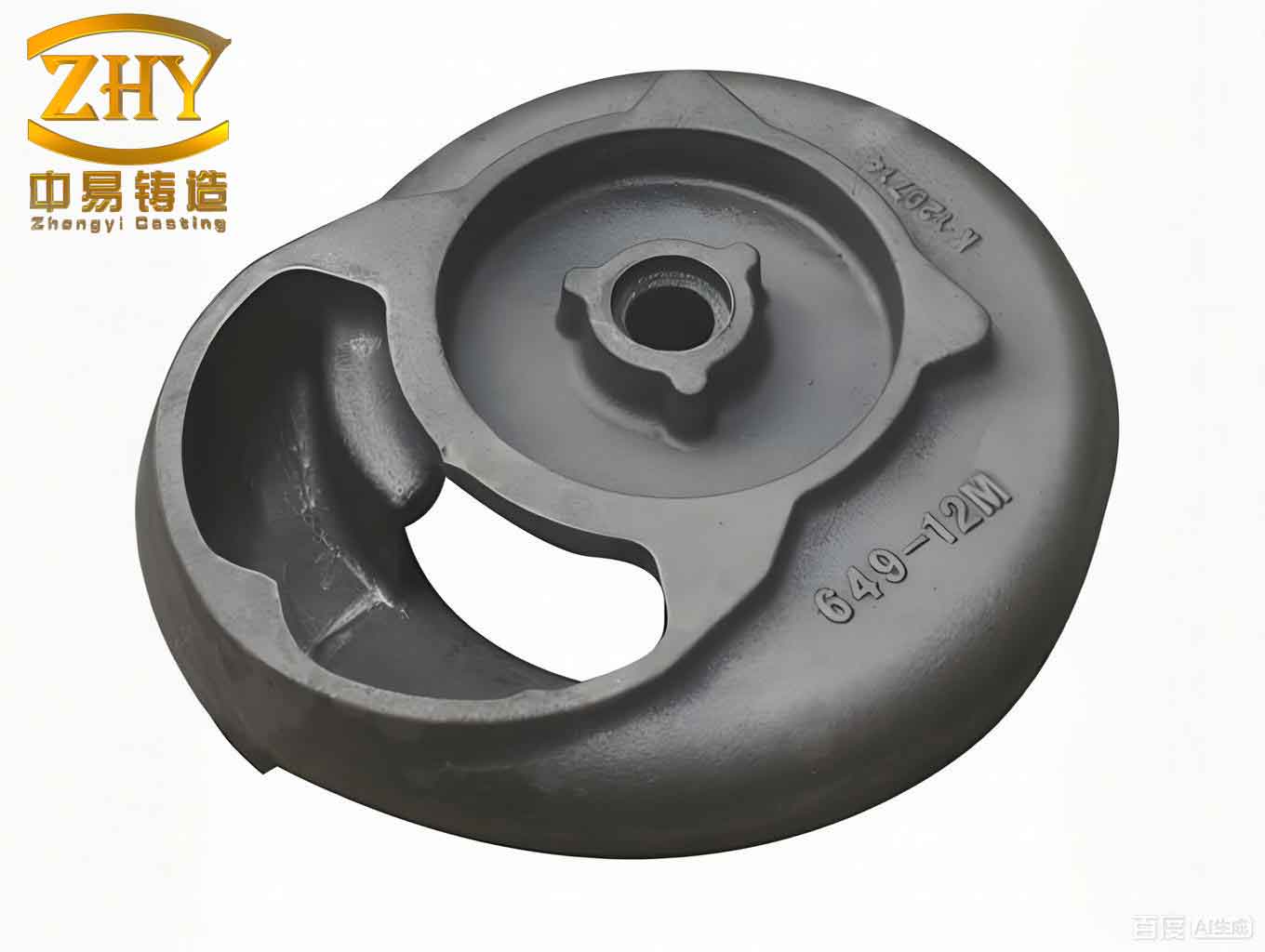
Sand casting products, especially those made from cast steel, are integral to sectors like mining, automotive, and wind energy. The shell casting examined here is a hollow component with internal surface quality requirements and varying wall thicknesses, typical of many sand casting products. To address the common defects, I initiated this study by designing multiple casting process schemes based on the shell’s geometry and material properties. The alloy used is ZG270-500, a medium-carbon cast steel with a composition tailored for good machinability and load-bearing capacity. The chemical composition is summarized in Table 1, which highlights the balance of elements essential for the desired microstructure and performance in sand casting products.
| Element | Content (wt%) |
|---|---|
| C | 0.4–0.5 |
| Mn | 0.7–0.8 |
| P | ≤0.04 |
| S | ≤0.05 |
| Fe | Balance |
The shell casting has a mass of approximately 392.93 kg and dimensions of 812 mm × 525 mm × 356 mm, with an average wall thickness of 8 mm. Such geometry necessitates careful gating system design to ensure proper filling and solidification. In my approach, I considered three distinct gating schemes to optimize the sand casting process for these steel shell products. The first scheme involved placing the ingates at the base of the casting, while the second positioned them along the cylindrical section. Both aimed for simplicity in molding, but preliminary simulations revealed shortcomings. The third scheme, developed after analysis, incorporated adjustments to ingate placement and the addition of risers to mitigate defects. The gating system was designed as an open type to promote smooth filling and reduce oxidation, common in sand casting products. Key calculations for pouring time and metal rise velocity were derived using fundamental foundry equations. The pouring time \( t \) is given by:
$$ t = \frac{G_L}{N n q} $$
where \( G_L \) is the mass of molten steel in the mold (450 kg), \( N \) is the number of ladles (1), \( n \) is the number of pouring holes per ladle (1), and \( q \) is the average pouring rate (27 kg/s). Substituting the values yields \( t = 16.7 \) s. The rise velocity \( v \) of molten steel in the mold is calculated as:
$$ v = \frac{C}{t} $$
with \( C \) being the height of the casting in the cavity (356 mm), resulting in \( v = 21.3 \) mm/s. These parameters ensure that the filling process aligns with best practices for sand casting products. The gating system cross-sectional areas were proportioned based on standard ratios for steel castings, with the sprue diameter set at 55 mm to facilitate adequate flow.
To evaluate the designed schemes, I employed numerical simulation software, specifically ProCAST, which is widely used for analyzing sand casting processes. The pre-processing phase involved importing the 3D model of the shell casting and meshing it with a grid size of 30 mm. This resulted in 12,722 surface elements and 45,906 volume elements, ensuring sufficient resolution for accurate simulation of sand casting products. I performed checks for mesh quality, addressing issues like cracks and overlaps, to guarantee reliable results. The material properties were assigned: the casting as Medium-Carbon AISI 1040 (equivalent to ZG270-500), and the mold and cores as silica sand. Boundary conditions included a mold temperature of 25°C, a heat transfer coefficient of 1000 W/(m²·K) between metal and sand, and gravity acceleration. The cooling method was set to COINCIDENT, typical for sand casting simulations. These settings mimic real-world conditions for producing sand casting products.
I simulated the filling and solidification processes for the initial two schemes with a pouring temperature of 1560°C and a pouring velocity of 1.6 m/s. The results, visualized through temperature fields and defect maps, indicated significant issues. In Scheme 1 and Scheme 2, incomplete filling occurred at the top of the cylindrical section, rendering the castings unsuitable. Additionally, porosity volumes were substantial: 28.23 cm³ for Scheme 1 and 50.58 cm³ for Scheme 2. These defects are critical in sand casting products as they can lead to failure under stress. Based on these findings, I developed a third scheme, which modified the ingate locations and incorporated four open risers—two cylindrical and two stepped—to enhance feeding and reduce shrinkage. The simulation of Scheme 3 showed improved filling patterns, with molten metal entering from the bottom and rising uniformly, minimizing gas entrapment. The temperature distribution during solidification indicated that thinner sections solidified first, while thicker areas, aided by risers, solidified later, reducing porosity in the final sand casting products.
The optimization of process parameters is crucial for enhancing the quality of sand casting products. In Scheme 3, I conducted an orthogonal experimental design to investigate the effects of pouring temperature and pouring velocity on porosity volume. The factors and levels are presented in Table 2, which serves as a guide for systematic testing in sand casting processes.
| Level | Pouring Temperature (°C) | Pouring Velocity (m/s) |
|---|---|---|
| 1 | 1530 | 1.3 |
| 2 | 1560 | 1.6 |
| 3 | 1590 | 1.9 |
Nine simulation runs were performed, and the porosity volumes were recorded. The results, along with range analysis, are summarized in Table 3. This table highlights the impact of each factor on defect formation in sand casting products, providing insights for process control.
| Run No. | Pouring Temperature (°C) | Pouring Velocity (m/s) | Porosity Volume (cm³) |
|---|---|---|---|
| 1 | 1530 | 1.3 | 2.368 |
| 2 | 1530 | 1.6 | 2.201 |
| 3 | 1530 | 1.9 | 2.503 |
| 4 | 1560 | 1.3 | 1.553 |
| 5 | 1560 | 1.6 | 1.416 |
| 6 | 1560 | 1.9 | 1.818 |
| 7 | 1590 | 1.3 | 1.984 |
| 8 | 1590 | 1.6 | 2.066 |
| 9 | 1590 | 1.9 | 2.206 |
The range analysis involved calculating the sums \( K_i \) for each factor level and the range \( R \). For pouring temperature, the values were \( K_1 = 7.072 \), \( K_2 = 4.782 \), \( K_3 = 6.256 \), yielding \( R = 2.290 \). For pouring velocity, \( K_1 = 5.905 \), \( K_2 = 5.683 \), \( K_3 = 6.527 \), with \( R = 0.844 \). The larger range for pouring temperature indicates it is the dominant factor influencing porosity in these sand casting products. The optimal combination was identified as a pouring temperature of 1560°C and a pouring velocity of 1.6 m/s, resulting in the smallest porosity volume of 1.416 cm³. This optimization underscores the importance of precise parameter control in manufacturing high-quality sand casting products.
Further analysis of the solidification process reveals the thermal dynamics at play. The temperature gradient \( \nabla T \) during solidification can be expressed as:
$$ \nabla T = \frac{\partial T}{\partial x} + \frac{\partial T}{\partial y} + \frac{\partial T}{\partial z} $$
where \( T \) is temperature and \( x, y, z \) are spatial coordinates. In sand casting products, a steeper gradient near risers promotes directional solidification, reducing shrinkage defects. The solidification time \( t_s \) for a section can be estimated using Chvorinov’s rule:
$$ t_s = k \left( \frac{V}{A} \right)^n $$
with \( V \) as volume, \( A \) as surface area, \( k \) as a mold constant, and \( n \) as an exponent typically around 2. For the shell casting, the modulus \( V/A \) varies across regions, influencing defect formation. By simulating these patterns, I could adjust riser designs to ensure longer solidification times in critical areas, a key strategy for optimizing sand casting products.
The mechanical properties of the final sand casting products are paramount. After implementing the optimized Scheme 3 with the recommended parameters, I validated the results through production trials. The yield rate improved from 81% to 96%, demonstrating the effectiveness of the simulation-driven approach. Microstructural examination confirmed a mix of austenite and ferrite, consistent with ZG270-500, and mechanical tests met the required standards for strength and toughness. These outcomes highlight how numerical simulation can enhance the reliability of sand casting products, reducing scrap and cost. The process optimization not only benefits this specific shell casting but also offers a template for other sand casting products with similar geometries, such as valve bodies or pump housings.
In discussing the broader implications, it is evident that sand casting products face inherent challenges due to the complexity of metal flow and solidification. The use of simulation software like ProCAST allows for virtual experimentation, which is less resource-intensive than physical trials. For instance, the filling process can be modeled using the Navier-Stokes equations for incompressible flow:
$$ \rho \left( \frac{\partial \mathbf{v}}{\partial t} + \mathbf{v} \cdot \nabla \mathbf{v} \right) = -\nabla p + \mu \nabla^2 \mathbf{v} + \mathbf{f} $$
where \( \rho \) is density, \( \mathbf{v} \) is velocity vector, \( p \) is pressure, \( \mu \) is dynamic viscosity, and \( \mathbf{f} \) represents body forces such as gravity. In sand casting products, these equations help predict turbulence and inclusion transport, enabling design adjustments to minimize defects. Additionally, the heat transfer during solidification is governed by the Fourier equation:
$$ \frac{\partial T}{\partial t} = \alpha \nabla^2 T $$
with \( \alpha \) as thermal diffusivity. By solving these equations numerically, I gained insights into temperature distributions that inform riser placement and cooling strategies for sand casting products.
The economic impact of optimizing sand casting products cannot be overstated. Reduced defect rates lead to lower material waste and fewer rejected parts, enhancing sustainability in manufacturing. Moreover, the shortened development cycle—from design to production—allows for faster time-to-market, a competitive advantage in industries reliant on sand casting products. For example, in the production of engine blocks or gearbox cases, similar simulation techniques can be applied to refine gating systems and process parameters. This scalability makes the methodology valuable for a wide range of sand casting products.
To further illustrate the parameter interactions, I developed a response surface model based on the orthogonal experiment data. The porosity volume \( P \) can be approximated as a function of pouring temperature \( T \) and pouring velocity \( v \):
$$ P(T, v) = a_0 + a_1 T + a_2 v + a_3 T^2 + a_4 v^2 + a_5 T v $$
where \( a_i \) are coefficients determined by regression analysis. For the sand casting products in this study, the model indicated a minimum near the optimal settings, confirming the robustness of the findings. Such mathematical models aid in fine-tuning processes for diverse sand casting products without exhaustive testing.
In conclusion, this study demonstrates the power of numerical simulation in optimizing the sand casting process for steel shell products. Through iterative design and parameter analysis, I achieved a significant reduction in defects, with porosity volume minimized to 1.416 cm³ under optimal conditions of 1560°C pouring temperature and 1.6 m/s pouring velocity. The third scheme, incorporating strategic riser placement, proved most effective, boosting the qualification rate to 96%. These results underscore the importance of integrating simulation tools into foundry practices to enhance the quality and efficiency of sand casting products. Future work could explore the effects of coating layers on mold surfaces or residual stresses in castings, further refining the process for complex sand casting products. By sharing this methodology, I aim to contribute to the advancement of sand casting technology, ensuring reliable and cost-effective production of critical components across industries.
Reflecting on this journey, I recognize that sand casting products will continue to evolve with advancements in simulation software and material science. The ability to predict and mitigate defects virtually not only saves resources but also fosters innovation in design. As I continue to investigate sand casting processes, I remain committed to improving the standards for sand casting products, leveraging tools like orthogonal experiments and thermal analysis to drive progress. This approach has broader applications, from automotive to aerospace, where sand casting products play a vital role. Ultimately, the fusion of traditional craftsmanship with modern technology paves the way for superior sand casting products that meet the demands of tomorrow’s challenges.