
The landscape of manufacturing, particularly for high-value sectors like aerospace, automotive, and defense, is characterized by an accelerating demand for complex, high-integrity sand casting products. These components often feature intricate internal passages, thin walls, and integrated functional geometries that push the boundaries of conventional foundry practices. Traditional methods for producing such sand casting products are frequently bottlenecked by the mold-making stage. The necessity for complex tooling, draft angles, and multi-part core assemblies not only increases lead times and costs but also limits design freedom and introduces potential sources of error during mold assembly, ultimately constraining innovation. The advent of Binder Jetting (BJ) 3D printing for sand molds and cores presents a paradigm shift, offering a direct digital manufacturing pathway that decouples geometric complexity from production difficulty. This article delves into the integrated methodology of combining sand 3D printing with simulation-driven process design to enable the rapid, cost-effective, and precise development and validation of advanced casting processes for complex sand casting products.
This exploration will detail the limitations of conventional methods, elucidate the fundamental principles and advantages of the binder jetting process, and present a framework for integrating numerical simulation with additive tooling. A detailed case study will demonstrate the practical application of this integrated approach. Finally, we will summarize the overarching benefits and future trajectory of this technology in revolutionizing the production of high-performance sand casting products.
The Limitations of Conventional Sand Casting for Complex Geometries
Traditional sand casting, while versatile, encounters significant challenges when applied to complex sand casting products. The process chain from design to a validated casting is often protracted and iterative.
- Tooling Dependency and Lead Time: The manufacture of patterns and core boxes is time-consuming and expensive. Any design change necessitates modifying or recreating this physical tooling, stifling rapid prototyping and design optimization.
- Geometric Constraints: The need for draft angles for pattern withdrawal and the practical limits on core complexity and assemblability restrict the geometries that can be reliably produced. Features like undercuts, zero-draft surfaces, and deeply recessed cavities become major obstacles.
- Assembly-Induced Variability: Complex internal cavities require multiple core pieces to be assembled within the mold. Misalignment, core shift, and variation in glue or sealing joints can lead to dimensional inaccuracies, finning, and increased scrap rates for critical sand casting products.
The table below summarizes a comparative analysis of key parameters between conventional and 3D printed sand mold processes for a typical complex component.
| Parameter | Conventional Sand Casting | 3D Printed Sand Casting |
|---|---|---|
| Lead Time (First Article) | 3-8 weeks | 3-7 days |
| Tooling Cost | High (Patterns & Core Boxes) | Very Low to None |
| Design Change Flexibility | Low (Requires new tooling) | Very High (Digital file update) |
| Geometric Freedom | Limited by draft & core assembly | Very High (No draft, monolithic cores) |
| Dimensional Consistency | Subject to assembly variation | High (Deterministic printing) |
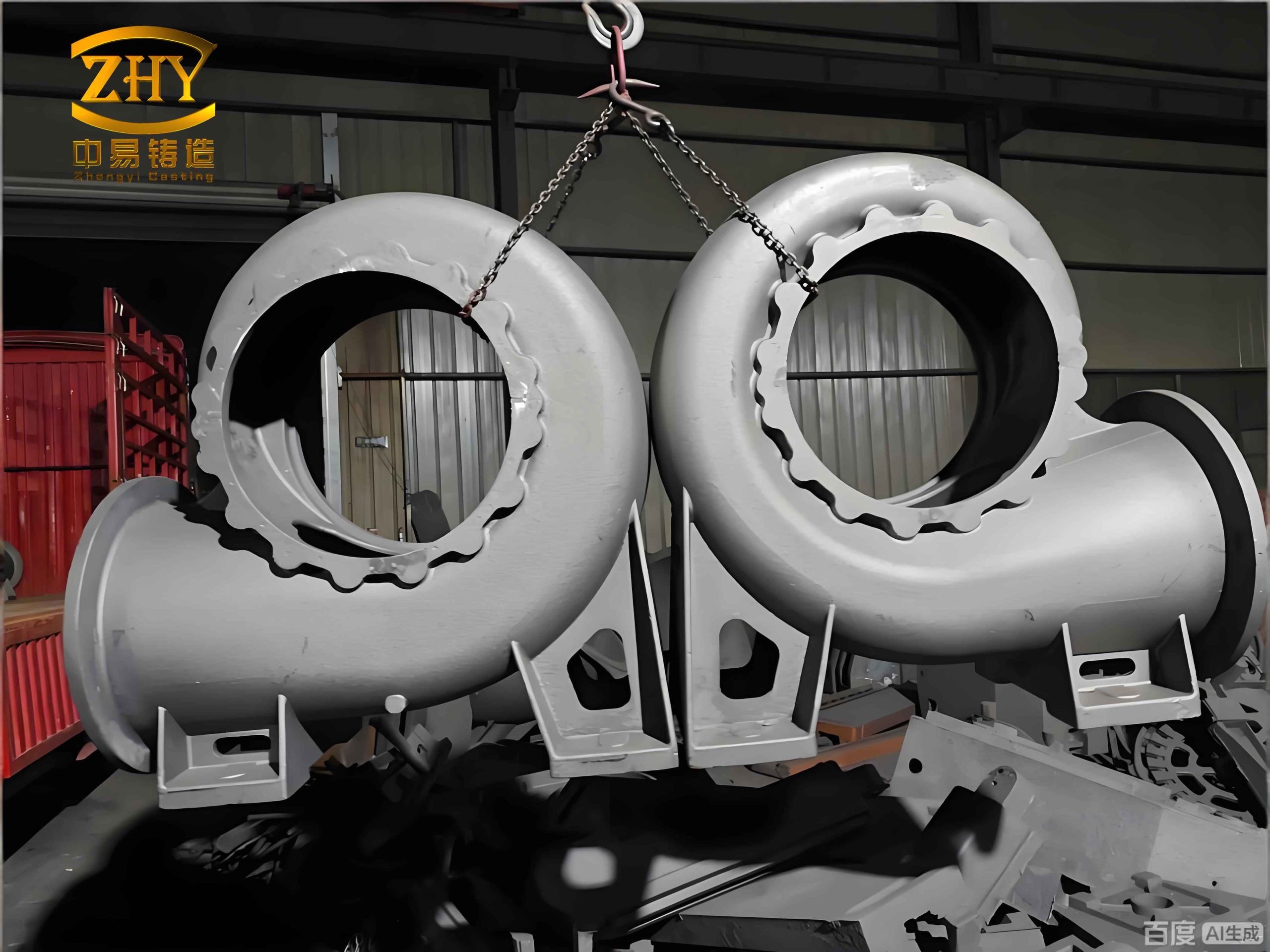
Binder Jetting 3D Printing Technology for Sand Molds and Cores
Binder Jetting is an additive manufacturing process that builds sand molds and cores layer-by-layer directly from a digital 3D model without the need for patterns. The fundamental process can be described as follows:
- A thin layer of silica sand (or other refractory aggregate) is spread across a build platform.
- An inkjet print head selectively deposits a liquid binding agent (typically a furan resin) onto the sand layer according to the cross-sectional geometry of the part.
- The binder reacts with a catalyst (often integrated into the sand pre-mix or co-printed) to initiate polymerization, bonding the sand grains locally.
- The build platform lowers, a new layer of sand is spread, and the process repeats until the complete sand mold or core assembly is fabricated.
The quality and performance of the final sand casting products are intrinsically linked to the properties of the printed sand molds, which are controlled by key process parameters:
| Process Parameter | Typical Range / Value | Primary Influence on Mold Properties |
|---|---|---|
| Resin Binder Content | 1.0 – 1.8 % (by weight of sand) | Tensile strength, brittleness, gas evolution |
| Layer Thickness | 0.28 – 0.35 mm | Surface finish, dimensional accuracy, build speed |
| Print Resolution (Drop Size) | 100 – 200 dpi | Feature definition, edge acuity |
| Saturation Level | Controlled by print speed & dosing | In-depth curing, green strength, moisture resistance |
| Post-Print Curing | Time & Temperature profile | Final tensile strength, gas evolution during pour |
The polymerization of the furan binder can be modeled as a temperature-dependent reaction. The curing process, essential for developing handling strength, can be described by an Arrhenius-type relationship for the degree of cure \(\alpha\):
$$\frac{d\alpha}{dt} = A \exp\left(-\frac{E_a}{RT}\right) (1-\alpha)^n$$
where \(A\) is the pre-exponential factor, \(E_a\) is the activation energy, \(R\) is the gas constant, \(T\) is the absolute temperature, and \(n\) is the reaction order. The final tensile strength \(\sigma_t\) of the printed sand is a function of the binder content \(C_b\) and the degree of cure \(\alpha\):
$$\sigma_t \propto C_b^m \cdot \alpha$$
where \(m\) is an empirical constant typically between 1 and 2. Optimizing these parameters is crucial for achieving molds that are strong enough for handling and casting yet collapsible for shakeout and produce minimal gas to avoid defects in the sand casting products.
Integrated Simulation-Driven Process Design
The synergy between sand 3D printing and numerical simulation is a cornerstone of modern casting process development. Simulation software (e.g., MAGMASOFT®, ProCAST, FLOW-3D® CAST) allows for the virtual testing of gating, feeding, and cooling systems before any physical mold is printed.
The governing equations for fluid flow and heat transfer during mold filling and solidification are solved numerically. The Navier-Stokes equations for incompressible flow with a free surface are used for filling:
$$\rho \left( \frac{\partial \mathbf{v}}{\partial t} + \mathbf{v} \cdot \nabla \mathbf{v} \right) = -\nabla p + \mu \nabla^2 \mathbf{v} + \rho \mathbf{g}$$
$$\nabla \cdot \mathbf{v} = 0$$
where \(\rho\) is density, \(\mathbf{v}\) is velocity, \(p\) is pressure, \(\mu\) is dynamic viscosity, and \(\mathbf{g}\) is gravity. The energy equation including latent heat release during solidification is:
$$\rho c_p \frac{\partial T}{\partial t} + \rho c_p \mathbf{v} \cdot \nabla T = \nabla \cdot (k \nabla T) + \rho L \frac{\partial f_s}{\partial t}$$
where \(c_p\) is specific heat, \(T\) is temperature, \(k\) is thermal conductivity, \(L\) is latent heat, and \(f_s\) is solid fraction.
For low-pressure casting of thin-walled sand casting products, simulation is used to:
- Design Conformal Gating: The flexibility of 3D printing allows for gating systems that follow the contour of the part. Simulation verifies that such systems provide uniform, progressive filling with minimal velocity and turbulence to prevent oxide entrainment. The pressure profile in low-pressure casting can be integrated:
$$P(t) = P_0 + \rho g h(t) + \frac{1}{2}\rho v(t)^2$$
where \(P_0\) is the applied furnace pressure, \(h(t)\) is the metal height in the riser tube, and \(v(t)\) is the metal velocity. - Optimize Feeding and Cooling: Simulation predicts thermal gradients and solidification sequences. This guides the placement of virtual feeders (which can be printed integrally) and chills to ensure directional solidification towards the feeder, minimizing shrinkage porosity in critical sections of the sand casting products.
- Predict Defect Formation: Algorithms based on thermal parameters (like the Niyama criterion \(G/\sqrt{\dot{T}}\), where \(G\) is temperature gradient and \(\dot{T}\) is cooling rate) are used to predict areas susceptible to microporosity.
This virtual validation loop dramatically reduces the number of physical trials required, compressing the development timeline for new sand casting products.
Application Case Study: Complex Thin-Walled Shell Casting
To illustrate the integrated approach, consider the development of a low-pressure cast aluminum alloy (e.g., A356/357 or equivalent ZL114A) shell component. The key characteristics and process steps are outlined below.
Component Challenge: The shell features a large, thin-walled main body (3-16 mm wall thickness), an intricate internal cavity with varying cross-section, and an array of thin, radially arranged internal fins/webs connecting the inner and outer walls. Traditional manufacture would require a complex, multi-part core assembly for the internal cavity and fins, posing significant risks for misalignment and core breakage.
Process Design & Simulation:
- Gating Design: A conformal, annular sprue and runner system with multiple tangential and vertical ingates was designed to envelope the shell. The ingate areas were sized using a pressurized system ratio (e.g., \(\Sigma A_{sprue} : \Sigma A_{runner} : \Sigma A_{ingate} = 1.0 : 1.2 : 1.5\) for low pressure) to ensure controlled filling.
- Simulation Outcome: Filling simulation showed a smooth, progressive upward fill with front velocities below 0.5 m/s, minimizing turbulence. Solidification simulation confirmed that thermal gradients could be managed with strategic chill placement on thick sections (like flanges), promoting directional solidification towards the integrated feeder in the central sprue. Predicted shrinkage was isolated to the feeder area.
Mold Fabrication via 3D Printing: The entire mold assembly was decomposed into a minimal number of parts for printing, post-processing, and assembly. Crucially, the entire internal core—including the complex cavity and all fins—was printed as a single, monolithic piece. This eliminated core assembly errors and guaranteed the dimensional fidelity of the most challenging features. The mold was printed using the optimized parameters from the table in Section 2.
| Aspect | Parameter / Outcome |
|---|---|
| Alloy | A356 (T6 Heat Treated) |
| Casting Method | Low-Pressure Sand Casting |
| Pouring Temperature | ~735 °C |
| Final Mold Strength | > 2.0 MPa Tensile |
| Cast Part Weight | ~14 kg |
| Dimensional Accuracy | CT6 per ISO 8062 (Avg. ±0.9 mm) |
| X-Ray Inspection Result | No major shrinkage/porosity in critical areas |
Results and Metallurgical Analysis: The cast component showed complete filling of thin sections and excellent surface finish. Dimensional inspection confirmed high accuracy. Metallographic analysis of samples taken from the casting wall revealed a refined microstructure. The Secondary Dendrite Arm Spacing (SDAS), a key indicator of local solidification time and cooling rate, was measured. For the 3D printed sand mold, the SDAS (\(\lambda_2\)) was approximately 20-22 µm, comparable to or slightly finer than typical traditional sand casts for similar sections, indicating a favorable thermal response. Mechanical testing of specimens extracted from the casting body showed properties meeting or exceeding specifications:
$$ \sigma_{UTS} \approx 328 \, \text{MPa}, \quad \varepsilon_f \approx 7.2\% $$
Fractography revealed a predominantly ductile fracture mode with a high population of dimples, corroborating the good elongation values. This demonstrates that sand casting products produced via 3D printed molds can achieve the metallurgical quality and mechanical performance required for demanding applications.
Advantages and Future Outlook
The integration of binder jetting 3D printing with simulation-based design offers transformative advantages for producing complex sand casting products:
- Radical Lead Time Compression: Development cycles can be reduced by over 70%, enabling rapid prototyping and faster time-to-market.
- Unprecedented Design Freedom: Geometric constraints are lifted, allowing for performance-optimized designs with conformal cooling, integrated structures, and topology-optimized lightweight parts.
- Cost-Effective Low-Volume Production: The elimination of hard tooling makes small-batch and customized production of high-value sand casting products economically viable.
- Enhanced Quality and Consistency: Monolithic cores eliminate assembly variation, and simulation-guided design minimizes casting defects, leading to higher first-pass yield.
The future of this field points towards further integration and sophistication:
- Intelligent Process Optimization: Combining simulation, real-time process monitoring, and machine learning algorithms to auto-correct and optimize printing and casting parameters.
- Advanced Materials: Development of specialized sands and binders for improved thermal properties, collapsibility, and surface finish to further enhance the quality of sand casting products.
- Fully Digital Foundries: End-to-end digital threads from CAD to finished casting, incorporating automated mold handling, pouring, and finishing for agile manufacturing.
In conclusion, the fusion of sand binder jetting 3D printing and computational simulation is not merely an incremental improvement but a fundamental enabler for the next generation of complex, high-performance sand casting products. It empowers engineers to transcend traditional manufacturing limitations, fostering innovation and agility in an increasingly demanding global market.