
In my extensive engagement with foundry operations, I have consistently observed that the production of centrifugal pump impellers through sand casting presents unique challenges, particularly for small-batch or custom orders. The quality of these sand casting products directly dictates the performance and efficiency of the final pump assembly. Traditional sand casting techniques, while versatile, often fall short in achieving high yield rates for complex geometries like impellers. This narrative details my analytical journey and the subsequent工艺 innovations developed to significantly elevate the qualification rate of离心泵叶轮铸件. The core of this improvement lies in reimagining gating, feeding, and venting systems specifically tailored for different impeller sizes within the砂型铸造 framework.
The fundamental principle of sand casting involves creating a mold cavity from compacted sand around a pattern. After removing the pattern, molten metal is poured into the cavity. Upon solidification, the sand mold is broken away to reveal the casting. For sand casting products like pump impellers, which feature intricate internal流道 (flow channels), cores made of bonded sand are essential. The choice of core sand and its properties—such as strength, permeability, and collapsibility—becomes critical. The traditional approach for impellers positioned the inlet face downward during pouring. While this facilitated feeding via risers placed atop the最后凝固 regions, it inherently created a problematic bottom-venting scheme for gases evolved from the core. This often led to gas entrapment and porosity, a primary defect causing high rejection rates, sometimes exceeding 30% in my initial observations.
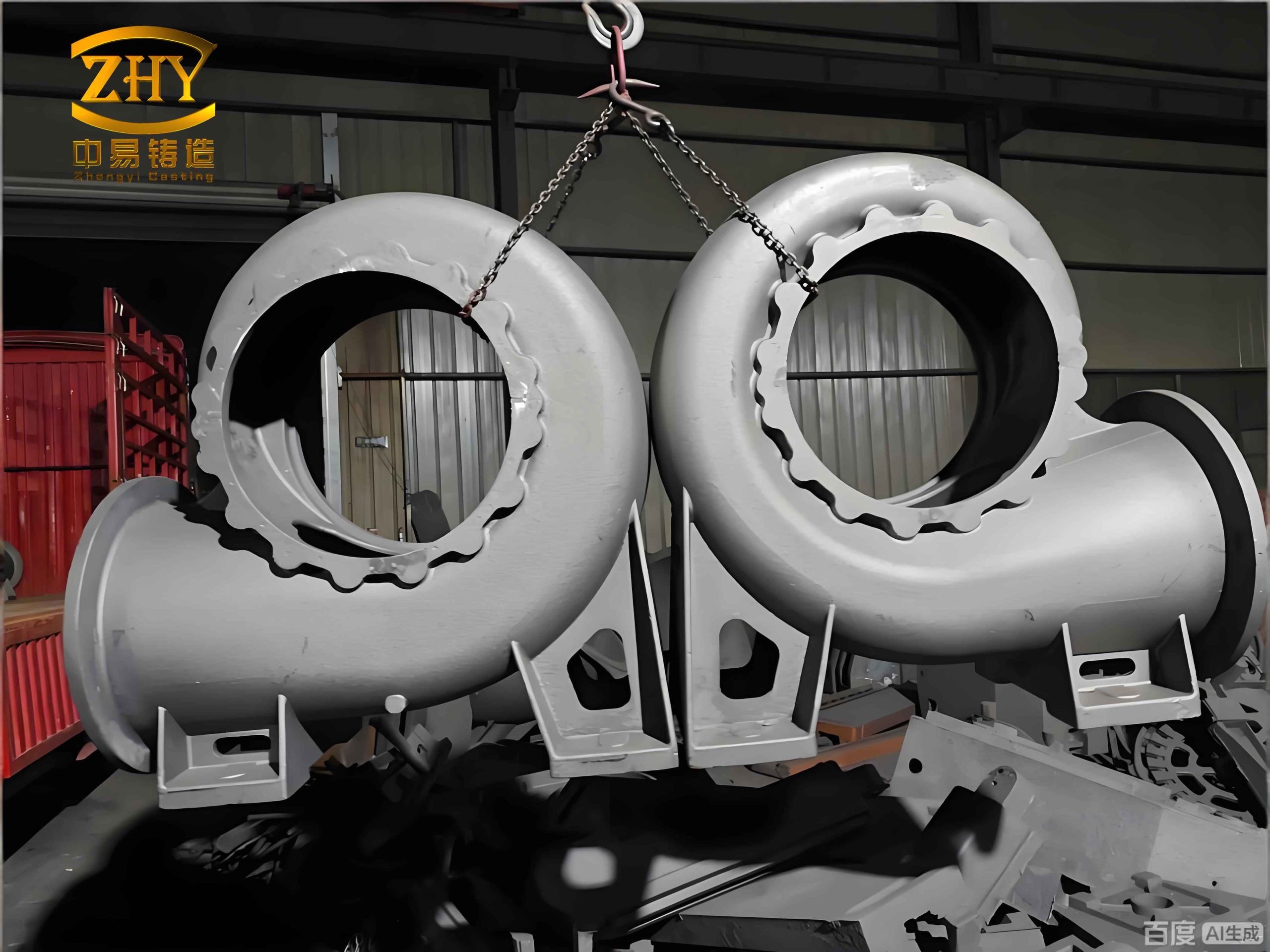
The genesis of the改进 was a focused attack on the venting problem. From first principles, the upward movement of gases is more natural and reliable than forcing them downward through the mold. Therefore, the most significant shift was inverting the casting orientation. By positioning the impeller with its inlet face upward, the venting for core gases transformed into a top-venting system. This simple yet profound change required complementary modifications to the entire工艺 system to ensure effective feeding and core stability. The改进 process was not monolithic; it branched into three distinct methodologies catering to general, small, and large impellers, acknowledging that one size does not fit all in producing high-quality sand casting products.
For general impellers of moderate size, the new工艺 is elegantly systematic. The mold is prepared with the impeller’s inlet facing upward. The core forming the internal流道 is now typically made from clay-bonded sand for better green strength and cost-effectiveness, rather than the traditional oil sand. The key to successful gas evacuation lies in creating an assured escape path. During mold assembly, a ring of compressed asbestos-free ceramic fiber rope is placed between the core print at the impeller’s outlet periphery and the upper mold cope. This creates a permeable buffer zone. Multiple vent holes are punched in the cope above this area. During pouring, gases from the heated core travel upward, are channeled through the fiber rope间隙, and are efficiently expelled via the vent holes. Feeding is addressed by extending the hub’s central bore upward into a generous riser, ensuring directional solidification toward this feed metal source. The solidification time for a section can be approximated using Chvorinov’s rule:
$$ t = C_m \left( \frac{V}{A} \right)^n $$
where \( t \) is the solidification time, \( V \) is the volume of the casting section, \( A \) is its surface area through which heat is extracted, \( C_m \) is the mold constant, and \( n \) is an exponent usually close to 2. For the hub section, a high \( V/A \) ratio indicates it will solidify last, justifying the placement of the riser directly above it. Implementing this工艺 for general impellers boosted the qualification rate to over 98%, a testament to the effectiveness of top venting combined with科学的 feeding design.
Small impellers, with outlet widths as narrow as 5-6 mm, introduced a new constraint: insufficient space to accommodate the venting rope without compromising the casting’s dimensional integrity. My solution was to integrate the feeding and venting functions creatively. The machining allowance on the impeller’s wear ring (阻水圈) upper face was strategically increased by 10 mm. This extra height provided the necessary space to position two oval-shaped side risers on the wear ring circumference. These risers serve a dual purpose: they supply feed metal to the entire thin-walled impeller structure during solidification, and their connection to the mold cavity creates a larger interface area with the core. This enlarged interface allows for effective placement of the venting rope around the core print, solving the spatial challenge. The feeding requirement for such small castings can be modeled by considering the required feed metal volume \( V_f \), which is a function of the alloy’s shrinkage rate \( \varepsilon \), and the thermal center’s volume \( V_c \):
$$ V_f = \varepsilon \cdot V_c $$
The design ensures the combined volume of the two oval risers satisfies \( V_{risers} > V_f \). This modified工艺 for small impellers has yielded near-perfect qualification rates, demonstrating that adaptive design is key for specialized sand casting products.
Large impellers, such as those for dredge pumps with diameters approaching 500 mm, presented the challenge of core stability. The long, curved blades made it extremely difficult to withdraw the pattern without collapsing the delicate油砂 core used in traditional methods. Analysis revealed that for these large流道,清砂 was not a significant issue due to ample access. Therefore, the core material was switched from oil sand to robust clay-bonded sand. Clay-sand cores possess significantly higher green strength, allowing them to withstand the stripping forces during pattern removal. While their collapsibility is poorer, the large流道 dimensions allow for mechanical cleaning if necessary. The feeding system for these large castings is more complex, often requiring multiple risers. The required riser neck diameter \( d_n \) to ensure feed metal flow can be related to the thermal dynamics of the section it feeds. A simplified model considers the solidification time of the riser \( t_r \) must be greater than that of the casting \( t_c \):
$$ \left( \frac{V}{A} \right)_r > \left( \frac{V}{A} \right)_c $$
For large impellers, several risers are calculated and placed on the hub and sometimes on thick sections of the shroud to create controlled solidification paths. This approach successfully resolved the core collapse issue, enabling the production of massive, sound impeller castings via砂型铸造.
The table below summarizes the key distinctions between the traditional and the three improved工艺 for different impeller categories, highlighting the targeted solutions for each challenge.
| Impeller Category | Traditional Process | Improved Process | Key Modification | Primary Issue Solved | Core Material | Venting Direction |
|---|---|---|---|---|---|---|
| General | Inlet down,油砂 core, bottom vent | Inlet up, clay-sand core, top vent with rope seal | Orientation inversion, vent path design | Gas porosity | Clay-bonded Sand | Upward |
| Small | Inlet down,油砂 core, insufficient vent space | Inlet up, enlarged wear ring allowance, side risers | Integrated riser/vent design on wear ring | Vent path feasibility | Clay-bonded Sand | Upward |
| Large | Inlet down,油砂 core, core collapse risk | Inlet up, clay-sand core, multiple risers | High-strength core material | Core stability during pattern draw | Clay-bonded Sand | Upward |
Beyond the工艺 layout, the properties of the molding and core sands are paramount. The permeability \( k \) of the sand, which dictates its ability to allow gases to pass, is a critical parameter. It can be characterized by empirical relationships involving grain size and packing. While exact formulas are complex, the importance of high permeability in the mold cope and vent channels is undisputed for producing sound sand casting products. Furthermore, the feeding efficiency is not just about riser size but also about the gradient established. The temperature gradient \( G \) and solidification rate \( R \) influence the microstructure; an ideal feeding condition promotes directional solidification, which minimizes shrinkage porosity. The thermal gradient can be expressed as:
$$ G = \frac{\Delta T}{\Delta x} $$
where \( \Delta T \) is the temperature difference over distance \( \Delta x \) within the casting. A steep gradient from the casting body toward the riser is desirable.
Another critical aspect is the calculation of the required number of vent holes. While often determined empirically, a basic model relates the total vent area \( A_v \) to the volumetric gas generation rate \( \dot{Q}_g \) and the permissible pressure buildup \( \Delta P \) in the mold, approximated by Darcy’s law for flow through porous media:
$$ \dot{Q}_g \approx \frac{k A_v \Delta P}{\mu L} $$
where \( \mu \) is the gas viscosity and \( L \) is the effective vent path length. This underscores why top venting is superior: the path length \( L \) is minimized compared to bottom venting.
The following table provides a comparative analysis of defect rates and process characteristics before and after implementing the improved sand casting methodologies across various production runs for these specialized sand casting products.
| Process Stage | Defect Rate (Porosity) | Typical Core Material | Venting Efficiency (Qualitative) | Ease of Core Stripping | Overall Yield |
|---|---|---|---|---|---|
| Traditional (All Sizes) | ~30% | Oil Sand | Low (Bottom Vent) | Difficult for Large | ~70% |
| Improved General | <2% | Clay-bonded Sand | High (Top Vent) | Good | >98% |
| Improved Small | ~0.5% | Clay-bonded Sand | High (Integrated) | Good | >99% |
| Improved Large | <3% | Clay-bonded Sand | High (Top Vent) | Excellent | >97% |
The economic and qualitative impact of these improvements is substantial. By systematically addressing the root causes of failure—gas porosity via venting redesign, feeding insufficiency via riser optimization, and core instability via material substitution—the reliability of砂型铸造 for complex pump impellers has been transformed. These methodologies underscore a fundamental principle in foundry engineering: successful production of high-integrity sand casting products requires a holistic view that integrates fluid dynamics, heat transfer, and material science into practical工艺 design. Each impeller category demanded a unique combination of these principles, proving that flexibility and deep process understanding are as important as the initial concept. The continued refinement of these techniques, potentially incorporating simulation software for solidification and gas flow modeling, promises even greater consistency and efficiency in the future for manufacturing critical components like centrifugal pump impellers through the versatile sand casting route.