
As someone deeply involved in the foundry industry, I have witnessed firsthand the challenges and transformations in sand casting. Traditional sand casting methods rely on molds and patterns to form products through assembly and pouring. For multi-variety, small-batch production, the cost of mold manufacturing is typically high, and since production volumes are low, the per-unit cost escalates, impacting profit margins. Moreover, such products often follow project-based procurement models, where identical items are ordered for specific projects, and once the project ends, demand dwindles. This leads to obsolete molds accumulating over time, occupying space and causing intangible asset waste. With societal shifts toward customization and personalization, mass production is declining, replaced by bespoke demands—even single-item customizations. This trend forces traditional foundries to innovate, grappling with how to ensure rapid prototyping, overcome existing hurdles, and undergo转型升级. The advent of 3D printing technology serendipitously aligns with these needs, offering a promising solution for sand casting products.
In this analysis, I will explore the application prospects of 3D printing in sand casting, drawing from industry experiences and case studies. The focus will be on how this technology addresses core issues while enhancing efficiency and sustainability. Throughout, I will emphasize the impact on sand casting products, as these are central to the industry’s evolution.
Challenges Facing the Sand Casting Industry
The sand casting sector, as a foundational industrial pillar, faces multifaceted problems that hinder progress. From my perspective, these can be categorized into three main areas: self-development, product structure, and environmental policies. Each aspect directly affects the production of sand casting products.
Self-Development Issues
Sand casting is traditionally labor-intensive, with harsh working conditions and significant environmental pollution. As economies advance, workers increasingly prioritize health-friendly environments and skilled roles, leading to a talent shortage in foundries. Young people are reluctant to enter this field, exacerbating recruitment and retention difficulties. Improving labor conditions has become imperative, but traditional methods offer limited solutions. For instance, manual molding and core-making are dusty and physically demanding, deterring workforce engagement. This threatens the sustainability of producing high-quality sand casting products.
Product Structure Demands
Customization and个性化 are now mainstream, driving a shift toward multi-variety, small-batch production. Demand-pull models are essential for business sustainability, yet high inventory and management costs reduce capital efficiency and flexibility. Sand casting products, such as those for automotive or machinery sectors, require rapid adaptation to design changes. Traditional approaches, dependent on fixed molds, struggle with this agility. The need for转型 is urgent to enhance competitiveness, especially for complex sand casting products that demand precision and quick turnaround.
Environmental Policy Pressures
Growing ecological awareness and stringent环保 policies have placed foundries under scrutiny. While companies invest in pollution control equipment, this reactive approach is costly and often inadequate. Traditional sand casting processes generate emissions and waste, conflicting with清洁 casting goals. Sustainable development mandates greener methods, prompting a reevaluation of how sand casting products are manufactured.
| Challenge Category | Description | Impact on Sand Casting Products |
|---|---|---|
| Self-Development | Labor-intensive processes, poor working conditions, talent shortage | Reduced production capacity and quality for sand casting products |
| Product Structure | Rise of customization, small-batch demands, inventory inefficiencies | Increased costs and delays in delivering sand casting products |
| Environmental Policy | Strict regulations, pollution control costs, sustainability requirements | Higher operational expenses and compliance risks for sand casting products |
These challenges underscore the necessity for innovation. In my view, 3D printing emerges as a transformative tool, particularly for sand casting products that require complexity and speed.
Advantages of 3D Printing Technology in Sand Casting
3D printing, as an additive manufacturing technique, offers distinct benefits for sand casting. From my experience, its application can revolutionize how we produce sand casting products. Below, I detail these advantages, supported by analytical insights.
Labor Environment Improvement
Traditional molding and core-making are dusty and strenuous, but 3D printing automates these steps within enclosed chambers. The process uses specialized sand materials and binders that minimize dust emission, significantly enhancing workplace conditions. This not only attracts skilled workers but also ensures consistent quality for sand casting products. For example, the reduction in manual handling decreases human error, leading to more reliable outputs.
Cost and Time Efficiency
By eliminating模具, 3D printing slashes upfront costs and storage needs. The direct digital-to-physical process allows rapid prototyping, crucial for sand casting products in试制 phases. The cost savings can be expressed mathematically. Let \( C_m \) represent the traditional mold cost, which includes design, fabrication, and maintenance. For 3D printing, the cost \( C_{3D} \) comprises material, energy, and machine usage. The savings per unit for sand casting products is:
$$ \text{Savings} = C_m – C_{3D} $$
Typically, \( C_m \) ranges from $20,000 to $50,000 per mold, while \( C_{3D} \) for small batches is lower, often under $5,000. Moreover, production cycle reduction is substantial. Traditional time \( T_t \) includes mold making \( T_{mm} \) and casting \( T_c \), whereas 3D printing time \( T_{3D} \) involves design \( T_d \) and printing \( T_p \). The efficiency gain is:
$$ \Delta T = T_t – T_{3D} = (T_{mm} + T_c) – (T_d + T_p) $$
In practice, \( \Delta T \) can be weeks, accelerating time-to-market for sand casting products.
Precision and Design Flexibility
3D printing enables precise control over砂型 dimensions, reducing加工余量 and minimizing material waste. The digital nature allows easy modifications, fostering innovation in sand casting products. For instance, complex geometries like thin walls or internal channels become feasible without mold constraints. This enhances the quality and functionality of sand casting products, meeting high standards in industries like automotive and aerospace.
Sustainability Benefits
3D printing promotes cleaner production by reducing waste and emissions. The enclosed process limits binder挥发, aligning with environmental policies. This sustainable approach is vital for the long-term viability of sand casting products.
| Aspect | Traditional Sand Casting | 3D Printing in Sand Casting | Impact on Sand Casting Products |
|---|---|---|---|
| Mold Requirement | Physical molds needed (costly and time-consuming) | No molds; digital files direct printing | Lower cost and faster iteration for sand casting products |
| Production Cycle | Weeks to months due to mold making | Days to weeks, depending on design complexity | Rapid prototyping and delivery of sand casting products |
| Design Flexibility | Limited by moldability and draft angles | High; complex shapes achievable without constraints | Enhanced innovation and customization in sand casting products |
| Environmental Impact | High waste and emissions from molding processes | Reduced waste and enclosed binder application | Greener production of sand casting products |
| Labor Dependency | High skill required for manual operations | Automated, reducing reliance on skilled labor | Consistent quality and lower labor costs for sand casting products |
These advantages position 3D printing as a key enabler for advancing sand casting products. In my work, I have seen these benefits materialize in various applications, which I will discuss next.
Application Case Studies
To illustrate the practical impact, I will present three case studies where 3D printing transformed the production of sand casting products. Each example highlights specific challenges and how 3D printing addressed them.
Case 1: Automotive Steering Gear Component
This sand casting product, weighing 34 kg, features complex structures and multiple machining holes. Traditionally, investment casting was used, involving wax patterning, shell building, and dewaxing—a process taking 3-5 repetitions over weeks. For试制, time is critical. With 3D printing, the workflow simplified to digital design, sand printing, metal pouring, and post-processing. The cycle shortened dramatically, and digital files allowed quick modifications. This expedites the development of sand casting products for automotive applications, ensuring faster validation and reduced costs.
The efficiency can be quantified. If traditional investment casting time is \( T_i = 4 \) weeks and 3D printing time is \( T_{3D} = 1 \) week, the time savings for producing such sand casting products is:
$$ \text{Time Savings} = T_i – T_{3D} = 3 \text{ weeks} $$
This accelerates the entire product lifecycle for sand casting products.
Case 2: Engine Component
This sand casting product demands high dimensional accuracy and lightweight designs for energy efficiency. Traditional methods used metal patterns and hot core boxes, with mold costs reaching $20,000-$50,000 and lead times of two months. Once molds are made, changes are difficult. During R&D, 3D printing offers rapid response, high precision, and low cost for small batches. It allows iterative testing until the design is finalized, after which metal molds can be commissioned for mass production. This approach slashes R&D expenses and speeds up innovation for sand casting products.
Consider the cost equation. For \( n \) design iterations, traditional cost \( C_t = n \times C_m \), while 3D printing cost \( C_{3D} = n \times C_p \), where \( C_p \) is the per-print cost. Since \( C_p \ll C_m \), the savings for developing sand casting products are substantial:
$$ \text{R&D Savings} = n(C_m – C_p) $$
For \( n=5 \) iterations, savings can exceed $100,000, benefiting sand casting products in high-stakes industries.
Case 3: Motor Housing Component
This sand casting product incorporates numerous散热片—40 to 100 pieces, each 100-120 mm deep, 4-8 mm thick, with 5-6 mm gaps. Traditional production required individual模块 for each fin, assembled manually in砂型, a tedious and error-prone process. 3D printing enables monolithic printing of fin arrays, ensuring dimensional integrity and avoiding damage during demolding. This improves quality and reduces scrap rates for such sand casting products.
The quality enhancement can be modeled. Let \( Q_t \) be the traditional yield rate (e.g., 80% due to fin damage) and \( Q_{3D} \) be the 3D printing yield rate (e.g., 95%). The improvement in output for sand casting products is:
$$ \Delta Q = Q_{3D} – Q_t = 15\% $$
This translates to fewer rejects and higher efficiency in producing sand casting products.
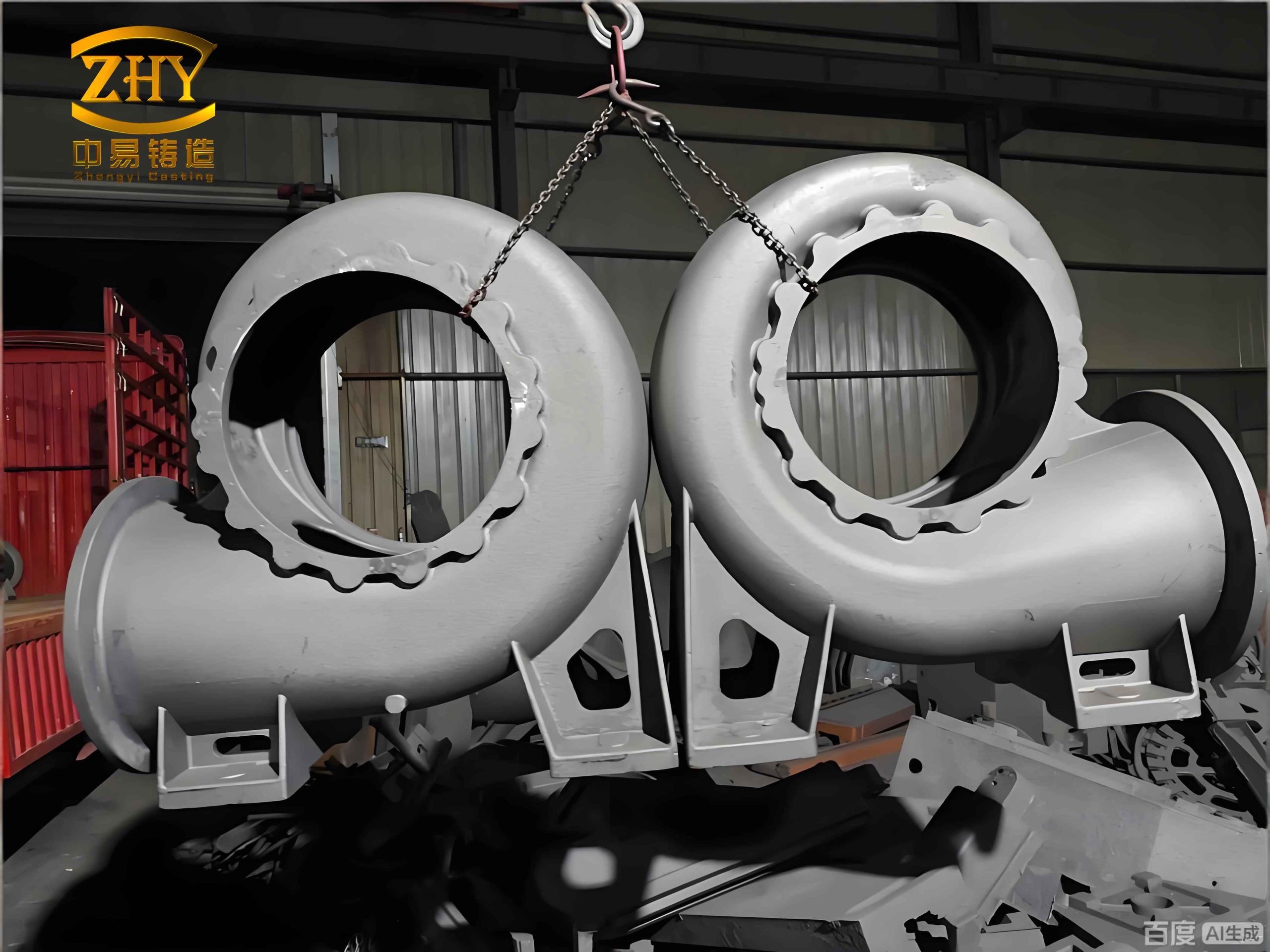
The image above exemplifies modern sand casting products, showcasing the complexity achievable with advanced techniques. In my experience, such visual aids help stakeholders appreciate the potential of 3D printing.
| Case Study | Traditional Method | 3D Printing Method | Key Benefits for Sand Casting Products |
|---|---|---|---|
| Automotive Steering Gear | Investment casting (weeks-long cycle) | Direct sand printing (days-long cycle) | Faster prototyping and lower costs for sand casting products |
| Engine Component | Metal patterns and core boxes (high mold cost) | Digital sand printing (low iteration cost) | Reduced R&D expense and enhanced design flexibility for sand casting products |
| Motor Housing | Manual fin module assembly (high defect rate) | Monolithic fin printing (high precision) | Improved quality and reduced waste in sand casting products |
These cases demonstrate that 3D printing is not just a theoretical upgrade but a practical solution for diverse sand casting products. The technology streamlines processes, cuts costs, and boosts innovation.
Mathematical Modeling for Efficiency Gains
To further substantiate the advantages, I have developed mathematical models that quantify the impact on sand casting products. These formulas help in strategic decision-making.
Cost-Benefit Analysis
The total cost \( TC \) for producing sand casting products can be broken down. For traditional methods, \( TC_t = F_m + V_t \cdot Q \), where \( F_m \) is fixed mold cost, \( V_t \) is variable cost per unit, and \( Q \) is quantity. For 3D printing, \( TC_{3D} = F_{3D} + V_{3D} \cdot Q \), with \( F_{3D} \) as machine depreciation and \( V_{3D} \) as material and energy costs. The breakeven quantity \( Q^* \) where 3D printing becomes cheaper is:
$$ Q^* = \frac{F_m – F_{3D}}{V_{3D} – V_t} $$
Given \( F_m \gg F_{3D} \) and \( V_{3D} \approx V_t \) for small \( Q \), 3D printing is optimal for low-volume sand casting products, aligning with customization trends.
Production Time Optimization
Time efficiency is crucial for sand casting products. Let \( L_t \) be the lead time for traditional methods, including design \( L_d \), mold making \( L_m \), and casting \( L_c \). For 3D printing, \( L_{3D} = L_d + L_p \), where \( L_p \) is printing time. The percentage reduction in lead time for sand casting products is:
$$ \text{Reduction} = \frac{L_t – L_{3D}}{L_t} \times 100\% $$
Assuming \( L_t = 8 \) weeks and \( L_{3D} = 2 \) weeks, the reduction is 75%, significantly accelerating the supply chain for sand casting products.
Quality and Yield Improvement
Defect rates affect the economics of sand casting products. Traditional yield \( Y_t \) is often lower due to manual errors, while 3D printing yield \( Y_{3D} \) is higher due to automation. The net benefit \( NB \) in terms of usable units for sand casting products is:
$$ NB = Q \cdot (Y_{3D} – Y_t) \cdot P $$
where \( P \) is the price per unit. For \( Q=100 \), \( Y_t=0.85 \), \( Y_{3D}=0.95 \), and \( P=\$1000 \), \( NB = 100 \cdot 0.1 \cdot 1000 = \$10,000 \), highlighting the value of 3D printing for sand casting products.
These models underscore the tangible benefits of adopting 3D printing for sand casting products. They provide a framework for evaluating investments in this technology.
Future Prospects and Conclusion
Looking ahead, I believe 3D printing will revolutionize sand casting, especially for complex, high-quality, and small-batch sand casting products. The technology simplifies molding processes, shortens production cycles, reduces costs, and enhances R&D efficiency. Its applicability spans automotive, aerospace, machinery, and beyond, where precision and speed are paramount.
From my perspective, widespread adoption hinges on continued technological advancements, such as faster printing speeds and broader material compatibility. However, the current trajectory is promising. As environmental regulations tighten and customization demands grow, 3D printing offers a sustainable and agile pathway for producing sand casting products.
In conclusion, the integration of 3D printing into sand casting is not merely an incremental improvement but a paradigm shift. It addresses longstanding industry challenges while unlocking new possibilities for innovation. For anyone involved in manufacturing sand casting products, embracing this technology is key to staying competitive in an evolving landscape. The future of sand casting lies in digitalization, and 3D printing is at its forefront, poised to transform how we conceive and create sand casting products for generations to come.