
In the production of sand casting products, particularly complex engine cylinder blocks using green sand molds, appearance sand adhesion is a prevalent defect that compromises surface quality. This issue not only increases cleaning workload and adds unnecessary weight to sand casting products but can also lead to scrap in severe cases. As a casting engineer, I have extensively studied this problem in our foundry operations. Here, I share insights into the causes and effective measures to mitigate appearance sand adhesion in green sand casting, focusing on practical adjustments to process parameters.
Green sand molding is widely adopted for manufacturing sand casting products due to its adaptability to various molding methods, cost-effectiveness, and suitability for different base sands. However, it suffers from poor flowability and filling performance. In our facility, we utilize a German HWS static pressure molding line with an upper mold compaction pressure of 45 MPa and a lower mold pressure of 50 MPa. The sand system comprises approximately 350 tons of reclaimed sand, with a continuous production cycle of about 15 hours. Sand mixing is performed in a 3-ton mixer to prepare 2.3 tons of molding sand, with online monitoring of sand properties. Additives include bentonite, coal dust, and necessary dust powder, while the lower mold is sprayed with an alcohol-based coating at 30° Bé. The cylinder block sand casting products are poured horizontally with two pieces per mold, made of HT250 cast iron, with a mold sand weight of 630 kg, core weight of 68 kg, poured iron weight of 120 kg, and pouring temperature ranging from 1410 to 1450°C.
The sand mixing process is critical for ensuring the quality of sand casting products. Below is a summary of our sand mixing procedure:
| Mixing Time Point (seconds) | Mixing Step | Mixing Content |
|---|---|---|
| 0 | Weighing | Weigh new sand, reclaimed sand, bentonite, coal dust, and dust powder in specific proportions. |
| 0-10 | Adding Raw Materials | Simultaneously add reclaimed sand and water for initial mixing. |
| 10-50 | Adding Additives | Incorporate bentonite and coal dust for further mixing. |
| 50-130 | Wet Mixing | Continue mixing to homogenize the sand. |
| 130 | Sampling and Inspection | After reaching the set mixing time, sample for online testing of compactability and green compression strength. Adjust water addition if necessary until specifications are met. |
| 130 to Discharge | Discharge | Once qualified, discharge the sand after approximately 180 seconds of total mixing. |
Appearance sand adhesion in green sand casting primarily manifests as mechanical penetration, where molten metal infiltrates the gaps between sand grains, sintering and adhering to the surface of sand casting products. This can range from a thin layer removable by rough cleaning to a thick layer requiring multiple precision cleaning cycles. Mechanical sand adhesion arises from three scenarios: static pressure driving metal infiltration, dynamic pressure from molten metal flow, and explosive pressure due to gas evolution during pouring. The latter, often termed “gas explosion sand adhesion,” is particularly relevant in our case.
In our production of sand casting products, we observed that as the sand system aged and equipment deteriorated, sand adhesion became more pronounced, especially for heavier and more complex parts. The initial sand system had efficient dust removal, leading to low fines content and clay levels, resulting in high permeability. Additionally, the use of 50/100 mesh sand for cores increased the average grain size (AFS value around 50-53), and accumulated dead clay in the reclaimed sand system exacerbated the issue. Pouring via bottom gating further contributed, as the molten iron continuously eroded the sand near the gates, where temperature and pressure were highest.
The core mechanism behind gas explosion sand adhesion involves excessive gas pressure within the mold cavity. This pressure stems from three sources: gas generation from resin and coatings in cores, gas from coal dust and moisture in the sand, and inherent gases in the mold. Coal dust and moisture are key contributors; coal dust, as a hydrocarbon, combusts vigorously upon contact with molten iron, producing large volumes of gas, while moisture rapidly expands into superheated steam at high temperatures. The instantaneous gas generation can cause sudden pressure spikes, leading to explosive phenomena like “fire coughing” or “shooting” during pouring. This is mathematically represented by the ideal gas law applied to mold conditions:
$$ PV = nRT $$
Where \( P \) is the gas pressure, \( V \) is the cavity volume, \( n \) is the number of moles of gas, \( R \) is the gas constant, and \( T \) is the temperature. During pouring, \( n \) increases rapidly due to decomposition and combustion, while \( V \) decreases as the cavity fills, causing \( P \) to rise sharply. If the gas cannot escape efficiently, it may ignite incompletely, resulting in explosions that force metal into sand gaps.
Defect analysis revealed that during pouring, as the cavity neared filling, gas pressure peaked, causing violent reactions at the risers or parting lines. The lower mold endured increased iron pressure and冲刷力, while the upper mold suffered from splashing iron and sand erosion due to explosions. Consequently, both upper and lower surfaces of sand casting products exhibited severe sand adhesion, particularly in intricate concave areas, as shown in the following illustration:
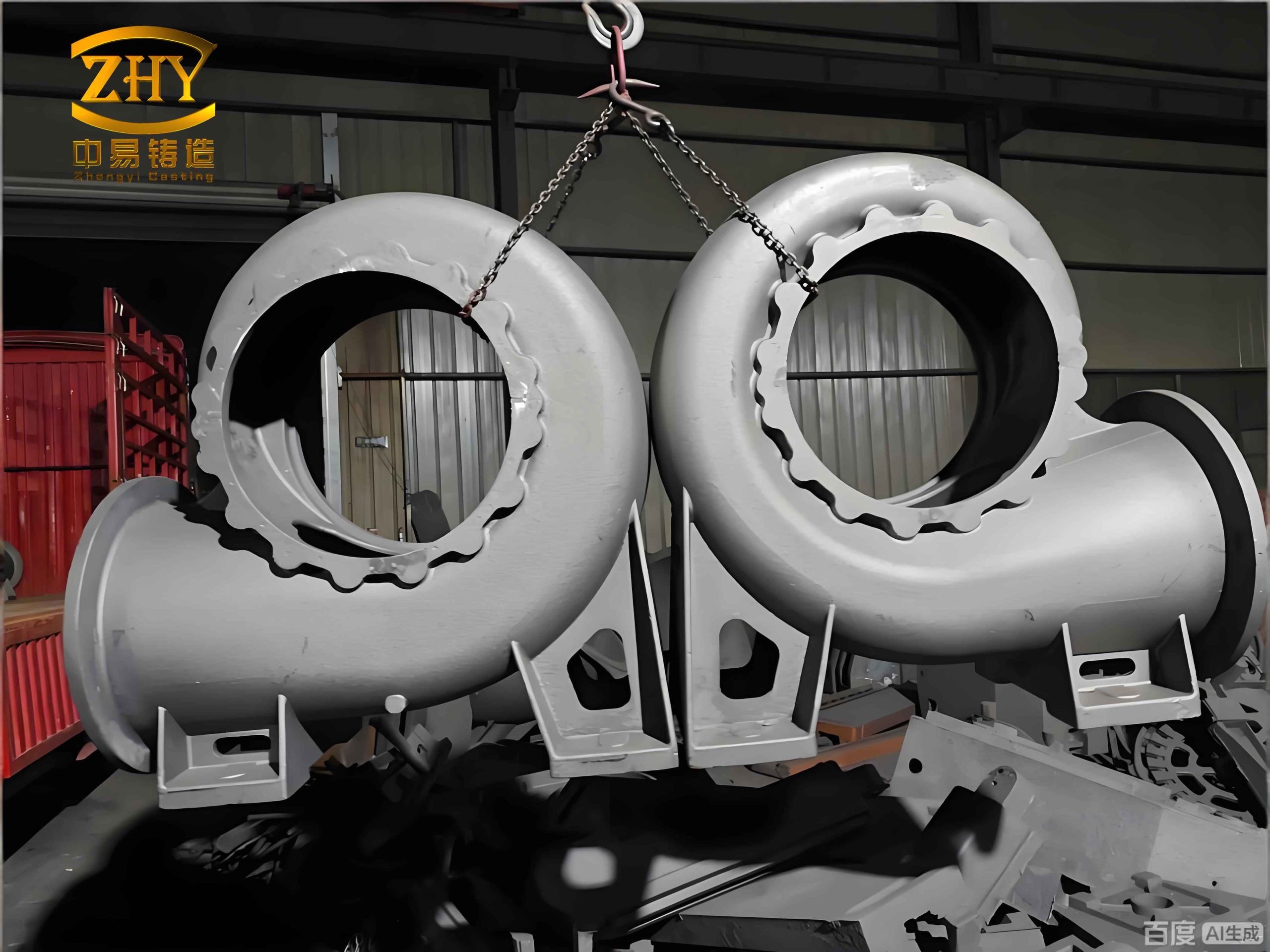
Normally, the upper mold of sand casting products does not experience sand adhesion, but under high gas evolution, it can become worse than the lower mold. This gas explosion sand adhesion requires extensive cleaning, increasing costs and resource usage. Based on our observations, with sand moisture content between 2.9-3.1% and gas evolution of 25-28 mL/g, both parameters were偏高, indicating that high moisture and gas evolution were primary causes.
To address this, we implemented改进措施 focused on reducing gas generation and enhancing venting. First, to decrease gas evolution, we adjusted additive proportions. Dust powder was suspended (reduced from 2.4 kg to 0 kg), bentonite addition was halved (from 24 kg to 12 kg initially), and coal dust was temporarily stopped (from 11 kg to 0 kg). Coal dust is essential for preventing sand adhesion via carbon film formation, but it also contributes significantly to gas generation. The optimal balance is given by the effective coal dust content, which can be expressed as:
$$ C_{\text{effective}} = C_{\text{added}} – C_{\text{lost}} $$
Where \( C_{\text{effective}} \) is the coal dust available for carbon film formation, \( C_{\text{added}} \) is the amount added, and \( C_{\text{lost}} \) is the amount consumed in gas generation. By reducing additions, we aimed to minimize \( C_{\text{lost}} \) while maintaining adequate \( C_{\text{effective}} \). Second, to improve venting, we added two vent holes (18 mm diameter) on the upper mold’s吊砂 areas, as these regions had high gas generation but poor排气. This enhanced gas escape through risers, parting lines, and sand grain interstices.
The effectiveness of these measures was monitored through sand property changes and product quality. Below is a table showing the variation in additive additions over time:
| Production Date | Product Model | Bentonite (kg) | Coal Dust (kg) | Dust Powder (kg) |
|---|---|---|---|---|
| Sept 20 | DK12-10 | 24 | 11 | 2.4 |
| Sept 21 | DK12-10 | 24 | 11 | 2.4 |
| Sept 22-24 | DK12-10 | 24 | 11 | 2.4 |
| Sept 25 | HD15 | 12 | 0 | 0 |
| Sept 26 | HD15 | 18 | 4 | 0 |
| Sept 27 | HD15 | 20 | 6.2 | 0 |
| Sept 28-30 | HD15 | 24 | 9.7 | 0 |
| Oct 3-5 | HD15 | 24 | 9.7 | 2.4 |
| Oct 6-8 | HD15 | 27 | 9.7 | 5.4 |
| Oct 9 | HD15 | 27 | 12.8 | 8.1 |
Corresponding changes in sand properties were tracked. The clay content decreased from an initial high level, as shown in the data below. Moisture content dropped from 3.0% to around 2.6%, gas evolution reduced from 28 mL/g to 22 mL/g, and compactability stabilized between 35-40%. These improvements contributed to better mold integrity and reduced gas pressure. The relationship between clay content and moisture can be approximated by:
$$ W = k_1 \cdot C_{\text{clay}} + k_2 $$
Where \( W \) is moisture content, \( C_{\text{clay}} \) is clay content, and \( k_1 \), \( k_2 \) are constants. By lowering clay content through reduced additive additions, we effectively decreased \( W \), thereby minimizing steam generation. Similarly, gas evolution \( G \) is proportional to coal dust content \( C_{\text{coal}} \) and moisture \( W \):
$$ G = \alpha \cdot C_{\text{coal}} + \beta \cdot W $$
With \( \alpha \) and \( \beta \) as coefficients. Our adjustments reduced both terms, lowering \( G \) significantly.
The product improvement was immediate. Pouring no longer exhibited fire coughing or explosions, and appearance sand adhesion on sand casting products was drastically reduced. Both upper and lower surfaces showed clean finishes without thick sand layers, as illustrated previously. This confirms that gas explosion sand adhesion in green sand casting can be mitigated by controlling sand properties and enhancing venting.
In conclusion, appearance sand adhesion in green sand casting, especially for complex sand casting products like cylinder blocks, is often linked to excessive gas pressure from high moisture and coal dust content. Through systematic measures—reducing dust powder and bentonite to lower clay content and moisture, optimizing coal dust addition to balance anti-adhesion and gas generation, and improving mold venting with additional holes—we successfully minimized gas explosions and sand adhesion. These practices not only enhance the quality of sand casting products but also reduce cleaning costs and scrap rates. Future work should focus on real-time monitoring of sand properties and automated adjustments to maintain optimal conditions for producing high-quality sand casting products consistently.