
The manufacturing sector stands at a critical juncture, facing increasing global scrutiny over its environmental footprint. Within this landscape, casting, as a foundational metal-forming technology, presents a significant paradox. It is indispensable for producing a vast array of industrial components, yet it is also a notable contributor to resource depletion and environmental pollution. The sheer scale of production amplifies this concern. Statistical data indicates that castings output has grown consistently, underscoring the industry’s economic importance but also highlighting the urgency for sustainable transformation. Historically, the development pattern within this sector has often been characterized as extensive, with ongoing challenges in environmental governance and workplace safety. This situation necessitates a shift towards greener production methodologies.
To mitigate the environmental burden of casting processes and enhance their ecological profile, researchers worldwide have explored various aspects, including energy conservation, emission reduction, and pollution control. Studies have focused on developing carbon emission prediction models for process optimization, redesigning exhaust gas purification systems, analyzing particulate matter emissions from different production stages, and investigating the emission characteristics of air pollutants. While these contributions are valuable, a noticeable gap exists. Much of the current research tends to focus on singular environmental impacts or specific waste streams. There is a lack of comprehensive, integrated assessments that evaluate the cumulative resource and environmental load throughout the entire sand casting process. Furthermore, comparative data quantifying the differences in these loads between various mainstream sand casting techniques remains insufficient.
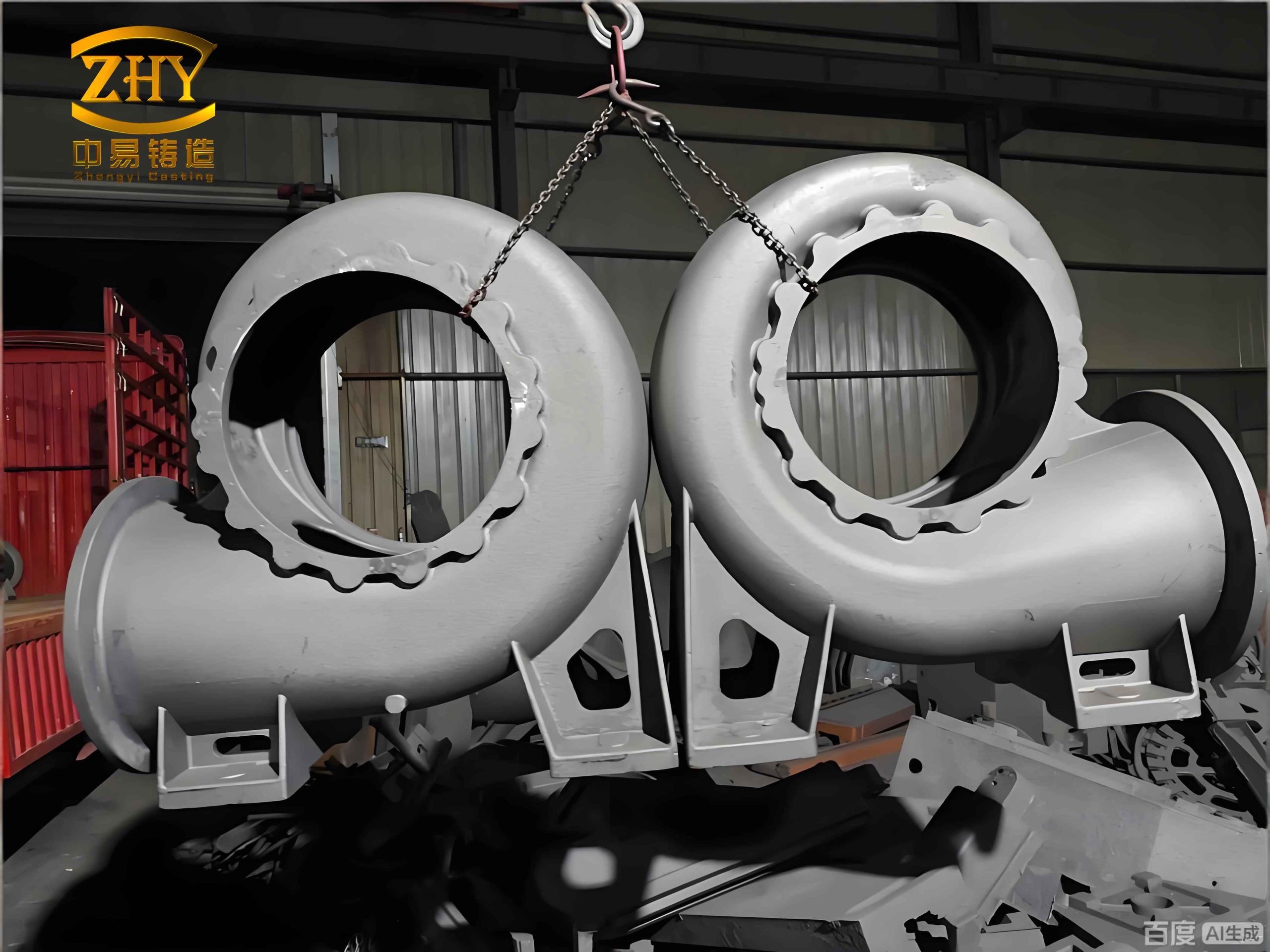
This study aims to address this gap by conducting a holistic evaluation of the resource and environmental load associated with two prevalent sand casting processes. The primary objective is to establish a robust evaluation framework, calculate the environmental impacts using a standardized methodology, and perform a comparative analysis to identify key areas for green improvement. The findings are intended to provide a data-driven foundation and methodological reference for assessing and comparing the environmental performance of different foundry operations, ultimately supporting the industry’s transition towards more sustainable manufacturing of sand casting products.
Establishing an Evaluation Framework for Typical Casting Processes
Process Analysis and Environmental Factor Identification
Sand casting is a versatile process where molten metal is poured into a cavity formed within a sand mold. After solidification, the mold is broken away to retrieve the casting. This method is capable of producing sand casting products of complex geometries, sizes, and weights, making it the most widely used casting technique.
The process can be categorized into several types, such as green sand molding and non-clay bonded sand molding (e.g., V-process). Despite variations, the core sequence involves numerous steps which can be consolidated into four main stages for systematic analysis:
- Melting: Metal charge (pig iron, scrap steel) is liquefied in furnaces (cupola, electric induction).
- Molding/Coremaking: Sand is mixed with binders (clay, resin) and formed into molds and cores, which are then assembled.
- Pouring: Molten metal is transferred and poured into the assembled mold cavity.
- Cleaning/Finishing: The solidified casting is shaken out (dislodged from sand), and undergoes processes like shot blasting, grinding, and cutting of gates/risers.
This production chain is resource and emission-intensive. Key inputs and outputs for each stage are summarized in the table below:
| Process Stage | Primary Equipment | Key Resource/Energy Inputs | Key Emissions/Outputs |
|---|---|---|---|
| Melting | Cupola, Induction Furnace | Pig Iron, Scrap Steel, Ferroalloys, Electricity | Dust, Volatile Organic Compounds (VOCs), Slag |
| Molding | Mixer, Molding Machine, Core Shooter | Sand, Binders (Bentonite, Resin), Coatings, Electricity | Dust, VOCs, Waste Sand |
| Pouring | Ladle, Pouring Machine | Electricity | Dust, Fumes |
| Cleaning | Shakeout, Shot Blast, Grinder | Steel Shot, Electricity, Water | Dust, Waste Sand, Noise |
Constructing the Resource and Environmental Load Indicator System
Based on the process analysis, a comprehensive evaluation indicator system was constructed. This system encompasses three dimensions: Resource Consumption, Environmental Load, and Human Health Impact, further broken down into nine specific midpoint impact categories. The selected indicators, their units, and representative substances are listed below:
| Indicator Name | Abbreviation | Unit | Representative Substances |
|---|---|---|---|
| Abiotic Depletion Potential | ADP | kg Sb eq | Iron ore, Minerals |
| Water Use | WU | kg | Freshwater, Industrial Water |
| Primary Energy Demand | PED | MJ | Crude Oil, Natural Gas, Coal |
| Global Warming Potential | GWP | kg CO₂ eq | CO₂, CH₄, N₂O |
| Acidification Potential | AP | kg SO₂ eq | SO₂, NOₓ, NH₃ |
| Eutrophication Potential | EP | kg PO₄³⁻ eq | NOₓ, Phosphate |
| Photochemical Ozone Creation Potential | POCP | kg NMVOC eq | VOCs, Formaldehyde |
| Human Toxicity Potential | HTP | CTUh | CO, Heavy Metals (via air/water) |
| Respiratory Inorganics | RI | kg PM₂.₅ eq | PM₂.₅, PM₁₀, SOₓ, NOₓ |
The hierarchical structure of the evaluation system is visually represented as follows. This framework allows for a multi-faceted assessment of the burdens associated with producing sand casting products.
[Resource and Environmental Load Evaluation System]
        |
        ├── Resource Consumption Indicators
        │     ├── ADP (Abiotic Depletion)
        │     ├── WU (Water Use)
        │     └── PED (Primary Energy Demand)
        |
        ├── Environmental Load Indicators
        │     ├── GWP (Global Warming)
        │     ├── AP (Acidification)
        │     ├── EP (Eutrophication)
        │     └── POCP (Photochemical Ozone)
        |
        └── Human Health Impact Indicators
              ├── HTP (Human Toxicity)
              └── RI (Respiratory Inorganics)
Determining Indicator Weights and the Comprehensive Evaluation Method
To aggregate the nine disparate impact category results into a single composite score, weighting is necessary. The weights reflect the relative importance of each impact category from an expert perspective. The Delphi method, a structured communication technique relying on a panel of experts, was employed. Questionnaires were distributed to over 20 experts from academia, industry, and research institutions. The consolidated weights were calculated using the formula:
$$ \alpha_i = \frac{\sum_{x=1}^{n} k_{i,x}}{\sum_{i=1}^{m} \sum_{x=1}^{n} k_{i,x}} $$
Where:
- $\alpha_i$ is the weight for indicator $i$.
- $k_{i,x}$ is the weight assigned to indicator $i$ by expert $x$.
- $n$ is the total number of experts.
- $m$ is the total number of indicators (9).
The final weights derived from the expert survey are presented in the table below:
| Dimension | Indicator | Weight (α) |
|---|---|---|
| Resource Consumption | Water Use (WU) | 0.012 |
| Abiotic Depletion (ADP) | 0.010 | |
| Primary Energy Demand (PED) | 0.052 | |
| Environmental Load | Global Warming (GWP) | 0.160 |
| Acidification (AP) | 0.190 | |
| Eutrophication (EP) | 0.152 | |
| Photochemical Ozone (POCP) | 0.170 | |
| Human Health Impact | Human Toxicity (HTP) | 0.028 |
| Respiratory Inorganics (RI) | 0.228 |
The comprehensive evaluation index ($CI_j$) for a specific casting process $j$ is then calculated using a linear weighted sum model. The calculation involves several steps:
- Goal and Scope Definition: Define the functional unit (e.g., 1 tonne of casting) and system boundaries (cradle-to-gate).
- Life Cycle Inventory (LCI): Collect primary data for inputs (materials, energy) and outputs (emissions, waste) for all processes within the boundary.
- Life Cycle Impact Assessment (LCIA): Calculate the characterized results for each of the nine indicators.
- Normalization: Divide each characterized result by a common baseline or reference value to obtain dimensionless scores. This allows for the comparison of disparate units (e.g., kg CO₂ eq vs. CTUh). The average impact value from the studied processes can serve as this baseline ($BL_i$).
- Weighting and Aggregation: Apply the weights and sum the normalized scores.
The formula for the final Comprehensive Index is:
$$ CI_j = \sum_{i=1}^{n} \left( \frac{LCIA_{i,j}}{BL_i} \times \alpha_i \right) $$
Where:
- $CI_j$ is the Comprehensive Index for process $j$.
- $LCIA_{i,j}$ is the Life Cycle Impact Assessment result for indicator $i$ and process $j$.
- $BL_i$ is the baseline (normalization) value for indicator $i$.
- $\alpha_i$ is the weight for indicator $i$.
- $n$ is the number of indicators (9).
A higher $CI_j$ value indicates a greater overall resource and environmental load per functional unit of sand casting products.
Life Cycle Impact Assessment of Typical Sand Casting Processes
Goal, Scope, and Functional Unit
This study applies the aforementioned framework to two specific sand casting processes: Green Sand Process with Squeeze Molding (静压铸造) and the V-Process (真空铸造). The goal is to compare their environmental performance. The functional unit is defined as “1 tonne of finished castings”. The system boundary is “cradle-to-gate,” encompassing all stages from raw material extraction (e.g., mining iron ore, producing electricity) through the four core foundry processes (Melting, Molding, Pouring, Cleaning) until the finished casting is ready for dispatch. Background data for upstream processes (e.g., electricity generation, material production) were sourced from the Chinese Life Cycle Database (CLCD).
Life Cycle Inventory (LCI) Analysis
Primary data for the foreground system (the foundry operations) were collected through on-site surveys and measurements at representative production facilities. The inventory tables for producing 1 tonne of castings via each process are summarized below. These tables detail the mass and energy flows across the four process stages.
| Input/Output | Melting | Molding | Pouring | Cleaning | Unit |
|---|---|---|---|---|---|
| Pig Iron | 465.84 | – | – | – | kg |
| Steel Scrap | 528.36 | – | – | – | kg |
| Slagging Agent | 8.38 | – | – | – | kg |
| Carburizer | 33.72 | – | – | – | kg |
| Ferrosilicon | 17.05 | – | – | – | kg |
| Bentonite | – | 101.98 | – | – | kg |
| Mixing Clay | – | 22.48 | – | – | kg |
| Molding Sand | – | 630.98 | – | – | kg |
| Steel Shot | – | – | – | 3.87 | kg |
| Electricity | 962.12 | – | 15.38 | 161.90 | kWh |
| Water | 166.99 | – | – | 55.66 | kg |
| Slag (Output) | 27.10 | – | – | – | kg |
| Waste Sand (Output) | – | 23.45 | – | 31.42 | kg |
| PM2.5 (Output) | 1.79 | 2.73 | 1.36 | 4.52 | kg |
| VOCs (Output) | 10.35 | 22.89 | 9.75 | 49.27 | g |
| Input/Output | Melting | Molding | Pouring | Cleaning | Unit |
|---|---|---|---|---|---|
| Pig Iron | 903.73 | – | – | – | kg |
| Steel Scrap | 89.35 | – | – | – | kg |
| Return Scrap | 37.87 | – | – | – | kg |
| Ferrosilicon | 16.72 | – | – | – | kg |
| EVA Film | – | 1.37 | – | – | kg |
| Molding Sand | – | 511.12 | – | – | kg |
| Steel Shot | – | – | – | 1.73 | kg |
| Electricity | 489.54 | 101.19 | 5.33 | 44.00 | kWh |
| Water | 103.49 | 129.36 | – | 25.87 | kg |
| Slag (Output) | 26.79 | – | – | – | kg |
| Waste Sand (Output) | – | 1.76 | – | 24.80 | kg |
| PM2.5 (Output) | 1.71 | 1.82 | 2.36 | 3.21 | kg |
| VOCs (Output) | 11.64 | 26.24 | 12.60 | 14.73 | g |
Life Cycle Impact Assessment (LCIA) Results
Using the inventory data and characterization factors from standard LCA methodologies (e.g., CML, ReCiPe), the environmental impacts for the nine indicators were calculated for each process. The results, broken down by the four process stages, are presented in the bar charts below. These figures illustrate the contribution of each stage to the total impact for producing one tonne of sand casting products.
Green Sand (Squeeze) Process LCIA Results: The chart shows a dominant contribution from the Melting stage across most impact categories, particularly for GWP, PED, and ADP. The Cleaning stage shows a significant contribution to Respiratory Inorganics (RI).
V-Process LCIA Results: A similar pattern is observed, with the Melting stage being the largest contributor. However, the relative magnitude of impacts, especially from the Molding stage, differs due to the distinct binder system (EVA film vs. clay/water).
Comprehensive Evaluation and Comparative Analysis
Calculation of Comprehensive Indices
To facilitate a direct comparison, the LCIA results for both processes were normalized using the average impact values of the two studied processes as the baseline ($BL_i$). These baseline values are listed below:
| Indicator | Baseline Value (BLi) | Unit |
|---|---|---|
| PED | 9.61E+04 | MJ |
| ADP | 2.29E-01 | kg Sb eq |
| WU | 5.59E+04 | kg |
| GWP | 7.64E+03 | kg CO₂ eq |
| AP | 2.60E+01 | kg SO₂ eq |
| RI | 5.64E+01 | kg PM₂.₅ eq |
| POCP | 6.55E+00 | kg NMVOC eq |
| EP | 2.76E+00 | kg PO₄³⁻ eq |
| HTP | 2.05E-05 | CTUh |
The normalized scores for each stage were then aggregated using the weights from Table 3, following the formula $CI_j = \sum (LCIA_{i,j}/BL_i \times \alpha_i)$. The final comprehensive indices, broken down by process stage and impact dimension, are presented in the tables below.
| Dimension | Melting | Molding | Pouring | Cleaning | Total |
|---|---|---|---|---|---|
| Resource Indicators | 2.19 | 0.40 | 0.01 | 0.12 | 2.72 |
| Environmental Indicators | 30.50 | 3.70 | 0.15 | 1.50 | 35.85 |
| Human Health Indicators | 5.38 | 3.49 | 1.40 | 7.40 | 17.67 |
| Composite Index (CI) | 38.07 | 7.59 | 1.56 | 9.02 | 56.24 |
| Dimension | Melting | Molding | Pouring | Cleaning | Total |
|---|---|---|---|---|---|
| Resource Indicators | 1.79 | 0.13 | 0.00 | 0.03 | 1.96 |
| Environmental Indicators | 25.68 | 1.61 | 0.07 | 0.42 | 27.79 |
| Human Health Indicators | 4.16 | 3.75 | 2.76 | 5.21 | 15.89 |
| Composite Index (CI) | 31.64 | 5.50 | 2.84 | 5.67 | 45.64 |
Discussion and Key Findings
The comprehensive evaluation yields several critical insights for the environmental management of sand casting products manufacturing:
1. Identification of Environmental Hotspots: For both sand casting processes, the Melting stage is unequivocally the dominant contributor to the overall resource and environmental load, accounting for approximately 68% of the total CI in Green Sand and 69% in the V-Process. This is primarily driven by high energy consumption (electricity for induction furnaces), significant material inputs (metal charge, ferroalloys), and associated emissions. Therefore, greening efforts should be primarily targeted here, focusing on:
- Optimizing charge composition and melting efficiency.
- Adopting high-efficiency furnaces and recuperative burners.
- Improving slag management and material yield.
2. Process Stage Comparisons: Following Melting, the Molding and Cleaning stages show comparable total CI contributions. However, their profiles differ. The Cleaning stage exhibits a disproportionately high contribution to Human Health Indicators, particularly Respiratory Inorganics (RI), due to high particulate matter generation during shakeout and shot blasting. This underscores the need for superior dust collection, containment, and worker protection measures in finishing areas. The Pouring stage has the minimal impact, suggesting that automation here is more beneficial for safety and precision than for broad environmental gains.
3. Comparative Analysis of the Two Processes: The overall Composite Index for the Green Sand (Squeeze) Process (CI = 56.24) is approximately 23% higher than that of the V-Process (CI = 45.64). This indicates that, under the studied conditions and for the considered functional unit, the V-Process presents a lower overall resource and environmental load for producing one tonne of castings.
The difference is largely attributable to the Melting stage (22% gap). Three factors explain this:
- Charge Mix: The Green Sand process used a much higher proportion of steel scrap (requiring more energy to melt and refine) versus the V-Process which used more pig iron.
- Auxiliary Materials: Higher consumption of additives like carburizer and slagging agent in the Green Sand melting operation.
- Process Parameters: Potentially higher target pouring temperatures for the specific sand casting products made via Green Sand, increasing energy demand.
Furthermore, the V-Process benefits from its binder system. The use of a dry, plastic film (EVA) under vacuum eliminates the need for water and clay-based binders, significantly reducing the environmental burden associated with the Molding stage compared to the clay-bonded green sand system.
4. Limitations and Context: This comparison is specific to the studied use cases. The V-Process in this study was used for larger, structurally simpler castings (e.g., counterweights), while the Green Sand process produced more complex, engineered components (e.g., housings, axle parts). Differences in product geometry, required metallurgical quality, and batch size can influence the per-tonne environmental profile. Nevertheless, the methodology clearly identifies hotspot stages and quantifies differences attributable to core process technology choices.
Conclusion
This study developed and applied a structured, multi-indicator framework to evaluate the resource and environmental load of sand casting processes. By integrating expert-derived weights with a detailed Life Cycle Assessment, it moves beyond single-issue analysis to provide a holistic view of the environmental pressures associated with manufacturing sand casting products.
The key conclusions are:
- The Melting stage is the most significant hotspot for both Green Sand and V-Process casting, contributing roughly 70% of the total burden. This stage should be the primary focus for process optimization, energy efficiency upgrades, and material conservation initiatives.
- The Cleaning/Finishing stage, while less impactful overall, poses the highest relative risk to human health due to particulate emissions, necessitating robust industrial hygiene and air pollution control measures.
- A comparative analysis revealed that, for the specific cases studied, the V-Process exhibited a 23% lower overall resource and environmental load per tonne of casting compared to the Green Sand (Squeeze) process. This advantage stems mainly from differences in melting charge practice and the absence of water/clay binders in the molding stage.
The established evaluation framework and methodology offer a valuable tool for foundries to benchmark their performance, identify improvement opportunities, and make informed decisions regarding process selection and green technology investment. By applying this approach, the industry can systematically reduce the environmental footprint of sand casting products, supporting a more sustainable future for this essential manufacturing sector.