
In the pursuit of lightweight equipment, especially in aerospace and military applications, the demand for high-performance materials has intensified. Magnesium alloys, with their low density, high specific strength, and stiffness, have emerged as pivotal energy-saving materials. This study focuses on the sand casting process for a magnesium alloy electric control box, a critical component in modern systems. Sand casting products, known for their cost-effectiveness and versatility, are ideal for producing complex geometries like this box, which measures 550 mm × 416 mm × 92 mm with thin walls of 7 mm and a thicker base of 12 mm. The structure features numerous holes, grooves, and bosses, making it a typical thin-walled box design. I investigated the optimization of the sand casting process through numerical simulation to minimize defects and enhance production efficiency for bulk manufacturing of sand casting products.
The electric control box exhibits a intricate design, including a U-shaped groove at the base, 22 holes of varying sizes on side walls, three 3-mm deep slots at the bottom, an 8-mm high boss, and a环形 groove on the top surface. Additionally, six ears at the base facilitate fixation, and six internal protrusions require threading for assembly. All edges are rounded to reduce stress concentrations. Such complexity poses challenges in achieving defect-free sand casting products, necessitating meticulous process design. To address this, I employed numerical simulation to analyze filling and solidification, optimizing the gating system and riser placement to ensure smooth metal flow and controlled solidification.
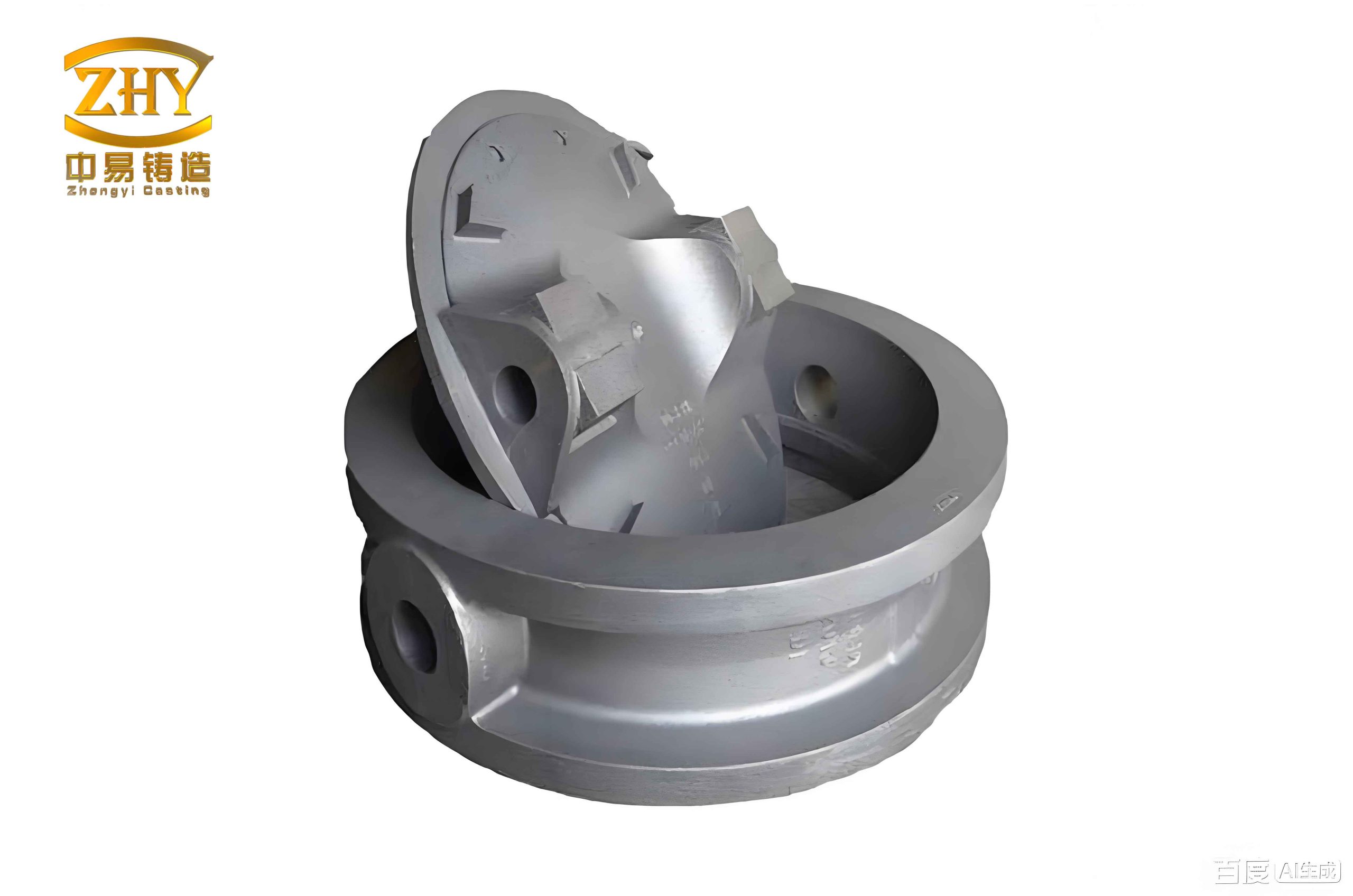
The methodology involved a detailed structural analysis followed by simulation using advanced software. For sand casting products, the gating system design is crucial to prevent turbulence, air entrapment, and cold shuts. I considered two approaches: unilateral and bilateral gating systems. The alloy used was a common magnesium alloy with properties summarized in Table 1. The simulation process began with 3D modeling, exported as an STL file, and imported into pre-processing for meshing and parameter setting. Key parameters included pouring temperature, flow rate, and boundary conditions, which influence the quality of sand casting products.
| Property | Value | Unit |
|---|---|---|
| Density (ρ) | 1.74 | g/cm³ |
| Thermal Conductivity (k) | 80 | W/(m·K) |
| Specific Heat Capacity (Cp) | 1.02 | J/(g·K) |
| Latent Heat of Fusion (L) | 370 | J/g |
| Liquidus Temperature | 650 | °C |
| Solidus Temperature | 540 | °C |
Numerical simulation of the filling process was conducted to visualize fluid dynamics. The governing equations for fluid flow and heat transfer in sand casting products include the continuity equation, Navier-Stokes equations, and energy equation. For incompressible flow, the continuity equation is:
$$\nabla \cdot \mathbf{v} = 0$$
where $\mathbf{v}$ is the velocity vector. The momentum equation accounts for gravity and viscous forces:
$$\rho \left( \frac{\partial \mathbf{v}}{\partial t} + \mathbf{v} \cdot \nabla \mathbf{v} \right) = -\nabla p + \mu \nabla^2 \mathbf{v} + \rho \mathbf{g}$$
Here, $\rho$ is density, $p$ pressure, $\mu$ dynamic viscosity, and $\mathbf{g}$ gravitational acceleration. The energy equation for temperature (T) distribution is:
$$\rho C_p \left( \frac{\partial T}{\partial t} + \mathbf{v} \cdot \nabla T \right) = \nabla \cdot (k \nabla T) + \dot{Q}$$
where $\dot{Q}$ represents heat source terms, crucial for modeling solidification in sand casting products.
For the unilateral gating system, metal enters through a sprue, flows into runners, and distributes via multiple ingates. The filling sequence showed initial turbulence at the base due to gravity-driven impact, but overall flow was relatively uniform. However, gas entrapment occurred in grooves, leading to potential porosity. The bilateral gating system promoted simultaneous filling from both sides, reducing splashing but causing gas accumulation at the confluence. To quantify this, I calculated the Reynolds number (Re) to assess flow regime:
$$Re = \frac{\rho v D}{\mu}$$
where $D$ is the hydraulic diameter. For sand casting products, maintaining laminar flow (Re < 2000) minimizes defects. Simulation results indicated Re values around 1500 for unilateral and 1200 for bilateral systems, suggesting both are within acceptable ranges but with different defect profiles.
| Parameter | Unilateral Gating | Bilateral Gating |
|---|---|---|
| Pouring Temperature | 700°C | 700°C |
| Flow Rate (Q) | 0.5 m³/s | 0.5 m³/s |
| Filling Time (t) | 8.2 s | 7.8 s |
| Maximum Velocity (vmax) | 1.2 m/s | 1.0 m/s |
| Gas Entrapment Risk | Moderate in grooves | High at confluence |
Solidification simulation was pivotal for predicting shrinkage and porosity. Using Chvorinov’s rule, the solidification time (ts) for a casting section is:
$$t_s = C \left( \frac{V}{A} \right)^n$$
where $V$ is volume, $A$ surface area, $C$ a constant dependent on mold material, and $n$ an exponent (typically 2 for sand molds). For this box, isolated liquid regions formed at ends, necessitating risers. I optimized riser placement to transfer hot spots, employing the modulus method to ensure risers solidify last. The modulus (M) is defined as:
$$M = \frac{V}{A}$$
Risers were designed with Mriser > Mcasting to enable effective feeding. Simulation results after optimization showed reduced shrinkage, as heat was concentrated in risers, enhancing the integrity of sand casting products.
The optimization process involved iterative simulations. Initially, unilateral gating with top risers was tested, but gas porosity persisted. By adjusting ingate sizes and adding filters, flow stability improved. Filters with mesh sizes of 1.5 mm × 1.5 mm or 2 mm × 2 mm were used to trap slag without impeding flow. For bilateral gating, despite smoother filling, gas venting was inadequate due to trapped air at the midline. This highlights the importance of vent design in sand casting products. The final optimized scheme combined unilateral gating with strategically placed risers at both ends, as shown in simulation results where solidification progressed directionally toward risers.
| Aspect | Unilateral Gating | Bilateral Gating | Optimized Design |
|---|---|---|---|
| Filling Stability | Moderate, some turbulence | High, minimal splashing | High, controlled flow |
| Gas Venting | Good in most areas | Poor at confluence | Excellent with vents |
| Solidification Sequence | Random, requires risers | Directional, but isolated zones | Directional toward risers |
| Defect Probability | Low porosity in grooves | High porosity at midline | Minimal defects |
| Suitability for Mass Production | High | Low | Very High |
Experimental validation was conducted by pouring molten magnesium alloy at 700°C into sand molds. The optimized process yielded castings with few defects, confirming simulation accuracy. Defect analysis revealed that unilateral gating produced minor gas pores in grooves, while bilateral gating led to clustered porosity. This underscores how numerical simulation can refine sand casting products for batch production. The success of this approach demonstrates that sand casting, when optimized, is a reliable method for manufacturing complex magnesium alloy components. Moreover, the economic benefits of sand casting products make them attractive for industries requiring lightweight solutions.
Further discussion on the thermodynamics of solidification is essential. The heat transfer during cooling can be modeled using Fourier’s law:
$$q = -k \nabla T$$
where $q$ is heat flux. For a sand mold, the interfacial heat transfer coefficient (h) between metal and mold affects cooling rates. The overall heat balance equation is:
$$\rho V C_p \frac{dT}{dt} = h A (T_m – T_a)$$
with $T_m$ as metal temperature and $T_a$ ambient temperature. This equation guides riser design to compensate for shrinkage, a common issue in sand casting products. By simulating temperature gradients, I identified critical sections prone to hot tears and adjusted cooling rates through mold material selection.
The role of alloy composition cannot be overlooked. Magnesium alloys often contain elements like aluminum and zinc to enhance castability. The phase diagram influences solidification paths; for instance, the Mg-Al system exhibits a eutectic reaction that impacts microstructure. The fraction of solid (fs) during solidification can be estimated using the Scheil equation:
$$f_s = 1 – \left( \frac{T_m – T}{T_m – T_l} \right)^{\frac{1}{1-k}}$$
where $T_l$ is liquidus temperature and $k$ the partition coefficient. This helps predict microporosity in sand casting products, guiding process adjustments such as increasing pouring temperature or modifying gating geometry.
In terms of practical implementation, the sand casting process for this box involves pattern making, mold assembly, and pouring. Key parameters like sand permeability and binder type affect gas escape. For magnesium alloys, protective atmospheres (e.g., SF6 mixtures) are used to prevent oxidation. The economic aspect is vital; sand casting products are cost-effective for low to medium volumes, but optimization reduces scrap rates, enhancing profitability. This study shows that through simulation, even intricate sand casting products can be produced with high yield, supporting sustainable manufacturing.
To summarize, the optimization of sand casting for magnesium alloy control boxes hinges on numerical simulation of filling and solidification. The unilateral gating system with optimized risers proved superior, minimizing defects like porosity and shrinkage. This approach ensures that sand casting products meet stringent quality standards for aerospace and military applications. Future work could explore advanced simulation techniques or alternative alloys to further improve the performance of sand casting products. Ultimately, the integration of simulation into process design represents a paradigm shift in foundry practices, enabling the mass production of lightweight, high-integrity components.