
As a foundry engineer with extensive experience in sand casting processes, I have often observed that the design of ventilation systems is a critical yet frequently overlooked aspect of casting production. In sand casting, the proper expulsion of gases generated during mold filling and solidification is paramount to achieving high-quality sand casting products. This article delves into the intricacies of vent system design, drawing from practical insights to elucidate its role in mitigating defects such as blowholes, sand burning, and mistruns. By integrating systematic approaches, including the use of tables and formulas, I aim to provide a comprehensive guide that enhances the reliability and efficiency of sand casting operations for various sand casting products.
The ventilation system in sand casting serves multiple essential functions. Primarily, it facilitates the removal of gases from the mold cavity, sand cores, and those liberated by the molten metal during pouring. This not only reduces gas pressure within the cavity, improving the fluidity and mold-filling capacity of the metal, but also allows for the expulsion of cooler metal and slag that may accumulate during initial filling. Additionally, vent systems enable visual monitoring of metal flow and cavity fill extent, which is crucial for process control in producing consistent sand casting products. Based on my experience, I classify ventilation systems into two main categories: mold cavity venting and sand core venting. Each category encompasses various measures, as summarized in the table below.
| Category | Venting Measures | Description |
|---|---|---|
| Mold Cavity Venting | Venting holes, venting pins, venting strips, exhaust filters, sand grain interstices, various risers (e.g., top, side, overflow), ignition venting | These are designed to release gases trapped in the mold cavity, often positioned at the highest points or dead zones. |
| Sand Core Venting | Venting holes, venting pins, venting channels, exhaust ropes, venting plugs, filled combustible media, increased porosity materials | These address gases evolved from sand cores, ensuring they are directed out of the mold without entering the metal. |
The design principles for ventilation systems emphasize separation between mold cavity and sand core gases to prevent contamination and defects. Key guidelines include: avoiding direct venting on the casting body to minimize sand inclusion risks; positioning vents at the highest points or where gas accumulation is likely; ensuring vent cross-sectional areas are adequate, typically matching or exceeding the choke area of the gating system; and employing indirect venting with lead-out channels for safety. For complex thin-walled sand casting products, such as those used in automotive or hydraulic applications, the total vent area often needs to be 1.5 to 2.5 times the choke area to ensure efficient gas escape. This is encapsulated in the formula:
$$ \Sigma F_{\text{vent}} = (1.5 \text{ to } 2.5) \times \Sigma F_{\text{choke}} $$
where $\Sigma F_{\text{vent}}$ is the total effective vent area and $\Sigma F_{\text{choke}}$ is the total choke area of the gating system. This ratio is vital for preventing defects in demanding sand casting products.
Inadequate vent system design is a common root cause of defects in sand casting products. From my observations, failures often stem from insufficient vent area, poor layout, or neglect of sand properties. For instance, if vents are too small or blocked, gases cannot escape rapidly, leading to侵入性气孔 (invasive blowholes) or爆炸性粘砂 (explosive sand burning). Similarly, high sand compactness in high-pressure molding reduces permeability, exacerbating gas entrapment. Other issues include improper sealing of core prints, which allows metal to block vent channels, and inadequate gating design that fails to establish a favorable temperature gradient for gas expulsion. These shortcomings not only compromise the integrity of sand casting products but also pose safety hazards like metal splash during pouring. Therefore, a holistic approach integrating vent design with sand preparation and pouring parameters is essential.
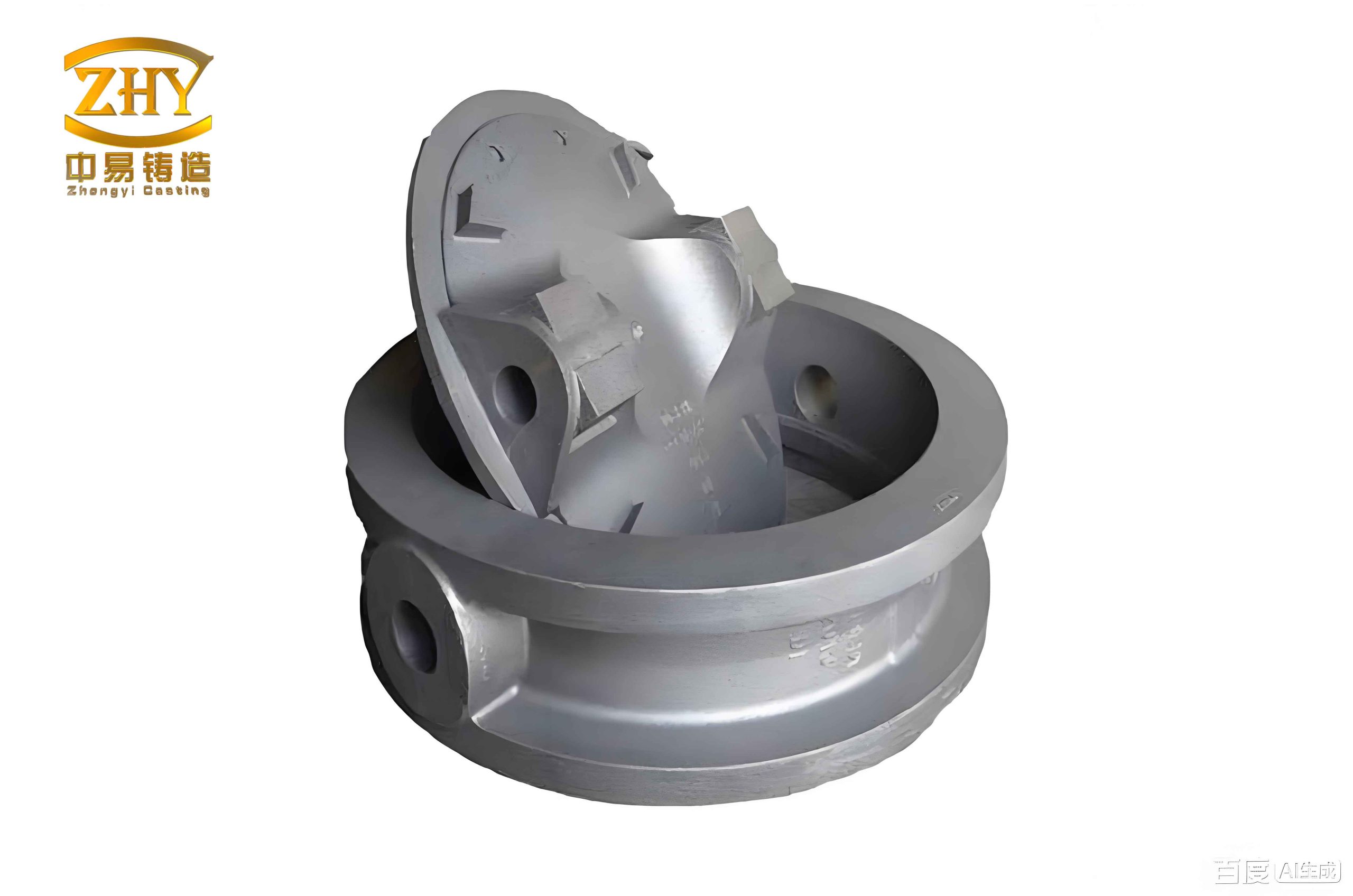
To achieve optimal venting, designers must focus on both mold cavity and sand core systems. For mold cavity venting, the gating and risering system plays a pivotal role. I recommend using risers like edge risers or necked-top risers that maximize vent area while facilitating slag removal and feeding. The gating system should be designed to promote upward temperature gradients, such as through middle or step gating, which aids gas evolution by keeping the upper metal hotter. Venting elements like pins and strips must be open to the atmosphere; for high-hardness molds, unconnected vents can act as gas inductors, causing blowholes. In such cases, exhaust filters placed at vent bases offer a solution, allowing gas escape while preventing sand fall-in. The vent area for mold cavities can be theoretically estimated using:
$$ S = (1.5 \text{ to } 4) \times \frac{22.6 \times G}{\rho \times t \times h_p \times \mu} $$
where $S$ is the vent area in cm², $G$ is the poured weight in kg, $\rho$ is the metal density in kg/cm³, $t$ is the pouring time in s, $h_p$ is the effective pouring head in cm, and $\mu$ is the velocity factor (0.45 without filters, 0.35 with filters). The multiplier (1.5 to 4) depends on casting wall thickness—higher for thinner sections common in precision sand casting products. Additionally, ignition venting during pouring is a simple yet effective practice to reduce cavity pressure and prevent defects.
Sand core venting requires meticulous attention due to the high gas evolution from binders. For simple cores, methods like wiring or using combustible ropes create vent channels after baking. Complex cores, such as those for engine blocks or turbine housings in sand casting products, often need drilled holes or预埋排气介质 (pre-embedded venting media like foam plastic) that vaporize to form continuous paths. The theoretical vent area for sand cores can be derived from:
$$ a_v = a_{cm}(1 – A) – a_p $$
where $a_v$ is the total vent area of the core, $a_{cm}$ is the contact area between core and metal, $a_p$ is the core print area, and $A$ is a factor accounting for gas generation. $A$ is given by:
$$ A = \frac{\gamma_1 \cdot H \cdot \rho}{\gamma_2 \cdot K \cdot G \cdot C} $$
Here, $\gamma_1$ and $\gamma_2$ are specific gravities of metal and core sand, respectively, $H$ is the metal head above the core, $\rho$ is core permeability, $G$ is gas evolution of core material, $C$ is the percentage of gas decomposition, and $K$ is a conversion constant. This formula underscores that higher metal density, head, and core permeability reduce the required vent area, which is crucial for optimizing cores in sand casting products. Moreover, core prints must be adequately sized and sealed to prevent metal intrusion, and using low-gas evolution sands (e.g., sodium silicate-bonded sands) can further mitigate risks.
A balanced vent system also hinges on sand properties. Selecting sands with low gas evolution and high permeability is fundamental; for example, resin sands may emit 15 mL/g at 850°C, whereas water glass sands emit only 6 mL/g, making them preferable for critical sand casting products. Proper sand compaction and baking are equally important to maintain vent efficiency. Furthermore, pouring parameters—temperature, speed, and steadiness—must be synchronized with vent design. Higher pouring temperatures delay oxide film formation on the metal surface, allowing internal gases to escape before sealing, thus reducing blowholes in sand casting products. However, this must be balanced against sand burning risks, emphasizing the need for integrated process control.
In conclusion, the design of ventilation systems in sand casting is a multifaceted endeavor that directly impacts the quality and yield of sand casting products. By adhering to principles such as separating mold and core gases, ensuring adequate vent areas, and employing practical measures like exhaust filters and ignition venting, foundries can significantly reduce defects. Theoretical calculations for vent areas provide a scientific basis, but empirical validation is essential, especially for complex sand casting products. Ultimately, a holistic approach that combines optimized gating, proper sand selection, and controlled pouring parameters will foster efficient gas expulsion, leading to superior sand casting products with minimized rework and enhanced performance in applications ranging from automotive to industrial machinery.