
In the field of metal casting, sand casting remains a pivotal technique for producing complex and large components, particularly in the manufacturing of valve shells for industrial applications. As an engineer involved in foundry operations, I have extensively worked with silicon brass alloys, specifically ZCuZn16Si4, which is renowned for its excellent corrosion resistance and mechanical properties in water-pressure applications. This article delves into the sand casting process for large selector valve shells made from silicon brass, focusing on defect prevention strategies to ensure leak-free performance. The insights shared here are based on practical experience and systematic studies, aiming to contribute to the advancement of sand casting products. Throughout this discussion, the term “sand casting products” will be emphasized to highlight the broader context of this manufacturing method.
Silicon brass ZCuZn16Si4 is widely utilized in industries such as petroleum, chemical, power, and shipbuilding due to its ability to withstand harsh environments. Its composition offers a balance of strength and castability, making it ideal for components like pump casings, impellers, and valve bodies. However, large and intricate valve shells, such as the selector valve discussed here, present significant challenges in sand casting. These include risks of leakage, cold shuts, shrinkage porosity, and oxide inclusions, which can compromise the integrity of sand casting products. The valve shell in question has dimensions of 380 mm in length, 319 mm in width, and 335 mm in height, with a maximum flange outer diameter of 240 mm and a thickness of 25 mm. Its thin-walled sections (as low as 9 mm) and complex internal cavities necessitate a meticulously designed casting process to avoid defects.
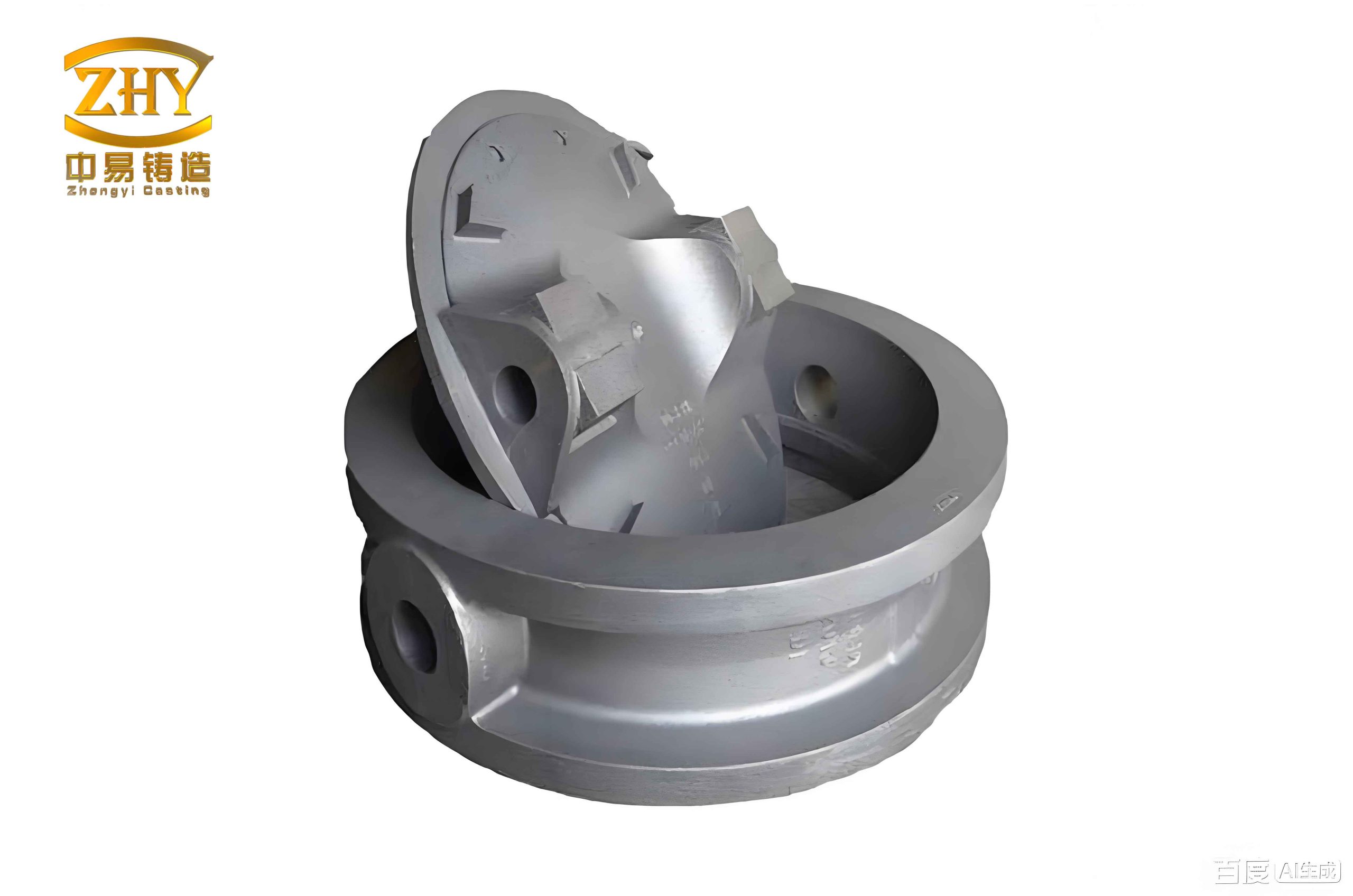
From my perspective, the success of sand casting products hinges on a deep understanding of material properties and structural nuances. Silicon brass ZCuZn16Si4 exhibits favorable casting characteristics, but it is prone to gas absorption and oxidation if not handled properly. The alloy’s chemical composition and mechanical properties are critical factors in process design. Below, I present tables summarizing these properties, which serve as a foundation for the casting approach.
| Element | Content Range |
|---|---|
| Copper (Cu) | 79.00–81.00 |
| Silicon (Si) | 2.50–4.50 |
| Zinc (Zn) | Remainder |
| Iron (Fe) | ≤0.60 |
| Aluminum (Al) | ≤0.10 |
| Manganese (Mn) | ≤0.50 |
| Antimony (Sb) | ≤0.10 |
| Tin (Sn) | ≤0.30 |
| Lead (Pb) | ≤0.50 |
| Total Impurities | ≤2.00 |
| Property | Value |
|---|---|
| Tensile Strength (Rm) | 345 MPa |
| Yield Strength (Rp0.2) | Not specified |
| Elongation (A) | 15% |
| Brinell Hardness (HBW) | 885 |
Analyzing the valve shell structure, I identified three primary defect risks: cold shuts due to thin walls and long flow paths, shrinkage cracks and porosity at thick sections like flanges and intersections, and oxide inclusions from turbulent flow during pouring. These defects are particularly detrimental for sand casting products intended for high-pressure applications, where leakage must be prevented. To address these, I developed countermeasures centered on gating design, chilling, and riser placement. For instance, the gating system is optimized to reduce flow distance, while chills are applied to promote directional solidification. This holistic approach is essential for producing reliable sand casting products.
In the casting process design, I considered several parameters to enhance the quality of sand casting products. The machining allowances were set based on section thickness: 6 mm for the thickest flange and sealing ring areas, and 5 mm for other surfaces. Shrinkage allowances were calculated using the following formula, which is fundamental in sand casting:
$$ \text{Shrinkage Allowance} = L \times S $$
where \( L \) is the original dimension and \( S \) is the shrinkage rate. For the mold, a shrinkage rate of 1.5% was used, while for cores, a rate of 1.0% was applied due to their reduced yield. This distinction ensures dimensional accuracy in complex sand casting products. The pouring position was chosen as horizontal to facilitate pattern removal and minimize oxidation, a common practice for valve shells in sand casting.
Riser design is critical for feeding and preventing shrinkage defects. I positioned risers at thick sections: a square riser on the top flange and two side risers on the flanges along the length direction. This triangular arrangement improves feeding efficiency and reduces flow distance. The riser dimensions were determined based on the modulus method, which can be expressed as:
$$ M = \frac{V}{A} $$
where \( M \) is the modulus, \( V \) is the volume, and \( A \) is the surface area. For sand casting products like this valve shell, ensuring that risers have a higher modulus than the casting sections helps achieve effective补缩. The gating system was designed as a closed-open type with a filter screen to trap oxides and reduce turbulence. The sprue diameter was set to 35 mm to increase initial pouring speed, enhancing mold filling. The gating ratio was optimized to minimize velocity and prevent oxide formation, a key aspect for high-integrity sand casting products.
Chills were strategically placed to eliminate hot spots and improve surface densification. Graphite chills were used due to their ease of shaping and low moisture absorption. Their thicknesses ranged from 18 mm to 30 mm, depending on the section. The use of chills can be modeled using heat transfer equations, such as Fourier’s law, to predict cooling rates:
$$ q = -k \nabla T $$
where \( q \) is the heat flux, \( k \) is the thermal conductivity, and \( \nabla T \) is the temperature gradient. In practice, chills accelerate solidification at critical zones, reducing shrinkage porosity in sand casting products. The overall process yield was calculated at 56%, with a casting weight of 75 kg and a total poured weight of 134 kg, which is typical for leak-proof sand casting products.
During actual production, we implemented this process in multiple batches, totaling around 30 valve shells. The first batch of five pieces was used for validation, and no defects were observed. Subsequent batches incorporated improvements, such as earlier shakeout at a dark red heat to promote air cooling and increase density without distortion. This adjustment further enhanced the leak resistance of the sand casting products. All valve shells passed hydrostatic testing at 0.9 MPa for 5 minutes, confirming the effectiveness of the process. The success in批量生产 underscores the robustness of this approach for manufacturing complex sand casting products.
To summarize, the prevention of defects in silicon brass valve shells relies on integrated strategies. For cold shuts,缩短金属液流程距离 and increasing pouring speed are vital; for shrinkage, riser placement and chilling are key; and for oxide inclusions, gating design and熔炼 control are essential. These principles are universally applicable to sand casting products, ensuring high quality and performance. The experience gained from this project highlights the importance of meticulous planning and adaptation in sand casting, particularly for demanding applications. As the industry evolves, such insights will continue to drive innovation in sand casting products, making them more reliable and efficient.
In conclusion, the sand casting process for large silicon brass valve shells involves a comprehensive analysis of material properties, structural design, and process parameters. By addressing potential defects through targeted measures, we can achieve leak-free sand casting products that meet stringent industrial standards. The use of tables and formulas, as demonstrated here, aids in standardizing and optimizing these processes. I believe that sharing such detailed accounts fosters continuous improvement in the field of sand casting, ultimately benefiting the production of diverse sand casting products. As we move forward, further research into alloy behavior and simulation tools will enhance our ability to predict and control casting outcomes, solidifying the role of sand casting as a cornerstone of manufacturing.
Reflecting on this work, I emphasize that the synergy between theoretical knowledge and practical execution is crucial for advancing sand casting products. The valve shell case study illustrates how defect prevention can be systematically achieved, leading to successful批量生产. This approach not only applies to silicon brass but also to other alloys used in sand casting, reinforcing the versatility of this ancient yet ever-evolving technique. For engineers and foundry professionals, mastering these细节 is key to delivering high-performance sand casting products that withstand the tests of time and pressure.