
In modern manufacturing, aluminum alloy castings are widely valued for their lightweight properties, excellent thermal conductivity, and corrosion resistance. Among various casting methods, sand casting remains a prevalent technique due to its flexibility and cost-effectiveness for producing complex geometries. This article delves into the comprehensive process design and simulation analysis for an aluminum alloy box component using sand casting. The focus is on optimizing the工艺 to eliminate internal defects, ensuring high-quality sand casting products. Through firsthand account, I will detail the steps from initial design to simulation-based refinement, emphasizing the role of numerical tools in enhancing sand casting products’ reliability.
The aluminum alloy box in question features intricate internal cavities and external ribs, with dimensions of approximately 1003 mm × 223 mm × 608 mm. Its asymmetric structure and varying wall thickness pose significant challenges in achieving defect-free sand casting products. The material specified is ZAlSi7Mg0.3, a common aluminum-silicon-magnesium alloy known for its good castability and mechanical properties. For small-batch production, resin sand core assembly in cold box processes is adopted to ensure precision and strength, which is critical for high-quality sand casting products. Below is a summary of the铸件’s key structural characteristics:
| Feature | Description |
|---|---|
| Overall Dimensions | 1003 mm (length) × 223 mm (width) × 608 mm (height) |
| Wall Thickness | Non-uniform, with thick sections prone to defects |
| Internal Structure | Hollow cavity with multiple ribs and bosses |
| Surface Quality | High requirements, especially on side walls |
| Material | ZAlSi7Mg0.3 aluminum alloy |
The铸造工艺 design begins with selecting the浇注 position and parting surface. After evaluating options, a vertical浇注 position with the large planar surfaces at the bottom is chosen to facilitate better filling and solidification control. This orientation minimizes turbulence and slag entrapment, key factors in producing reliable sand casting products. The parting surface is set at the maximum cross-section, a flat plane that simplifies mold making and core assembly. For areas with undercuts, side cores are incorporated, ensuring the mold’s integrity for complex sand casting products.
Next, the gating and risering system is designed. An open gating system is employed to promote smooth metal flow. The浇注 system consists of a sprue, runners, and ingates, with dimensions calculated using the choke area method. The formula for determining the choke area \(A_c\) is based on the铸件’s volume and desired filling time \(t\):
$$ A_c = \frac{V}{\rho \cdot v \cdot t} $$
where \(V\) is the铸件 volume, \(\rho\) is the metal density, and \(v\) is the flow velocity. For aluminum alloys, typical values are adjusted to prevent oxidation. To enhance slag removal, ceramic filters are placed in the sprue, and slag traps are integrated into the runners. Four open risers, each sized at 45 mm × 55 mm × 140 mm with a 5° taper, are positioned on the top surfaces to provide feeding during solidification. Additionally, chill plates are strategically placed in thick sections to directionalize solidification, reducing shrinkage defects in sand casting products. The layout is summarized below:
| Component | Dimensions/Details | Purpose |
|---|---|---|
| Sprue | Diameter: 40 mm, height: 300 mm | Deliver metal from pouring basin |
| Runner | Cross-section: 30 mm × 40 mm | Distribute metal to ingates |
| Ingate | Sloped design, parallel to浇注 surface | Ensure平稳充型 |
| Riser | 45 mm × 55 mm × 140 mm, tapered | Provide feeding for shrinkage |
| Chill Plates | Two pieces in thick zones | Accelerate cooling, prevent hot spots |
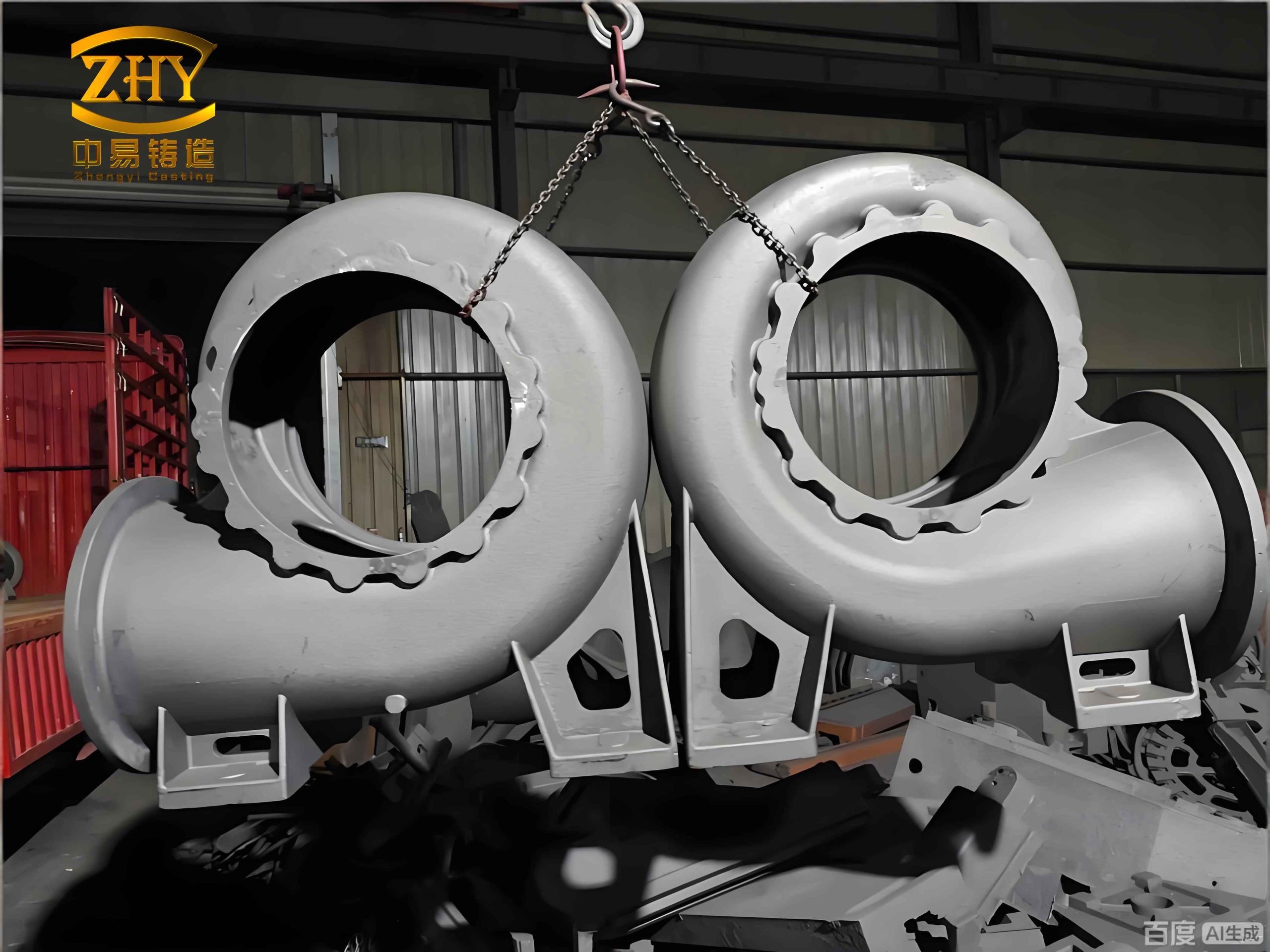
The sand mold design involves a horizontal parting with vertical浇注. A large core forms the internal cavity, while side cores handle external features. Venting holes are added to the core to facilitate gas escape, crucial for avoiding porosity in sand casting products. The assembly sequence ensures proper alignment and stability during pouring. To illustrate the versatility of sand casting, consider the following image showcasing typical sand casting products, which highlights the complexity achievable with this method:
Moving to simulation analysis, I utilize Anycasting software to model the filling and solidification processes. The numerical simulation helps predict potential defects, such as shrinkage porosity and cold shuts, in sand casting products. The governing equations for fluid flow and heat transfer during casting are based on Navier-Stokes and energy conservation principles. For filling, the volume of fluid (VOF) method tracks the metal front, described by:
$$ \frac{\partial \alpha}{\partial t} + \nabla \cdot (\alpha \mathbf{u}) = 0 $$
where \(\alpha\) is the volume fraction and \(\mathbf{u}\) is the velocity vector. For solidification, the heat equation incorporates latent heat release:
$$ \rho c_p \frac{\partial T}{\partial t} = \nabla \cdot (k \nabla T) + \rho L \frac{\partial f_s}{\partial t} $$
Here, \(T\) is temperature, \(k\) is thermal conductivity, \(c_p\) is specific heat, \(L\) is latent heat, and \(f_s\) is solid fraction. Simulation results for the initial design indicate a filling time of 18.7 seconds, with平稳充型 but缺陷 concentration in thick areas, particularly at the bottom corners. The solidification analysis shows late freezing zones, leading to predicted shrinkage defects. This underscores the need for optimization in sand casting products to meet quality standards.
Based on the simulation, I optimize the工艺 by modifying the risers and chills. The open risers are replaced with insulated risers to enhance feeding efficiency, and an additional blind riser is added to the thick bottom section, coupled with extra chill plates. The optimized gating system maintains the same basic layout but with adjusted riser sizes and positions. The new design aims to shift the最后凝固 locations to the risers, thereby isolating defects in these sacrificial areas. The optimization parameters are summarized below:
| Optimization Measure | Details | Expected Impact |
|---|---|---|
| Insulated Risers | Four risers with insulating sleeves | Improve feeding, reduce shrinkage |
| Blind Riser | One at bottom thick zone | Localize defects for easy removal |
| Additional Chills | Two more plates near critical areas | 加快凝固, eliminate hot spots |
| 浇注 System Tuning | Minor adjustments to ingate angles | Enhance flow平稳性 |
Re-simulating the optimized design shows significant improvement. The filling process remains smooth, with no evidence of turbulence or air entrapment. Solidification sequences now indicate that the最后凝固 occurs in the risers, effectively preventing defects in the main铸件 body. Defect prediction maps confirm that porosity and shrinkage are confined to the riser areas, which can be easily removed during post-processing. This outcome validates the optimization strategy for producing high-integrity sand casting products. The comparative analysis between initial and optimized designs can be quantified using a defect index \(D_i\), defined as the volume fraction of predicted defects relative to the铸件 volume:
$$ D_i = \frac{V_{\text{defects}}}{V_{\text{casting}}} \times 100\% $$
For the initial design, \(D_i\) was approximately 2.5%, while after optimization, it reduced to below 0.5%, demonstrating the efficacy of simulation-driven design in sand casting products.
In conclusion, this comprehensive process design and simulation analysis for an aluminum alloy box component underscores the importance of integrating numerical tools with traditional sand casting techniques. By carefully selecting浇注 positions, designing effective gating and risering systems, and using chill plates to control solidification, I achieved a robust工艺 that minimizes internal defects. The use of Anycasting software enabled precise defect prediction and guided optimization steps, resulting in a reliable method for producing complex sand casting products. This approach not only enhances quality but also reduces trial-and-error costs, making it invaluable for industrial applications. Future work could explore advanced materials or real-time monitoring to further refine sand casting products, ensuring their continued relevance in demanding sectors like aerospace and automotive industries.