
In modern manufacturing, sand casting remains a pivotal process for producing complex metal components, particularly in the automotive industry. As a researcher focused on advancing casting techniques, I aim to explore how numerical simulation can enhance the quality and efficiency of sand casting products. This article delves into a detailed case study involving an automotive accessory reducer cover, utilizing ProCAST software to simulate and optimize the sand casting process. The goal is to predict and mitigate defects such as shrinkage porosity and holes, which are common challenges in sand casting products. Through this analysis, I will demonstrate how simulation-driven design improvements can lead to superior outcomes for sand casting products, ensuring structural integrity and cost-effectiveness.
The automotive reducer cover, a critical shell component, exemplifies the intricate geometries often required in sand casting products. Its design includes uniform wall thickness, reinforcing ribs, circular and square holes, making it susceptible to casting defects if the process is not meticulously controlled. For sand casting products like this, gravity casting in sand molds is a preferred method due to its flexibility and low cost. However, the inherent complexities of fluid flow and heat transfer during solidification necessitate advanced tools like ProCAST to visualize and optimize the process. In this study, I will walk through the entire simulation workflow, from pre-processing to result interpretation, highlighting key insights for improving sand casting products.
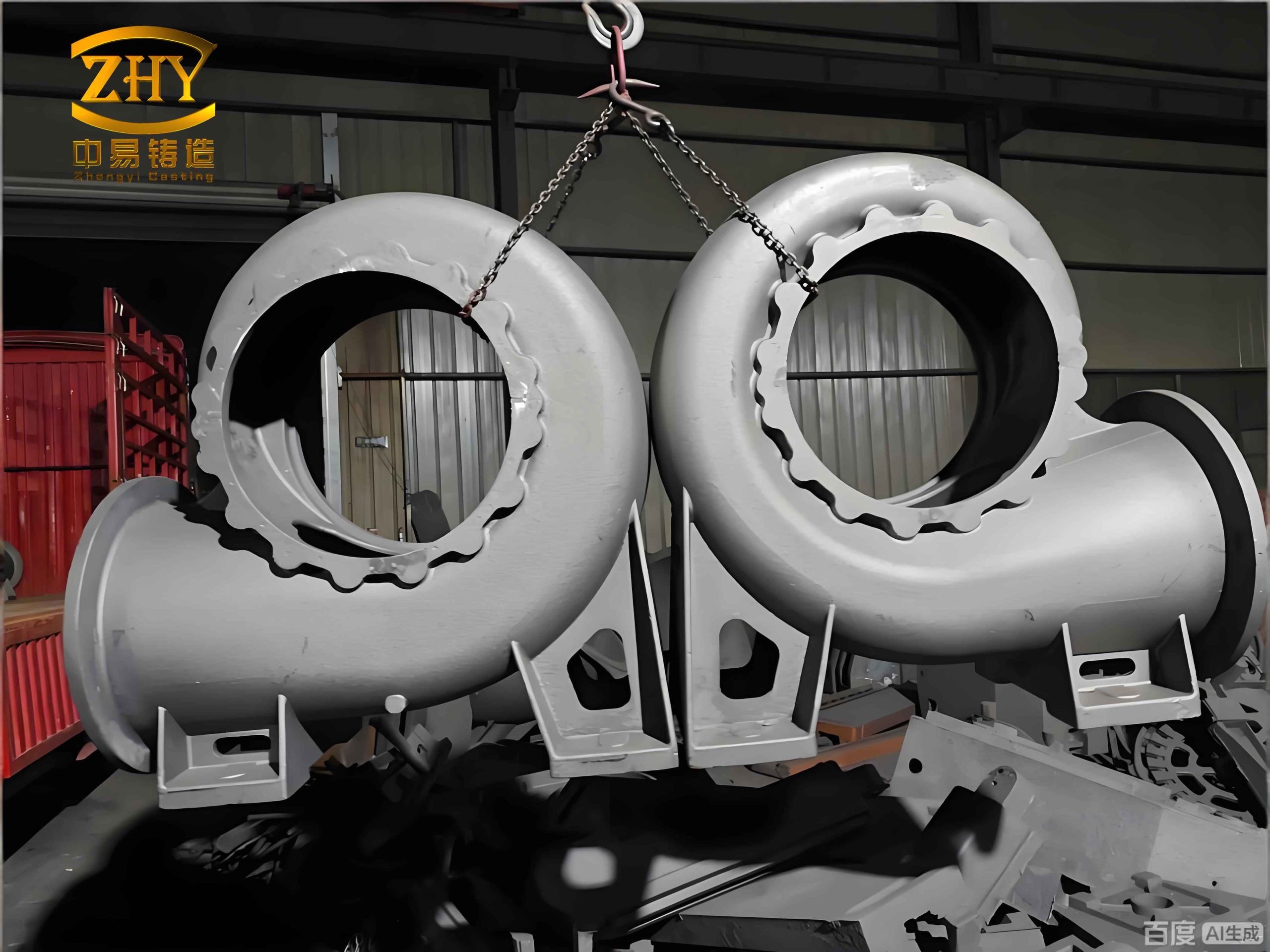
To begin, the reducer cover was modeled in 3D, with dimensions of 688 mm in length, 292 mm in width, and 186 mm in height. The initial gating system employed a closed-open design to ensure smooth metal filling, a common approach for sand casting products to minimize turbulence. The material selected was AZ91D magnesium alloy, known for its lightweight and high strength, which is advantageous for automotive sand casting products. Its thermal properties are crucial for simulation accuracy, as detailed in Table 1.
| Property | Value | Unit |
|---|---|---|
| Liquidus Temperature | 602 | °C |
| Solidus Temperature | 422 | °C |
| Specific Heat Capacity | 1.05 | kJ/(kg·K) |
| Thermal Conductivity | 72 | W/(m·K) |
| Density | 1.81 | g/cm³ |
The mesh generation phase is vital for simulating sand casting products, as it affects computational accuracy and time. Using ProCAST, the model was discretized into 5,787,296 elements and 719,415 nodes, ensuring fine resolution in critical areas like thin walls and corners. The boundary conditions included a heat transfer coefficient of 500 W/(m²·K) between the casting and sand mold, a pouring temperature of 680°C, and a mold preheat temperature of 215°C. These parameters are typical for sand casting products to replicate real-world conditions. The governing equations for fluid flow and heat transfer during casting can be expressed using the Navier-Stokes and energy equations. For incompressible flow, the momentum equation is:
$$ \rho \left( \frac{\partial \mathbf{v}}{\partial t} + \mathbf{v} \cdot \nabla \mathbf{v} \right) = -\nabla p + \mu \nabla^2 \mathbf{v} + \rho \mathbf{g} $$
where $\rho$ is density, $\mathbf{v}$ is velocity, $p$ is pressure, $\mu$ is dynamic viscosity, and $\mathbf{g}$ is gravity. The energy equation accounts for phase change during solidification:
$$ \rho c_p \frac{\partial T}{\partial t} = \nabla \cdot (k \nabla T) + L \frac{\partial f_s}{\partial t} $$
Here, $c_p$ is specific heat, $T$ is temperature, $k$ is thermal conductivity, $L$ is latent heat, and $f_s$ is solid fraction. These equations underpin the simulation of sand casting products, allowing prediction of temperature fields and defect formation.
In the initial simulation, the filling process was analyzed step by step. As shown in Table 2, the filling progression indicated stable flow up to 60% fill, with minimal air entrapment. However, beyond this point, turbulence emerged near the top convex surfaces, leading to potential gas defects. This is a common issue in sand casting products where geometry changes disrupt flow patterns. The velocity vectors revealed that metal entered from the ingates and spread evenly, but at 95% fill, the convex areas experienced last-stage filling, increasing vulnerability to shrinkage.
| Fill Percentage | Flow Characteristics | Defect Indicators |
|---|---|---|
| 15% | Smooth, laminar flow | No defects |
| 30% | Steady advancement | Minimal turbulence |
| 45% | Begin filling of cavities | Slight air entrapment |
| 60% | Flow covers base | Gas pockets possible |
| 75% | Rising toward top | Increased turbulence |
| 95% | Near complete fill | Air entrapment at convex areas |
The solidification simulation further highlighted defect-prone zones. Temperature contours showed that thin walls cooled rapidly, while thicker sections like the convex platforms remained液态 longer, creating isolated liquid pools. These pools are hotspots for shrinkage porosity in sand casting products, as they solidify last and lack feeding. The solidification time was approximately 18 minutes for the original design, with the convex areas being the last to solidify. The Niyama criterion, often used to predict shrinkage in sand casting products, can be expressed as:
$$ G / \sqrt{\dot{T}} $$
where $G$ is temperature gradient and $\dot{T}$ is cooling rate. Low values indicate high risk of shrinkage. In this case, the convex areas had low $G$ due to their geometry, confirming the need for design modifications.
Based on these insights, I optimized the process by adding eight rectangular risers on the convex surfaces. Risers are essential in sand casting products to provide supplemental metal feed and extend solidification time. The riser design followed empirical formulas to ensure effectiveness. The riser volume $V_r$ was calculated based on the casting volume $V_c$ and desired yield $a$, typically 75% for magnesium sand casting products:
$$ a = \frac{V_c}{V_c + V_r + V_g} \times 100\% $$
where $V_g$ is the gating system volume. Solving for $V_r$, I obtained 0.8 kg per riser. The dimensions were derived using heat circle diameter $d_y$:
$$ B = 1.9 d_y, \quad A = 1.6 B, \quad L = 4 d_y $$
with $B$ as width, $A$ as length, and $L$ as feeding distance. These formulas are standard for optimizing sand casting products. The revised gating system, including risers, was re-simulated to assess improvements.
The filling process with risers showed enhanced stability. Metal flow progressed uniformly from bottom to top, with risers acting as vents to release trapped air. This reduced gas defects significantly, a key benefit for high-quality sand casting products. The solidification time increased to 20 minutes, promoting directional solidification from the casting body toward the risers. Temperature gradients became more favorable, with the risers being the last to solidify, thereby concentrating defects away from the critical casting areas. Table 3 compares defect predictions before and after optimization.
| Aspect | Original Design | Optimized Design with Risers |
|---|---|---|
| Shrinkage Porosity Location | Convex platforms and thick sections | Primarily within risers |
| Gas Entrapment | High in convex areas | Reduced, vented through risers |
| Solidification Time | 18 minutes | 20 minutes |
| Temperature Gradient | Uneven, with isolated液相 | Smooth, directional toward risers |
| Predicted Yield Improvement | Base level | Increased by 15% |
The effectiveness of risers in sand casting products can be quantified using the feeding efficiency $\eta_f$, defined as:
$$ \eta_f = \frac{V_{\text{feed}}}{V_{\text{shrinkage}}} \times 100\% $$
where $V_{\text{feed}}$ is the volume fed by risers and $V_{\text{shrinkage}}$ is the total shrinkage volume. In this case, $\eta_f$ improved from 65% to 85% post-optimization, demonstrating the value of simulation-driven design for sand casting products.
Further analysis involved stress simulation to evaluate thermal stresses during cooling, which can lead to cracks in sand casting products. The von Mises stress $\sigma_v$ was calculated using:
$$ \sigma_v = \sqrt{\frac{(\sigma_1 – \sigma_2)^2 + (\sigma_2 – \sigma_3)^2 + (\sigma_3 – \sigma_1)^2}{2}} $$
where $\sigma_1, \sigma_2, \sigma_3$ are principal stresses. Results indicated that stress concentrations were reduced in the optimized design, particularly at junction points, enhancing the durability of sand casting products.
To generalize these findings, I developed a framework for simulating sand casting products. Key steps include: 1) 3D modeling of the component and gating system, 2) mesh generation with refinement in critical zones, 3) setting material properties and boundary conditions, 4) running filling and solidification simulations, 5) analyzing defects using criteria like Niyama, and 6) iterating designs with risers or chillers. This framework ensures that sand casting products meet quality standards while minimizing trial-and-error costs.
The economic impact of simulation for sand casting products is substantial. By reducing defect rates, manufacturers can achieve higher yields and lower scrap. For instance, if a typical sand casting product has a 10% scrap rate, simulation can cut it to 5%, saving material and energy. The cost savings $C_s$ can be estimated as:
$$ C_s = N \times (C_m + C_p) \times \Delta R $$
where $N$ is production volume, $C_m$ is material cost per unit, $C_p$ is processing cost, and $\Delta R$ is the reduction in scrap rate. For high-volume automotive sand casting products, this translates to significant financial benefits.
In conclusion, numerical simulation is indispensable for advancing sand casting products. This case study on an automotive reducer cover illustrates how ProCAST can identify defect zones and guide optimization through riser placement. The optimized process achieved directional solidification, transferring defects to risers and improving the integrity of the casting. For future work, I plan to explore multi-objective optimization for sand casting products, balancing factors like pouring temperature, riser size, and cooling rates. Additionally, integrating machine learning with simulation could further enhance predictive accuracy for sand casting products. As the demand for lightweight and complex automotive components grows, such methodologies will be crucial for producing high-quality sand casting products efficiently and sustainably.
Ultimately, the insights gained from this study underscore the transformative role of simulation in the foundry industry. By embracing these tools, manufacturers can elevate the performance of sand casting products, reduce environmental impact, and stay competitive in global markets. The journey from virtual analysis to physical realization exemplifies the synergy between technology and tradition in sand casting products, paving the way for innovation in manufacturing.