
As a researcher immersed in the field of manufacturing, I have witnessed firsthand the transformative potential of additive manufacturing, commonly known as 3D printing, in revolutionizing traditional processes like sand casting. The production of sand casting products has long relied on wooden patterns, which are time-consuming to create, costly for small batches, and limit design flexibility. In this article, I will elaborate on my exploration of how 3D printing can replace wooden patterns in sand casting, leading to faster, cheaper, and more personalized sand casting products. Through detailed analysis, including tables and formulas, I aim to demonstrate the profound impact of this integration, which promises to redefine the future of casting industries.
The traditional sand casting process involves creating a wooden pattern, around which sand is packed to form a mold. This method, while effective for mass production, becomes inefficient for small to medium batches due to the high cost and long lead time of pattern making. In contrast, 3D printing builds objects layer by layer from digital models, offering a digital, material-efficient alternative. My research focuses on using fused deposition modeling (FDM) with polylactic acid (PLA) material to produce patterns for sand casting, thereby streamlining the workflow for creating diverse sand casting products. This approach not only accelerates prototyping but also enables complex geometries that are difficult to achieve with conventional woodworking.
Additive manufacturing technologies, particularly 3D printing, have gained prominence in recent years for their ability to produce physical objects directly from computer-aided design (CAD) models. Unlike subtractive methods that remove material, 3D printing adds material sequentially, which reduces waste and allows for intricate designs. In the context of sand casting, 3D printing can be applied in two primary ways: first, by printing patterns that replace wooden ones for mold making; and second, by directly printing molds or cores using techniques like selective laser sintering (SLS). My work centers on the first approach, as it is more accessible and cost-effective for small-scale operations aiming to produce high-quality sand casting products. The key advantages include shortened production cycles, lower costs for customization, and enhanced design freedom, all of which are critical for modern manufacturing demands.
To understand the material selection for 3D printed patterns, I compared PLA with acrylonitrile butadiene styrene (ABS), a common thermoplastic in printing. PLA is derived from renewable resources, biodegradable, and exhibits minimal shrinkage during printing, making it ideal for pattern applications where dimensional stability is crucial. The mechanical and thermal properties of these materials directly influence the quality of the resulting sand casting products. Below is a detailed table summarizing their parameters:
| Property | PLA | ABS |
|---|---|---|
| Melting Point | 180°C | 200°C |
| Melt Flow Index | 7.8 g/10 min | 1.43 g/10 min |
| Tensile Yield Strength | 62.63 MPa | 40.96 MPa |
| Elongation at Break | 4.43% | 20.86% |
| Flexural Strength | 65.02 MPa | 45.44 MPa |
| Flexural Modulus | 2504.4 MPa | 1948.45 MPa |
| Notched Impact Strength | 4.28 kJ/m² | 22.11 kJ/m² |
| Printing Temperature | 190-230°C | 220-240°C |
| Key Characteristics | Biodegradable, high stiffness, low warping | Strong odor, suitable for small models |
From this comparison, PLA’s higher stiffness and lower warping tendency make it superior for pattern making, as it ensures accurate mold cavities for sand casting products. The thermal behavior during printing can be modeled using the Arrhenius equation for viscosity, which relates to layer adhesion: $$\eta = A \exp\left(\frac{E_a}{RT}\right)$$ where $\eta$ is the viscosity, $A$ is a pre-exponential factor, $E_a$ is the activation energy, $R$ is the gas constant, and $T$ is the temperature in Kelvin. For PLA, the lower printing temperature reduces energy consumption and minimizes thermal distortion, critical for maintaining pattern integrity.
In my experimental setup, I designed a 3D model of a casting with an internal core, typical for producing complex sand casting products. Using SolidWorks, I created a digital representation of the pattern and core prints, ensuring proper draft angles and tolerances for sand mold assembly. The CAD model was exported to STL format and processed in slicing software, where parameters were optimized for FDM printing. The layer height, a key factor affecting surface finish and printing time, was set to 0.15 mm based on printer precision. The relationship between layer height and surface roughness can be approximated by: $$R_a \approx \frac{h}{2}$$ where $R_a$ is the average surface roughness and $h$ is the layer height. For sand casting, a smoother pattern reduces finishing work on the final sand casting products.
Other printing parameters included a speed of 30 mm/min, nozzle temperature of 205°C, build plate temperature of 70°C to prevent warping, support structure angle of 50°, support spacing of 6 mm, and infill density of 20%. The infill density balances strength and material usage; for pattern applications, a lower infill suffices since the pattern only needs to withstand molding pressures. The printing time, approximately 6 hours, was calculated based on the volume and printing speed. The material consumption totaled 40 grams of PLA filament, costing around $10, significantly lower than wooden pattern fabrication. This efficiency underscores the cost-effectiveness of 3D printing for prototyping sand casting products.
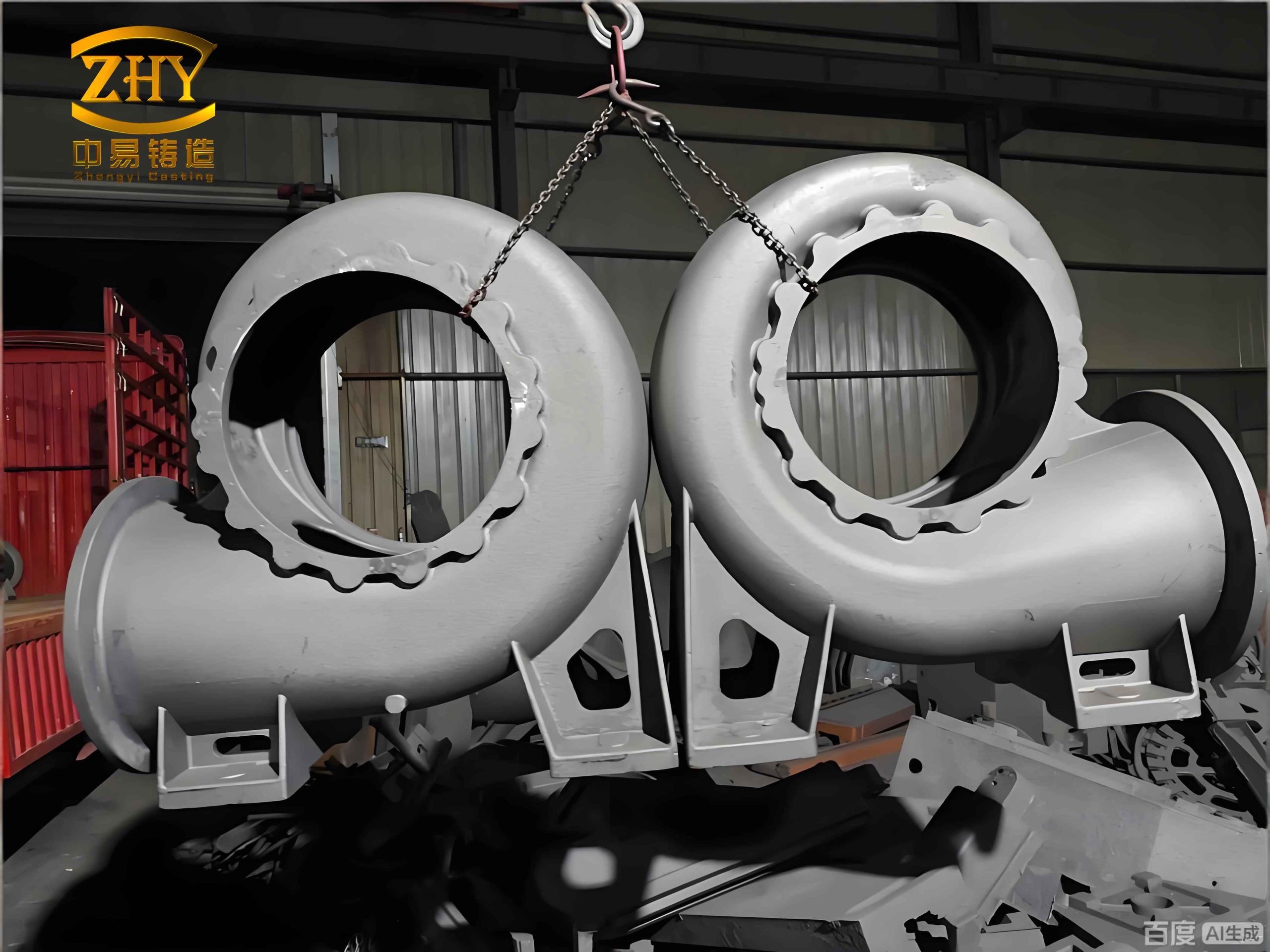
The image above illustrates typical sand casting products, highlighting the versatility and complexity achievable through this method. With 3D printed patterns, such products can be rapidly iterated, allowing for customization without the constraints of traditional tooling. During the printing process, the FDM printer deposits molten PLA in layers, with each layer bonding through thermal fusion. The cooling rate affects crystallinity, which can be modeled by the Avrami equation: $$X(t) = 1 – \exp(-kt^n)$$ where $X(t)$ is the fraction of crystallinity at time $t$, $k$ is a rate constant, and $n$ is the Avrami exponent. For PLA, controlled cooling ensures dimensional stability, essential for accurate sand casting products.
After printing, the pattern and core prints were used in conventional sand casting. I employed a resistance crucible furnace to melt ZL102 aluminum-silicon alloy with 12.5% silicon content, chosen for its fluidity and common use in sand casting products. The molding process involved preparing the drag and cope halves, positioning the 3D printed pattern, and assembling the sand mold with the core. The gating system was designed to minimize turbulence, based on Bernoulli’s principle: $$P + \frac{1}{2}\rho v^2 + \rho gh = \text{constant}$$ where $P$ is pressure, $\rho$ is density, $v$ is velocity, and $h$ is height. Proper gating ensures defect-free sand casting products by controlling metal flow.
Upon pouring the molten alloy at approximately 700°C, the mold was left to cool before shakeout. The resulting casting was cleaned and inspected, revealing good surface detail and dimensional accuracy. To quantify the benefits, I compared the cycle time and cost between 3D printed and wooden patterns for producing this sand casting product. The table below summarizes the findings:
| Aspect | 3D Printed Pattern | Wooden Pattern |
|---|---|---|
| Design and Modeling | 1 hour (CAD work) | 4 hours (drawings and planning) |
| Pattern Fabrication | 5 hours (printing, unsupervised) | 2 days (manual carpentry) |
| Molding and Pouring | 2 hours | 2 hours |
| Total Time | 8 hours | Approximately 50 hours |
| Material Cost | $10 (PLA filament) | $200 (wood and labor) |
| Furnace Operation Cost | $50 | $50 |
| Overall Cost | $60 | $250 |
| Key Outcome | Rapid, low-cost, customizable | Slow, expensive, fixed design |
This comparison clearly shows that 3D printing reduces the total time by over 80% and costs by 76%, making it highly advantageous for small-batch production of sand casting products. The digital workflow also allows for easy modifications, enabling personalized sand casting products without additional tooling expenses. Furthermore, the environmental impact is reduced due to PLA’s biodegradability and lower material waste, aligning with sustainable manufacturing goals.
To delve deeper into the mechanical performance, I analyzed the stress distribution in the 3D printed pattern during molding using finite element analysis (FEA). The pressure exerted by compacted sand can be estimated by: $$P_m = \rho_s g h_s$$ where $P_m$ is the molding pressure, $\rho_s$ is the sand density, $g$ is gravity, and $h_s$ is the sand height. For typical green sand, $\rho_s \approx 1600 \text{ kg/m}^3$, leading to pressures around 0.015 MPa, well within PLA’s compressive strength. The pattern’s infill structure can be optimized using lattice formulas to minimize weight while maintaining rigidity, such as the Gibson-Ashby model for cellular solids: $$\frac{E}{E_s} = C \left(\frac{\rho}{\rho_s}\right)^n$$ where $E$ is the effective modulus, $E_s$ is the solid material modulus, $\rho$ is the density, $\rho_s$ is the solid density, and $C$ and $n$ are constants. For PLA with 20% infill, this ensures adequate strength for producing multiple sand casting products.
In terms of thermal stability, the pattern must withstand the heat from molten metal during pouring. Although PLA has a lower melting point than ABS, its glass transition temperature of around 60°C means it can briefly endure the thermal shock without deforming, as the sand mold insulates the pattern. The heat transfer can be modeled by Fourier’s law: $$q = -k \nabla T$$ where $q$ is the heat flux, $k$ is thermal conductivity, and $\nabla T$ is the temperature gradient. For sand, $k$ is low, protecting the pattern and ensuring accurate mold cavities for sand casting products.
My research also explored the scalability of this method for larger sand casting products. By segmenting large patterns into printable sections and assembling them post-printing, the limitations of printer build volume can be overcome. The alignment accuracy between sections is critical, achievable with dowel pins or digital registration. The cost function for scaling can be expressed as: $$C_{\text{total}} = C_{\text{material}} V + C_{\text{machine}} t + C_{\text{labor}}$$ where $V$ is the volume, $t$ is time, and $C$ terms represent costs. For 3D printing, $C_{\text{machine}}$ and $C_{\text{labor}}$ are low due to automation, making it economical even for large, complex sand casting products.
Looking ahead, the integration of 3D printing with sand casting opens avenues for mass customization and on-demand manufacturing. Industries such as automotive, aerospace, and art can benefit from rapid prototyping of sand casting products with intricate geometries. For instance, topology optimization algorithms can generate lightweight designs that are directly printable as patterns, enhancing performance while reducing material usage. The objective function in optimization might minimize weight subject to stress constraints: $$\min \rho V \quad \text{subject to} \quad \sigma \leq \sigma_{\text{allow}}$$ where $\sigma$ is stress and $\sigma_{\text{allow}}$ is the allowable stress. This synergy between digital design and additive manufacturing will drive innovation in sand casting products.
Moreover, advancements in 3D printing materials, such as composites or high-temperature resins, could further improve pattern durability for high-volume production. The use of machine learning for parameter optimization could automate the printing process, reducing trial and error. For example, neural networks can predict optimal layer heights and temperatures based on desired properties for sand casting products, modeled as: $$y = f(x_1, x_2, \dots, x_n)$$ where $y$ is an output like surface finish, and $x_i$ are input parameters. This data-driven approach will enhance consistency and quality.
In conclusion, my investigation confirms that 3D printing is a game-changer for sand casting, particularly in the realm of sand casting products. By replacing wooden patterns with 3D printed ones, we achieve dramatic reductions in lead time and cost, while unlocking unprecedented design freedom. The use of PLA material in FDM printing offers an eco-friendly, precise solution for pattern making, enabling the production of personalized and complex sand casting products. As technology evolves, I anticipate broader adoption across the casting industry, fostering agility and innovation. This integration not only revitalizes traditional processes but also paves the way for a future where digital and physical manufacturing converge seamlessly, ensuring that sand casting products remain vital in a competitive market.