
In the modern industrial landscape, valves are critical components across sectors such as petrochemicals, power generation, and infrastructure. They operate under extreme pressures and temperatures, demanding exceptional mechanical strength, pressure integrity, and corrosion resistance. Consequently, primary components like valve bodies are predominantly manufactured via casting processes, including sand casting and various forms of **investment casting process**. The market’s escalating demands for superior surface finish, dimensional accuracy, and shorter lead times present significant challenges, especially for large-diameter, thin-walled castings like a 16″-150LB gate valve body. Traditional methods like sand casting or conventional sodium silicate-based **investment casting process** often fall short, leading to issues like sand inclusion, dimensional inaccuracy, and internal shrinkage. To overcome these limitations, we developed and implemented a hybrid **compound investment casting process**, integrating computer simulation for robust process design.
The initial challenge was selecting the appropriate manufacturing route. The target component, a WCB carbon steel valve body with major dimensions of 750 mm x 420 mm x 600 mm and a nominal wall thickness of 17.5 mm, is relatively large yet thin-walled. Sand casting, while cost-effective for large parts, often results in dimensional deviations, sand burn-on, and inadequate feeding for such geometries. A full silica sol-based **investment casting process** guarantees excellent surface quality and precision but is prohibitively expensive for large carbon steel castings. Therefore, we devised a cost-effective hybrid approach: a **compound investment casting process** utilizing a silica sol face coat paired with sodium silicate-based backup coats. This method leverages the superior refractory properties and surface finish of silica sol for the critical inner layers while employing the more economical and faster-drying sodium silicate system to build the necessary shell strength and thickness.
The cornerstone of a successful **investment casting process** is a robust gating and feeding system designed for directional solidification. For this valve body, the major thermal centers are located at the three flanges and the central seat area. We employed CAE simulation software to virtually prototype and optimize the system. The primary goal was to establish a clear thermal gradient from the casting to the risers. The risers were positioned directly over these hot spots. To ensure an open feeding path, chills or padding were added beneath the risers using the “hot-spot circle” method, where the padding taper is derived from the hot spot diameter. The riser volume was calculated to fulfill the feeding demand of the controlled contraction during solidification. A key formula governing the required riser volume ($V_{riser}$) relative to the casting volume ($V_{casting}$) in steel is often expressed as a rule of thumb:
$$ V_{riser} \geq k \cdot V_{casting} $$
where $k$ is a factor accounting for the alloy’s volumetric shrinkage and the riser efficiency, typically ranging from 0.15 to 0.25 for steel. For our design, the total casting weight was 300 kg, and the gating/riser system added 85 kg, yielding a respectable yield of approximately 78%.
The simulation was pivotal in validating the design. It analyzed the filling pattern to minimize turbulence, which can lead to oxide entrapment. Pouring from one side flange riser was identified as optimal, creating a stable, progressive fill front. More critically, the solidification simulation confirmed a perfect directional sequence, as shown by the temperature gradient and fractional solid plots. The criterion for soundness is that the solid fraction ($f_s$) in the risers must remain lower than in the casting body until the casting is fully solidified, mathematically ensuring:
$$ \left( \frac{\partial f_s}{\partial t} \right)_{riser} < \left( \frac{\partial f_s}{\partial t} \right)_{casting} \quad \text{for } t < t_{total} $$
The simulation confirmed this, showing the casting sections solidifying first, followed sequentially by the feeding paths and finally the risers themselves, guaranteeing their effectiveness in combating shrinkage porosity.
| Process Attribute | Sand Casting | Full Silica Sol Investment Casting | Compound (Silica Sol + Na-silicate) Investment Casting |
|---|---|---|---|
| Surface Finish | Poor | Excellent | Very Good |
| Dimensional Accuracy | Low | Very High | High |
| Feeding Control for Thin Walls | Challenging | Excellent | Excellent |
| Shell Refractoriness | N/A | Very High | High (Face Coat Dependent) |
| Relative Cost for Large CS Castings | Low | Very High | Moderate |
| Lead Time for Shell Build | Short | Very Long | Moderate |
The shell-building sequence in this **compound investment casting process** is a carefully engineered multi-layer system. Each layer serves a distinct purpose, and its parameters are tightly controlled, as summarized below.
| Layer Sequence & Function | Binder System | Refractory Flour | Stucco Sand | Stucco Size (Mesh) | Slurry Viscosity (s)* | Number of Layers |
|---|---|---|---|---|---|---|
| Primary Face Coat (Critical for finish) | Silica Sol | Fused Silica | Fused Silica | 50-100 | 55-65 | 2 |
| Secondary Face/Transition Coat | Silica Sol | Mulite | Mulite | 30-60 | 60-70 | 2 |
| Backup Coat (Builds strength) | Sodium Silicate | Aluminosilicate | High Alumina | 10-20 | 50-60 | 4 |
*Viscosity measured in a standard flow cup.
The face coats are crucial. Fused silica is used for its very low coefficient of thermal expansion, minimizing the risk of shell cracking, and high purity, which provides excellent resistance to metal penetration at the high pouring temperatures required for steel. The transition to sodium silicate after two silica sol and two intermediate coats significantly reduces the overall shell-building time and cost. The sodium silicate-based coats are hardened in a crystallizing aluminum chloride solution, which reacts to form silica gel and aluminum hydroxide, providing rapid green strength. The total shell thickness ($\delta_{shell}$) can be estimated based on the number of layers and the average stucco size, a critical factor for withstanding the metallostatic pressure ($P_m$) during pouring:
$$ P_m = \rho g h $$
where $\rho$ is the metal density, $g$ is gravity, and $h$ is the height of the metal head. The shell must possess sufficient hot strength to resist this pressure without distortion. After dewaxing in a hot water bath, the shell is fired at high temperature (typically above 1000°C) to develop final strength, burn out residuals, and prepare it for pouring.
Melting and pouring are conducted with strict parameter control to complement the precision of the **investment casting process**. The WCB chemistry is tightly controlled to ensure mechanical properties and weldability, with slight enhancements over the ASTM A216 standard for improved consistency in our **investment casting process**.
| Element | ASTM A216 WCB Max. | Internal Control Target |
|---|---|---|
| C | 0.30 | 0.18 – 0.21 |
| Si | 0.60 | 0.35 – 0.55 |
| Mn | 1.00 | 0.80 – 1.00 |
| P | 0.040 | ≤ 0.035 |
| S | 0.045 | ≤ 0.030 |
Melting is performed in a medium-frequency induction furnace. Deoxidation is a multi-stage process: preliminary deoxidation with ferrosilicon and ferromanganese in the furnace, followed by a final aluminum wire addition before tapping. A further aluminum wire addition (0.01%) in the ladle provides final cleansing. The pouring temperature ($T_{pour}$) is a critical parameter, balancing fluidity against the risk of shell reaction and grain growth. It is calculated based on the liquidus temperature ($T_L$) of the alloy:
$$ T_{pour} = T_L + \Delta T_{superheat} $$
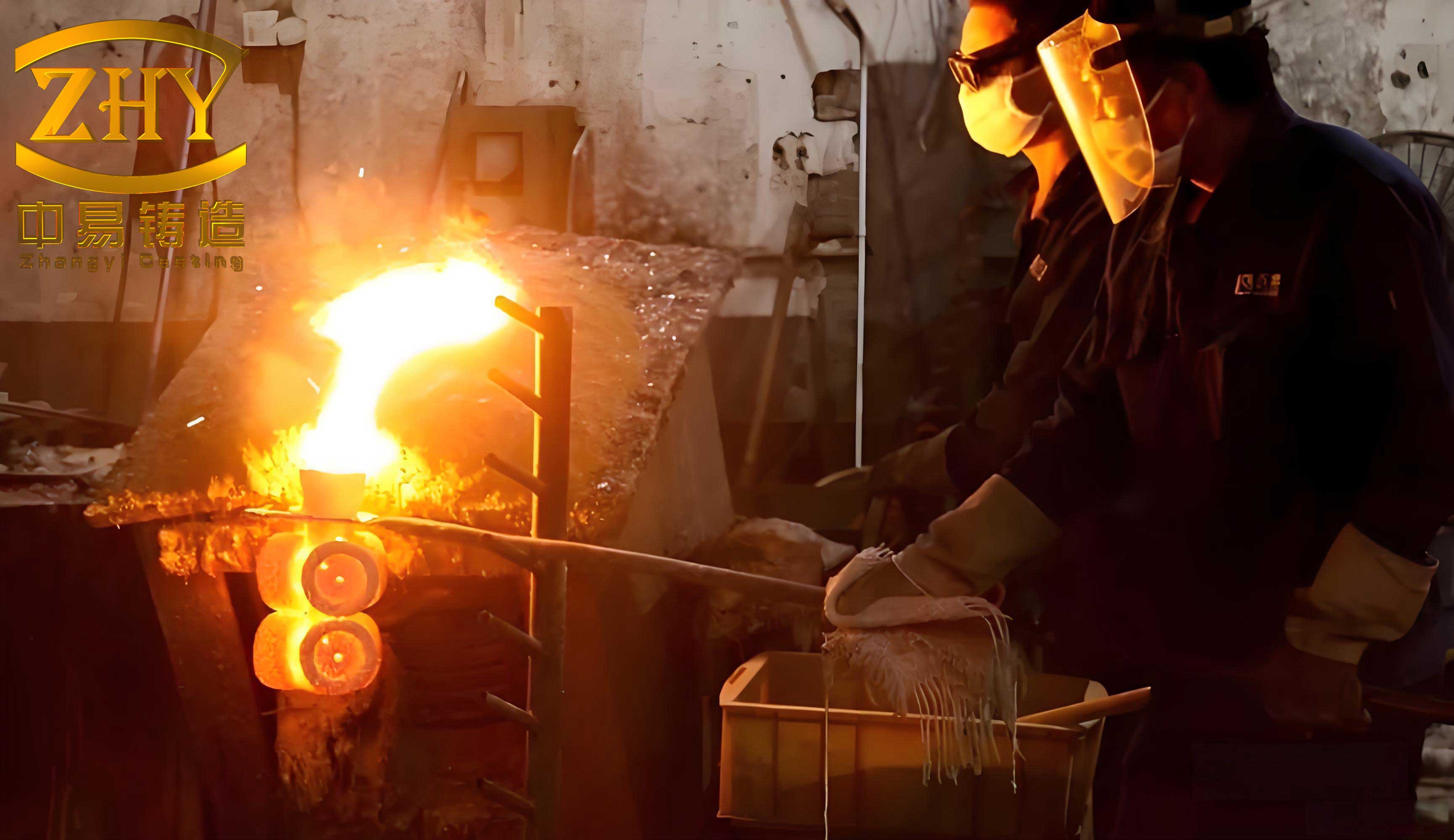
For this WCB steel with a $T_L$ of approximately 1510°C, a superheat ($\Delta T_{superheat}$) of 70-80°C was used, resulting in a $T_{pour}$ of 1580°C ± 10°C. The pouring sequence follows the simulation guidance: a slow pour is initiated into one side flange riser to establish calm flow, then the stream is increased to fill the mold rapidly up to the riser necks. The pour is paused briefly to allow a solid skin to form on the casting, then the risers are topped up sequentially to maintain a hot, molten reservoir for efficient feeding. This practice maximizes the thermal gradient and feeding efficiency, which are hallmarks of a well-executed **investment casting process**.
As-cast steel components possess a coarse, non-uniform microstructure with significant residual stress. Therefore, heat treatment is mandatory to achieve the required mechanical properties and machinability. For WCB, a full austenitizing followed by air cooling (normalizing) is employed. The process involves heating the castings to a temperature above the Ac3 transformation line, holding for sufficient time to achieve complete austenitization, and then cooling in still air. The holding time ($t_{hold}$) is a function of the section thickness ($D$), often estimated by:
$$ t_{hold} = k \cdot D $$
where $k$ is a coefficient (e.g., 1.5 to 2.0 minutes per centimeter of thickness). This treatment refines the grain structure, homogenizes the microstructure, and relieves casting stresses. The result is a uniform ferrite-pearlite microstructure with enhanced toughness and consistent mechanical properties throughout the casting, as verified by separately cast test coupons.
| Mechanical Property | ASTM A216 WCB Requirement | Average Result from Process Coupons |
|---|---|---|
| Tensile Strength, $\sigma_b$ | 485 – 655 MPa | 512 MPa |
| Yield Strength, $\sigma_{0.2}$ | ≥ 250 MPa | 324 MPa |
| Elongation, A | ≥ 22 % | 42 % |
| Reduction of Area, Z | ≥ 35 % | 51 % |
The successful development and production of the 16″-150LB valve body validate the efficacy of the integrated approach combining CAE simulation and the **compound investment casting process**. The castings exhibited excellent surface quality, dimensional conformity, and were free from internal shrinkage defects as confirmed by non-destructive testing. This **compound investment casting process** effectively addresses the trilemma of quality, cost, and lead time for large-diameter, medium-pressure valve bodies. The use of simulation minimizes costly trial-and-error, while the hybrid shell system optimizes the cost-structure of the **investment casting process**. This methodology provides a reliable and scalable solution for producing high-integrity, complex steel castings where both precision and economy are paramount, extending the competitive edge of the **investment casting process** into a domain traditionally dominated by less precise methods.