
The landscape of manufacturing is undergoing a profound transformation, driven by the principles of additive manufacturing, commonly known as 3D printing. My exploration into this field reveals its most disruptive potential lies not in replacing traditional methods outright, but in augmenting and revolutionizing them. Among these, the ancient yet precision-centric investment casting process has found a powerful ally in 3D printing technologies. This synergy is dismantling long-standing barriers related to complexity, lead time, and cost, particularly for low-volume, high-complexity components. This article delves into the technical integration of 3D printing within the investment casting process, analyzing its workflows, comparative advantages, and the resultant expansion of design possibilities, all framed from a firsthand perspective of technological adoption and analysis.
Fundamental 3D Printing Technologies: A Foundational Overview
To understand the fusion with casting, one must first grasp the core 3D printing methodologies. While numerous variants exist, several key technologies form the backbone of modern additive manufacturing applications in foundries. Their operational principles are distinct, catering to different material and precision requirements.
Vat Polymerization (Stereolithography – SLA): This process utilizes a photopolymer resin cured by a UV laser layer by layer. It is renowned for producing parts with excellent surface finish and high dimensional accuracy, making it a prime candidate for creating intricate patterns for the investment casting process.
Material Jetting (PolyJet): Similar to inkjet printing, this technology jets photopolymer materials which are instantly cured by UV light. It allows for multi-material printing and supports extremely fine details, ideal for complex, multi-feature sacrificial patterns.
Powder Bed Fusion – Plastic (Selective Laser Sintering – SLS): A laser selectively sinters (fuses) powdered polymer material, such as nylon or wax-composite blends. The unsintered powder supports the structure, enabling the creation of geometries impossible with traditional machining. It is directly applicable for creating robust casting patterns.
Binder Jetting: This process involves depositing a liquid binding agent onto a thin layer of powder (polymer, sand, or metal). For casting, it is revolutionary for directly printing sand molds and cores (3D Sand Printing) without any traditional pattern, as well as for printing ceramic or plaster molds for investment casting.
Fused Deposition Modeling (FDM): A thermoplastic filament is heated and extruded through a nozzle, depositing material layer by layer. While typically used for prototypes and functional parts, advanced materials have enabled its use for creating robust, low-cost sacrificial patterns or even mold boxes for certain casting applications, as demonstrated in the initial study on bearing housing sand casting patterns.
The selection of a specific 3D printing technology for augmenting the investment casting process depends on a matrix of factors, as summarized in the table below.
| 3D Printing Technology | Typical Pattern Material | <strongkey advantage="" casting | Primary Limitation | Best Suited For |
|---|---|---|---|---|
| Stereolithography (SLA) | Photopolymer Resins (Burn-out grades) | Superior surface finish & fine detail capture | Relatively brittle; requires support structures | High-precision, intricate components (e.g., turbine blades, medical implants) |
| Material Jetting (PolyJet) | Photopolymer Resins | Multi-material printing; ultra-high resolution | Higher material cost; lower heat resistance | Complex assemblies printed as one piece with varying properties |
| Selective Laser Sintering (SLS) | Nylon, Wax-Polymer Blends | Mechanically strong patterns; no support needed | Grainy surface finish often requires sealing | Functional prototypes and end-use patterns with undercuts |
| Binder Jetting (for patterns) | Plaster/Polymer Composite, Sand | Fast printing of large patterns; direct ceramic shell mold printing | Lower strength; may require infiltration | Large components or direct mold fabrication |
The Universal 3D Printing Workflow: From Concept to Physical Object
Regardless of the specific technology, the digital-to-physical workflow of 3D printing follows a consistent sequence. This process is the digital thread that integrates seamlessly with the investment casting process.
1. 3D Model Creation: It all begins with a digital model. This can be generated using Computer-Aided Design (CAD) software, derived from reverse engineering via 3D scanning, or even created through algorithmic generative design. For the investment casting process, this model must already incorporate necessary casting allowances: shrinkage, draft (if required for the pattern removal in traditional methods, often eliminated with 3D printing), and machining stock. The shrinkage allowance is particularly critical and is a multiplicative factor applied to the final part dimensions. If the linear shrinkage of the metal alloy is denoted by $S$, the pattern dimension $D_{pattern}$ is calculated from the desired final cast dimension $D_{final}$ as:
$$D_{pattern} = D_{final} \times (1 + S)$$
For instance, for an aluminum alloy with 1.3% shrinkage, a 100 mm desired part requires a pattern sized at 101.3 mm.
2. Model Preparation and Slicing: The CAD model is exported, typically in STL (Stereolithography) format, which approximates surfaces with a mesh of triangles. This file is then imported into printer-specific software. Here, the part is oriented optimally to minimize support material, build time, and to ensure critical surfaces have the best possible finish. The software then “slices” the model into hundreds or thousands of thin horizontal layers, generating a machine-readable path (G-code) for each layer. Layer thickness ($\Delta z$) is a key parameter influencing surface quality and build time. The total build time $T_{build}$ can be approximated by considering the time per layer $t_{layer}$, which is a function of layer area, print speed, and recoating/dipping time:
$$T_{build} \approx \sum_{i=1}^{n} t_{layer}(i)$$
where $n = \frac{H}{\Delta z}$ and $H$ is the total part height.
3. Additive Manufacturing Process: The printer executes the G-code, building the part layer by layer through its specific mechanism (laser curing, material jetting, sintering, extrusion). This stage is largely automated.
4. Post-Processing: After printing, parts almost always require post-processing. This includes support structure removal, washing off uncured resin or excess powder, and surface finishing (sanding, polishing, sealing). For patterns used in the investment casting process, a critical post-processing step is often applying a sealant to achieve a perfectly smooth, non-porous surface to ensure the ceramic shell replicates it faithfully.
Revolutionizing the Investment Casting Process with 3D Printing
The traditional investment casting process relies on injecting wax or similar material into expensive, machined metal dies to create sacrificial patterns. This makes economic sense only for high-volume production. For prototypes, complex cores, or low-volume batches, the cost and lead time for these dies are prohibitive. 3D printing directly addresses this bottleneck by enabling the rapid, tool-less production of these sacrificial patterns, or even by bypassing the pattern stage altogether.
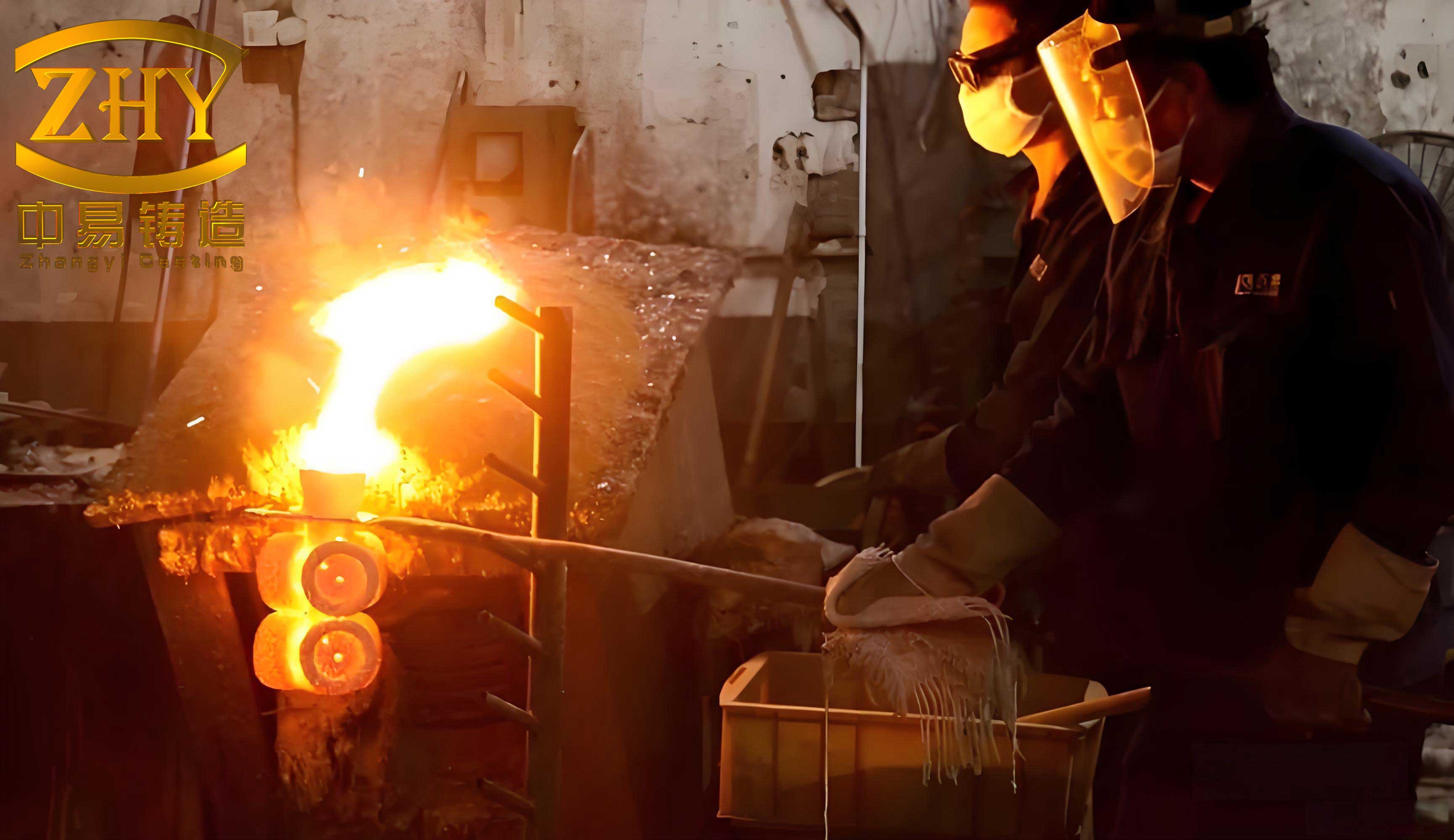
Pathway 1: 3D Printed Sacrificial Patterns. This is the most direct integration. Technologies like SLA, Material Jetting, and SLS are used to print patterns using specialized materials designed to burn out cleanly from the ceramic shell. The workflow becomes:
- Design and 3D print the pattern cluster (including gates, runners, and risers).
- Assemble multiple patterns onto a central wax sprue to form a “tree.”
- Dip the tree into a ceramic slurry, coat with stucco sand, and repeat to build up a robust shell (the same as traditional investment).
- De-wax/ Burn-out: The entire assembly is placed in a furnace. The 3D printed pattern material melts, vaporizes, or burns out completely, leaving a hollow ceramic cavity.
- Preheat the ceramic mold and pour molten metal.
- After cooling, break away the ceramic shell to reveal the metal casting tree.
The benefits are transformative: lead times can shrink from months to weeks or even days, and the cost of complex geometry becomes virtually independent of complexity.
Pathway 2: Direct Shell Production. Binder Jetting technology can be used to print the ceramic shell mold directly, completely eliminating the need for a physical pattern. In this process:
- A print head deposits a liquid binder onto a thin layer of ceramic powder (e.g., silica, zircon), binding it selectively.
- Layer by layer, a porous ceramic mold is created, incorporating the part cavity, gating system, and vents in one integrated piece.
- The unbound powder is removed, and the mold is sintered to gain strength.
- Molten metal is then poured directly into this 3D printed ceramic mold.
This represents the ultimate digital foundry, where a CAD model goes directly to a ready-to-pour mold with zero tooling or pattern-making steps.
The economic and operational impact of integrating 3D printing into the investment casting process is stark when quantified, as shown in the comparative analysis below.
| Parameter | Traditional Investment Casting (with Metal Dies) | 3D Printing-Enhanced Investment Casting (Printed Patterns) | Quantitative Advantage |
|---|---|---|---|
| Initial Tooling Lead Time | 8 – 16 weeks | 24 – 72 hours (for pattern printing) | Reduction of >90% |
| Tooling Cost for Complex Part | $20,000 – $100,000+ | $500 – $5,000 (pattern material & print time) | Cost saving of 85-99% |
| Geometric Complexity Cost Impact | Exponential increase with undercuts, internal channels | Near-zero marginal cost increase | Enables previously “un-castable” designs |
| Design Change Implementation | Costly and slow; requires new/modified dies | Fast and cheap; modify CAD and re-print | Agility improved by orders of magnitude |
| Ideal Production Volume | High volume (>10,000 pieces) | Low to medium volume (1 – 10,000 pieces) | Perfect for prototyping, bridge production, and bespoke parts |
Technical Deep Dive: Material Considerations and Process Optimization
The success of the 3D printed investment casting process hinges on material science and precise process control. Key technical challenges must be addressed.
Pattern Material Burn-out Characteristics: The printed pattern must completely decompose during the dewaxing/burn-out stage without leaving ash residue that could cause surface defects on the final casting. This requires precise thermal decomposition profiles. The burn-out cycle must be carefully calibrated to the specific polymer. The rate of heating $R_{h}$ must be slow enough to avoid cracking the ceramic shell from rapid gas generation, which can be modeled by considering the pressure buildup $P$ inside the shell:
$$P \propto \frac{\dot{m}_{gas} \cdot R \cdot T}{V_{cavity}}$$
where $\dot{m}_{gas}$ is the rate of gas generation from the decomposing pattern, $R$ is the universal gas constant, $T$ is the temperature, and $V_{cavity}$ is the cavity volume. A controlled, multi-stage furnace cycle is essential.
Dimensional Accuracy and Compensation: Multiple sources of dimensional deviation exist: the shrinkage of the 3D printed polymer during curing/cooling, the expansion/contraction of the ceramic shell during firing, and the solidification shrinkage of the metal. A comprehensive compensation factor must be applied to the original CAD model. If we denote:
- $C_{print}$ as the shrinkage factor of the printed pattern,
- $C_{ceramic}$ as the dimensional change factor of the fired ceramic shell,
- $C_{metal}$ as the solidification shrinkage factor of the alloy,
then the final dimension $D_{final}$ is related to the dimension in the master CAD file $D_{CAD}$ by a combined compensation $C_{total}$:
$$D_{final} = D_{CAD} \times C_{total}$$
where $C_{total}$ is empirically derived and often close to $(1 + C_{metal})$, assuming the pattern and shell processes are calibrated to be dimensionally neutral, which is a significant engineering challenge.
Surface Finish and Porosity: The surface finish of the 3D printed pattern is directly transferred to the ceramic shell and thus to the metal casting. SLA and Material Jetting provide the best as-printed surfaces. SLS and FDM parts often exhibit a “stair-stepping” effect or grainy texture, requiring additional sealing (e.g., with a thin wax coating or epoxy infiltrant) to achieve a casting-worthy surface. The surface roughness $R_a$ of the final casting is a function of the pattern’s roughness and the ceramic slurry’s ability to replicate it:
$$R_{a,casting} \approx f(R_{a,pattern}, \text{slurry particle size}, \text{stucco sand size})$$
| Material Type (Technology) | Example Material | Ash Content | Key Advantage | Typical Casting Alloy Suitability |
|---|---|---|---|---|
| Photopolymer Resin (SLA) | Burn-out/ Castable Resins | < 0.02% | Excellent detail, smooth finish | All alloys (Steel, Ni-based, Al, Ti) |
| Wax-like Photopolymer (PolyJet) | Visijet M3 CAST | < 0.01% | Mimics injection wax; easy cluster assembly | All alloys, especially precious metals |
| Polymer/Wax Composite (SLS) | Polyamide (PA) with filler | < 0.05% (after infiltration/sealing) | Mechanical strength for handling | Aluminum, Bronze, Steel |
| High-Temperature Resin (DLP/SLA) | Ceramic-filled resins | > 30% (converts to ceramic) | Can be burned out to form part of the shell itself | Specialty applications |
Challenges, Future Directions, and Conclusion
Despite its transformative potential, the marriage of 3D printing and the investment casting process is not without challenges. Material costs for high-performance castable resins remain high. The build volume of high-precision printers (like SLA) can limit the size of parts or clusters. Achieving consistent, production-level reliability in terms of surface finish and dimensional repeatability across multiple builds requires rigorous process control and operator expertise. Furthermore, post-processing steps like support removal and sealing add manual labor and time.
The future trajectory points towards greater integration and automation. Developments in direct shell printing via binder jetting will mature, offering faster turnaround for simpler geometries. Hybrid approaches will emerge, such as 3D printing only the complex core sections of a pattern while using traditional methods for simpler body sections. Machine learning and artificial intelligence are poised to play a significant role in optimizing print orientation, support generation, and predicting thermal distortions to automate the compensation factor calculation. The trend is towards a fully digital thread, from generative design and topology optimization directly to a digital mold ready for printing and pouring.
In conclusion, 3D printing is not merely an alternative for creating prototypes within the investment casting process; it is a foundational technology that is reshaping the economics and possibilities of precision metal casting. By decoupling cost from complexity and drastically reducing lead times, it empowers designers with unprecedented freedom and provides manufacturers with agile, responsive production capabilities for low-to-medium volumes. From aerospace turbines to biomedical implants, the synergy of additive and formative manufacturing is unlocking a new era of innovation, proving that the most profound advancements often come from the convergence of the digital and the physical, the new and the timeless.