
In my extensive research into ancient metallurgical techniques, I have delved deeply into the origins and evolution of lost-wax casting, a topic that has long captivated scholars worldwide. The debate surrounding its inception in China remains unresolved, with conflicting views based on archaeological artifacts and historical records. To address this, I turned to the modern investment casting process, which shares the core principle of lost-mold fabrication with ancient lost-wax methods. By conducting detailed investigations and simulations, I aim to reverse proof the ancient techniques through the lens of contemporary practices. This article presents my first-person perspective on how the investment casting process can illuminate the complexities of lost-wax casting, using empirical observations, formulas, and tables to summarize key insights. Throughout this exploration, I will repeatedly emphasize the investment casting process as a bridge to understanding historical craftsmanship.
The study of lost-wax casting in China spans nearly a century, yet consensus eludes the academic community. Early scholars proposed various hypotheses for its technical origins, such as the “lost-wax and lost-weave method,” “peeling wax method,” “wax-pasting method,” “brush-shell method,” “lost-lead method,” “leak-lead method,” and “burn-out method.” These ideas revolve around how the initial solid mold was created, but they all hinge on the fundamental principle of losing the mold—a concept that underpins both ancient and modern practices. In my view, the investment casting process, as a refined version of lost-wax casting, offers a unique vantage point to dissect these historical puzzles. By examining modern industrial procedures, I can infer the challenges and solutions that ancient artisans might have faced.
Academic debates have evolved through phases, from initial assumptions of complete lost-wax casting to periods dominated by block-mold casting theories. The discovery of intricate openwork bronzes, like the Zeng Hou Yi zun-pan and the Xichuan xia-si copper jin, sparked intense disputes over whether these artifacts were made via lost-wax or piece-mold techniques. Critics argue that features like mold seams or flow marks are not definitive proof, leading to a stalemate. In my analysis, this impasse arises from a narrow focus on specific artifact types, such as openwork ornaments. To move forward, I believe we must broaden the scope to include hollow vessels and other forms, leveraging the investment casting process to identify universal technical signatures. For instance, recent studies on bronze waterfowl from the Qin Shihuang Mausoleum have shifted attention to hollow objects, revealing clues through residual core materials and repair traces—a direction I find promising for understanding the lost-mold principle.
To ground my research, I conducted hands-on investigations of the investment casting process in industrial settings. This modern method involves five main stages: wax pattern making, shell building, pouring, post-processing, and inspection. I focused on the wax pattern and shell-building steps, as they are most relevant to ancient techniques. Below, I detail my observations, supported by formulas and tables to encapsulate critical parameters.
Wax Pattern Manufacturing in the Investment Casting Process
In the investment casting process, wax pattern creation is a meticulous procedure that mirrors ancient wax-working practices. I observed that wax handling begins with melting medium-temperature wax blocks at 90°C, blending new and recycled wax in a 9:1 ratio. This step highlights a key aspect often overlooked in historical studies: wax回收 and reuse. Ancient artisans likely faced similar material constraints, necessitating efficient wax management. The viscosity of molten wax, crucial for flow and molding, can be described by the Arrhenius equation for temperature dependence:
$$ \eta = A e^{E_a / (RT)} $$
where $\eta$ is viscosity, $A$ is a constant, $E_a$ is activation energy, $R$ is the gas constant, and $T$ is temperature. In ancient contexts, wax blends might have included animal fats or plant resins, altering these properties.
During wax injection, pressure is applied at 4–6 MPa to fill模具 cavities, followed by rapid cooling via water-cooled plates at 8–13°C. This process ensures precise replication, but it also introduces artifacts like flow lines or seams—features that parallel ancient wax模 defects. I noted that demolding relies on compressed air to break vacuum adhesion, a technique reminiscent of the proposed “lost-wax and lost-weave method” where fabrics aided release. For complex internal structures, ceramic cores are used, analogous to ancient core supports or chaplets. In my experiments, I documented how these cores prevent漂芯 during wax injection, much like芯骨 in historical bronzes. To summarize wax pattern parameters, I developed Table 1:
| Parameter | Typical Range | Ancient Analog |
|---|---|---|
| Wax Melting Temperature | 90°C | Animal fats or beeswax blends |
| Injection Pressure | 4–6 MPa | Manual pressing or pouring |
| Cooling Temperature | 8–13°C | Ambient or water cooling |
| Wax Recycling Ratio | 1:9 (new:old) | Likely high reuse due to scarcity |
| Core Material | Ceramic | Clay or sand cores |
Wax pattern修整 involves removing seams, bubbles, and flow marks—imperfections that could leave traces on final castings. In ancient lost-wax casting, similar flaws might manifest as ridges or folds, often debated as evidence. For example, the “folds” observed on Zeng Hou Yi zun-pan could stem from wax welding or repair, a common step in modern investment casting process when assembling pattern trees. I used electric soldering irons at 120–130°C to join wax components, creating localized wrinkles that resemble archaeological findings. This reinforces the idea that ancient artisans may have combined multiple wax pieces, rather than carving monolithic models.
Shell Building and Its Implications for Ancient Techniques
The shell-building phase in the investment casting process is where slurry formulations and layering techniques come into play. I prepared面层 slurry by mixing zircon flour (140 mesh) with silica sol,消泡剂, and distilled water, aiming for a viscosity of 10±2 seconds as measured by a flow cup. The slurry’s stability is governed by the DLVO theory for colloidal systems:
$$ V_T = V_A + V_R $$
where $V_T$ is total potential energy, $V_A$ is attractive van der Waals forces, and $V_R$ is repulsive electrostatic forces. Ancient artisans might have used natural clays and binders like salt or paper pulp to achieve similar effects, as hinted in historical texts describing “thin slurry” and “fine yellow earth.” In my experiments, I found that slurry viscosity critically affects shell permeability and strength—factors essential for successful dewaxing and pouring.
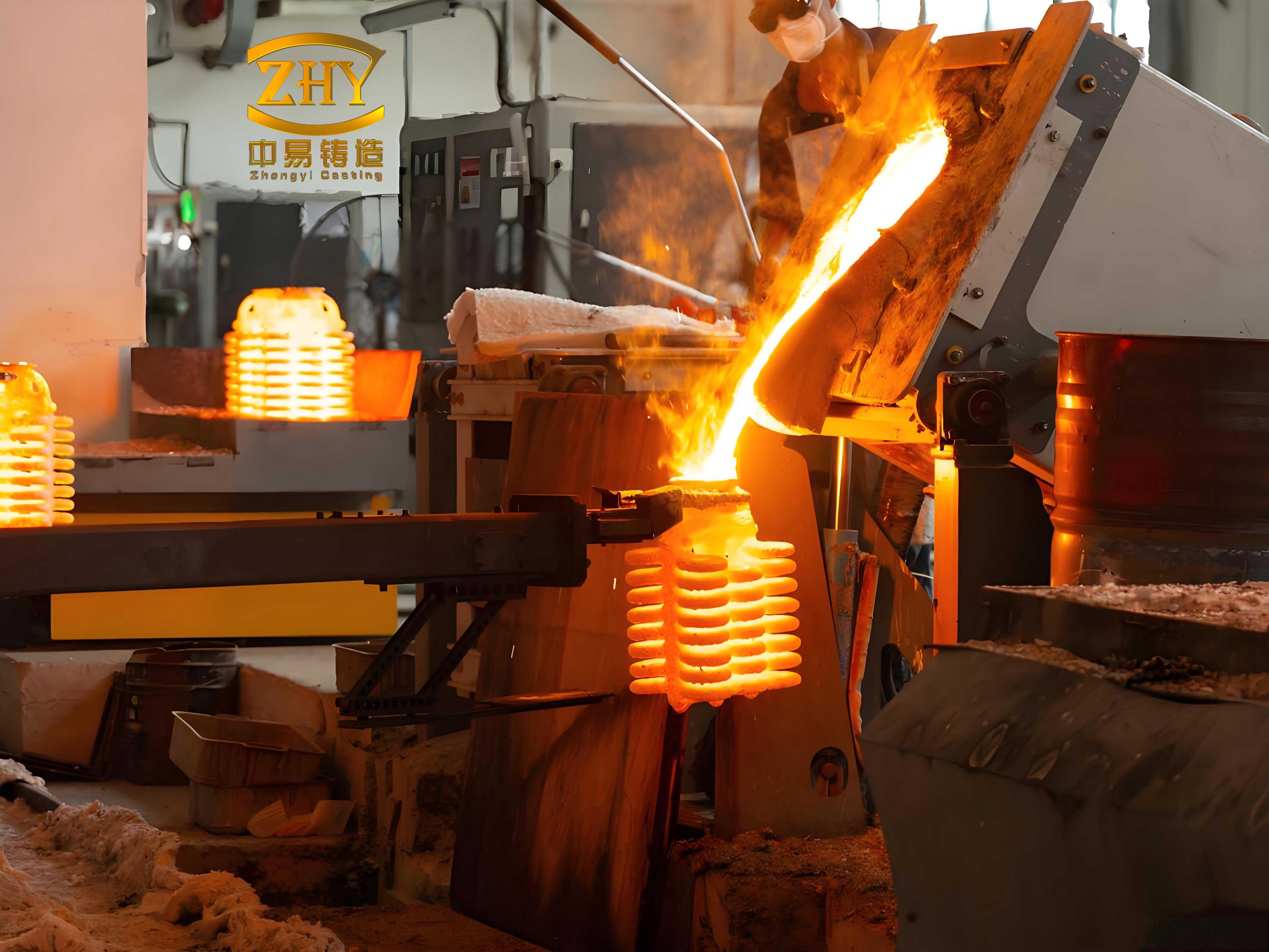
After dipping wax patterns into slurry, I applied stucco砂 of progressively coarser grades (80–120 to 16 mesh) for背层, building 3–4 layers to ensure shell integrity. Each layer required drying in controlled humidity, a process that could take days—a time constraint ancient craftsmen likely faced. Dewaxing was done using steam at 300°C, which removes wax but may leave residues. Historically, wax could be melted out via fire heating or boiling water, with the latter allowing for wax recovery. I estimate that ancient dewaxing temperatures hovered around the wax’s melting point (~140°C), based on the formula for heat transfer during thermal removal:
$$ Q = m c_p \Delta T $$
where $Q$ is heat input, $m$ is wax mass, $c_p$ is specific heat, and $\Delta T$ is temperature change. Inefficient heating might have caused wax burn-off, increasing ash content in molds—a potential clue in archaeological residues.
Shell焙烧 at 1050°C enhances strength through sintering, a process described by the Frenkel model for viscous flow:
$$ \frac{1}{\eta} = \frac{1}{\eta_0} e^{-Q_s / (RT)} $$
where $\eta_0$ is initial viscosity and $Q_s$ is sintering activation energy. Ancient shells, made of clay-rich materials, would have sintered at lower temperatures, but the principle remains: color changes (e.g., whitening) indicate completion, a heuristic I observed in modern kilns. Shell repairs with slurry patches are common, mirroring ancient fixes that could leave distinct fracture patterns in excavated molds. To encapsulate shell-building parameters, I present Table 2:
| Parameter | Modern Value | Ancient Inference |
|---|---|---|
| Slurry Viscosity | 10±2 s (face), 17±2 s (back) | Empirical adjustments with clays |
| Stucco Grit Size | 140 to 16 mesh | Graded sand or crushed ceramics |
| Drying Time | 1–2 days per layer | Natural air drying, days to weeks |
| Dewaxing Temperature | 300°C (steam) | Fire heating or boiling water |
| 焙烧 Temperature | 1050°C | ~800–1000°C for clay shells |
| Shell Layers | 3–4 | Multiple layers for strength |
Through this detailed shell analysis, I infer that ancient lost-wax casting relied on similar multilayer, permeable structures. The investment casting process thus serves as a robust analog for testing historical assumptions, such as the role of organic additives in slurry or the impact of drying conditions on shell cracking.
Reverse Proofing Ancient Lost-Wax Casting via Investment Casting Process
In my reverse proofing endeavor, I applied insights from the investment casting process to reevaluate ancient techniques. For instance, the “lost-wax and lost-weave method” proposed for northern animal-style plaques suggests fabric was used to aid demolding. In modern practices, I observed that fabric-like materials can reduce vacuum adhesion during wax pattern release, supporting this hypothesis. Similarly, the “folds” on bronze artifacts might originate from wax flow during pattern assembly or repair—a phenomenon I replicated by welding wax parts, yielding wrinkles that match archaeological descriptions.
Wax recycling is another area where the investment casting process offers clues. Ancient artisans likely reclaimed wax from dewaxing processes, possibly using sedimentation to separate impurities. The mass balance for wax recovery can be expressed as:
$$ m_{\text{recycled}} = m_{\text{initial}} – m_{\text{lost}} – m_{\text{ash}} $$
where $m_{\text{lost}}$ accounts for burnout losses. Inefficient recovery would have increased material costs, prompting innovations in wax blends or dewaxing methods.
Core usage in the investment casting process, such as ceramic cores for internal channels, parallels ancient芯骨 and芯撑 found in hollow bronzes like chariots or waterfowl. I analyzed how cores maintain dimensional accuracy during wax injection, a challenge ancient craftsmen solved with clay cores or metal chaplets. The stress on cores during pouring can be modeled via Euler-Bernoulli beam theory:
$$ \sigma = \frac{M y}{I} $$
where $\sigma$ is stress, $M$ is bending moment, $y$ is distance from neutral axis, and $I$ is moment of inertia. Ancient cores might have been optimized empirically to withstand thermal and mechanical loads.
Furthermore, slurry formulation in the investment casting process underscores the importance of colloidal chemistry. Historical texts mention “salt and paper” as additives, which could act as flocculants or strengtheners. The effect of salt on slurry viscosity can be approximated by the empirical formula:
$$ \eta_{\text{slurry}} = \eta_{\text{base}} + k C_{\text{salt}} $$
where $k$ is a constant and $C_{\text{salt}}$ is salt concentration. Such tweaks would have been crucial for achieving durable shells without modern synthetic binders.
To synthesize these cross-comparisons, I developed Table 3, linking modern investment casting process steps to ancient lost-wax casting features:
| Modern Investment Casting Step | Ancient Lost-Wax Feature | Evidence from Reverse Proofing |
|---|---|---|
| Wax injection with pressure | Manual wax shaping or pouring | Flow lines and seams on artifacts |
| Ceramic cores for internal voids | Clay cores or chaplets in bronzes | Residual core materials in excavations |
| Slurry dipping and stuccoing | Multilayer clay molds | Shell fragments with layered structures |
| Steam dewaxing at 300°C | Fire or water-based wax removal | Ash residues or wax drips on molds |
| Shell焙烧 for strength | Kiln firing of clay molds | Vitrified mold surfaces |
| Wax recycling and blending | Reuse of wax materials | Economic constraints in ancient production |
This table illustrates how the investment casting process provides a framework for interpreting archaeological data. By simulating ancient conditions—such as using natural waxes or clay slurries—I could test hypotheses about mold-making and casting outcomes.
Technological Iteration Crises in Lost-Mold Principles
In my research, I also explored the broader context of technological evolution. Both ancient lost-wax casting and the modern investment casting process face similar crises: they are specialized techniques often superseded by more efficient methods. For example, sand casting frequently replaces investment casting for simpler parts, just as piece-mold casting might have been preferred over lost-wax for bulk production in antiquity. This dynamic highlights the “lost-mold principle” as a niche solution for complex geometries.
The economic viability of the investment casting process hinges on cost-benefit analysis, which can be formalized as:
$$ C_{\text{total}} = C_{\text{material}} + C_{\text{labor}} + C_{\text{equipment}} $$
where $C_{\text{total}}$ is total cost, and the process is justified only for high-value components. Ancient lost-wax casting likely followed a similar logic, reserved for ritual bronzes or prestige items. As technologies iterate, manual skills decline; in modern investment casting process settings, I observed that half the craft relies on artisanal know-how—a echo of ancient craftsmanship now at risk of being lost.
Moreover, the investment casting process itself confronts obsolescence from additive manufacturing or precision machining. The rate of technological displacement can be modeled using logistic growth curves:
$$ \frac{dP}{dt} = r P \left(1 – \frac{P}{K}\right) $$
where $P$ is adoption of new technology, $r$ is growth rate, and $K$ is carrying capacity. For ancient lost-wax casting, the “K” might have been limited by material availability or social需求, leading to its sporadic use.
Through this lens, I argue that the study of investment casting process is not merely academic; it preserves the continuum of lost-mold principles. By documenting modern procedures in detail, we safeguard insights that could fade with automation—much like how ancient techniques are inferred from scant evidence.
Conclusion and Future Directions
My investigation into the investment casting process as a reverse proof for lost-wax casting has yielded multifaceted insights. By examining wax pattern fabrication, shell building, and core usage, I have identified parallels that help demystify ancient practices. The recurring theme of the investment casting process throughout this study underscores its utility as an analytical tool. Formulas and tables have allowed me to quantify parameters that ancient artisans might have optimized empirically, such as slurry viscosity or dewaxing temperatures.
Looking ahead, I recommend further interdisciplinary studies that combine investment casting process experiments with archaeological science. For instance, analyzing organic residues in ancient mold fragments could reveal wax compositions or binder types. Similarly, simulating historical wax blends in modern investment casting process trials could test hypotheses about flow behavior or defect formation. The lost-mold principle, embodied in both ancient and modern contexts, remains a fertile ground for research.
In closing, I emphasize that the investment casting process is more than a manufacturing method; it is a living repository of technical heritage. By embracing this perspective, we can bridge temporal divides and appreciate the ingenuity embedded in lost-wax casting—a testament to human innovation across millennia.