
My extensive experience in the foundry industry, particularly within the realm of precision casting, has been significantly shaped by the challenges and requirements of the petrochemical sector. The demand for valves capable of operating reliably in low-temperature environments has grown increasingly stringent. Specifications such as SH/T 3064-2003, which govern the selection, inspection, and acceptance of steel valves in petrochemical plants, establish rigorous criteria that manufacturers must meet. While many investment casting foundries, especially in regions known for valve production, are familiar with common materials, a recurring issue I have observed is the conflation of low-temperature carbon steel (LCB) with the general-purpose cast carbon steel (WCB). This misunderstanding often leads to products that either meet strength requirements but fail in low-temperature impact toughness, or vice versa. This persistent problem underscores the critical necessity to delve deeply into and master the specific investment casting process for LCB steel valve bodies. The following discussion consolidates my practical insights and systematic approach to producing qualified low-temperature valve components.
The valve body serves as the primary pressure-bearing component, directly subjected to medium pressure. Its material must possess the requisite mechanical properties under specified service temperatures and pressures. A fundamental challenge with cast carbon steels is the phenomenon of cold brittleness, where toughness plummets and brittleness increases dramatically at low temperatures, raising the risk of catastrophic brittle fracture. Consequently, the paramount requirement for low-temperature valve body materials is their ability to retain sufficient ductility and toughness. The primary acceptance criterion, therefore, becomes the Charpy V-notch impact value at the designated low temperature. The American Society for Testing and Materials (ASTM) standard A352/A352M, “Standard Specification for Steel Castings, Ferritic and Martensitic, for Pressure-Containing Parts, Suitable for Low-Temperature Service,” clearly delineates the performance requirements for grade LCB, as summarized in Table 1.
| Property | Requirement | Note |
|---|---|---|
| Tensile Strength, σb | 65 – 90 ksi (455 – 630 MPa) | Range specified. |
| Yield Strength, σ0.2 | 35 ksi (245 MPa) min. | Minimum value. |
| Elongation, δ (%) | 24 min. | Minimum value. |
| Reduction of Area, Ψ (%) | 35 min. | Minimum value. |
| Charpy V-Notch Impact, (-46°C / -50.8°F) | 14 J min. (single specimen) 18 J avg. (3 specimens) |
Key low-temperature property. |
Note: 1 ksi ≈ 6.895 MPa. QT: Quenched and Tempered; NT: Normalized and Tempered.
A common pitfall in the investment casting process for this material stems from a superficial reading of the standard. While ASTM A352 specifies identical chemical composition ranges for LCB and WCB, their mechanical property requirements diverge profoundly, most notably in the mandatory low-temperature impact toughness for LCB. Assuming the chemistries are interchangeable without strategic selection is a fundamental error that inevitably leads to substandard impact values. Optimal mechanical properties are intrinsically guaranteed by a carefully chosen chemical composition. For cast carbon steel intended for low-temperature service, the foundational principle is to reduce carbon content to increase the proportion of ferrite in the microstructure, which is inherently more ductile and tough. The strategic selection of alloying elements within the permissible ranges transforms what appears to be a simple carbon steel into an effective C-Mn or low-alloy steel, enabling the achievement of balanced properties through subsequent heat treatment.
The chemical composition is the first and most critical lever to control. The standard composition ranges are provided in Table 2. The art lies in selecting specific targets within these bounds.
| Element | ASTM A352 Max. | Typical Target for LCB | Rationale |
|---|---|---|---|
| C | ≤ 0.30 | 0.14 – 0.18 | Minimized to maximize ferrite, ensuring ductility and low-temperature toughness. Strength is compensated by other elements. |
| Si | ≤ 0.60 | ~0.40 | Essential for deoxidation. Higher levels can promote temper embrittlement and raise ductile-brittle transition temperature. |
| Mn | ≤ 1.00* | 1.00 – 1.20 | Primary strengthening element. Compensates for strength loss from low C. Improves hardenability. The standard allows Mn increase if C is reduced. |
| P | ≤ 0.04 | As low as possible | Severe embrittling element. Strictly controlled via raw materials. |
| S | ≤ 0.045 | As low as possible | Forms inclusions harmful to toughness. Controlled via raw materials. |
| Ni | ≤ 0.50 | 0.20 – 0.40 | Strengthens ferrite, improves toughness, and significantly lowers the ductile-brittle transition temperature. |
| Cr | ≤ 0.50 | 0.20 – 0.35 | Enhances hardenability and provides solid solution strengthening. |
| Mo | ≤ 0.20 | 0.05 – 0.10 | Suppresses grain growth, enhances strength, and mitigates temper embrittlement. |
| RE | – | ~0.10 (as FeSiRE) | Not in standard. Added for deoxidation, inclusion modification, and grain refinement, boosting impact toughness. |
* Note: The standard allows Mn to exceed 1.00% if carbon is below the maximum, typically 0.04% Mn increase per 0.01% C decrease.
The effect of carbon can be conceptually related to strength and transition temperature. A simplified expression for the ductile-brittle transition temperature (DBTT) trend is: $$ DBTT \propto f([C]) $$ where a lower carbon content $[C]$ generally shifts the DBTT to a lower temperature. Manganese plays a dual role in strengthening and mitigating sulfur’s effect. Its influence on yield strength can be approximated as an additive contribution. The combined effect of key elements on hardenability, crucial for the subsequent quenching step, is often estimated using the ideal critical diameter $D_I$ formula, such as the Grossmann approach, where $D_I$ is a function of the composition: $$ D_I = f([C], [Mn], [Ni], [Cr], [Mo]…) $$ A higher $D_I$ allows thicker sections to transform to martensite upon quenching, which is essential for achieving high strength in the final tempered condition.
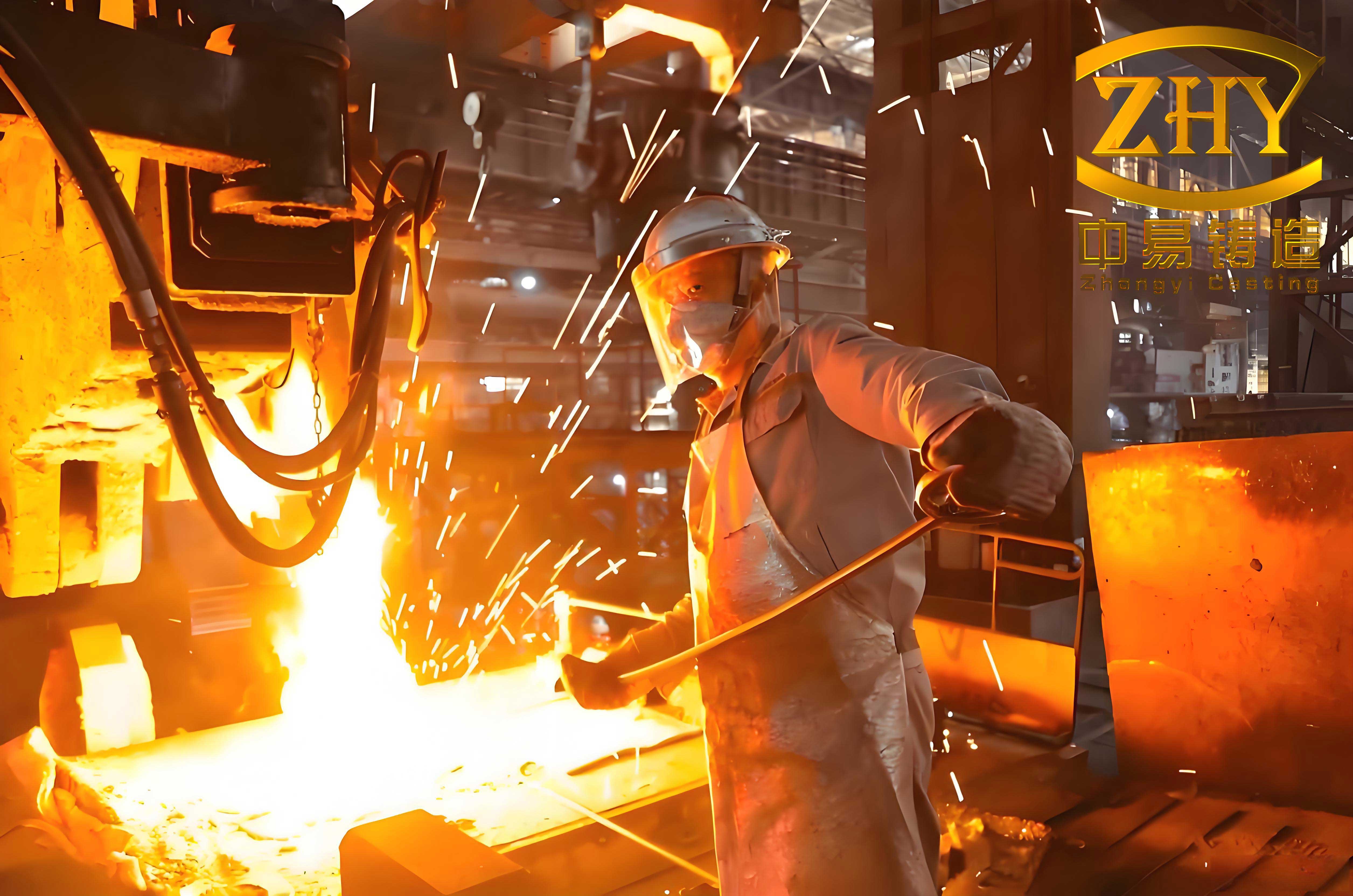
The investment casting process itself imposes specific design constraints and considerations for a valve body. The primary objective is to produce a sound, dense casting free from shrinkage porosity, which is critical for pressure integrity. The process naturally lends itself to the principle of directional solidification.
Gating and Risering System: A top-gating system with feeders (risers) attached via in-gates is typically employed. The molten metal enters through the feeder, promoting thermal gradients that solidify the casting toward the feeder, which feeds shrinkage. The in-gates are strategically placed on thick sections like the valve’s end flanges or center body flange. Their dimensions are critical: width is typically 1/4 to 1/3 of the flange diameter, and thickness is 1.2 to 1.5 times the flange thickness. For large, high-pressure valve bodies, additional feeding aids or chills might be incorporated into the wax pattern to enhance directional solidification.
Pattern and Die Design: The linear casting shrinkage for LCB steel in ceramic shell molds typically ranges from 1.8% to 2.2%. The die is designed to produce a wax pattern that includes the in-gates (riser connections) but not the main runners or pour cup, which are often assembled later. Draft angles and partings are designed to facilitate mold release and pattern extraction. For complex valve bodies, careful attention is paid to avoiding hot spots and ensuring uniform shell thickness.
Process Yield: The yield, or casting yield, defined as the weight of the casting divided by the total weight of metal poured (casting + gating system), is a key economic factor. For valve bodies, a yield of 60% to 65% is common. The runner system must be robust enough to withstand handling during shell building and dewaxing, leading to somewhat thicker runners compared to sand casting.
Common Casting Defects in the Investment Casting Process: Leakage under hydrostatic test and failure to meet mechanical properties are universal concerns. However, the layered nature of the ceramic shell introduces unique defect possibilities. “Lamination” defects such as rat tails, scabs, or washes can occur if the bond between successive ceramic shell layers is inadequate. During dewaxing (autoclave or flash fire), the expansion of the wax can delaminate weak layers. Similarly, non-uniform thermal expansion during shell firing or prolonged exposure to molten metal can cause layer separation. These defects often manifest on large, flat, or gently curved surfaces of the casting. Environmental control, especially humidity in the slurry room, and strict process control in slurry viscosity, stuccoing, and drying are paramount to prevent these issues.
Heat treatment is the final and decisive step in tailoring the microstructure to achieve the balance of strength and low-temperature toughness specified in Table 1. The standard allows for either Normalizing & Tempering (NT) or Quenching & Tempering (QT). However, practical experience strongly dictates the optimal choice. To illustrate this, consider the data from two distinct compositional and heat treatment approaches summarized in Table 3.
| Parameter | Trial 1: Higher Carbon (0.26% C), Lower Mn (0.86%) | Trial 2: Lower Carbon (0.16% C), Higher Mn (1.08%), Added Ni | ||
|---|---|---|---|---|
| Heat Treatment | 910°C Normalize + 650°C Temper | 910°C Quench + 650°C Temper | 910°C Normalize + 650°C Temper | 910°C Quench + 650°C Temper |
| Tensile Strength (MPa) | 462 | 405 | 479 | 517 |
| Yield Strength (MPa) | 257 | 240 | 265 | 323 |
| Elongation (%) | 26 | 30 | 27 | 38 |
| Reduction of Area (%) | 36 | 37 | 38 | 40 |
| Impact @ -46°C (J) – Min | 6 | 19 | 8 | 18 |
| Impact @ -46°C (J) – Avg (3) | 11 | 26 | 12 | 26 |
| Assessment | Strength OK (NT), Impact FAILS. Quench improves impact but strength is borderline low. | Normalize gives good impact but low strength. Quench & Temper delivers balanced, specification-meeting properties. | ||
The data unequivocally demonstrates that for LCB to reliably meet all requirements, a low-carbon, higher manganese composition with small additions of nickel must be processed via a full quenching and tempering cycle. The normalizing treatment, while sometimes yielding acceptable impact values, cannot reliably produce the required yield strength (≥ 245 MPa). The quenching operation transforms the austenite into a martensitic structure, providing a high-strength base. The subsequent tempering then relieves stresses, improves ductility and toughness, and precipitates carbides to achieve the final stable microstructure. The tempering temperature, typically between 620°C and 680°C, is carefully selected to optimize the toughness-strength balance. The kinetic transformation during tempering can be described by tempering parameter models like the Hollomon-Jaffe parameter: $$ P = T (k + \log t) $$ where $T$ is the absolute temperature, $t$ is time, and $k$ is a constant. This parameter helps in predicting the equivalent microstructural state for different time-temperature combinations.
In conclusion, the successful production of qualified LCB steel low-temperature valve bodies via the investment casting process is a multifaceted engineering challenge that requires a synergistic approach. It begins with a clear understanding of the service requirements, moving beyond a simple reading of standard composition tables. A strategic, lean chemical composition is fundamental: low carbon (0.14-0.18%), high manganese (up to 1.2%), with purposeful micro-additions of nickel, chromium, and rare earths. The investment casting process must be meticulously designed to ensure soundness, employing principles of directional solidification with properly sized gates and feeders, while maintaining strict shell-building controls to prevent lamellar defects. Finally, the heat treatment cycle is not an option but a necessity: a full austenitizing quench followed by a high-temperature temper is essential to develop the fine-tempered martensitic or bainitic microstructure that delivers the crucial combination of strength and superior low-temperature impact toughness. Mastery of each of these stages—composition design, precision casting, and controlled heat treatment—is indispensable for consistently manufacturing valve bodies that meet the rigorous demands of low-temperature petrochemical service.