
In the realm of advanced materials engineering, casting aluminum alloys hold significant importance due to their favorable strength-to-weight ratio, corrosion resistance, and versatility in applications across aerospace, automotive, and defense industries. Among these, ZL210A alloy has emerged as a promising candidate, offering high strength, good machinability, and cost-effectiveness compared to alternatives like ZL205A, which require stringent purity controls and expensive raw materials. My focus in this investigation is to delve into the influence of the investment casting process on the microstructural evolution and mechanical properties of ZL210A alloy. The investment casting process, known for its ability to produce complex, near-net-shape components with excellent surface finish, presents unique thermal conditions that can profoundly affect alloy behavior. By comparing it with sand casting and metal mold casting, I aim to provide a detailed understanding of how this sophisticated manufacturing technique shapes the alloy’s performance in as-cast, solid-solution, and aged states.
The investment casting process involves creating a ceramic shell around a wax pattern, which is then melted out to form a mold cavity for metal pouring. This method typically results in slower cooling rates due to the insulating nature of the ceramic shell, leading to distinct microstructural features. In contrast, sand casting offers moderate cooling, while metal mold casting provides rapid solidification. To systematically evaluate these effects, I conducted experiments involving alloy preparation, casting via different methods, heat treatments, and comprehensive mechanical testing. The goal is to correlate process parameters with material properties, using quantitative analyses through tables and formulas to encapsulate key findings.
First, I prepared the ZL210A alloy using high-purity aluminum (99.99%) and master alloys, with the chemical composition detailed in Table 1. The melting was carried out in a resistance furnace at 740°C, followed by refinement with C2Cl6 to ensure homogeneity. Specimens were cast using three methods: investment casting with ceramic shells, sand casting with SLS-coated sand, and metal mold casting. After machining into standard tensile bars, the samples underwent heat treatment: solid solution at (540±5)°C for 7 hours with water quenching, and aging at (155±5)°C for 6.5 hours with furnace cooling. Mechanical properties, including tensile strength (σ_b), yield strength (σ_0.2), elongation (δ), and Vickers hardness (HV), were measured using universal testing machines and hardness testers. Microstructural observation was performed via optical microscopy to assess grain size and phase distribution.
| Element | Cu | Mn | Ti | Cd | Si | Mg | Zn | Zr | Fe | Al |
|---|---|---|---|---|---|---|---|---|---|---|
| Standard Range | 4.50-5.10 | 0.35-0.80 | 0.15-0.35 | 0.07-0.50 | ≤0.20 | ≤0.05 | ≤0.10 | ≤0.15 | ≤0.15 | Bal. |
| Actual Composition | 5.01 | 0.55 | 0.21 | 0.20 | 0.10 | 0.0007 | 0.0005 | 0.0002 | 0.15 | Bal. |
The microstructural analysis revealed that the investment casting process consistently produced coarser grain structures compared to sand and metal mold casting, regardless of the state—as-cast, solid-solution, or aged. This is attributed to the reduced cooling rate in the ceramic shell, which allows for longer solidification times and grain growth. For instance, in the as-cast condition, investment-cast samples exhibited prominent grain boundaries with significant eutectic phase segregation, while sand and metal mold samples showed finer, more equiaxed grains. After solid solution treatment, the investment-cast specimens retained coarse grains but with dissolved phases into the matrix, leading to a supersaturated solid solution. Aging further promoted the precipitation of fine dispersoids, such as T-Al12CuMn2 and θ-Al2Cu phases, which are critical for strengthening. The grain size effect can be quantified using the Hall-Petch relationship:
$$ \sigma_y = \sigma_0 + k d^{-1/2} $$
where $\sigma_y$ is the yield strength, $\sigma_0$ is the friction stress, $k$ is a material constant, and $d$ is the average grain diameter. In investment casting, larger $d$ values result in lower $\sigma_y$, explaining the observed strength reductions relative to other methods. However, the investment casting process also enhances hardness due to better phase distribution and reduced porosity, as evidenced by higher HV values.
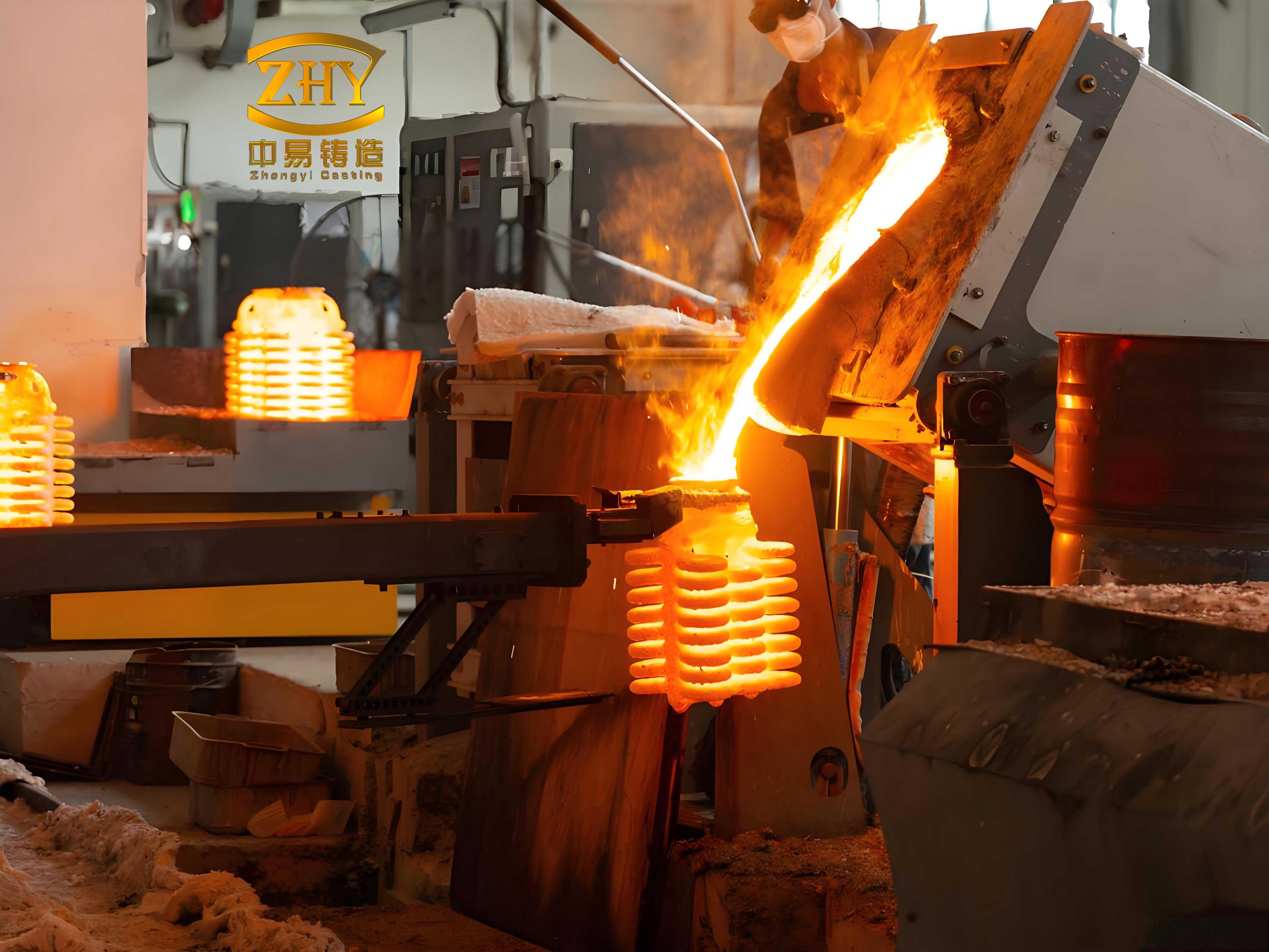
To illustrate the investment casting process in action, consider the following visual representation of precision components manufactured via this technique:
The mechanical properties data are summarized in Table 2, highlighting the comparative performance across casting methods and heat treatment states. For investment-cast samples, the as-cast tensile strength was 187 MPa, slightly lower than sand-cast (198 MPa) and metal mold-cast (220 MPa) counterparts. This aligns with the coarse microstructure induced by the investment casting process. However, elongation for investment casting matched metal mold casting at 9%, surpassing sand casting’s 7%, indicating better ductility in certain aspects. Hardness values were superior for investment casting, with as-cast HV of 65 compared to 61 for sand and 60 for metal mold, suggesting enhanced resistance to deformation due to microstructural features unique to this process.
| Casting Method | State | σ_b (MPa) | σ_0.2 (MPa) | δ (%) | Hardness (HV) |
|---|---|---|---|---|---|
| Investment Casting | As-Cast | 187 | 67 | 9 | 65 |
| Solid Solution | 262 (1.4×) | 134 (2.0×) | 10 (1.1×) | 78 (1.2×) | |
| Aged | 410 (2.2×) | 295 (4.4×) | 9 (1.0×) | 134 (2.1×) | |
| Sand Casting | As-Cast | 198 | 83 | 7 | 61 |
| Solid Solution | 317 (1.6×) | 141 (1.7×) | 9 (1.3×) | 73 (1.2×) | |
| Aged | 416 (2.1×) | 166 (2.0×) | 14 (2.0×) | 98 (1.6×) | |
| Metal Mold Casting | As-Cast | 220 | 94 | 9 | 60 |
| Solid Solution | 330 (1.5×) | 150 (1.6×) | 14 (1.6×) | 72 (1.2×) | |
| Aged | 418 (1.9×) | 180 (1.9×) | 16 (1.8×) | 78 (1.3×) |
Solid solution treatment significantly improved properties across all casting methods. For the investment casting process, σ_b increased by 1.4 times, σ_0.2 by 2.0 times, δ by 1.1 times, and hardness by 1.2 times relative to as-cast values. This enhancement stems from the dissolution of alloying elements like Cu and Mn into the aluminum matrix, creating a supersaturated solid solution that strengthens via lattice strain. The strengthening contribution can be modeled using solid solution strengthening theory:
$$ \Delta \sigma_{ss} = G b \sqrt{c} $$
where $\Delta \sigma_{ss}$ is the strength increment, $G$ is the shear modulus, $b$ is the Burgers vector, and $c$ is the solute concentration. In investment-cast samples, despite coarse grains, the effective $c$ from dissolved phases leads to notable hardening. Aging treatment further amplified strength and hardness for investment casting, with σ_b reaching 410 MPa (2.2× as-cast), σ_0.2 at 295 MPa (4.4×), and HV at 134 (2.1×). However, elongation remained unchanged at 9%, indicating a trade-off between strength and ductility due to precipitate-matrix interactions. The aging response can be described by precipitation hardening mechanisms, where fine dispersoids act as obstacles to dislocation motion. The Orowan strengthening equation provides insight:
$$ \Delta \sigma_{age} = \frac{0.4 G b}{\pi \sqrt{1-\nu}} \cdot \frac{\ln(2r/b)}{L} $$
Here, $\Delta \sigma_{age}$ is the strength increase, $\nu$ is Poisson’s ratio, $r$ is the precipitate radius, and $L$ is the inter-precipitate spacing. In the investment casting process, the slower cooling may promote more uniform precipitate distribution, enhancing hardness despite grain coarseness.
To delve deeper, I analyzed the microstructural phases using quantitative metallography. The investment casting process resulted in a higher volume fraction of T-Al12CuMn2 phases, which are thermally stable and contribute to hardness. In contrast, sand and metal mold casting showed finer θ-Al2Cu precipitates after aging, aiding strength but with different size distributions. The interplay between grain size and precipitate morphology is crucial; for investment casting, coarse grains reduce strength but are compensated by dense precipitates, leading to superior hardness. This is encapsulated in a combined strengthening model:
$$ \sigma_{total} = \sigma_0 + \Delta \sigma_{gb} + \Delta \sigma_{ss} + \Delta \sigma_{age} $$
where $\sigma_{total}$ is the overall strength, $\Delta \sigma_{gb}$ is grain boundary strengthening (inversely proportional to $d^{1/2}$), and other terms are as defined. For investment-cast samples, $\Delta \sigma_{gb}$ is lower due to large $d$, but $\Delta \sigma_{age}$ is higher, aligning with the observed hardness trends.
The investment casting process also influences defect formation, such as porosity and shrinkage, which can affect mechanical properties. Due to the ceramic shell’s insulating effect, solidification occurs gradually, reducing thermal gradients and minimizing hot tearing but potentially increasing microporosity. However, in ZL210A alloy, the hardness benefits suggest that any porosity is offset by phase transformations. To quantify this, I consider the density of defects using empirical relations, though detailed non-destructive testing would be needed for full validation.
In terms of applications, the investment casting process offers advantages for manufacturing complex, thin-walled components where precision is paramount. For ZL210A alloy, this means that despite slightly lower tensile strength compared to other methods, the high hardness and good elongation make it suitable for aerospace parts requiring wear resistance and dimensional accuracy. For instance, turbine blades or structural brackets produced via investment casting could leverage these properties. The process parameters, such as pouring temperature and shell thickness, can be optimized to refine grains—e.g., by incorporating chill zones or using finer ceramic powders—but this may alter the cost-effectiveness of the investment casting process.
Future research directions include exploring hybrid casting techniques, such as combining investment casting with rapid cooling methods, to mitigate grain coarseness while retaining hardness benefits. Additionally, advanced characterization tools like SEM and TEM could reveal nano-scale precipitate behaviors unique to the investment casting process. Thermodynamic simulations using software like Thermo-Calc can predict phase evolution under different cooling rates, aiding in process design.
In conclusion, my investigation demonstrates that the investment casting process profoundly affects ZL210A alloy’s microstructure and mechanical properties. It leads to coarser grains but enhances hardness through favorable phase distributions. Solid solution and aging treatments amplify strength, with aging particularly effective in investment-cast samples, though ductility remains limited. Compared to sand and metal mold casting, investment casting offers a balanced profile for applications where hardness and complexity are critical. By leveraging formulas and tables, I have quantified these effects, providing a foundation for optimizing the investment casting process in industrial settings. This work underscores the importance of tailoring manufacturing techniques to alloy characteristics, with the investment casting process being a versatile tool in the materials engineer’s arsenal.