
The development of high-performance, defect-free steel castings for critical railway components, such as locomotive couplers, represents a significant challenge in modern manufacturing. The coupler is a pivotal safety component responsible for connecting railway vehicles and transmitting massive traction and buffering forces. Its failure can lead to catastrophic consequences. Therefore, it must exhibit exceptional comprehensive mechanical properties, including high strength, toughness, and fatigue resistance, while being entirely free from internal defects like shrinkage cavities, porosity, and, most critically, cracks. Traditional sand casting methods often struggle to meet the stringent dimensional accuracy and internal quality requirements for such complex, thin-walled, and high-stress components. This is where the advantages of prototype investment casting become paramount. The process allows for the production of near-net-shape components with excellent surface finish and dimensional precision, making it ideal for prototyping and manufacturing complex geometries like couplers. However, the inherent characteristics of the prototype investment casting process—such as the use of ceramic shells, rapid cooling in thin sections, and the difficulty of implementing extensive external chills—introduce unique challenges in controlling solidification patterns and mitigating thermal stresses to prevent defects in high-strength steel alloys.
This study focuses on the systematic development of a robust prototype investment casting process for an E-grade cast steel locomotive coupler (ZG25MnCrNiMo). The primary objectives were to eliminate hot tearing and minimize shrinkage defects through a science-based approach combining numerical simulation, designed experimentation, and physical validation. We employed a Taguchi orthogonal design based on ProCAST simulations to optimize key process parameters. The optimized parameters were then used for a comprehensive simulation of the casting process, analyzing the temperature field, stress evolution, and final microstructure. Finally, a physical coupler was produced using the optimized prototype investment casting parameters and subjected to rigorous testing to validate the simulation predictions and assess the final mechanical properties.
The coupler geometry is inherently complex, featuring a hollow structure with significant variations in wall thickness. The main body includes the hook head, hook shank, base, and the draft gear housing, with an overall envelope dimension of approximately 594 mm × 370 mm × 350 mm and a casting weight of about 70 kg. For the prototype investment casting process, a vertical top-gating system with side runners was designed. This gating strategy aims to ensure a平稳的, controlled filling sequence and establish a favorable temperature gradient for directional solidification. A top riser was placed above the hook head to feed this thick section and mitigate shrinkage.
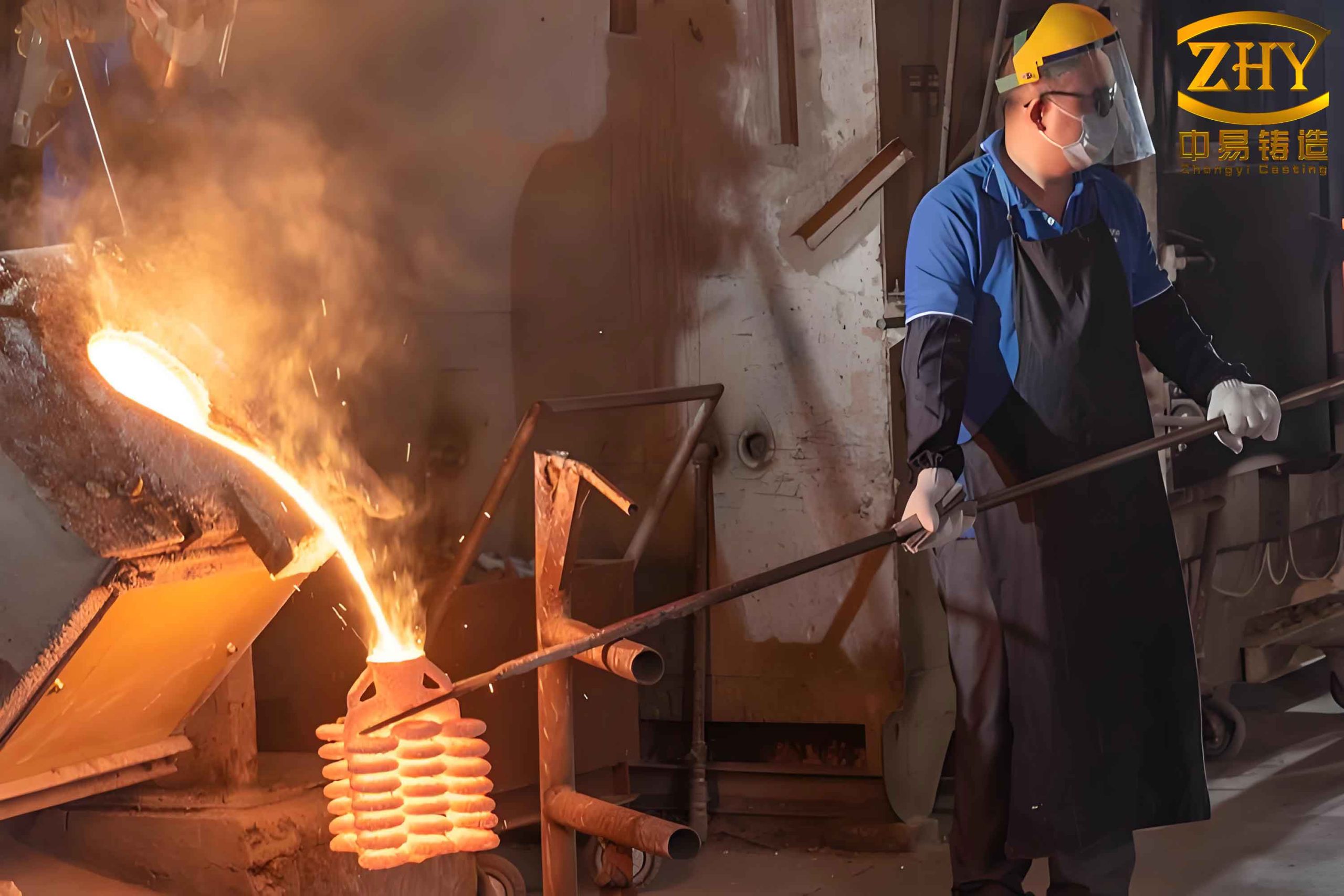
The material used is ZG25MnCrNiMo, a low-alloy high-strength cast steel specified for railway applications. Its typical composition provides a good balance of strength, hardenability, and low-temperature impact toughness. The thermophysical properties critical for simulation accuracy, such as thermal conductivity, density, and enthalpy, were derived from the ProCAST database’s mixture model for this specific composition. The key thermal properties as a function of temperature are summarized below:
| Property | Trend / Key Values |
|---|---|
| Liquidus Temperature | ~1,500 °C |
| Solidus Temperature | ~1,450 °C |
| Thermal Conductivity | Increases from ~25 W/m·K at solidus to ~33 W/m·K at 800°C, then stable. |
| Density | ~7,500 kg/m³ at room temperature, decreasing linearly in the liquid state. |
| Specific Heat / Enthalpy | Sharp increase at solidus/liquidus due to latent heat of fusion. |
The initial simulation conditions for the prototype investment casting process were set based on foundry experience, as shown in the following table:
| Parameter | Value |
|---|---|
| Pouring Temperature (Initial) | 1,550 °C |
| Shell Preheat Temperature (Initial) | 400 °C |
| Pouring Time (Initial) | 15 s |
| Interfacial Heat Transfer (Metal-Shell) | 500 W/m²·K |
| Mesh Size (Cast Part) | 5 mm |
Process Optimization via Orthogonal Experimentation
To systematically improve the prototype investment casting process and minimize defects, a Taguchi L16(4^3) orthogonal array was designed. Three critical factors most influential on casting soundness and stress were selected: Pouring Temperature (A), Shell Preheat Temperature (B), and Pouring Time (C). Each factor was evaluated at four levels, with ranges chosen based on the material’s liquidus temperature and practical foundry limits for such a prototype investment casting.
| Level | A: Pouring Temp. (°C) | B: Shell Temp. (°C) | C: Pouring Time (s) |
|---|---|---|---|
| 1 | 1,530 | 350 | 28 |
| 2 | 1,550 | 400 | 30 |
| 3 | 1,570 | 450 | 32 |
| 4 | 1,590 | 500 | 34 |
The objective was to minimize two key response variables obtained from ProCAST simulations: the total volume of shrinkage porosity and cavities (V_sp), and the maximum residual stress (σ_max) at critical, failure-prone nodes in the coupler body (e.g., the transition regions between the hook shank and head). Sixteen simulations were run according to the orthogonal array. The signal-to-noise (S/N) ratio analysis, following the “smaller-is-better” characteristic, was used to determine the optimal factor levels for each response.
The analysis of variance (ANOVA) for the simulated responses indicated that Pouring Temperature (Factor A) had the most statistically significant effect on both shrinkage volume and residual stress. The effects of Shell Temperature and Pouring Time were less pronounced but still meaningful for shrinkage formation. The rank of influence for minimizing shrinkage was A > C > B, while for minimizing stress it was A > C > B. The optimal level combinations derived from the S/N ratio analysis were:
- For Minimum Shrinkage (V_sp): A3 B4 C1 (Pouring: 1,570°C, Shell: 500°C, Time: 28s)
- For Minimum Stress (σ_max): A3 B1 C2 (Pouring: 1,570°C, Shell: 350°C, Time: 30s)
To achieve a balanced compromise between minimizing both shrinkage and stress in the final prototype investment casting, the optimum parameters were taken as the average of the two recommendations: Pouring Temperature = 1,570 °C, Shell Preheat Temperature = 425 °C, Pouring Time = 29 s. This parameter set was adopted for all subsequent detailed simulations and the physical trial of the prototype investment casting.
Comprehensive Simulation of the Optimized Prototype Investment Casting Process
Temperature Field and Solidification Analysis
Under the optimized parameters, the simulation revealed a favorable solidification sequence. The thinner sections of the base and central shank began to solidify first, followed by progressive solidification towards the thicker sections and the gating system. The hook head, being a thick mass, solidified last, aided by the top riser. This sequence promotes directional solidification towards the riser, which acts as a feed metal source. The temperature gradient was managed effectively by the designed gating and the controlled shell preheat temperature, reducing the risk of isolated hot spots. The final predicted shrinkage was isolated to the top of the riser itself and a small volume in the thickest part of the draft gear housing, with a total volume of only 0.879 cm³. Critically, no shrinkage porosity was predicted within the critical load-bearing sections of the coupler body, confirming the effectiveness of the optimized prototype investment casting process.
Stress Evolution and Hot Tearing Susceptibility
Thermal stress development is the root cause of hot tearing, a major concern in steel prototype investment casting. The stress simulation utilized a thermo-elasto-plastic model, with a bilinear isotropic hardening constitutive model for the steel. The material’s stress-strain relationship in the plastic region is given by:
$$
\sigma = \sigma_{0.2} + E_2 (\varepsilon – \varepsilon_s) \quad \text{for} \quad \varepsilon > \varepsilon_s
$$
where $\sigma_{0.2}$ is the yield strength, $E_2$ is the plastic modulus, and $\varepsilon_s$ is the strain at yield.
The stress evolution at five critical nodes was tracked. The results showed that stresses began to develop significantly during the late stages of solidification when the mushy zone coherence was established. The maximum principal stress peaked at around 470 MPa in the base region at approximately 6,000 seconds into the process. However, this peak stress remained well below the high-temperature tensile strength of the material in the coherent mushy state. A hot cracking index, which maps regions where thermal strain accumulation exceeds a critical threshold during the vulnerable solidification interval, showed that the highest susceptibility was confined to areas directly connected to the heavy gating sections. These areas are the last to solidify and experience constrained contraction. Nevertheless, the predicted stress levels were not sufficient to initiate a hot tear in this prototype investment casting under the optimized conditions.
Microstructure Simulation Using CAFE Model
Predicting the as-cast grain structure is vital for anticipating mechanical properties. We employed a Cellular Automaton – Finite Element (CAFE) model coupled with the Kurz-Giovanola-Trivedi (KGT) dendrite tip growth kinetics model. The model incorporates a continuous nucleation law based on a Gaussian distribution:
$$
\frac{dn}{d(\Delta T)} = \frac{n_{\text{max}}}{\sqrt{2\pi} \cdot \Delta T_\sigma} \exp\left[-\frac{1}{2}\left(\frac{\Delta T – \Delta T_{\text{max}}}{\Delta T_\sigma}\right)^2\right]
$$
where $dn/d(\Delta T)$ is the nucleation density, $n_{\text{max}}$ is the maximum nucleus density, $\Delta T$ is the undercooling, $\Delta T_{\text{max}}$ is the mean nucleation undercooling, and $\Delta T_\sigma$ is the standard deviation.
The growth kinetics parameters for the ZG25MnCrNiMo alloy were defined. The CAFE simulation results for the optimized prototype investment casting process clearly showed three distinct zones: a surface chill zone of fine equiaxed grains, columnar grains growing perpendicular to the mold walls in intermediate regions, and coarse equiaxed grains in the thermal center of thick sections. In the critical hook shank and shoulder areas, which are subject to high service loads, the simulation predicted a predominance of fine equiaxed and columnar grains, indicating a relatively fast cooling rate and a potentially favorable, fine-grained microstructure with good isotropy. The following table summarizes key findings from the simulations:
| Aspect | Key Finding | Implication for Prototype Investment Casting |
|---|---|---|
| Solidification | Directional sequence from thin to thick sections, ending at riser. | Effective feeding, minimal internal shrinkage in the part. |
| Shrinkage Volume | 0.879 cm³, located only in riser and a non-critical thick zone. | High internal soundness of the cast coupler body. |
| Max Residual Stress | ~470 MPa (below hot strength). | Low risk of hot tearing or cold cracking. |
| Microstructure | Fine chill zone, mixed columnar/equiaxed in body, coarse grains in thermal centers. | Predicted good mechanical properties, especially in high-stress areas. |
Physical Validation and Mechanical Testing
To validate the simulation-based optimization, a physical coupler was produced using the determined optimum parameters in a prototype investment casting foundry. The ceramic shell was preheated to 425°C, and ZG25MnCrNiMo steel was poured at 1,570°C with a controlled pour time.
The as-cast coupler was first inspected visually and then subjected to X-ray radiography (RT) on critical sections: the hook head, the hook shank connection, and the base. The RT results confirmed the simulation predictions, revealing no detectable cracks, shrinkage cavities, or porosity within the body of the coupler. This non-destructive testing validated the effectiveness of the optimized prototype investment casting process in achieving internal soundness.
Metallographic samples were extracted from the as-cast coupler’s shoulder region. The microstructure consisted of primary ferrite (light etching) and pearlite (dark etching). The ferrite exhibited a mixture of Widmanstätten and grain boundary morphologies, typical of a continuous cooling transformation from austenite. Scanning Electron Microscopy (SEM) and Energy Dispersive Spectroscopy (EDS) confirmed a relatively uniform distribution of alloying elements (Mn, Cr, Ni, Mo) without significant macro-segregation.
The coupler was subsequently heat-treated (normalized at 910°C, oil quenched, and tempered at 590°C) to achieve the required mechanical properties. The final microstructure was a fine, homogeneous tempered sorbitte (tempered martensite), with a very fine effective grain size below 1 micrometer as observed under SEM.
Tensile test specimens were machined from the heat-treated coupler from two different locations (shoulder and body). The results demonstrated excellent and consistent mechanical properties, exceeding the standard requirements for E-grade coupler steel.
| Property | Standard Requirement | Average Measured Value |
|---|---|---|
| Yield Strength (Rp0.2) | ≥ 590 MPa | 810 MPa |
| Tensile Strength (Rm) | ≥ 830 MPa | 1020 MPa |
| Elongation (A) | ≥ 14 % | 14.5 % |
| Reduction of Area (Z) | ≥ 30 % | 34.5 % |
| Hardness (HBW) | 241 – 311 | 315 |
Conclusion
This study successfully developed and validated an optimized prototype investment casting process for a high-strength steel locomotive coupler. Through a systematic approach integrating Taguchi-based orthogonal design of simulations, we identified the optimal combination of key parameters: a pouring temperature of 1,570°C, a ceramic shell preheat temperature of 425°C, and a pouring time of 29 seconds. Comprehensive numerical simulations under these conditions predicted a sound casting with a favorable solidification pattern, minimized and isolated shrinkage, acceptable stress levels, and a fine-grained microstructure in critical areas.
The physical production of the coupler using this optimized prototype investment casting process confirmed the simulation accuracy. Non-destructive testing revealed no internal defects, and metallurgical analysis showed a uniform as-cast structure that transformed into a fine tempered sorbitte after heat treatment. The resulting mechanical properties significantly exceeded the standard specifications, demonstrating the capability of a well-engineered prototype investment casting process to produce safety-critical components with superior quality and performance. This methodology provides a reliable framework for the development and optimization of prototype investment casting processes for other complex, high-integrity steel components.