
The Lost Foam Casting (LFC) process, also known as Expendable Pattern Casting (EPC), represents a significant advancement in foundry technology. This method involves creating a cluster of foam patterns identical to the desired casting, coating it with a refractory wash, drying it, and then compacting it within dry, unbonded sand under a vacuum. The molten metal is then poured, displacing and decomposing the foam pattern to form the final casting. While this process eliminates many traditional steps like core-making and mold assembly, leading to superior dimensional accuracy and surface finish, it introduces unique challenges to internal casting quality. Among these, the formation of microscopic slag inclusions stands out as a particularly insidious defect, often determining the overall yield and reliability of cast components, especially in demanding applications.
The complexity of slag formation in LFC stems from the superposition of two distinct mechanisms. First, there are the conventional sources common to all casting processes: non-metallic inclusions originating from the melt itself, such as oxides, sulfides, and residuals from metallurgical treatments. Second, and more specific to LFC, are the by-products from the thermal decomposition of the foam pattern. During pouring, the intense heat of the metal causes the foam to undergo pyrolysis—a complex process involving melting, vaporization, and chemical breakdown. If this process is incomplete, or if the gaseous products are not swiftly evacuated by the applied vacuum, carbonaceous residue from the pattern can become entrapped within the advancing metal front. These residues solidify as black, often sub-surface, slag inclusions within the casting matrix.
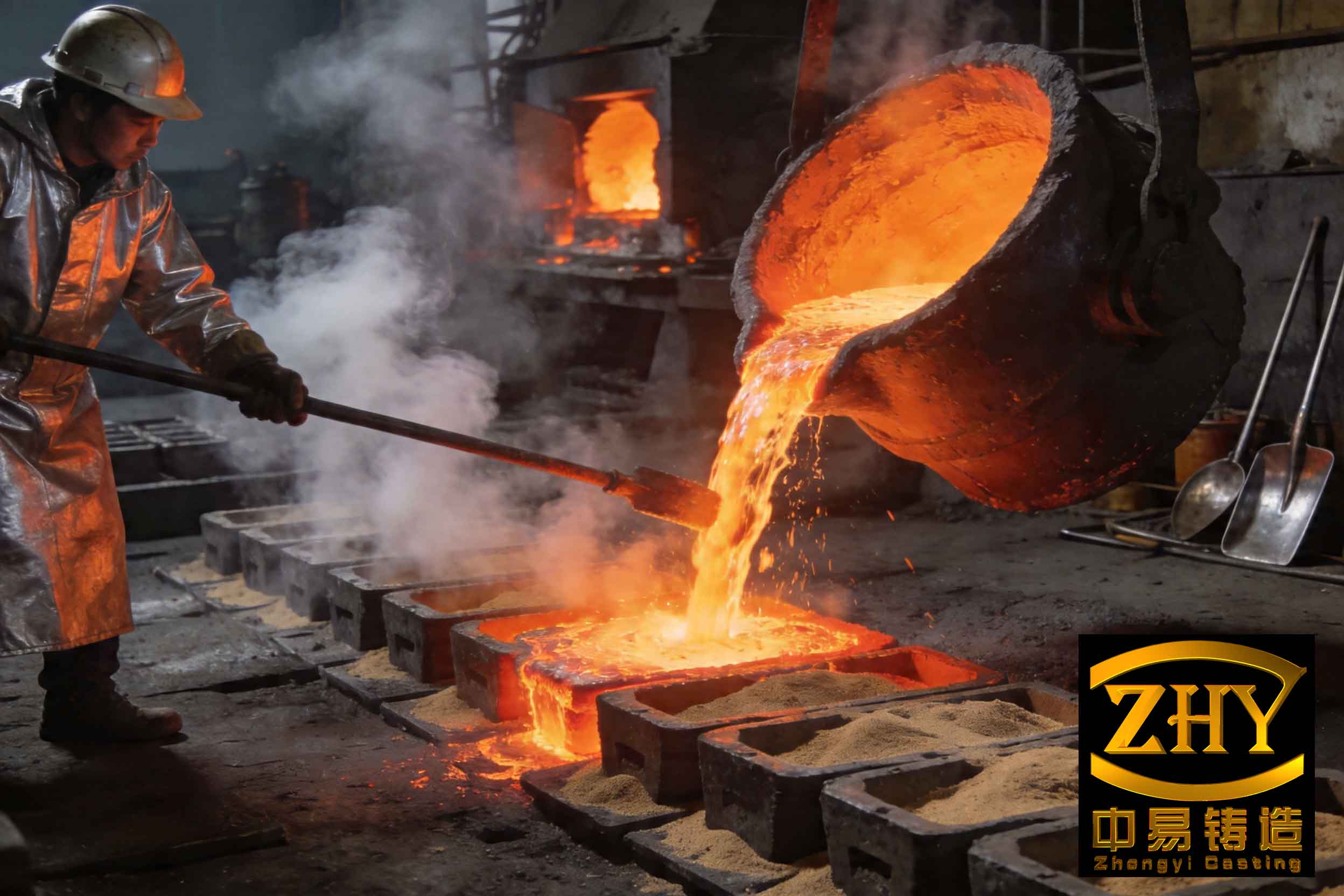
In our production experience, these defects predominantly manifest in critical, high-stress areas of a casting, such as just beneath the skin or at section transitions and fillets. Their appearance can vary from fine, discontinuous lines to irregular patches. A stark example was encountered during the initial production of a critical railway component. Destructive testing revealed microscopic black anomalies at a key load-bearing junction. Microscopic analysis showed these slag inclusions constituted approximately 10% of the area in that localized region, posing a severe risk to mechanical performance and component safety. This incident underscored the necessity to distinguish between inclusion types and address their root causes systematically.
Detailed Analysis of Inclusion Sources
The fundamental challenge in diagnosing slag inclusions in LFC is their similar visual manifestation—typically black or dark grey—regardless of origin. However, their formation mechanisms differ, requiring tailored countermeasures. We can classify them into two primary categories:
| Feature | Metallurgical Slag Inclusions | Pattern-Derived Slag Inclusions |
|---|---|---|
| Primary Source | Impurities in charge materials, oxidation during melting, reaction products (e.g., from inoculation/ductile treatment). | Incomplete pyrolysis of the expandable polystyrene (EPS) pattern and its gaseous by-products. |
| Typical Size & Morphology | Often larger, more globular or irregular masses; can be visible to the naked eye. | Typically microscopic or very fine, forming films, lines, or clusters just below the casting surface. |
| Formation Driver | Poor melt quality, inadequate slag removal, turbulent transfer. | Low pattern density, poor coating/gas permeability, unstable vacuum, improper pouring parameters. |
| Key Differentiator | Can occur throughout the casting volume. | Concentrated in areas of last fill or where metal front velocity is low, allowing residue accumulation. |
The thermal decomposition of the foam pattern is a kinetic process governed by heat transfer. The rate of gas generation must be balanced by the rate of evacuation through the coating and sand. The fundamental energy balance and pyrolysis rate can be conceptually described. The heat flux ($q$) from the metal to the pattern interface drives the reaction:
$$ q = h(T_m – T_i) $$
where $h$ is the heat transfer coefficient, $T_m$ is the metal temperature, and $T_i$ is the pattern decomposition interface temperature. The mass loss rate of the pattern ($\dot{m}_p$) is a function of this heat flux and the specific heat of gasification ($L_g$):
$$ \dot{m}_p \propto \frac{q}{L_g} $$
If the gaseous products cannot escape quickly enough, pressure builds in the gap between the metal and the pattern ($P_g$), which can inversely affect the heat transfer coefficient and even force liquid pyrolysis products into the metal stream. The permeability of the system is, therefore, critical and is a composite of the coating permeability ($k_c$) and the sand permeability ($k_s$). An idealized condition for clean filling seeks to maintain:
$$ \frac{\dot{m}_g \cdot R \cdot T}{A \cdot (k_c + k_s)} < \Delta P_{vacuum} $$
where $\dot{m}_g$ is the mass flow rate of generated gas, $R$ is the gas constant, $T$ is the gas temperature, $A$ is the interfacial area, and $\Delta P_{vacuum}$ is the pressure differential created by the vacuum system. When this condition is not met, the risk of pattern-residue slag inclusions increases dramatically.
Comprehensive Preventive Measures and Process Controls
Based on the dual-source analysis, effective prevention requires a holistic strategy targeting both melt quality and the unique LFC process dynamics. The following integrated measures have proven successful in mitigating slag inclusions.
1. Rigorous Melt Preparation and Treatment
The goal is to minimize the introduction and retention of non-metallic inclusions in the metal before it enters the mold. For ductile iron production, this is especially crucial.
- Charge Material Preparation: All charge materials (pig iron, steel scrap, returns) must be cleaned to remove rust, sand, oil, and moisture. Processes like vibratory cleaning, shot blasting, or pre-heating are employed.
- Active Slag Management during Melting:
- Use efficient slag coagulants (e.g., based on calcium-alumina-silicates) to aggregate fine oxides for easy removal.
- Employ a “superheating and settling” practice: raise the melt temperature approximately 100°C above the target pouring temperature, hold to allow inclusions to float, and remove slag aggressively. Then, cool to the desired tapping temperature.
- Treatment Ladle and Additives: The treatment ladle must be preheated and free of old slag. Inoculants and nodularizing agents must be dry, often pre-baked. Covering agents like clean, pre-heated steel punchings are used to minimize atmosphere contact during treatment.
- Post-Treatment Slag Removal: After the nodularizing reaction subsides, allow a settling period of 3-5 minutes. Multiple skimming actions with a slag coagulant are performed to ensure a clean metal surface before pouring.
2. Controlled Pouring Practices
This stage prevents re-oxidation and the entrainment of surface slag into the mold cavity.
| Control Parameter | Target/Requirement | Rationale |
|---|---|---|
| Pouring Cup | Use only refractory-lined cups (e.g., sand-bonded with sodium silicate). Avoid simple open cones. | Provides a calm basin for metal, facilitates slag trapping, and withstands thermal shock without contaminating the metal. |
| Slag Damming | Mandatory use of a slag dam or skilled operator for manual skimming at the cup. | Prevents the slag layer on the metal surface from entering the downsprue. |
| Pouring Regime | Fast pour initiation, maintaining a full pouring cup throughout with a steady, non-turbulent flow. | Minimizes air aspiration, maintains consistent pressure head, and promotes laminar mold filling to avoid entrapping pattern residues. |
| Vacuum Control | Stabilize vacuum level within a narrow range (e.g., ±0.01 MPa of set point) during the entire pour. | A stable vacuum ensures consistent gas evacuation rates, preventing pressure fluctuations that can disturb the metal front and trap pyrolysis products. |
3. Pattern Cluster Optimization
This is the core defense against pattern-derived slag inclusions. The objective is to minimize the mass of material to be decomposed and maximize the escape paths for the resulting gases.
- Pattern Density Control: For EPS patterns, density is paramount. It must be minimized while maintaining sufficient handling strength. This is controlled by pre-expansion bead size, steam pressure, and cycle time in the molding machine. For a typical small iron casting, a target density range of 0.018–0.026 g/cm³ is effective. The gating system patterns should be even lighter, targeting 0.016–0.022 g/cm³, as they are the first to be consumed. The gas volume produced is directly related to pattern mass:
$$ V_{gas} \propto m_{pattern} = \rho_{pattern} \cdot V_{pattern} $$
Therefore, reducing $\rho_{pattern}$ directly reduces the gas load. - Coating Permeability: The coating must act as a porous barrier. Its permeability is a function of the particle size distribution, shape, and packing of the refractory flour (e.g., fused silica, alumina), the type and amount of binder, and the layer thickness. The goal is to maximize gas transit without allowing metal penetration. The permeability ($k_c$) can be conceptually estimated using a modified Kozeny-Carman relation for packed beds:
$$ k_c \approx \frac{\phi^3}{C \cdot S_0^2 \cdot (1-\phi)^2} $$
where $\phi$ is the coating porosity, $S_0$ is the specific surface area of the refractory particles, and $C$ is a constant. Using coarser, well-graded refractories increases $\phi$ and reduces $S_0$, thereby increasing $k_c$. - Cluster Assembly: Minimize the use of organic adhesives. Where possible, use mechanical interlocking or “hot wire” fusion to join patterns. Excess adhesive creates localized dense regions that degrade unevenly and can be a significant source of carbonaceous slag inclusions.
4. Sand and Mold Integrity
The dry sand medium must support the process by providing consistent, high permeability.
- Sand Granulometry: Use rounded-grain silica sand with a tight, controlled grain size distribution (e.g., AFS GFN 55-65). This promotes high and uniform bulk permeability ($k_s$).
- Sand Conditioning and Filling: Implement effective sand cooling and continuous dedusting systems. Fines (material below 70 mesh) must be kept below 0.5-0.8% as they drastically reduce permeability. Sand should be filled with gentle, multi-directional vibration to achieve compaction without coating damage.
Implementation and Verification
The implementation of this multi-faceted approach requires disciplined process control. After establishing the protocols, a validation run was conducted. An entire batch of the railway component was produced and subjected to 100% destructive testing by sectioning the critical stress areas. No subsurface slag inclusions were detected in these initial samples. To confirm statistical reliability, five subsequent production batches were monitored with a 50% sampling plan. Out of nearly 1000 inspected castings, only two exhibited visible slag defects in non-critical areas, and critically, microscopic examination of the key fillet regions confirmed the absence of the previously observed micro-inclusions. The process controls were then standardized and implemented for full-scale production, effectively eliminating slag inclusions as a primary yield detractor.
In conclusion, combating microscopic slag inclusions in Lost Foam Cast iron is not a matter of a single fix but requires a systematic engineering approach. It demands a clear understanding of the dual-source mechanism—metallurgical and pattern-derived. Success hinges on the integrated control of four pillars: impeccable melt cleanness, precise pouring dynamics, optimized pattern cluster properties for minimal and manageable gas generation, and a highly permeable mold system. By treating the process as an interconnected system and controlling key parameters such as pattern density ($\rho_{pattern}$), coating permeability ($k_c$), and vacuum stability ($\Delta P_{vacuum}$), it is possible to virtually eliminate these hidden defects, unlocking the full potential of the Lost Foam Casting process for producing high-integrity, complex iron castings.