
In my extensive experience with ductile iron castings, particularly for automotive components, the occurrence of slag inclusions remains a persistent challenge that compromises structural integrity and pressure tightness. This article delves into a detailed analysis and mitigation strategies for slag inclusions, drawing from a case study on steering gear housing castings. Slag inclusions, often manifested as subsurface defects, can lead to catastrophic failures in parts subjected to high hydraulic pressure, such as the EQ153 steering gear housing. Through first-hand investigation and process optimization, we have identified key factors contributing to slag inclusions and implemented effective countermeasures. The insights shared here aim to provide a comprehensive guide for foundry engineers dealing with similar issues, emphasizing the critical role of metallurgical control, gating design, and operational practices in minimizing these defects.
Slag inclusions in ductile iron castings primarily originate from two sources: primary slag inclusions, which arise during the nodularization treatment, and secondary slag inclusions, formed during pouring and solidification. Primary slag inclusions consist of reaction products like magnesium oxides, silicates, and rare-earth compounds, while secondary slag inclusions result from re-oxidation of the molten metal as it flows through the gating system and fills the mold cavity. The presence of slag inclusions not only reduces mechanical properties but also acts as stress concentrators, leading to leakage paths in pressure-containing applications. In our study, we focused on a specific casting—the steering gear housing—which requires stringent quality standards due to its function in hydraulic steering systems. The casting, with complex geometry and varying wall thicknesses, was prone to slag inclusions in critical areas, necessitating a thorough root-cause analysis and process overhaul.
The initial production process involved high-pressure molding with horizontal parting, using a closed gating system and hot risers. The melting was conducted in a coreless induction furnace, followed by treatment with rare-earth magnesium alloy for nodularization and ferrosilicon for inoculation. Despite these standard practices, the rejection rate due to slag inclusions exceeded 90%, as revealed by machining samples from 100 castings. This alarming defect rate prompted us to systematically investigate the factors influencing slag inclusion formation. We examined chemical composition, gating design, pouring temperature, and operational procedures, correlating each with the incidence of slag inclusions. Our findings highlighted that slag inclusions are not merely random occurrences but are predictable and controllable through targeted interventions.
To understand the mechanisms behind slag inclusion formation, we must consider the thermodynamics and kinetics of reactions in ductile iron. During nodularization, magnesium and rare-earth elements react with sulfur and oxygen in the melt, forming compounds that can either float to the surface or remain suspended. The efficiency of slag removal depends on factors like reaction kinetics, bubble dynamics, and melt viscosity. For instance, the reaction between magnesium and sulfur can be represented as: $$Mg + S \rightarrow MgS$$ This compound, along with oxides such as $$2Mg + O_2 \rightarrow 2MgO$$ and rare-earth oxides like $$2RE + 3O \rightarrow RE_2O_3$$, contributes to primary slag inclusions. The density of these inclusions relative to the iron melt determines their buoyancy; while MgO and MgS are less dense and tend to rise, some rare-earth oxides have densities closer to iron, making them prone to entrapment. Secondary slag inclusions form due to turbulent flow during pouring, which introduces air and promotes oxidation reactions at the metal surface. The formation of oxide films can be modeled using Arrhenius-type equations, where the rate of oxide growth increases with decreasing temperature: $$k = A e^{-E_a/RT}$$ where \(k\) is the rate constant, \(A\) is the pre-exponential factor, \(E_a\) is the activation energy, \(R\) is the gas constant, and \(T\) is the temperature in Kelvin. This underscores the importance of maintaining elevated pouring temperatures to retard oxide formation.
Chemical composition plays a pivotal role in slag inclusion propensity. Specifically, the residual levels of magnesium and rare-earth elements after nodularization are critical. Excessive residuals lead to increased formation of stable oxides and sulfides that may not float out efficiently. In our analysis, we compared the chemistry of regions with slag inclusions to defect-free areas, as summarized in Table 1. The data clearly indicates higher residual magnesium and rare-earth contents in slag inclusion zones, suggesting that optimizing nodularizer addition is essential. We derived an empirical relationship to estimate the risk of slag inclusions based on residuals: $$R_{slag} = k_1 \cdot [Mg]_{res} + k_2 \cdot [RE]_{res}$$ where \(R_{slag}\) is a risk index, \([Mg]_{res}\) and \([RE]_{res}\) are residual concentrations in weight percent, and \(k_1\) and \(k_2\) are constants determined from experimental data. This formula helps in fine-tuning the treatment process to minimize residuals without compromising nodularization.
| Region | Residual Mg (%) | Residual RE (%) | Slag Inclusion Presence |
|---|---|---|---|
| Slag Inclusion Zone | 0.052 | 0.045 | High |
| Defect-Free Zone | 0.046 | 0.023 | Low |
Pouring temperature is another decisive factor influencing slag inclusions. Lower temperatures promote the formation of solid oxide films that can be entrained into the mold cavity. We conducted a series of experiments to quantify the relationship between pouring temperature and slag inclusion occurrence, with results tabulated in Table 2. The data shows a sharp increase in slag inclusion rate as temperature drops below 1380°C. This aligns with the theoretical understanding that iron melt surface cleanliness deteriorates below 1450°C, with liquid oxides appearing in the 1352–1450°C range and solid oxides dominating below 1350°C. To mitigate this, we established a strict pouring temperature window of 1380–1420°C, which delays oxide film formation and enhances slag buoyancy. The effect of temperature on slag inclusion formation can be expressed using a statistical model: $$P_{slag} = \frac{1}{1 + e^{-(\alpha + \beta T)}}$$ where \(P_{slag}\) is the probability of slag inclusion occurrence, \(T\) is the pouring temperature in °C, and \(\alpha\) and \(\beta\) are coefficients derived from regression analysis. This logistic curve highlights the non-linear nature of the temperature effect, emphasizing the need for precise thermal control.
| Pouring Temperature Range (°C) | Number of Castings Poured | Number with Slag Inclusions | Slag Inclusion Rate (%) |
|---|---|---|---|
| 1380–1370 | 10 | 2 | 20.0 |
| 1370–1360 | 14 | 4 | 28.6 |
| 1360–1350 | 15 | 6 | 40.0 |
The gating system design profoundly impacts fluid flow dynamics and slag entrapment. Our initial closed gating system, with a ratio of sprue:runner:ingate areas of 2:1.5:1, caused high velocity and turbulence, aggravating oxide generation and carrying slag particles into the cavity. Moreover, the runner’s low height-to-width ratio offered poor slag trapping capability. To address this, we redesigned the gating system to a semi-open type with an area ratio of 1.4:1.6:1, increasing the runner’s height relative to width to 1.5:1. This modification reduces flow velocity, promotes laminar flow, and provides more time for slag flotation. Additionally, we incorporated a ceramic filter at the runner, as shown in the schematic of the improved setup. The filter, with a mesh size of 4 mm × 4 mm, effectively captures primary slag inclusions and finer secondary particles through mechanical sieving and electrostatic adsorption. The efficiency of slag removal by the filter can be approximated by: $$\eta = 1 – \exp\left(-\frac{C \cdot d_p^2}{\mu \cdot v}\right)$$ where \(\eta\) is the removal efficiency, \(C\) is a constant dependent on filter geometry, \(d_p\) is the particle diameter, \(\mu\) is the dynamic viscosity of the melt, and \(v\) is the flow velocity. This equation underscores the importance of optimizing filter placement and flow conditions to maximize slag capture.
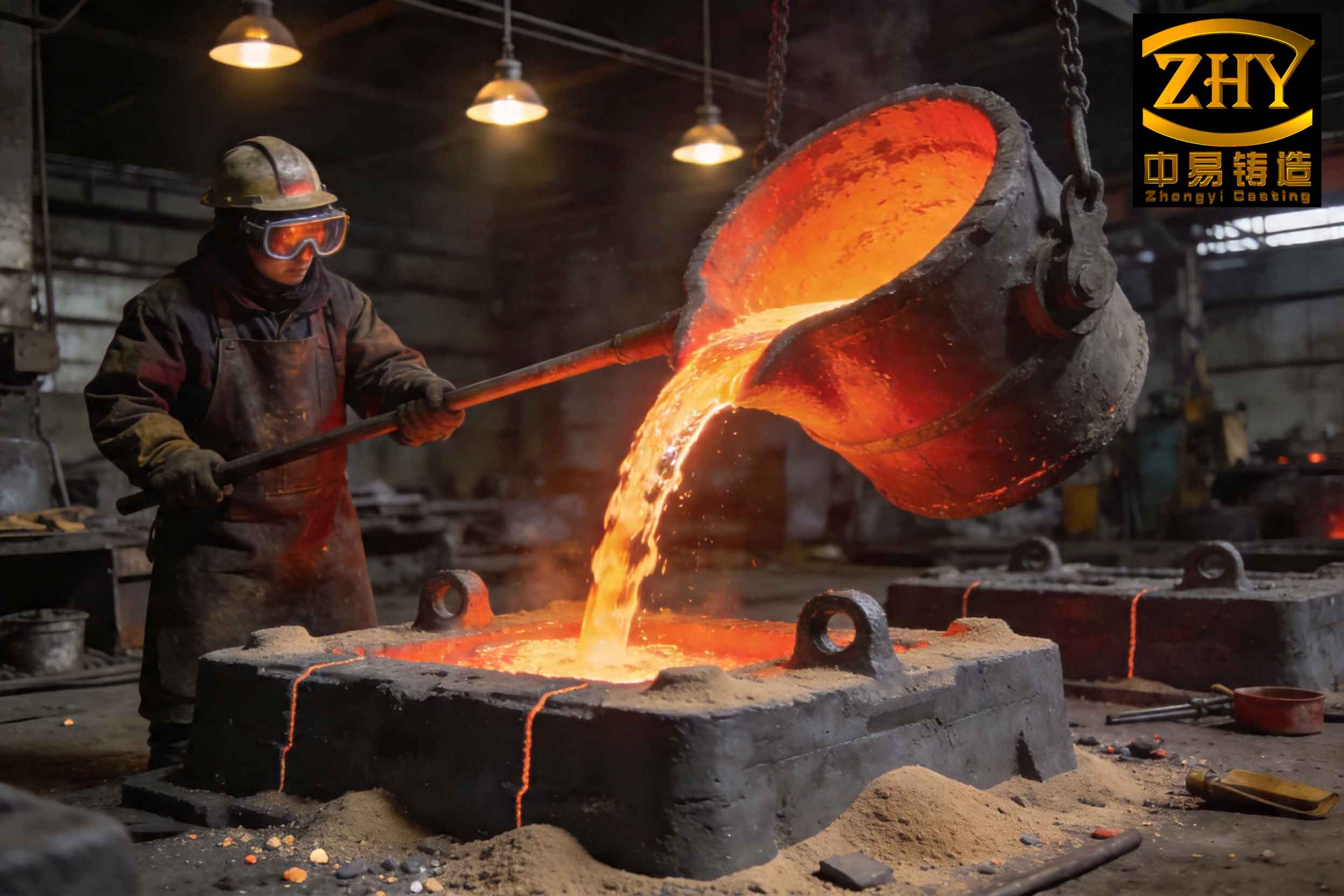
The image above illustrates typical slag inclusions in ductile iron castings, highlighting their morphology and distribution near the casting surface. Such visual evidence reinforces the need for rigorous process control. In our revised process, we also adjusted the nodularizer addition rate from 1.3–1.6% to 1.2–1.4%, balancing adequate nodularization with minimized residual content. To enhance magnesium recovery stability, we covered the treatment ladle with iron chips during addition, reducing oxidation losses. Furthermore, we implemented strict slag-off practices: after treatment, the melt surface was skimmed and covered with cryolite powder (0.15%) to prevent re-oxidation during transfer and pouring. These operational steps are crucial for preventing primary slag inclusions from entering the mold.
Fluid flow simulation and experimental validation were employed to optimize the gating system. Using computational fluid dynamics (CFD), we modeled the filling sequence and identified regions of high turbulence and potential slag entrapment. The simulation results guided adjustments to runner geometry and ingate positions, ensuring a more uniform fill with minimal surface disruption. The governing equations for incompressible flow include the continuity equation: $$\nabla \cdot \mathbf{v} = 0$$ and the Navier-Stokes equation: $$\rho \left( \frac{\partial \mathbf{v}}{\partial t} + \mathbf{v} \cdot \nabla \mathbf{v} \right) = -\nabla p + \mu \nabla^2 \mathbf{v} + \mathbf{f}$$ where \(\mathbf{v}\) is the velocity vector, \(\rho\) is density, \(p\) is pressure, \(\mu\) is viscosity, and \(\mathbf{f}\) represents body forces. By solving these equations numerically, we predicted flow patterns that minimize slag inclusion risks, corroborating our empirical findings.
The improved process yielded significant reductions in slag inclusion defects. Over six months of production, the rejection rate due to slag inclusions dropped to below 1%, with an overall scrap rate of 6.8%. Post-mortem analysis of gating systems revealed abundant slag particles upstream of the filter, while the runner and riser tops contained trapped slag, confirming the filter’s effectiveness. We conducted statistical process control (SPC) to monitor key variables, such as pouring temperature and residual magnesium, using control charts to ensure consistency. The success of these measures underscores the multifaceted approach required to combat slag inclusions: it is not enough to address one factor in isolation; rather, an integrated strategy encompassing chemistry, temperature, gating, and operation is essential.
To generalize our findings, we developed a comprehensive framework for preventing slag inclusions in ductile iron castings. This framework includes: (1) optimizing nodularizer addition to achieve residuals in the range of 0.03–0.05% Mg and 0.01–0.03% RE; (2) maintaining pouring temperatures above 1380°C to suppress oxide film formation; (3) designing semi-open gating systems with adequate slag trapping features, such as filters and extended runners; (4) implementing rigorous slag-off and protective covering practices; and (5) employing real-time monitoring and CFD simulations for continuous improvement. The interplay of these factors can be summarized in a holistic equation: $$Q_{slag} = f(C, T, G, O)$$ where \(Q_{slag}\) represents the quality metric related to slag inclusions, and \(C\), \(T\), \(G\), and \(O\) denote chemical, thermal, gating, and operational parameters, respectively. By optimizing each variable, foundries can achieve near-zero defect rates for slag inclusions.
In conclusion, slag inclusions in ductile iron castings are a complex defect influenced by metallurgical and process variables. Through detailed analysis and systematic improvements, we have demonstrated that slag inclusions can be effectively minimized by controlling residual elements, elevating pouring temperatures, redesigning gating systems with filters, and adhering to strict operational protocols. The case of the steering gear housing serves as a testament to the importance of a scientific approach to foundry engineering. Future work may explore advanced filtration materials, automated slag detection systems, and machine learning models for predictive defect avoidance. Nonetheless, the principles outlined here provide a robust foundation for addressing slag inclusions across various ductile iron applications, ensuring high-integrity castings for demanding industrial uses.