
In the field of advanced manufacturing, the production of heavy-section nodular cast iron castings has become increasingly critical, particularly for applications in clean energy sectors such as wind power and nuclear energy. These castings, including components like wind turbine hubs, bases, and nuclear waste containers, demand exceptional mechanical properties and structural integrity due to their large cross-sections and extended solidification times. As a practitioner involved in the development and manufacturing of such components, I have engaged extensively in the production of heavy-section nodular cast iron using electric arc furnace melting. This process presents unique challenges, including controlling graphite degeneration, minimizing shrinkage defects, and ensuring consistent microstructure in thick-walled sections. Through rigorous process design, numerical simulation, and meticulous melting practices, we have successfully produced large-scale nodular cast iron castings with satisfactory performance. This article delves into the detailed production practice, emphasizing key technological measures and analytical insights to achieve high-quality heavy-section nodular cast iron.
The foundation of producing heavy-section nodular cast iron lies in a well-designed casting process that addresses the inherent issues of prolonged solidification and thermal gradients. For a large annular casting with a maximum wall thickness of 330 mm and a weight of approximately 33 tons, the casting geometry is symmetrical with uniform wall thickness, but the sheer size necessitates careful planning. We adopted a bottom-gating open feeding system to ensure smooth metal flow and minimize turbulence. The gating ratio was established as ΣAinner: ΣArunner: ΣAsprue = 2.0: 1.5: 1.0, calculated using the choke section method. Ceramic tubes were employed for the gating system, incorporating filters and slag traps to enhance metal purity. Riser design followed empirical proportional methods, with necked insulating risers evenly distributed around the top circumference to provide uniform feeding. Additionally, chills were placed on both the inner and outer peripheries of the annular casting to accelerate solidification and reduce shrinkage defects. The chill thickness was optimized through numerical simulation, as detailed later. This comprehensive approach ensures that the heavy-section nodular cast iron casting solidifies in a controlled manner, mitigating defects.
Numerical simulation plays a pivotal role in predicting solidification behavior and optimizing process parameters for heavy-section nodular cast iron. We utilized casting simulation software to analyze the solidification time and defect tendency under various chill conditions. The governing heat transfer equation during solidification can be expressed as:
$$ \frac{\partial T}{\partial t} = \alpha \nabla^2 T + \frac{L}{C_p} \frac{\partial f_s}{\partial t} $$
where \( T \) is temperature, \( t \) is time, \( \alpha \) is thermal diffusivity, \( L \) is latent heat, \( C_p \) is specific heat, and \( f_s \) is solid fraction. For nodular cast iron, the release of latent heat during graphite precipitation significantly influences cooling curves. The simulation results indicated that without chills, the solidification time for the annular casting was excessively long, leading to severe shrinkage porosity and graphite flotation. By incorporating chills, the solidification time was drastically reduced. The table below summarizes the solidification times under different chill thicknesses, demonstrating the effectiveness of chills in enhancing cooling rates for heavy-section nodular cast iron.
| Cooling Condition | Solidification Time (hours) | Solidification Time (seconds) |
|---|---|---|
| Sand Mold Only | 13.25 | 47,700 |
| Sand Mold + 250 mm Chill | 2.80 | 10,085 |
| Sand Mold + 300 mm Chill | 2.72 | 9,784 |
| Sand Mold + 320 mm Chill | 2.72 | 9,811 |
| Sand Mold + 350 mm Chill | 2.72 | 9,803 |
From the table, it is evident that a chill thickness of 300 mm yields the shortest solidification time, with diminishing returns beyond this point. The simulation also predicted shrinkage cavity and porosity distribution, showing that chills effectively reduce defect concentration in thermal junctions. Based on this analysis, we selected 300 mm chills for the production, ensuring balanced solidification and minimal defects in the heavy-section nodular cast iron casting. This optimization is crucial for maintaining the integrity of nodular cast iron in thick sections, where slow cooling can lead to graphite degeneration.
The molding process for heavy-section nodular cast iron requires precision to accommodate the large size and complex geometry. We used self-hardening sand for mold making, adopting a segmented core assembly approach along the circumferential direction to match the symmetrical structure. Chills were spaced 20-30 mm apart to allow for expansion and contraction, and a graphite-based alcohol coating approximately 1.5 mm thick was applied to improve surface finish. The mold was divided into three parts: bottom, middle, and top. The gating system and attached test blocks (designed according to standard specifications with 70 mm thickness) were placed in the bottom box, the casting in the middle box, and the risers in the top box. After assembly, the mold was dried at 400°C for over 8 hours to achieve a cavity temperature of 80-100°C, reducing moisture-related defects. This meticulous molding setup is essential for producing sound heavy-section nodular cast iron castings, as any inconsistency can exacerbate shrinkage or distortion.
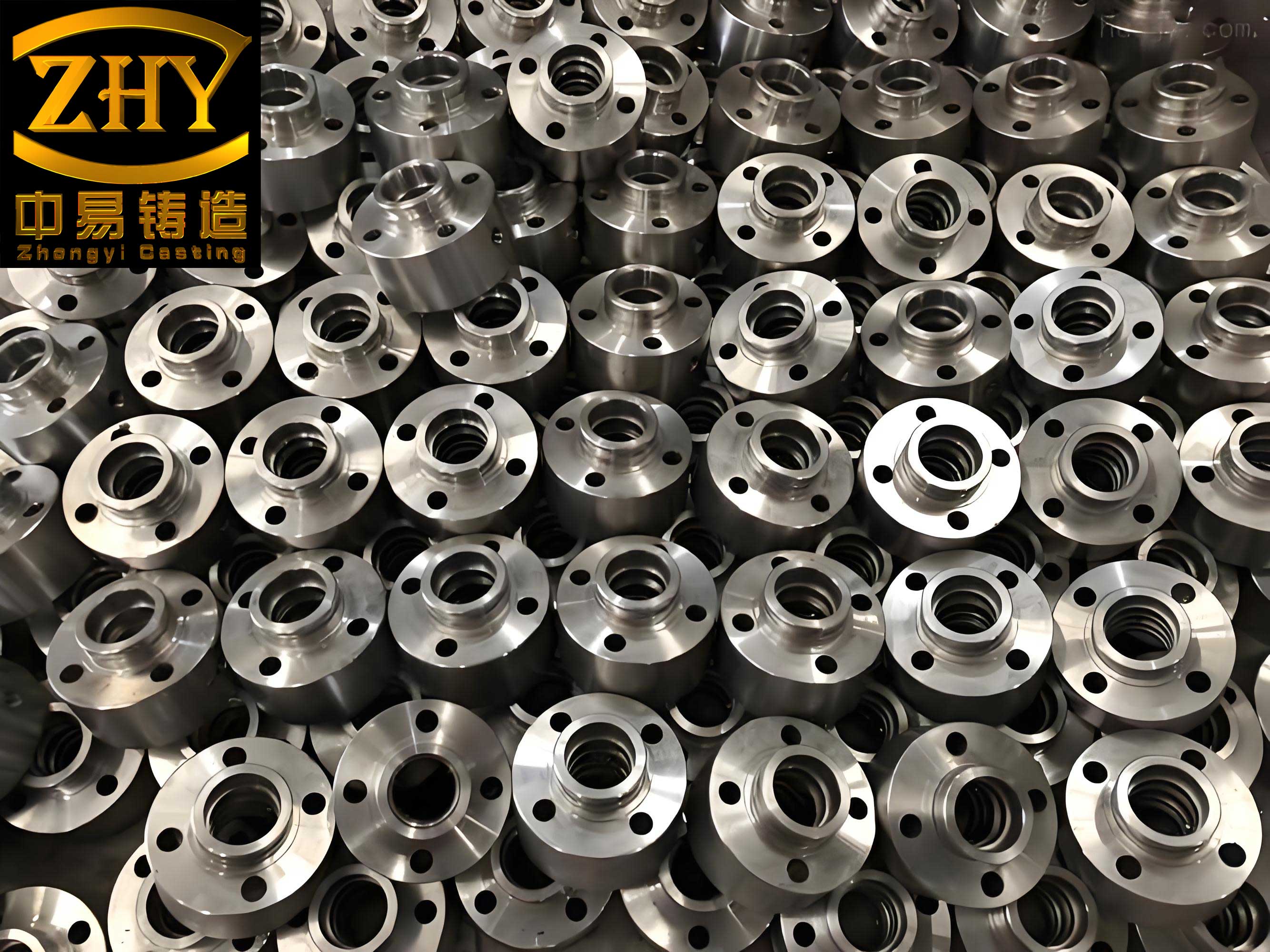
Melting and treatment processes are the heart of producing high-quality heavy-section nodular cast iron. Controlling the chemistry, temperature, and weight of the molten iron is paramount, especially when using an electric arc furnace for large batches. For this project, the total required metal weight was nearly 40 tons, considering the casting, risers, and a 10% surplus. We employed high-purity pig iron and scrap steel as raw materials, with careful charge calculations to meet the target composition. The chemical composition requirements for the nodular cast iron are listed in the table below, emphasizing low impurity levels to enhance graphite nodularity and mechanical properties.
| Element | Target Range (wt%) | Importance for Nodular Cast Iron |
|---|---|---|
| Carbon (C) | 3.60–3.80 | Promotes graphite formation, affects fluidity and shrinkage |
| Silicon (Si) | 1.90–2.30 | Strengthens ferrite matrix, influences graphite morphology |
| Manganese (Mn) | < 0.10 | Minimized to prevent carbide formation in heavy sections |
| Sulfur (S) | < 0.02 | Low levels essential for effective magnesium treatment |
| Phosphorus (P) | < 0.03 | Reduced to avoid embrittlement in thick-walled castings |
| Magnesium (Mg) | 0.04–0.06 | Key for graphite spheroidization in nodular cast iron |
In the electric arc furnace, we melted the charges in multiple batches, with each batch fully melted before adding the next. After each melting, we performed slag removal, temperature measurement, and chemical analysis. The superheating temperature was maintained at 1490–1500°C to ensure proper dissolution of carbon and other elements. Carbon loss during arc furnace melting is a concern; we accounted for this by starting with a base carbon content of 3.5% and using carbon inoculants to adjust to the target of 3.7%. The final tapping temperature was controlled at 1440–1460°C to facilitate subsequent treatment. The weight control was achieved by precise weighing of charges and ensuring complete emptying of the furnace through proper lining maintenance. These steps are critical for consistent nodular cast iron production, as variations can lead to poor graphite structure in heavy sections.
The treatment of molten iron for nodular cast iron involves spheroidization and inoculation to achieve the desired graphite nodules and matrix structure. We used a 50-ton bottom-pour dam-type ladle for treatment. In one side of the ladle dam, 1.4% spheroidizing agent (typically magnesium-based) was placed, covered with 0.4% high-calcium barium inoculant and iron chips. In the other side, 0.15% high-calcium barium inoculant was added. During tapping, two-thirds of the molten iron was rapidly poured into the ladle to initiate spheroidization and primary inoculation. After the reaction subsided, the remaining iron was added, followed by slag removal. Then, 0.15% high-calcium barium inoculant was added for secondary inoculation. After further slag removal, the temperature was measured at approximately 1350°C, and pouring commenced with stream inoculation using sulfur-oxygen inoculants. Post-pouring, insulating materials were applied to risers to slow cooling, and the casting was shake-out below 300°C. This multi-stage treatment ensures effective graphite nodularization and uniform microstructure in heavy-section nodular cast iron, combating recession effects due to long solidification times.
The results of our production practice for heavy-section nodular cast iron are evaluated through chemical analysis, mechanical testing, and metallographic examination. The table below presents the actual chemical composition of the treated iron, showing compliance with the target ranges. The low sulfur and phosphorus levels are particularly noteworthy, as they facilitate superior graphite formation in nodular cast iron.
| Element | Measured Value (wt%) |
|---|---|
| C | 3.71 |
| Si | 2.20 |
| Mn | 0.09 |
| S | 0.019 |
| P | 0.022 |
| Mg | 0.05 |
Mechanical properties were assessed from attached test blocks, which represent the casting’s thick sections. The results, averaged over three samples, are summarized in the following table. Despite the wall thickness exceeding standard limits, the nodular cast iron exhibited excellent ductility and strength, meeting the requirements for heavy-section applications.
| Property | Target Value | Measured Value |
|---|---|---|
| Tensile Strength (MPa) | 350 | 366 |
| Yield Strength (MPa) | 200 | 215 |
| Elongation (%) | 15 | 24.5 |
| Elastic Modulus (GPa) | 150 | 157 |
Metallographic analysis revealed a graphite nodularity of 90%, with graphite size ratings of 5–6 and a fully ferritic matrix. This microstructure is ideal for heavy-section nodular cast iron, as it combines good toughness with adequate strength. Non-destructive testing via ultrasonic inspection confirmed the absence of internal defects in the machined casting. The successful production of this large annular nodular cast iron component underscores the effectiveness of our integrated approach.
From a theoretical perspective, the solidification kinetics of nodular cast iron can be modeled using equations that account for graphite growth and heat evolution. The cooling curve analysis for heavy-section nodular cast iron often shows a distinct eutectic plateau due to graphite precipitation. The solidification time \( t_s \) can be approximated by:
$$ t_s = \frac{V}{A} \cdot \frac{\rho L}{h (T_m – T_0)} $$
where \( V \) is volume, \( A \) is surface area, \( \rho \) is density, \( L \) is latent heat, \( h \) is heat transfer coefficient, \( T_m \) is melting temperature, and \( T_0 \) is ambient temperature. For nodular cast iron, the latent heat is higher due to graphite formation, leading to longer solidification times in sand molds. Chills increase \( h \), thereby reducing \( t_s \), as observed in our simulation. Additionally, the nodularity of graphite in nodular cast iron is influenced by the magnesium content and cooling rate. A higher cooling rate promotes finer graphite nodules, which is beneficial for mechanical properties in heavy sections. Our process achieved this through chill application and controlled treatment.
In conclusion, the production of heavy-section nodular cast iron castings via electric arc furnace melting demands a holistic strategy encompassing advanced casting design, numerical simulation, and precise metallurgical control. By optimizing chill dimensions through simulation, using high-purity raw materials, strictly regulating molten iron chemistry and temperature, and implementing robust spheroidization and inoculation treatments, we obtained nodular cast iron components with satisfactory microstructure and performance. The key takeaway is that successful manufacturing of heavy-section nodular cast iron relies on mitigating solidification-related defects through accelerated cooling and maintaining high metallurgical quality. This practice contributes to the broader advancement of nodular cast iron technology for demanding applications in clean energy and beyond.
Further considerations for improving heavy-section nodular cast iron production include exploring alternative melting methods, such as induction furnaces for better temperature homogeneity, and advanced inoculation techniques to enhance graphite uniformity. The integration of real-time monitoring systems during melting and pouring could also provide better control over process variables. As the demand for large-scale nodular cast iron castings grows, continuous refinement of these practices will be essential to achieve consistent quality and economic efficiency. Ultimately, the journey of mastering heavy-section nodular cast iron is a testament to the synergy between traditional foundry skills and modern technological tools, paving the way for innovative solutions in material engineering.