
In the production of large ductile iron crankshafts, the occurrence of slag inclusions has been a persistent and critical issue leading to high rejection rates. Through systematic investigation and process optimization, I have analyzed the root causes of slag inclusions formation and implemented preventive measures that significantly reduced defect rates. This article delves into the factors influencing slag inclusions, including magnesium addition, molten iron temperature, mold conditions, and gating system design, supported by experimental data, formulas, and tables. The insights are based on first-hand production experiences, aiming to provide a comprehensive understanding for improving casting quality.
Slag inclusions in ductile iron castings, particularly in crankshafts, are non-metallic impurities that degrade mechanical properties and surface integrity. These slag inclusions primarily consist of oxides, sulfides, and silicates formed during melting, treatment, and pouring. In our production, we faced batch rejections with scrap rates exceeding 10%, prompting an in-depth analysis. By adjusting process parameters and employing statistical methods, we stabilized scrap rates below 5%. The formation of slag inclusions is multifaceted, involving chemical reactions, thermal dynamics, and fluid flow phenomena, which I will explore in detail.
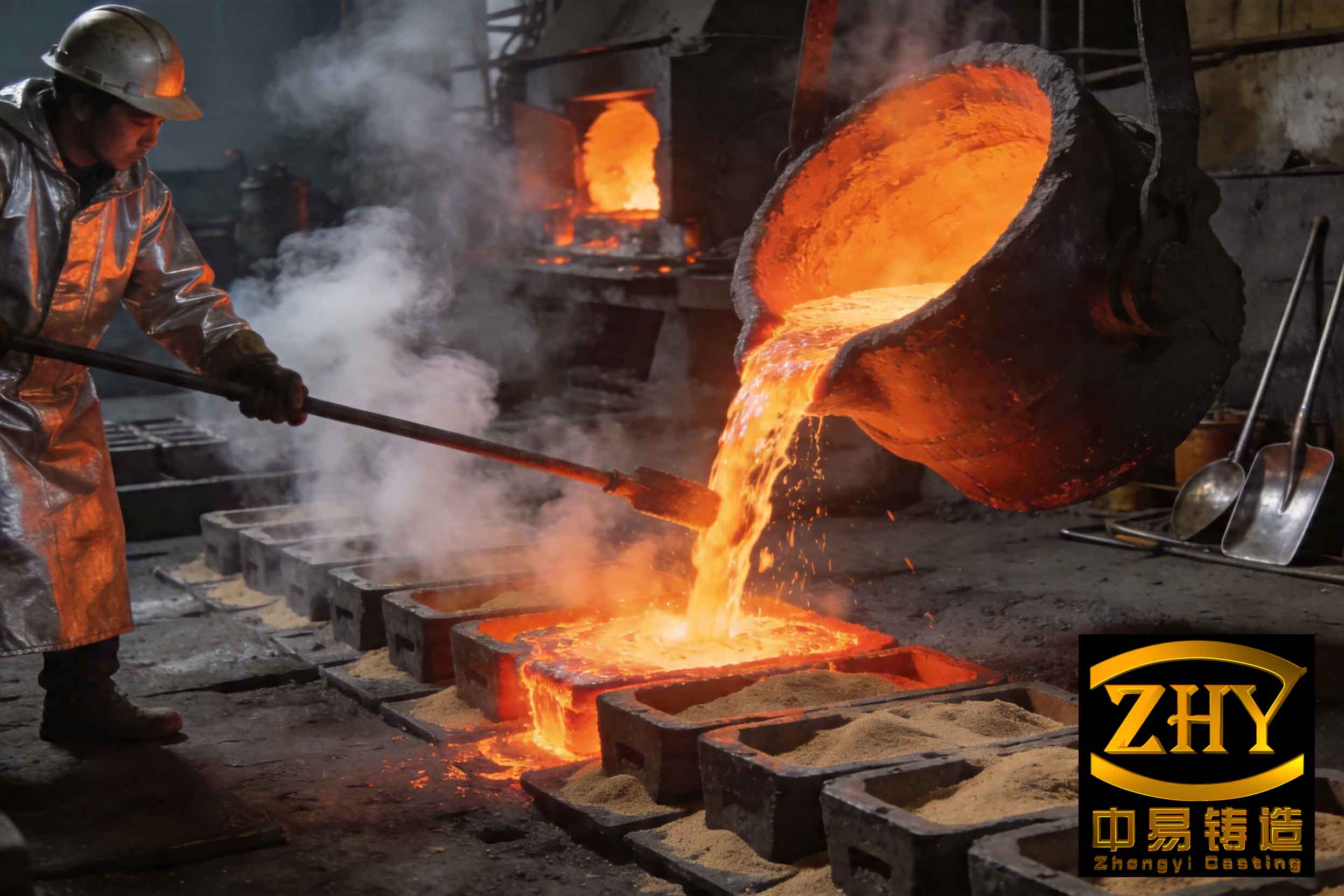
The production setup involved melting iron in an acid-lined cupola furnace with a capacity of several tons per hour. The tapping temperature ranged from 1380°C to 1420°C, and pouring temperature was maintained between 1300°C and 1350°C. Chemical composition of the base iron and treated iron is summarized in Table 1. Ductile iron treatment was performed using a plunging method with nodularizing agents, followed by slag removal and cover flux application. The mold system utilized dry sand molds with two castings per box. Key parameters influencing slag inclusions were systematically varied to observe effects on defect severity.
| Element | Base Iron | Treated Iron | Remarks |
|---|---|---|---|
| C | 3.6-3.9 | 3.4-3.7 | Graphite nodularity affected |
| Si | 1.8-2.2 | 2.5-3.0 | Influences fluidity |
| Mn | 0.3-0.5 | 0.3-0.5 | Minimal impact on slag inclusions |
| P | <0.05 | <0.05 | Low to avoid brittleness |
| S | 0.02-0.04 | 0.01-0.02 | Key factor in slag formation |
| Mg | – | 0.03-0.06 | Residual after treatment |
| RE | – | 0.02-0.04 | Rare earth elements |
Slag inclusions were analyzed through spectroscopy and microscopy, revealing higher concentrations of sulfur, magnesium, and rare earths in defective zones compared to sound areas. This suggests that slag inclusions comprise compounds like MgO, MgS, RE oxides, and FeO. The formation kinetics can be described by reactions such as: $$ \text{Mg} + \text{O} \rightarrow \text{MgO} $$ and $$ \text{Mg} + \text{S} \rightarrow \text{MgS} $$. These reactions are influenced by process variables, which I investigated through controlled experiments.
The impact of magnesium addition on slag inclusions was studied by varying the magnesium content in the nodularizing agent while keeping rare earth levels constant. As shown in Table 2, reducing magnesium addition decreased the depth and frequency of slag inclusions. Residual magnesium should be controlled below 0.05%, with an optimal nodularizer composition of 5-7% Mg, 1-2% RE, balance Fe-Si and scrap. This aligns with the formula for slag formation propensity: $$ S_f = k_1 \cdot [\text{Mg}] + k_2 \cdot [\text{S}] $$ where \( S_f \) is the slag formation index, and \( k_1, k_2 \) are constants dependent on temperature. Excessive magnesium increases dross formation, elevating slag inclusions risk.
| Mg in Nodularizer (%) | Residual Mg (%) | Slag Inclusion Depth (mm) | Defect Rate (%) | Notes |
|---|---|---|---|---|
| 8-10 | 0.06-0.08 | 2-5 | 15-20 | Severe slag inclusions |
| 6-8 | 0.04-0.06 | 1-3 | 10-15 | Moderate slag inclusions |
| 4-6 | 0.02-0.04 | 0.5-1.5 | 5-10 | Reduced slag inclusions |
| <4 | <0.02 | <0.5 | <5 | Minimal slag inclusions |
Molten iron temperature plays a dual role in slag inclusions formation. Higher temperatures reduce viscosity, facilitating removal of primary slag (e.g., sulfides) during treatment. Conversely, low temperatures promote secondary oxidation slag at the metal surface. Based on experimental data, the relationship between temperature and slag formation is depicted in Figure 1 (conceptual). At temperatures above 1350°C, slag inclusions are negligible; between 1300°C and 1350°C, thin slag films appear; below 1300°C, solid slag particles and crusts form. The critical temperature for magnesium evaporation cessation is around 1250°C. Thus, pouring above 1320°C is recommended to minimize slag inclusions. The effect can be modeled as: $$ \eta(T) = \eta_0 \cdot e^{-E_a / RT} $$ where \( \eta \) is fluid viscosity, \( E_a \) is activation energy, and \( T \) is temperature. Lower viscosity enhances slag floatation, reducing entrapped slag inclusions.
Mold conditions significantly affect slag inclusions by influencing metal flow and oxidation. Sand mold moisture, venting, and core design can cause metal boiling (called “inhalation”) that entraps gases and forms oxides. We conducted tests with chills, varying rust levels and coatings, to simulate crankpin regions. Results showed that inhalation occurred not from chill rust but from gas entrapment in core tops. Improving venting by adding vent cores reduced inhalation and subsequent slag inclusions. Mold pressure balance is crucial; positive pressure prevents air ingress. The gating system design also impacts slag inclusions distribution. A closed gating system with a choke ratio of 1:1.2:1.5 (sprue:runner:gate) is effective. Gates should be placed at low points to disperse slag inclusions. We modified gates from five to four, increased cross-sectional area, and relocated positions, which cut defect rates by over 50%.
Further analysis of slag inclusions composition revealed that they are often layered, with inner layers rich in Mg and RE compounds and outer layers of FeO. The formation mechanism involves sequential reactions during cooling. Using thermodynamic calculations, the stability of oxides can be assessed via the Gibbs free energy equation: $$ \Delta G = \Delta H – T \Delta S $$. For instance, MgO formation is favored at high temperatures, contributing to slag inclusions. Preventive measures include flux additions; we used cryolite (Na3AlF6) at 0.1-0.2% post-treatment and as a cover before pouring. This flux lowers slag melting point, promoting coalescence and removal. Statistical process control showed that with these measures, magnetic particle inspection pass rates exceeded 95%.
To quantify the combined effects, a multiple regression model was developed for slag inclusions index \( I_s \): $$ I_s = \alpha \cdot [\text{Mg}] + \beta \cdot [\text{S}] + \gamma \cdot T^{-1} + \delta \cdot M $$ where \( \alpha, \beta, \gamma, \delta \) are coefficients, \( T \) is pouring temperature, and \( M \) is mold moisture. Coefficients were derived from production data, emphasizing that magnesium and sulfur are primary drivers. Table 3 summarizes optimal parameters to prevent slag inclusions. Implementing these reduced scrap rates consistently below 5%, even for larger crankshafts weighing over 500 kg, where slower cooling exacerbates slag inclusions. For such castings, we adopted horizontal pouring with vertical cooling, coupled with enhanced fluxing, achieving pass rates above 90%.
| Parameter | Optimal Range | Effect on Slag Inclusions | Rationale |
|---|---|---|---|
| Residual Mg | <0.05% | High reduction | Limits oxide/sulfide formation |
| Residual RE | <0.03% | Moderate reduction | Controls inclusion nucleation |
| Pouring Temperature | >1320°C | Significant reduction | Enhances fluidity and slag floatation |
| Gating Ratio | 1:1.2:1.5 (closed) | Improves distribution | Reduces turbulence and oxidation |
| Mold Moisture | <1% | Prevents inhalation | Minimizes gas-induced slag inclusions |
| Flux Addition | 0.1-0.2% cryolite | Effective slag removal | Lowers slag viscosity and promotes separation |
In conclusion, slag inclusions in ductile iron crankshafts are manageable through integrated process control. Key lessons include minimizing magnesium addition, maintaining high pouring temperatures, optimizing gating systems, ensuring dry molds, and using appropriate fluxes. Continuous monitoring via chemical analysis and non-destructive testing is essential. Our experience demonstrates that slag inclusions can be reduced to acceptable levels, enhancing product reliability. Future work may focus on real-time sensors for slag detection and advanced modeling to predict slag inclusions formation under dynamic conditions. By sharing these insights, I hope to contribute to improved casting practices industry-wide, where slag inclusions remain a critical quality challenge.