
In the production of ductile iron, one of the most persistent and detrimental issues I encounter is the slag inclusion defect. This defect arises primarily during the magnesium treatment of molten iron, where magnesium readily reacts with oxygen and sulfur to form non-metallic inclusions that can be entrapped within the castings. Understanding and controlling this phenomenon is critical for ensuring the mechanical properties and integrity of ductile iron components. In this comprehensive discussion, I will delve into the nature of slag inclusion defects, their identification, and the multifaceted approaches to prevent their occurrence. Throughout this article, the term “slag inclusion defect” will be emphasized to reinforce its significance in foundry practice.
The formation of slag inclusion defects is fundamentally linked to the chemistry of molten iron during processing. When magnesium is added to treat the iron for spheroidal graphite formation, it undergoes exothermic reactions. The primary reactions can be expressed using chemical equations. For instance, the oxidation of magnesium is given by:
$$ \text{2Mg} + \text{O}_2 \rightarrow \text{2MgO} $$
Similarly, the desulfurization reaction proceeds as:
$$ \text{Mg} + \text{S} \rightarrow \text{MgS} $$
These products, magnesium oxide (MgO) and magnesium sulfide (MgS), have lower densities than the molten iron and tend to float to the surface, forming a slag layer. However, if not properly removed, these inclusions can be carried into the mold cavity during pouring, leading to the slag inclusion defect. Moreover, post-treatment oxidation of residual magnesium can exacerbate the issue, generating additional oxides that contribute to the defect. The propensity for slag formation is influenced by factors such as the initial sulfur content, magnesium addition levels, and processing temperatures. To quantify the risk, I often consider the relationship between residual magnesium and sulfur, which can be approximated by:
$$ [\text{Mg}]_{\text{res}} \propto \frac{1}{[\text{S}]_{\text{initial}}} $$
where higher initial sulfur necessitates more magnesium addition, increasing slag generation.
Identifying slag inclusion defects requires a systematic approach, as they manifest in various forms and locations. Typically, these defects are found near the upper surfaces of castings, at the lower faces of cores, in corner sections, and sometimes on vertical walls. The morphology can range from surface wrinkles or波纹 patterns to embedded sand particles, all containing non-metallic inclusions. Upon fracturing the casting, the affected areas appear dark and lack metallic luster, with distributions varying from large patches to scattered spots. In severe cases, the slag inclusion defect may combine with gas porosity, becoming evident after shot blasting. Subsurface defects, often revealed only after machining, may consist of dispersed graphite particles and entrapped materials, occasionally extending from the surface as fibrous non-metallic strands. To accurately diagnose the composition and origin of these inclusions, microscopic analysis of samples from defect zones is essential. Studies consistently show that these areas are rich in sulfur and oxygen, containing compounds of silicon, manganese, aluminum, and particularly magnesium. Sulfur printing techniques can be employed to distinguish sulfides. For instance, the presence of MgS can be confirmed through microanalysis, highlighting the complex nature of the slag inclusion defect.
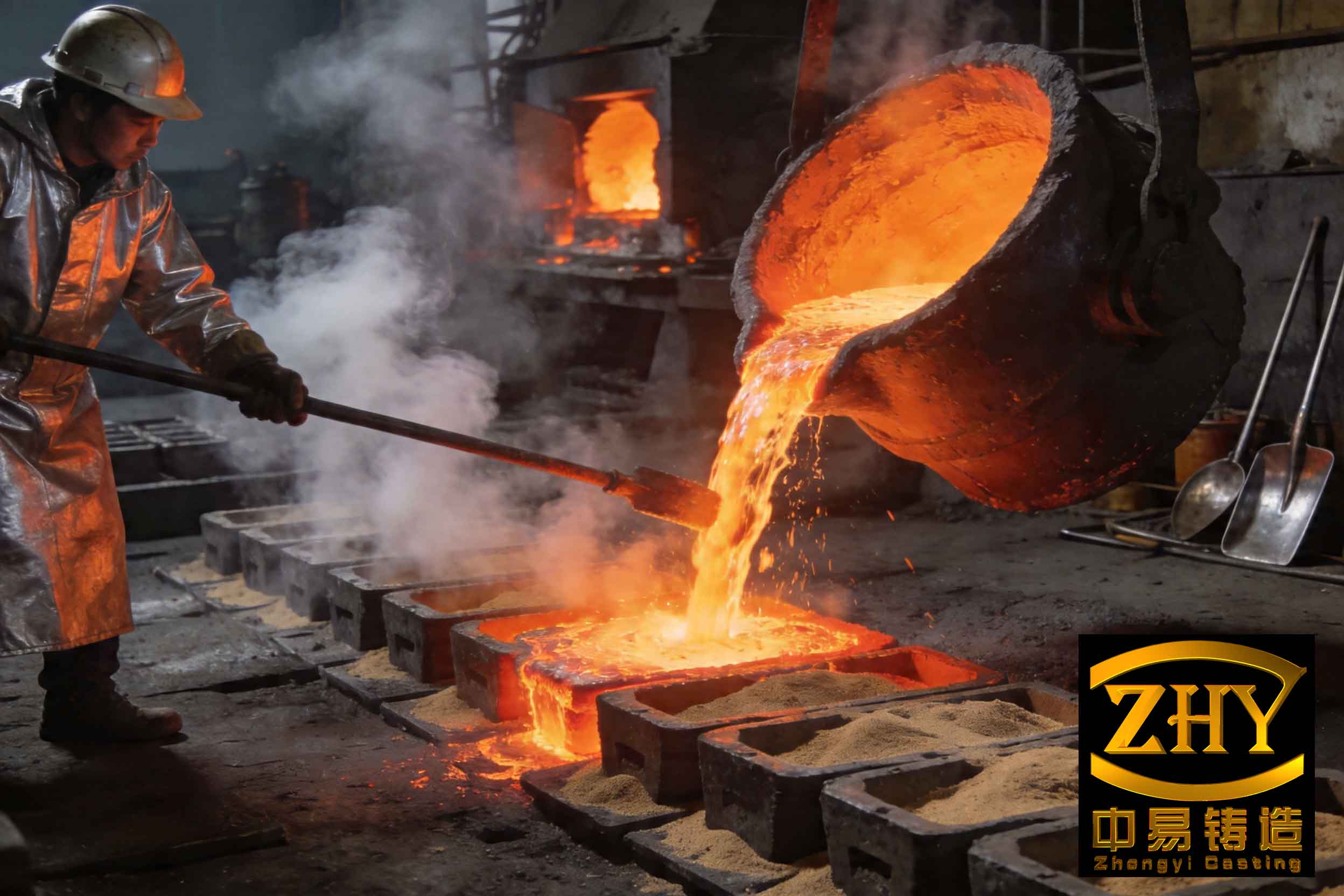
Preventing slag inclusion defects involves a holistic strategy aimed at minimizing slag formation, hindering its entry into molds, and limiting its development within the cavity. I have categorized these measures into several key areas, each supported by practical guidelines and theoretical insights. The core principle is to reduce the sources of inclusions while enhancing their removal. Below, I outline these strategies in detail, incorporating tables and formulas for clarity.
First, the melting and charge materials play a pivotal role. Controlling the melt chemistry to lower the initial sulfur content is crucial, as it reduces the amount of magnesium required for treatment, thereby decreasing slag generation. The relationship can be summarized by the formula:
$$ \text{Slag Mass} \approx k \cdot [\text{Mg added}] \cdot [\text{S}]_{\text{initial}} $$
where \( k \) is a proportionality constant dependent on process conditions. Additionally, avoiding excessively high carbon equivalents is important to prevent graphite flotation, which can segregate to the upper surfaces and contribute to slag inclusion defects. A recommended range for carbon equivalent (CE) is:
$$ \text{CE} = \%\text{C} + \frac{1}{3}\%\text{Si} \leq 4.5 $$
Table 1 summarizes the melting control parameters to mitigate slag inclusion defect risks.
| Parameter | Target Range | Effect on Slag Inclusion Defect |
|---|---|---|
| Initial Sulfur Content | < 0.02% | Reduces Mg addition, lowers slag formation |
| Carbon Equivalent (CE) | 4.2 – 4.5 | Prevents graphite flotation and segregation |
| Melt Temperature | 1500 – 1550°C | Ensures proper fluidity and reaction kinetics |
| Charge Material Purity | Low in oxides and sulfides | Minimizes exogenous inclusion sources |
Second, the球化处理 and inoculation processes require precise management. The goal is to achieve effective nodularization while minimizing residual magnesium. The residual magnesium level should be optimized using the equation:
$$ [\text{Mg}]_{\text{res}} = [\text{Mg}]_{\text{added}} – \alpha [\text{S}]_{\text{initial}} – \beta [\text{O}]_{\text{initial}} $$
where \( \alpha \) and \( \beta \) are consumption coefficients. Incorporating rare earth elements can lower the temperature at which an oxidizing film forms on the iron surface, reducing slag inclusion defect propensity. Furthermore, adding fluxes like salt (NaCl) during treatment helps coalesce sulfides and oxides into low-melting-point slags that float readily. Post-treatment, a brief holding period allows for slag flotation, followed by thorough skimming and coverage with carbonaceous materials like charcoal to prevent reoxidation. Inoculation should be controlled to avoid high aluminum content, which can promote oxide formation. Table 2 presents key guidelines for球化处理 and inoculation.
| Practice | Recommendation | Rationale |
|---|---|---|
| Mg Addition Level | Minimize to 0.03-0.05% residual Mg | Reduces MgO and MgS generation |
| Rare Earth Content | 0.01-0.03% residual | Lowers oxidation film formation temperature |
| Treatment Temperature | > 1450°C | Enhances slag flotation and reaction efficiency |
| Flux Addition | 0.1-0.2% NaCl or similar | Promotes slag coalescence and removal |
| Holding Time | 3-5 minutes after treatment | Allows slag separation |
| Inoculant Al Content | < 1.0% | Reduces Al-based oxide inclusions |
Third, molding materials significantly influence the occurrence of slag inclusion defects. The mold atmosphere should be weakly oxidizing or reducing to minimize metal-mold reactions that generate oxides. Using carbon-rich additives in the sand, such as coal dust or graphite, can create a protective environment. However, high-sulfur coal dust must be avoided, as it can introduce sulfur into the system, exacerbating the slag inclusion defect. The optimal carbon content in mold sand can be estimated by:
$$ \%\text{C}_{\text{sand}} \geq 2.0 + 0.5 \cdot \log(\text{casting thickness in mm}) $$
This ensures sufficient reducing potential. Additionally, mold coatings should be applied and dried properly to prevent moisture-related gas evolution that might carry inclusions.
Fourth, the design of the gating system is critical for preventing slag inclusion defects. The system should incorporate features that separate and trap slag before the metal enters the mold cavity. This includes using pouring basins, sprue wells, and runners with proper ratios to minimize turbulence. The gating ratio, often expressed as \( A_{\text{sprue}} : A_{\text{runner}} : A_{\text{gate}} \), should be designed to maintain laminar flow. A common ratio for ductile iron is 1 : 1.5 : 2, which helps reduce vortex formation that can entrain slag. Moreover, ceramic filters can be installed to physically capture inclusions. The effectiveness of a gating system in reducing slag inclusion defects can be modeled by the inclusion capture efficiency \( \eta \):
$$ \eta = 1 – \exp\left(-\frac{k_g \cdot L}{v}\right) $$
where \( k_g \) is a geometric constant, \( L \) is the flow path length, and \( v \) is the flow velocity. Table 3 outlines key gating design principles.
| Design Element | Specification | Impact on Slag Inclusion Defect |
|---|---|---|
| Pouring Basin | Large, with dam and weir | Promotes slag separation at entry |
| Sprue Well Depth | > 1.5 × sprue diameter | Absorbs kinetic energy, reduces turbulence |
| Runner Cross-Section | Trapezoidal or round | Minimizes sharp corners where slag accumulates |
| Gating Ratio | 1 : 1.5 : 2 (sprue:runner:gate) | Ensures steady flow, prevents vortexing |
| Filter Usage | Ceramic foam filters in runner | Physically traps inclusions |
| Gate Location | At bottom or side of cavity | Reduces splashing and slag entrainment |
Fifth, pouring practices are the final line of defense against slag inclusion defects. Maintaining a high pouring temperature is essential, as it improves fluidity and enhances slag flotation. Empirical data show that pouring temperatures above 1350°C significantly reduce the incidence of slag inclusion defects. The relationship can be expressed as:
$$ P(\text{defect}) \propto \exp\left(-\frac{T_p – T_c}{\beta}\right) $$
where \( P(\text{defect}) \) is the probability of slag inclusion defect occurrence, \( T_p \) is the pouring temperature, \( T_c \) is a critical temperature (around 1300°C), and \( \beta \) is a material constant. Additionally, ladle maintenance is crucial: refractory linings should be chosen to minimize slag formation, and regular deslagging during pouring is necessary. Controlling pouring speed to avoid turbulent flow and using ladle covers or tundishes can further prevent slag entry. In practice, I recommend a pouring rate \( Q \) calculated based on casting modulus \( M \):
$$ Q = k_p \cdot M^{1.5} $$
where \( k_p \) is a proportionality factor, typically 0.5-1.0 kg/s·cm\(^{1.5}\), to ensure smooth filling. Implementing these measures collectively can dramatically lower the risk of slag inclusion defects.
In conclusion, addressing slag inclusion defects in ductile iron requires a comprehensive approach that spans from melt preparation to final pouring. Each stage—melting, treatment, molding, gating, and pouring—presents opportunities to minimize slag generation and entrapment. By adhering to the guidelines outlined here, such as controlling sulfur levels, optimizing magnesium additions, designing effective gating systems, and maintaining high pouring temperatures, foundries can significantly reduce the occurrence of this pervasive defect. Continuous monitoring and microscopic analysis remain vital for diagnosing and refining these processes. Ultimately, a deep understanding of the mechanisms behind slag inclusion defects enables proactive prevention, ensuring the production of high-quality ductile iron castings with enhanced reliability and performance.
To further illustrate the interplay of factors, I have derived a comprehensive model for slag inclusion defect risk assessment. This model integrates key variables into a single risk index \( R \):
$$ R = \frac{[\text{S}]_{\text{initial}} \cdot [\text{Mg}]_{\text{res}} \cdot \exp(-\gamma T_p)}{[\text{CE}] \cdot \eta \cdot t_{\text{hold}}} $$
where \( \gamma \) is a temperature coefficient, \( \eta \) is the gating efficiency, and \( t_{\text{hold}} \) is the holding time after treatment. A lower \( R \) value indicates a reduced likelihood of slag inclusion defects. By systematically applying the strategies discussed—supported by tables, formulas, and practical insights—foundry engineers can effectively combat this challenge, leading to improved casting quality and efficiency.