
In the production of diesel engine crankshafts using ductile iron, the occurrence of slag inclusion defects has been a persistent and costly issue, leading to high scrap rates and compromising product reliability. As an engineer involved in this field, I have witnessed firsthand how subtle changes in manufacturing processes can exacerbate the formation of slag inclusion defects, resulting in significant financial losses and production delays. This article delves into a comprehensive analysis of the factors contributing to slag inclusion defects in a series of diesel engine crankshafts, outlines the underlying mechanisms, and presents effective countermeasures based on practical experience. The goal is to provide a detailed, first-person account of how systematic improvements can drastically reduce the incidence of slag inclusion defects, ensuring higher quality and efficiency in casting operations.
The production environment for these crankshafts involves specific conditions that influence the formation of slag inclusion defects. The molten iron is melted in a large duplex acid-lined cupola, with tapping temperatures ranging from 1420°C to 1450°C and pouring temperatures between 1320°C and 1350°C. The chemical composition of the iron, both before and after treatment, plays a critical role in determining the propensity for slag inclusion defects. The following table summarizes the typical chemical composition ranges for the base iron and the treated iron, which is essential for understanding the material’s behavior during processing.
| Item | C (%) | Si (%) | Mn (%) | P (%) | S (%) | Mg (%) | RE (%) | Nodularity Grade | As-Cast Pearlite (%) |
|---|---|---|---|---|---|---|---|---|---|
| Base Iron | 3.6–3.8 | 1.6–1.9 | 0.5–0.7 | <0.07 | 0.02–0.04 | – | – | – | – |
| Treated Iron | 3.4–3.6 | 2.4–2.8 | 0.5–0.7 | <0.07 | <0.02 | 0.03–0.05 | 0.02–0.04 | ≥1 | >85 |
Nodularization is achieved using a bell method with a Fe-Si-Mg-RE alloy, where the nodulizing agent is prepared in a specific ratio (e.g., rare earth, magnesium, ferrosilicon, and cast iron chips) and melted into a bell shape. Each ladle holds 500–600 kg of iron, and dehydrated sodium carbonate is added uniformly in the trough for desulfurization before the first slag removal. This process sets the stage for potential slag inclusion defects if not carefully controlled. The presence of oxides and sulfides in the melt can lead to the formation of non-metallic inclusions, which manifest as slag inclusion defects in the final castings, often visible as magnetic indications on machined surfaces or large-area defects on crankarms.
To understand the root causes of slag inclusion defects, it is imperative to analyze the formation mechanisms. Slag inclusion defects arise primarily from the oxidation and reaction products during nodularization and pouring. The key reactions involve the formation of various oxides and sulfides. For instance, during nodularization, magnesium reacts with oxygen to form magnesium oxide (MgO), a primary component of the initial slag. The reaction can be represented as:
$$2Mg + O_2 \rightarrow 2MgO$$
Similarly, silicon and other elements contribute to oxide formation. After nodularization, secondary oxidation occurs at the surface of the iron, leading to the formation of complex compounds such as silicates and aluminates. The secondary slag often includes compounds like $$2MgO \cdot SiO_2$$ and $$MgO \cdot Al_2O_3$$, which have lower densities than the iron and can become entrapped as slag inclusion defects if not properly removed. The density of ductile iron is approximately 7.1 g/cm³, while that of many slag particles is around 2.5–3.5 g/cm³, making them prone to floating or settling depending on the solidification conditions. The formation of these slags is influenced by factors such as temperature, surface tension, and the presence of oxidizing agents. For example, the oxidation tendency increases at lower temperatures, as the affinity of magnesium and rare earths for oxygen rises. This can be expressed through the temperature dependence of oxidation reactions, where the Gibbs free energy change $$ \Delta G $$ for oxide formation becomes more negative with decreasing temperature, promoting slag formation. Thus, controlling these parameters is crucial to minimizing slag inclusion defects.
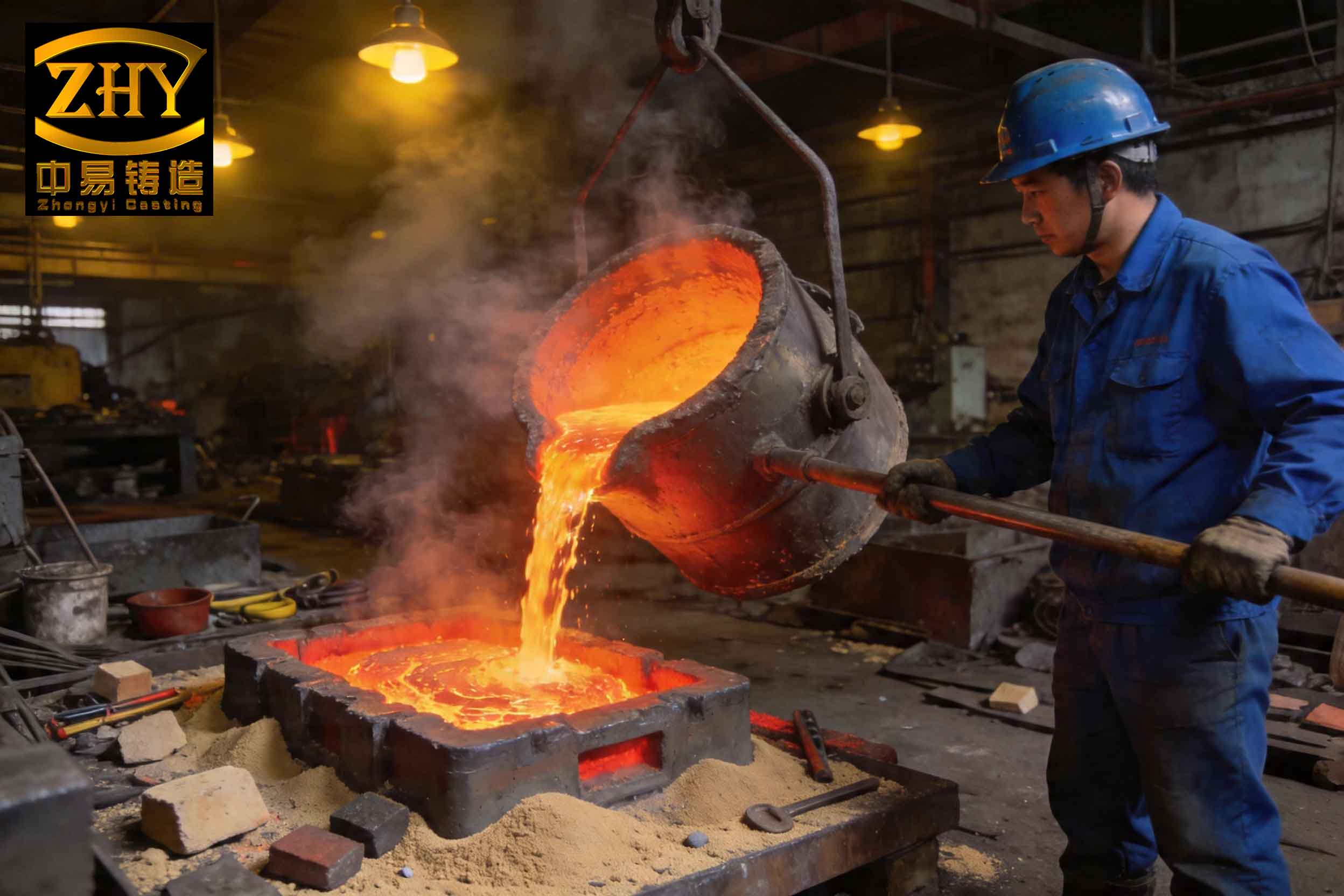
Several factors were identified as major contributors to the increase in slag inclusion defects during production. Through process audits and quality control initiatives, three key process changes were linked to a significant rise in slag inclusion defect rates. First, the substitution of sintered cast chips with scrap steel in the charge mix introduced issues related to rust and irregular sizing. Scrap steel often contains iron oxides (e.g., FeO) from corrosion, which increase the oxygen content in the melt. This enhances oxidation reactions, leading to more slag formation and subsequent slag inclusion defects. The oxidation reaction from rust can be simplified as:
$$4Fe + 3O_2 \rightarrow 2Fe_2O_3$$
Second, the use of a ductile iron cover agent instead of rice husk ash for slag coverage and protection exacerbated slag inclusion defects. The cover agent contained about 5% moisture and was primarily composed of SiO₂, which promoted oxidation at the iron surface. In contrast, rice husk ash, rich in potassium carbonate (K₂CO₃), is moisture-free and has reducing properties that prevent secondary oxidation. The switch to the cover agent increased the formation of secondary slag, directly contributing to slag inclusion defects. Third, changing the pouring and solidification orientation from horizontal pouring with vertical cooling to horizontal pouring with horizontal cooling altered the buoyancy dynamics of slag particles. In vertical cooling, slag particles tend to float upward and accumulate in the riser, away from the casting body. However, in horizontal cooling, they can become trapped within the casting, increasing the likelihood of slag inclusion defects. This change alone led to a dramatic surge in defect rates, highlighting the importance of solidification design in mitigating slag inclusion defects.
The properties of the slag, such as melting point and surface tension, are critical in understanding its behavior and removal efficiency. The following table summarizes the melting points and surface tensions of slag at different stages of treatment, which influence how easily slag can be removed to prevent slag inclusion defects.
| Stage | Melting Point (°C) | Surface Tension (mN/m) |
|---|---|---|
| Initial Slag (Before Mg Treatment) | 1300–1400 | 400–500 |
| After Mg Treatment | 1500–1600 | 800–900 |
| After Inoculation | 1400–1500 | 600–700 |
| After Cryolite Addition | 1000–1100 | 400–500 |
As shown, after magnesium treatment, the slag has a high melting point and surface tension, making it viscous and difficult to remove. This viscosity increases the risk of slag entrapment, leading to slag inclusion defects. The addition of cryolite (Na₃AlF₆) significantly lowers both the melting point and surface tension, transforming the slag into a more fluid state that can be easily skimmed off. This reduction is due to cryolite’s ability to dissolve oxides and sulfides, as described by the reaction:
$$Na_3AlF_6 + MgO \rightarrow MgF_2 + Na_2O + Al_2O_3$$
Moreover, cryolite decomposes at high temperatures to generate fluorine compounds that form a protective layer, preventing further oxidation. This is crucial for reducing the formation of secondary slag and, consequently, slag inclusion defects. The decomposition reaction can be represented as:
$$Na_3AlF_6 \rightarrow 3NaF + AlF_3$$
At around 1000°C, the vapor pressure of AlF₃ reaches 1 atm, creating a shielding effect. This protective layer minimizes the exposure of iron to air, thereby curbing the oxidation that leads to slag inclusion defects.
Based on the analysis, several countermeasures were implemented to address the slag inclusion defect issue. First, the charge mix was revised to exclude rusty or improperly sized scrap steel. Instead, only clean, non-corroded scrap steel was used to reduce the introduction of iron oxides. This simple change lowered the initial oxygen content in the melt, decreasing the propensity for slag formation and slag inclusion defects. Second, the coverage method was optimized by adding cryolite powder after slag removal and before pouring, followed by a layer of rice husk ash. The cryolite powder, as noted, reduces slag viscosity and promotes easy removal, while the rice husk ash provides a reducing atmosphere that prevents secondary oxidation. This dual-layer coverage effectively minimized slag entrapment and oxidation-related slag inclusion defects. Third, the pouring and solidification process was reverted to horizontal pouring with vertical cooling. This orientation leverages the density difference between iron and slag, allowing slag particles to float upward into the riser rather than being trapped in the casting. This geometric adjustment proved highly effective in reducing slag inclusion defects. Fourth, the tapping temperature was increased from 1420–1450°C to 1460–1480°C, and the pouring temperature was raised to 1340–1360°C. Higher temperatures reduce the oxidation tendency of magnesium and rare earths, as the affinity of carbon for oxygen increases with temperature. The relationship can be expressed using the temperature dependence of oxidation equilibria, where the equilibrium constant $$K$$ for oxide formation decreases with rising temperature, making oxidation less favorable. This temperature elevation thus suppresses slag formation and mitigates slag inclusion defects.
The effectiveness of these measures was evident in the subsequent production data. After implementing the changes, the scrap rate due to slag inclusion defects stabilized below 1%, compared to previous rates exceeding 5%. This significant reduction underscores the importance of holistic process control in combating slag inclusion defects. Regular monitoring and adjustments based on real-time data further ensured consistency. For instance, the use of optical pyrometers for temperature verification helped maintain optimal pouring conditions, directly impacting the incidence of slag inclusion defects. Additionally, employee training on proper handling of cover agents and scrap selection reinforced these improvements, creating a culture of quality awareness focused on preventing slag inclusion defects.
In conclusion, the battle against slag inclusion defects in ductile iron crankshafts requires a multifaceted approach that addresses material composition, process parameters, and operational practices. By understanding the mechanisms behind slag formation—such as oxidation reactions and slag property changes—and implementing targeted countermeasures like cryolite addition, orientation control, and temperature management, it is possible to achieve substantial reductions in slag inclusion defects. The experience shared here highlights that even minor process deviations can have major impacts on quality, but with systematic analysis and corrective actions, slag inclusion defects can be effectively minimized. This not only enhances product reliability but also boosts production efficiency, demonstrating that proactive quality management is key to overcoming challenges like slag inclusion defects in foundry operations. Future work could explore advanced techniques such as real-time slag detection or automated coverage systems to further reduce slag inclusion defects, paving the way for even higher standards in casting excellence.