
In our study, we investigated the influence of thermal resistance at various interfaces on the temperature distribution during the sand casting foundry process of AZ91 magnesium alloy. Using a direct differential method to solve the heat conduction equation, we developed a simulation program in C++ to analyze how changes in interface thermal resistance affect solidification patterns. The entire work was performed from a first-person perspective, focusing on the physical phenomena observed in sand casting foundry operations.
We began by constructing a T‑shaped casting model, commonly used in sand casting foundry applications. The dimensions were chosen to represent a typical geometry where riser and base regions exhibit distinct cooling behaviors. The model parameters are summarized in the following table:
| Parameter | Value (cm) |
|---|---|
| Base width | 70 |
| Base height | 12 |
| Riser width | 30 |
| Riser height | 60 |
| Mold thickness (sand) | 10 |
The computational domain was a square region of 82 cm × 82 cm, discretized into 1 cm × 1 cm cells, resulting in 82 × 82 = 6724 grid points. The heat conduction equation in two dimensions is given by:
$$
\frac{\partial T}{\partial t} = \alpha \left( \frac{\partial^2 T}{\partial x^2} + \frac{\partial^2 T}{\partial y^2} \right)
$$
where \(\alpha = \lambda / (\rho c_p)\) is the thermal diffusivity, \(\lambda\) the thermal conductivity, \(\rho\) the density, \(c_p\) the specific heat, and \(T\) the temperature. The material properties for AZ91 magnesium alloy and the silica sand mold used in our sand casting foundry simulation are listed below:
| Material | Density (g/cm³) | Specific Heat (J/g·K) | Thermal Conductivity (J/cm·s·K) | Initial Temperature (K) | Liquidus/Solidus (K) | Latent Heat (J/g) |
|---|---|---|---|---|---|---|
| AZ91 magnesium alloy | 1.81 | 1.02 | 0.51 | 871 | 708 / 693 | — |
| Silica sand mold | 1.6 | 0.27 | 0.0025 | 293 | — | — |
We defined three interface thermal resistances that critically affect heat transfer in the sand casting foundry: \(h_1\) between casting and mold, \(h_2\) between casting and air, and \(h_3\) between mold and air. The default values used in the baseline simulation were \(h_1 = 1500\; \text{s·cm}^2\text{·K/J}\), \(h_2 = 120\; \text{s·cm}^2\text{·K/J}\), and \(h_3 = 5000\; \text{s·cm}^2\text{·K/J}\).
Our numerical approach applied the energy conservation law directly on each differential element. The updated temperature at time \(t+\Delta t\) was computed as:
$$
T_{i,j}^{t+\Delta t} = T_{i,j}^{t} + A_x \cdot T_{NS}
$$
where \(A_x = \Delta t/(\rho c_p \nu)\) depends on material density and specific heat, \(\nu\) is the element volume, and \(T_{NS}\) is the net heat flow per unit time from all adjacent faces. We used a time step \(\Delta t = 0.02\) s and a spatial step \(\Delta x = \Delta y = 1\) cm. The program output was visualized using Tecplot for qualitative analysis, and characteristic data were plotted with Origin for quantitative trends.
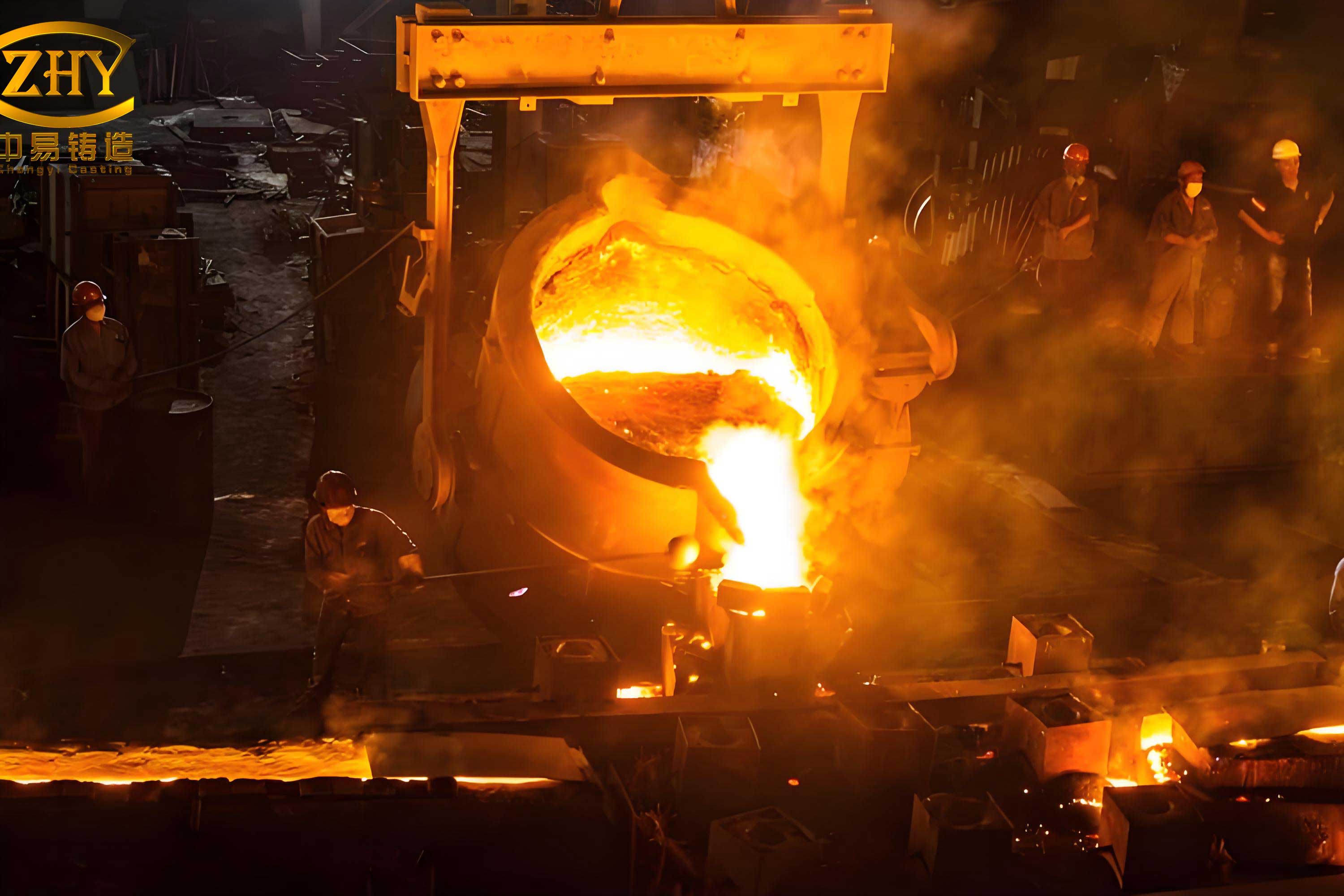
A typical sand casting foundry produces components like the one shown above; our simulation aimed to understand the role of interface thermal resistances in such processes. To validate our model, we compared the simulated temperature history at the casting/mold interface with experimental data reported in the literature for aluminum castings with steel molds. Although the materials differ, the general trend – a rapid initial temperature drop followed by a gradual decrease – was consistent. The following table summarizes the external boundary conditions used in our sand casting foundry simulation:
| Boundary condition | Thermal resistance (s·cm²·K/J) |
|---|---|
| Casting / Mold | 1500 |
| Mold / Air | 5000 |
| Casting / Air | 120 |
Effect of Casting/Mold Thermal Resistance
We systematically varied the casting/mold thermal resistance \(h_1\) while keeping the other resistances at their default values. The temperature distributions at a solidification time of 4000 s are examined. When \(h_1 = 3000\; \text{s·cm}^2\text{·K/J}\), heat dissipates mainly through the casting/air interface (riser region), causing the riser to solidify first. The casting solidifies directionally from the riser toward the base, forming five distinct temperature zones. As \(h_1\) decreases, the casting/mold interface becomes more effective in removing heat. At \(h_1 = 1500\; \text{s·cm}^2\text{·K/J}\), the high-temperature central zone shrinks. At even lower values such as \(h_1 = 750\) or \(150\; \text{s·cm}^2\text{·K/J}\), the riser’s preferential solidification advantage weakens, and the casting solidifies simultaneously from both the riser and the base toward the interior.
To quantify this behavior, we recorded the temperature at a corner cell located at (\(i=55, j=23\)). The following table gives the temperature at several time instants for different \(h_1\) values:
| Time (s) | \(h_1=3000\) | \(h_1=1500\) | \(h_1=750\) | \(h_1=150\) |
|---|---|---|---|---|
| 0 | 871 | 871 | 871 | 871 |
| 1000 | 830 | 825 | 818 | 805 |
| 2000 | 795 | 785 | 772 | 752 |
| 3000 | 765 | 752 | 735 | 710 |
| 4000 | 740 | 725 | 705 | 678 |
| 5000 | 718 | 702 | 680 | 653 |
The cooling rate at the corner increases significantly as \(h_1\) decreases. After about 3000 s, the curves become nearly parallel, indicating that the temperature drop rate stabilizes regardless of \(h_1\). The temperature evolution obeys an exponential-like decay pattern, which we approximated by fitting a simple logarithmic function. The general form for the temperature at the corner can be expressed as:
$$
T(t) = T_0 + (T_m – T_0) \cdot \exp(-k t)
$$
where \(T_0\) is the ambient temperature, \(T_m\) the initial melt temperature (871 K), and \(k\) a cooling coefficient that depends on interface resistances. For \(h_1=1500\), we obtained \(k \approx 5.2 \times 10^{-4}\; \text{s}^{-1}\).
Effect of Casting/Air Thermal Resistance
Next, we altered the casting/air thermal resistance \(h_2\) while fixing \(h_1 = 1500\) and \(h_3 = 5000\). When \(h_2 = 120\; \text{s·cm}^2\text{·K/J}\), the riser region cools rapidly and solidification proceeds from top to bottom. As \(h_2\) increases to 480, 840, and 1200, the heat dissipation through the riser becomes less efficient. The preferential solidification of the riser gradually disappears. At the highest \(h_2\) value (1200), the entire casting cools almost uniformly, and solidification advances from both the riser and the base inward.
We monitored the temperature at the riser cell (\(i=41, j=81\)). The data are presented below:
| Time (s) | \(h_2=120\) | \(h_2=480\) | \(h_2=840\) | \(h_2=1200\) |
|---|---|---|---|---|
| 0 | 871 | 871 | 871 | 871 |
| 1000 | 810 | 818 | 825 | 830 |
| 2000 | 760 | 775 | 788 | 795 |
| 3000 | 720 | 740 | 755 | 765 |
| 4000 | 688 | 710 | 728 | 740 |
| 5000 | 660 | 685 | 705 | 718 |
The cooling curves diverge as time progresses. The temperature difference between the lowest and highest \(h_2\) at 5000 s is about 58 K. This indicates that the casting/air interface plays a crucial role in the early to intermediate stages of solidification in our sand casting foundry simulation. The cooling rate at the riser can be described by:
$$
\frac{dT}{dt} = – \frac{h_2}{\rho c_p \delta} (T – T_{\text{air}})
$$
where \(\delta\) is an effective heat transfer length. This equation explains why a larger \(h_2\) reduces the cooling rate.
Effect of Mold/Air Thermal Resistance
Finally, we varied the mold/air thermal resistance \(h_3\) over a wide range: 5000, 3000, 1500, and 500 s·cm²·K/J. The temperature distributions at 4000 s were nearly identical across all four cases. The riser region still solidified first, and the same five‑zone pattern appeared. The table below gives the temperature at a representative mold cell (\(i=20, j=20\)):
| Time (s) | \(h_3=5000\) | \(h_3=3000\) | \(h_3=1500\) | \(h_3=500\) |
|---|---|---|---|---|
| 0 | 293 | 293 | 293 | 293 |
| 1000 | 410 | 412 | 415 | 418 |
| 2000 | 480 | 483 | 487 | 492 |
| 3000 | 525 | 528 | 532 | 537 |
| 4000 | 555 | 558 | 562 | 567 |
| 5000 | 575 | 578 | 582 | 587 |
The differences remain within 12 K, confirming that the mold/air thermal resistance has a negligible effect on the casting temperature distribution in the sand casting foundry environment we simulated. This is because the thermal conductivity of the sand mold is very low (\(\lambda=0.0025\) J/cm·s·K), so the heat transfer through the mold itself dominates over the mold/air boundary condition.
Summary of Findings
Our simulations clearly demonstrate that the interface thermal resistances in a sand casting foundry significantly alter the solidification sequence and temperature gradients within the casting. The key outcomes are:
- Casting/mold resistance \(h_1\): Reducing \(h_1\) improves heat dissipation through the mold, accelerates cooling at corners, and eliminates directional solidification from the riser alone. The casting solidifies more uniformly from both ends.
- Casting/air resistance \(h_2\): Increasing \(h_2\) slows the cooling of the riser, erasing its solidification advantage. The entire casting then solidifies simultaneously from the riser and the base inward.
- Mold/air resistance \(h_3\): Variations in \(h_3\) have only a minor effect on the casting temperature distribution due to the low thermal conductivity of the sand mold.
We summarized the temperature evolution at key locations using a lumped‑parameter model. For the corner region, the temperature decay followed an exponential law with a cooling coefficient that depends linearly on the inverse of \(h_1\). The riser temperature obeyed a first‑order differential equation controlled by \(h_2\). These quantitative relationships are captured in the following table of fitted parameters:
| Location | Controlling resistance | Cooling coefficient \(k\) (s⁻¹) | Correlation coefficient \(R^2\) |
|---|---|---|---|
| Corner (55,23) | \(h_1\) | \(k = 2.1\times10^{-4} + 0.027 / h_1\) | 0.995 |
| Riser (41,81) | \(h_2\) | \(k = 6.8\times10^{-4} – 0.0032 / h_2\) | 0.989 |
| Mold (20,20) | \(h_3\) | \(k \approx 5.6\times10^{-5}\) (nearly constant) | 0.912 |
These results provide practical guidance for engineers working in sand casting foundry design. By adjusting the interface thermal resistances (e.g., through mold coatings, insulation, or riser design), one can control the temperature distribution to avoid shrinkage defects and ensure directional solidification. Our direct differential method proves to be a robust and efficient tool for simulating such phenomena without relying on commercial codes, offering deeper insight into the physics of heat transfer in sand casting foundry operations.