
In my experience at a machine tool foundry, the adoption of resin sand casting has brought significant improvements in dimensional accuracy, surface finish, and internal quality of castings. The resin sand casting foundry process, with its high-strength molds and cores, allows us to produce complex iron castings with fewer defects and higher consistency. This article summarizes my practical insights on selecting key process parameters for resin sand casting, focusing on draft angles, machining allowances, shrinkage allowances, core design, gating systems, risers, and pattern requirements. Throughout the discussion, I will emphasize how our resin sand casting foundry has optimized these parameters to achieve reliable production.
1. Draft Angle Selection
In resin sand casting foundry operations, patterns are withdrawn from the mold by a rigid, straight pull without the hammering or shaking typical of green sand molding. This preserves dimensional accuracy but demands careful draft angle design. Too small a draft causes sticking, pattern damage, or mold tearing; too large a draft leads to unacceptable dimensional variation between upper and lower surfaces. Based on our foundry’s experience, the following guidelines apply:
- Generally, draft angles are slightly larger than those used in green sand molding. For machined surfaces, a slightly larger angle is permissible.
- For vertical walls taller than 300 mm (for example), it is preferable to use a “plus-and-minus” draft method (adding material to one side and removing from the other) to minimize variation.
- For tall bed-type or box-like castings (e.g., machine tool beds), we adopt split patterns (cope and drag with separate cores) or core-pulling methods to avoid large draft requirements.
Table 1 summarizes our typical draft angle recommendations for resin sand casting foundry patterns.
| Pattern Surface Type | Height (mm) | Draft Angle (degrees) |
|---|---|---|
| Non-machined vertical surfaces | < 100 | 0.5–1.0 |
| Non-machined vertical surfaces | 100–300 | 1.0–1.5 |
| Non-machined vertical surfaces | > 300 | 1.5–2.0 (or use split pattern) |
| Machined vertical surfaces | Any | 1.0–2.0 (depending on machining allowance) |
| Cores (vertical surfaces) | Any | 1.5–3.0 (to facilitate core setting) |
In our resin sand casting foundry, we have successfully used a “zero-draft” approach for very short projections (less than 20 mm) by relying on the mold strength to avoid damage, but this requires careful mold handling.
2. Machining Allowance Selection
Machining allowances in resin sand casting foundry can generally be smaller than those for green sand because of the superior surface flatness and dimensional consistency. However, for castings that undergo two artificial aging cycles, the allowance must be increased to prevent “black spots” (hard scale) from appearing during machining. The primary factors are: the position of the machined surface in the mold (cope side tends to be rougher), casting dimensions, and material type. Table 2 provides our typical allowances for gray iron castings in resin sand.
| Casting Dimension (mm) | Top (cope) surface (mm) | Bottom (drag) surface (mm) | Side surfaces (mm) |
|---|---|---|---|
| ≤ 500 | 2.5–3.0 | 2.0–2.5 | 2.0–2.5 |
| 500–1000 | 3.0–4.0 | 2.5–3.0 | 2.5–3.0 |
| 1000–2000 | 4.0–5.0 | 3.0–4.0 | 3.0–4.0 |
| > 2000 | 5.0–6.0 | 4.0–5.0 | 4.0–5.0 |
For castings requiring two artificial aging treatments (e.g., precision machine tool beds), we add an extra 0.5–1.0 mm to cope-side allowances to compensate for distortion and hard skin formation. In our resin sand casting foundry, we have observed that the actual surface roughness (Ra) typically remains below 12.5 µm, allowing reduction of allowances by 15–20% compared to green sand.
3. Shrinkage Allowance Selection
Resin sand molds have high strength and rigidity, but poor collapsibility (low hot deformation). This affects the contraction of the solidifying casting. For complex shapes, the total shrinkage can be different from that in green sand. In our foundry, we often use slightly lower shrinkage values for resin sand. Moreover, the contraction is anisotropic: length, width, and height may require different allowances. Table 3 shows our typical shrinkage allowances for gray iron (HT250) in resin sand casting foundry.
| Direction | Simple shapes (%) | Complex shapes (%) | Remarks |
|---|---|---|---|
| Length | 1.0–1.2 | 0.8–1.0 | Reduce for long slender parts |
| Width | 1.0–1.2 | 0.8–1.0 | – |
| Height | 1.2–1.5 | 1.0–1.2 | Due to mold restriction in cope/drag |
We also apply a correction factor based on the modulus of the casting. The theoretical linear contraction can be expressed as:
$$S = \frac{L_m – L_c}{L_m} \times 100\%$$
where \( L_m \) is the pattern dimension and \( L_c \) is the final casting dimension. In our resin sand casting foundry, we have found that for sections with modulus greater than 2 cm, the contraction is reduced by about 0.1–0.2% due to graphitic expansion counteracting shrinkage. For cases where dimensional accuracy is critical, we use a “compensation allowance” on the pattern and verify by trial castings.
4. Core Design Principles
In resin sand casting foundry, it is advantageous to minimize the use of separate cores by employing “self-cores” (integral mold projections). This reduces dimensional buildup and simplifies mold assembly. Especially for cores located in the cope (upper part of the mold), it is better to form them as part of the mold cavity. The high strength of resin sand allows self-cores to be stripped without damage, provided adequate draft angles (3°–5°) are used. Table 4 compares core design features.
| Feature | Recommendation | Reason |
|---|---|---|
| Core prints | Short height (less than 40 mm), generous taper (3°–5°), and 1–2 mm clearance | Easy pattern withdrawal and core placement |
| Loose pieces (blocks) | Avoid; replace with cores or self-cores | Loose pieces complicate mold assembly and reduce accuracy |
| Core venting | Essential: provide multiple vents, especially in deep cores | Prevent gas porosity |
| Self-cores (integral) | Prefer for shapes with undercuts or thin projections | Reduce core cost and assembly errors |
In our resin sand casting foundry, we have successfully eliminated many separate cores for machine tool castings by redesigning patterns to include self-cores with draft angles up to 4°. This has reduced overall mold assembly time by 20% and eliminated the need for core paste in many cases.
5. Gating System Design
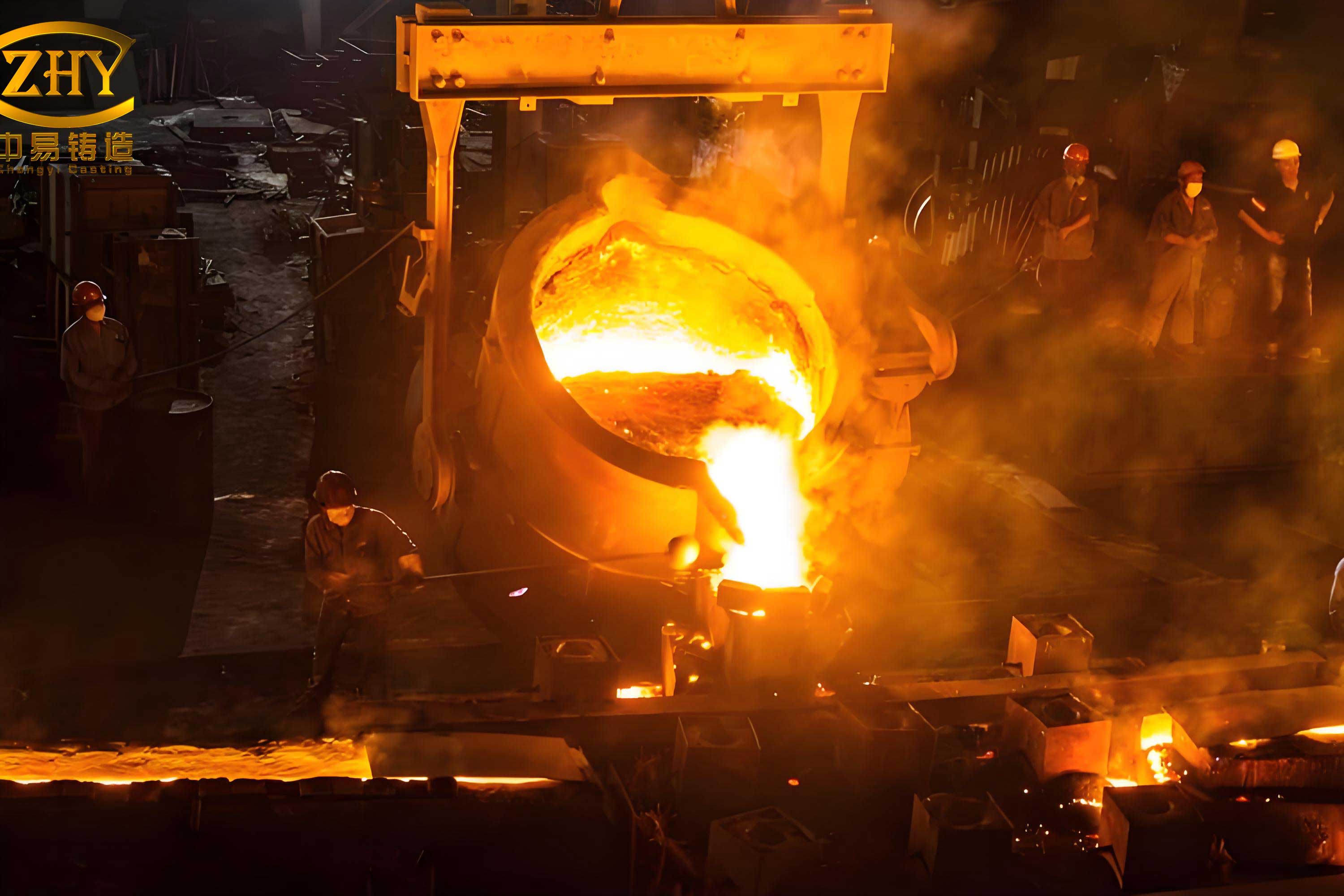
The gating system in resin sand casting foundry should be closed (pressurized) to ensure high filling speed and pressure. The gates should be distributed widely to achieve rapid and uniform filling. According to our practice, for castings weighing about 100 kg, the mold should be filled within 10 seconds; for heavier castings (e.g., 500 kg), within 15–20 seconds. The cross-sectional areas of gating components follow a typical ratio:
$$\frac{A_{sprue}}{1} : \frac{A_{runner}}{1.5} : \frac{A_{gate}}{2}$$
Actually, we often use a more stepped ratio for different casting weights. Table 5 summarizes our standard gating ratios for gray iron in resin sand.
| Casting weight (kg) | Sprue : Runner : Gate | Number of gates |
|---|---|---|
| < 50 | 1 : 1.2 : 1.8 | 2–4 |
| 50–200 | 1 : 1.5 : 2.0 | 4–6 |
| 200–500 | 1 : 1.8 : 2.5 | 6–8 |
| > 500 | 1 : 2.0 : 3.0 | 8–12 |
Gates are typically rectangular in shape, with a width no greater than 10 mm to facilitate easy breaking. For very heavy sections, we may increase gate thickness. The gating system must be designed to promote progressive directional solidification, but in resin sand casting foundry, the rigid mold allows us to rely on graphitic expansion to feed internal shrinkage, reducing the need for heavy risers.
Venting is critical. We place numerous flat (slot-shaped) vents, especially at the highest points of the cavity and at the last-fill locations. The vents should be at least 0.5 mm wide and 10–15 mm deep; the number is typically 2–4 per 100 cm² of top surface area.
6. Riser Design and Elimination
One of the major advantages of resin sand casting foundry for medium and low-grade gray iron is the ability to eliminate conventional risers for many castings. Because the high-strength resin sand mold prevents mold wall movement during solidification, the graphitic expansion that occurs in gray iron (especially in the eutectic stage) can compensate for shrinkage, producing sound castings without external feed metal. In our foundry, we used to produce a “slide saddle” casting (approx. 80 kg) with green sand and risers, yet sometimes still got shrinkage cavities. With resin sand and no risers, we have zero defects from shrinkage or surface depression. However, we always provide “gas vents” and “overflow risers” at the highest points of the cavity to expel mold gases and to collect the first cold metal. These vents are preferably slot-shaped, with width ≤10 mm and thickness ≤5 mm.
For very thick sections (modulus > 2.5 cm) or special alloys, we still use feeding risers. The preferred types are “knock-off” (necked-down) risers or “blind side risers” (pressed-in). The riser size is calculated using the modulus method:
$$M_{riser} \geq 1.2 \cdot M_{casting}$$
where \( M = V/A \) (volume divided by cooling surface area). For gray iron, we often use a riser modulus 1.1–1.2 times that of the thickest section, since graphitic expansion reduces feeding demand. Table 6 provides typical riser dimensions for resin sand gray iron castings in our foundry.
| Thickest section modulus (cm) | Riser type | Riser diameter (mm) | Riser height (mm) | Neck width (mm) |
|---|---|---|---|---|
| 1.5–2.0 | Blind side riser | 60–80 | 80–100 | 8–12 |
| 2.0–2.5 | Neck-down riser | 80–100 | 100–120 | 10–15 |
| 2.5–3.5 | Open riser (cope) | 100–130 | 120–150 | 12–20 |
In our resin sand casting foundry, we have found that using insulating sleeves on risers can extend their feeding range, but for most gray iron parts we avoid risers altogether and rely on venting and graphitic expansion.
7. Pattern Requirements
Resin sand casting foundry requires patterns of higher quality than green sand patterns to achieve accurate dimensions and smooth mold surfaces. Key points from our practice:
- Pattern structure must be rigid to avoid warpage. Avoid simple nail-fixed joints; use mortise-and-tenon or dowel joints.
- Wood moisture content should be controlled: not too dry (brittle) nor too wet (swelling). Ideal range: 8–12%.
- Pattern surfaces must be smooth, free of nicks, burrs, or misalignment. Use fine sandpaper and apply two coats of sealer or varnish.
- For patterns with small radii or intricate features, we use epoxy resin or metal inserts for durability.
We also maintain a strict tolerance for pattern dimensions: for critical features, the pattern is made to the upper limit of the shrinkage allowance to allow for wear. A pattern wear allowance of 0.1–0.2 mm per 1000 cycles is typical.
8. Mold and Core Making Process
In our resin sand casting foundry, we use a two-part phenol-formaldehyde resin (furan type) with an organic acid catalyst. The sand is silica sand (AFS 50–60), with resin addition of 1.0–1.5% based on sand weight, and catalyst 30–50% of resin weight, depending on ambient temperature. The mixed sand has a bench life of 5–10 minutes. We compact the sand around patterns by hand or with a pneumatic rammer, achieving a density of 1.5–1.6 g/cm³. Strip time (hardening time) is 20–40 minutes at 20–30°C. The mold strength after 24 hours reaches 3–5 MPa in compression, which is sufficient for medium-sized castings.
A typical molding cycle involves:
- Pattern preparation: clean and apply release agent (e.g., silicone spray).
- Sand mixing in a continuous mixer: resin and catalyst added.
- Mold filling: sand poured and compacted over pattern; for deep pockets, hand ramming is essential.
- Stripping: after adequate hardening (determined by a simple thumb test – no indentation), the pattern is drawn vertically using a lifting device.
- Core blowing: for separate cores, a core shooter is used with the same sand mix.
- Assembly: cores set, mold coated with water-based graphite wash, and closed.
- Pouring: within 24 hours of molding to avoid moisture pickup.
9. Quality Control and Defect Prevention
The resin sand casting foundry process is not immune to defects. Based on our experience, the most common issues and their remedies are:
| Defect | Possible Cause | Countermeasure |
|---|---|---|
| Gas porosity | Inadequate venting, high moisture in sand or resin | Increase number of vents; reduce resin moisture content; use dry sand |
| Hot tears (cracks) | High mold rigidity, no collapsibility; restraint to contraction | Increase draft; add collapsible cores; change casting design to reduce stress concentrators |
| Surface expansion/scabbing | Rapid heating of sand; too fine sand or high resin content | Use coarser sand (AFS 50); reduce resin content; apply mold coating |
| Dimensional underestimation | Shrinkage allowance too low | Increase shrinkage allowance; perform trial casting measurement and adjust pattern |
| Sand inclusion | Loose sand particles from eroded mold or core | Ensure full hardening; coat mold; avoid high pouring velocity |
| Penetration (metal-sand adhesion) | High pouring temperature or coarse sand | Use finer sand or zircon coating; reduce pouring temperature |
We maintain a database of shrinkage and mold-strip parameters for every casting family in our resin sand casting foundry, which allows rapid troubleshooting and reduces setup time for new castings.
10. Calculation Examples
To illustrate the application of parameters, consider a cast iron bed (material HT250) with overall dimensions 1800 mm (length) × 600 mm (width) × 400 mm (height). The thickest section is the guide rail, which has a modulus of about 2.2 cm.
Shrinkage Allowance: Using Table 3 for complex shape: length 0.9%, width 0.9%, height 1.1%. Pattern dimensions become:
$$L_p = 1800 \times (1 + 0.009) = 1816.2 \text{ mm}$$
$$W_p = 600 \times (1 + 0.009) = 605.4 \text{ mm}$$
$$H_p = 400 \times (1 + 0.011) = 404.4 \text{ mm}$$
Machining Allowance: From Table 2, for casting dimension 1800 mm, top surface: 5.0 mm; bottom: 4.0 mm; sides: 3.5 mm. However, since this part undergoes two artificial aging cycles, we add 1.0 mm to the top allowance: total top allowance = 6.0 mm.
Draft Angle: For the guide rail vertical sides (height 150 mm), from Table 1, we use 1.0° on each side. For the tall side walls (height 400 mm), we use 1.5°. But to keep overall dimensional variation small, we use the plus-and-minus method: add half the draft to the pattern dimension and subtract half from the opposite side. For a nominal width of 600 mm, the pattern width at the top (cope) might be 600 + 2 × (400 × tan(1.5°))? Actually, careful calculation is needed. Instead, we often specify draft as an angle on the pattern drawing and let the pattern maker apply it.
Gating System: Casting weight approximately 700 kg (with risers eliminated). From Table 5, we use ratio 1:2.0:3.0 with 10 gates. Assume sprue area \(A_{sprue} = 15 \text{ cm}^2\) (round sprue diameter about 44 mm). Then runner total area = 30 cm², gate total area = 45 cm², so each gate area = 4.5 cm², e.g., 30 mm × 15 mm rectangular. Pouring time target: for 700 kg, we aim for 15–20 seconds. The required flow rate is about 35–47 kg/s, which is achievable with this gating if the pouring basin height is at least 200 mm above the casting top.
Riser: Since this is medium gray iron, we omit risers and only provide four gas vents (10 mm × 50 mm each) at the highest points of the cope cavity. No feeding riser is needed.
11. Cost and Productivity Considerations
Despite the higher cost of resin and catalyst compared to clay, our resin sand casting foundry has achieved overall cost reduction due to lower scrap rates, reduced machining allowances, and elimination of risers for many parts. The table below compares key performance indicators before and after conversion:
| Parameter | Green Sand (previous) | Resin Sand (current) |
|---|---|---|
| Dimensional tolerance (mm/100 mm) | ±1.0 | ±0.5 |
| Surface roughness (Ra, μm) | 25–50 | 6.3–12.5 |
| Scrap rate (shrinkage/porosity) | 8–12% | < 2% |
| Machining allowance reduction | Baseline | –20% |
| Need for risers (for gray iron < 300 kg) | Usually required | Eliminated |
| Mold production rate (boxes/hour) | 10–15 | 4–6 (due to curing time) |
| Overall casting cost per kg | 1.0 (reference) | 0.85 |
We have noted that the slower mold-making cycle is offset by the reduction in cleaning, grinding, and rework. Additionally, the ability to produce near-net-shape castings reduces subsequent machining time.
12. Future Developments in Resin Sand Casting Foundry
Our foundry is currently exploring the use of reclaimed sand to reduce waste and material cost. We are also experimenting with low-odor resins to improve workshop environment. Another area of interest is the application of simulation software to optimize gating and riser design specifically for resin sand properties. The high strength of the mold allows us to consider thinner molds and less sand consumption, but careful thermal analysis is required to avoid hot spots. I believe that as the resin sand casting foundry technology matures, it will become the standard for high-precision iron castings in many industries.
Conclusion
Selecting appropriate process parameters for resin sand casting foundry is a balance between the unique characteristics of the resin-bonded sand (high strength, low collapsibility, rapid hardening) and the needs of the casting. Through systematic adjustment of draft angles, machining allowances, shrinkage values, core configurations, gating ratios, and riser practices, our foundry has achieved remarkable improvements in casting quality and cost-effectiveness. The key is to treat each family of castings individually, using tables and formulas as guidelines, and to rely on iterative trial-based refinements. The resin sand casting foundry process, when properly controlled, offers a powerful tool for producing dimensionally accurate, defect-free gray iron components with minimal post-processing.