
In our foundry, we have been dedicated to advancing sand casting foundry technologies to meet the increasing demands for precision and cost efficiency. One of our significant achievements is the development of a low-machining-allowance sand casting process for saber-type stationary blades used in steam turbines. These blades, characterized by their twisted and curved shape resembling a saber or bow, are critical components in low-pressure stages of upgraded turbine units. Through systematic trials and optimization, we have successfully produced blades with surface quality and dimensional accuracy meeting stringent mechanical standards, while achieving substantial economic benefits. This article presents our journey, challenges, and solutions in implementing this innovative sand casting foundry method.
The trend in casting production is toward precision—reducing dimensional tolerances, improving geometrical accuracy, and minimizing machining allowances. Low-machining-allowance sand casting is a method where the casting is produced with minimal stock on surfaces that will later be finished only by grinding or polishing, eliminating heavy machining. This approach saves raw materials, shortens production cycles, and lowers costs. The saber-type blade, due to its complex twisted profile and thin edges, posed unique challenges for sand casting foundry. Its shape leads to difficulties in controlling distortion and surface defects. In collaboration with research institutes, we undertook multiple experiments to develop a stable production process.
The blade has 14 cross-sections with varying parameters. The maximum thickness is 22 mm, the minimum thickness is only several millimeters, and the overall length is about 400 mm. The blade’s airfoil shape is highly twisted, with a maximum chord width of approximately 120 mm and an average chord of 90 mm. The material is a martensitic stainless steel, requiring strict control of chemical composition and mechanical properties. The acceptance criteria include a maximum thickness tolerance of ±0.5 mm, trailing edge thickness meeting specified dimensions, and a permissible light gap between the blade profile and a template of 0.3 mm on the concave side and 0.5 mm on the convex side. Surface defects such as cracks, penetrative flaws, and linear defects are prohibited, especially in the critical zone.
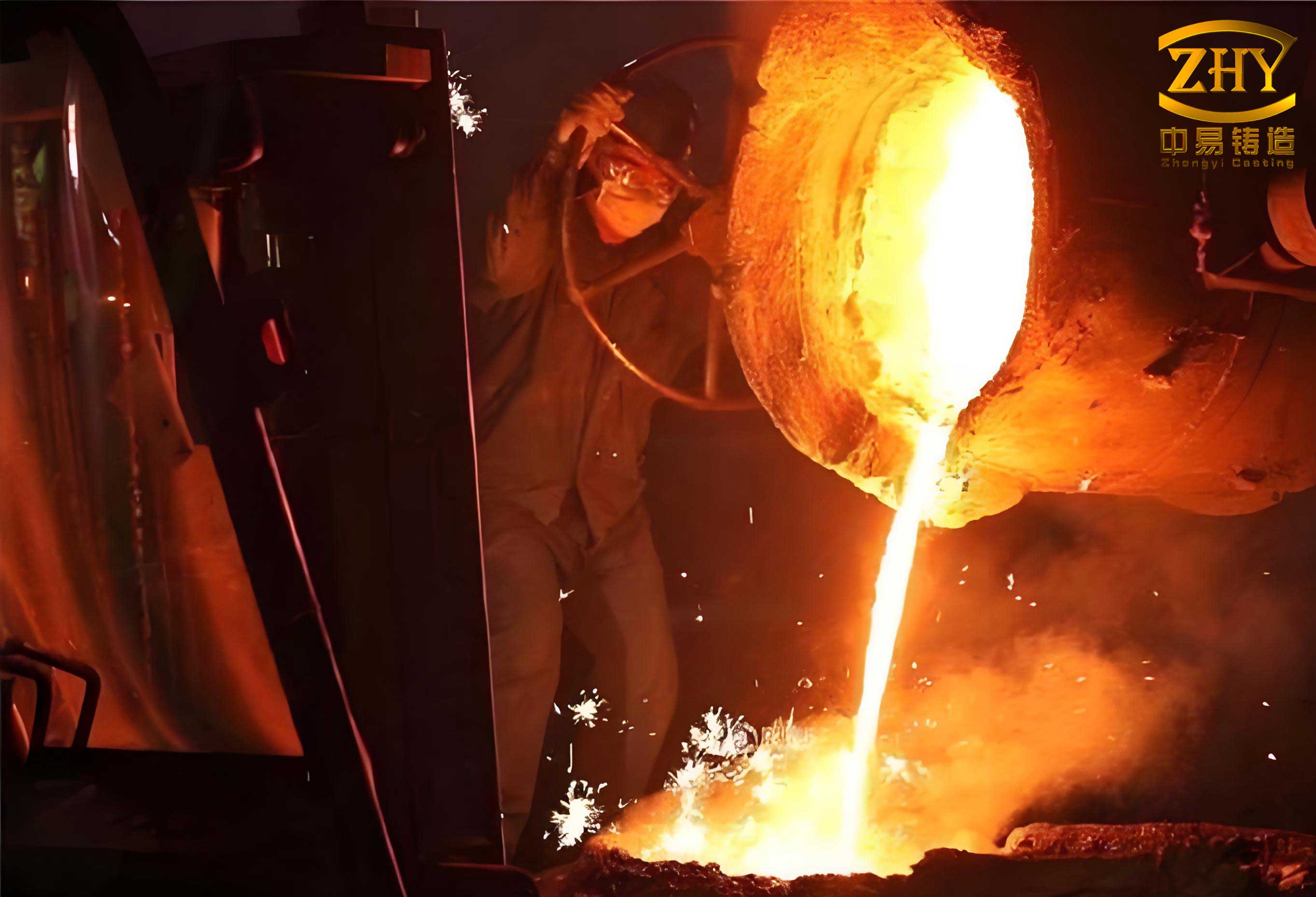
We initially considered investment casting (lost-wax) but it was impractical due to the blade’s size (about 8 kg gross weight) and severe thickness variations. Wax pattern distortion, shell cracking, and high costs led us to focus on sand casting foundry with low machining allowances. We chose organic ester-cured self-hardening sodium silicate sand for its ability to achieve high dimensional accuracy by stripping the pattern after hardening. The sand mixture consisted of 50-mesh quartz sand, sodium silicate (5% by weight), an organic ester hardener (0.3–0.5%), and a collapsibility enhancer. Melting was performed in a 500 kg medium-frequency induction furnace. To ensure proper filling of thin sections and good surface quality, we controlled the pouring temperature between 1580°C and 1620°C, slightly on the high side to facilitate gas escape and slag floatation.
We designed three gating systems for comparison: side-gating, top-gating, and bottom-gating. The following table summarizes the key features of each system.
| Gating Method | Ingate Design | Riser/Exhaust | Pouring Position |
|---|---|---|---|
| Side-gating | Slot-like ingate along trailing edge from small end to large end | Spherical blind riser at large end with vent hole | Vertical casting with horizontal mold assembly |
| Top-gating | Direct pouring through a contoured top riser | Same top riser acts as pouring cup and feeder | Vertical casting, metal poured from top |
| Bottom-gating | Horn-shaped ingate at small end, connected to sprue | Contoured top riser at large end | Vertical casting, metal enters from bottom |
In the initial exploratory phase, we cast five blades per method. The side-gated blades exhibited severe surface defects on the concave (inner) side, with concentrated slag and sand inclusions. The convex (back) side also had defects but fewer. The need to cut off the slot-like ingate increased cleaning effort. Yield was low (about 55%). The top-gated blades had scattered defects on both sides but relatively better surface quality, with a yield of about 70%. The bottom-gated blades showed concentrated defects on the trailing edge—a critical zone—and also exhibited shrinkage depression under the riser. After heat treatment (normalizing and tempering), we measured distortion. The distortion pattern was similar for all three: large deformation at both ends and smaller deformation in the middle, ranging from 0.8 mm to 1.2 mm. However, heat treatment deformation was larger than as-cast deformation. Given that the bottom-gating produced defects in the critical trailing edge area, we eliminated that option. We proceeded with side and top gating for further improvement.
In the improvement phase, we adjusted the pattern dimensions by applying directional compensation: 0.3% shrinkage allowance plus additional local compensation for thin sections. We also replaced the original corundum-based alcohol coating with a zircon-based alcohol coating. Zircon has high refractoriness, good sintering characteristics, low thermal expansion, and excellent high-temperature strength, reducing coating peel-off. We cast five more blades for each method. After cleaning, the as-cast distortion was controlled within the grinding allowance of 0.8–1.0 mm. Surface defects significantly decreased, but the top-gated blades still showed better quality. Therefore, we selected top-gating as the optimal method for our sand casting foundry. Additionally, we improved the heat treatment packing technique. Instead of stacking blades flat and mixed, we used a dedicated fixture that held each blade vertically with the trailing edge downward and the large end slightly raised, creating a small inclination. The blades were spaced with gaps to ensure uniform heating and cooling. This reduced heat treatment distortion effectively.
In the final validation phase, we produced 80 blades over 10 heats using the top-gating method with controlled parameters. The table below shows measured distortion values for a sample batch.
| Blade No. | As-Cast Max Distortion (mm) | After Heat Treatment Max Distortion (mm) | Remaining Allowance (mm) |
|---|---|---|---|
| 1 | 0.5 | 0.7 | 0.9 |
| 2 | 0.4 | 0.6 | 1.0 |
| 3 | 0.6 | 0.8 | 0.8 |
| 4 | 0.5 | 0.7 | 0.9 |
| 5 | 0.5 | 0.7 | 0.9 |
All blades remained within the grinding allowance of 0.8–1.0 mm. The final surface quality was inspected: no cracks, no penetrative flaws, and no linear defects. Minor surface porosities (if any) were repaired by welding and re-polishing, meeting acceptance standards. Dimensional checks on maximum thickness, trailing edge thickness, and template light gap were performed by qualified inspectors. The following table lists light gap measurements for several blades.
| Blade No. | Section | Concave Gap | Convex Gap |
|---|---|---|---|
| A | 1-1 | 0.15 | 0.20 |
| 2-2 | 0.10 | 0.15 | |
| 3-3 | 0.12 | 0.18 | |
| B | 1-1 | 0.20 | 0.25 |
| 2-2 | 0.15 | 0.20 | |
| 3-3 | 0.18 | 0.22 | |
| C | 1-1 | 0.12 | 0.18 |
| 2-2 | 0.10 | 0.15 | |
| 3-3 | 0.14 | 0.20 |
All light gaps were within the specified limits (0.3 mm concave, 0.5 mm convex). The chemical composition and mechanical properties also conformed to standards. We have summarized the typical results in the following tables.
| Element | C | Si | Mn | Cr | Ni | Mo | P | S |
|---|---|---|---|---|---|---|---|---|
| Specification | 0.10–0.15 | ≤0.60 | 0.30–0.60 | 12.0–14.0 | 1.5–2.0 | 0.3–0.5 | ≤0.030 | ≤0.025 |
| Typical Analysis | 0.12 | 0.35 | 0.45 | 12.8 | 1.7 | 0.4 | 0.018 | 0.010 |
| Property | Specification (min) | Typical Value |
|---|---|---|
| Tensile Strength (MPa) | 830 | 890 |
| Yield Strength (MPa) | 685 | 740 |
| Elongation (%) | 12 | 15 |
| Impact Toughness (J/cm²) | 50 | 65 |
We attribute the success to several key factors in our sand casting foundry process. First, the choice of top-gating minimized turbulence and coating erosion. The zircon coating provided excellent resistance to metal wash. Second, the use of epoxy resin patterns (instead of wood) ensured dimensional stability and surface finish. Third, the heat treatment fixture with vertical inclined placement reduced thermal distortion drastically. The compensation pattern design accounted for both solidification shrinkage and thermal distortion. The shrinkage model we used can be expressed as:
$$ \Delta L = L_0 \cdot (\alpha_c + \alpha_t) + \delta $$
where $$\Delta L$$ is the total compensation, $$L_0$$ is the nominal dimension, $$\alpha_c$$ is the casting shrinkage coefficient (0.3% for this steel), $$\alpha_t$$ is the thermal expansion coefficient during heat treatment (about 0.1%), and $$\delta$$ is a local adjustment factor (0.05–0.15 mm depending on section thickness).
The final product fully met the requirements of the mechanical standard for stationary blades. Since 1987, we have supplied low-machining-allowance saber-type blades for two upgraded turbine units, replacing conventional blades. Direct savings in raw materials and machining costs amount to nearly 1 million RMB per unit. By the end of 1994, our company had produced 20 such turbine units, and all will eventually be upgraded. The cumulative economic benefit is substantial. Furthermore, the technology has been extended to other stationary blade types, promising even greater returns.
Although our sand casting foundry method for low-machining-allowance saber blades has been successfully industrialized, we continue to explore improvements. Topics for future work include optimizing the coating composition, refining the heat treatment cycle using simulation, and investigating the feasibility of automated grinding. We welcome feedback from the community to further enhance this technology.
In conclusion, we have demonstrated that low-machining-allowance sand casting is a viable and economical approach for producing complex curved blades. This achievement represents a significant step toward precision casting in the foundry industry, blending traditional sand casting foundry techniques with modern process control.