
In our sand casting foundry practice, the manual sand casting process has always been the fundamental method for producing a wide variety of castings due to its low-cost molding materials, simple mold preparation, and adaptability to single-piece, batch, and mass production. This article presents a comprehensive study on the application of sand casting foundry technology in the production of low-carbon steel rear axle housings for heavy-duty buses, specifically the JT6120 model. Through systematic trial production, we identified and resolved critical defects, ultimately establishing a mature and reliable sand casting foundry process.
1. Casting Requirements and Analysis
1.1 Casting Specifications
The JT6120 rear axle housing is made of ZG35 low-carbon steel with a gross weight of 184 kg. The casting requires a smooth surface free from defects such as gas porosity, slag inclusions, shrinkage cavities, and cracks. After machining, it must pass a hydraulic pressure test at 0.5 MPa without any leakage. The rear axle housing of a large bus must withstand complex stresses including compression, bending, torsion, and impact, thus demanding high strength and rigidity. Additionally, to prevent oil leakage, the casting must possess high density and no permeability. Low-carbon steel exhibits poor castability and high shrinkage, and the housing has uneven wall thickness with stringent quality requirements. Therefore, the sand casting foundry process for low-carbon steel in such applications is challenging and not yet fully mature.
1.2 Casting Dimensions and Thermal Analysis
The casting is a thin-walled box structure with overall dimensions of 1442 mm × 393 mm × 148 mm, with a nominal wall thickness of 50 mm. The upper annular plane (between Φ308 mm and Φ424 mm) has a wall thickness of 13 mm, plus an additional 21 mm for machining allowance and process correction. The connection between the ring (annular part) and the plate (large flange) creates a local thermal node with a modulus of M = 2.76 cm. The lower annular plane (between Φ310 mm and Φ424 mm) has a wall thickness of 14 mm, plus 25 mm for machining and correction, resulting in a thermal modulus of 1.25 cm. The two end flanges of the casting have a thermal modulus of 1.7 cm. This casting represents a typical thin-walled steel box with uneven thickness, complex geometry, and two large annular planes that require machining without shrinkage porosity or cavities. The dimensional accuracy and mechanical property requirements are high, making it one of the most difficult aspects of sand casting foundry design.
2. Initial Sand Casting Foundry Process Design
2.1 Molding and Core Making
Based on existing tooling, we selected a flask size of 2100 mm × 1500 mm × 500/400 mm, producing two castings per mold. Sodium silicate self-hardening sand was used for molding. The casting has a large central cavity that tapers towards the ends, formed by a single sand core. If the core lacks adequate collapsibility, internal cracks and deformation may occur. We initially planned to use resin-bonded sand for steel castings with zircon flour quick-drying coating, and designed collapsible holes in the core.
2.2 Pouring Position Selection
Considering the casting structure, the lower annular plane (Φ310–Φ424) is the critical machined surface and must be placed in the lower mold cavity. The upper annular plane (Φ308–Φ424) involves a rod-plate connection with a larger thermal modulus, making it suitable for the upper mold where risers can be placed for feeding.
2.3 Gating System Design
We calculated the ingate cross-sectional area as 30 mm × 35 mm × 40 mm, resulting in a total ingate area ΣFin = 26 cm². The runner cross-section was 48 mm × 56 mm × 55 mm, giving ΣFrun = 28.6 cm². The sprue diameter was 70 mm, with ΣFspr = 38.46 cm². The area ratio was ΣFspr : ΣFrun : ΣFin = 1 : 1.5 : 1.4.
| Component | Dimensions (mm) | Total Area (cm²) | Ratio |
|---|---|---|---|
| Sprue | Φ70 | 38.46 | 1.0 |
| Runner | 48 × 56 × 55 | 28.6 | 1.5 |
| Ingate | 30 × 35 × 40 | 26.0 | 1.4 |
2.4 Risers and Chill Blocks
Following the principle of directional solidification and the modulus method, we placed risers at about a dozen thermal nodes to compensate for liquid shrinkage, and chill blocks on thick sections of the lower mold to promote simultaneous solidification. Using the hot-spot circle proportional enlargement method, we initially arranged eight risers and ten chill blocks.
2.5 Casting Yield
The casting yield was calculated as the ratio of finished casting weight to total poured weight:
$$ \text{Casting yield} = \frac{\text{Weight of finished casting}}{\text{Weight of casting + risers + gating}} \times 100\% = 55\% $$
2.6 Shrinkage Allowance
We applied a shrinkage allowance of 1.3% in the longitudinal direction and 2% in all other directions.
3. Trial Production Procedure
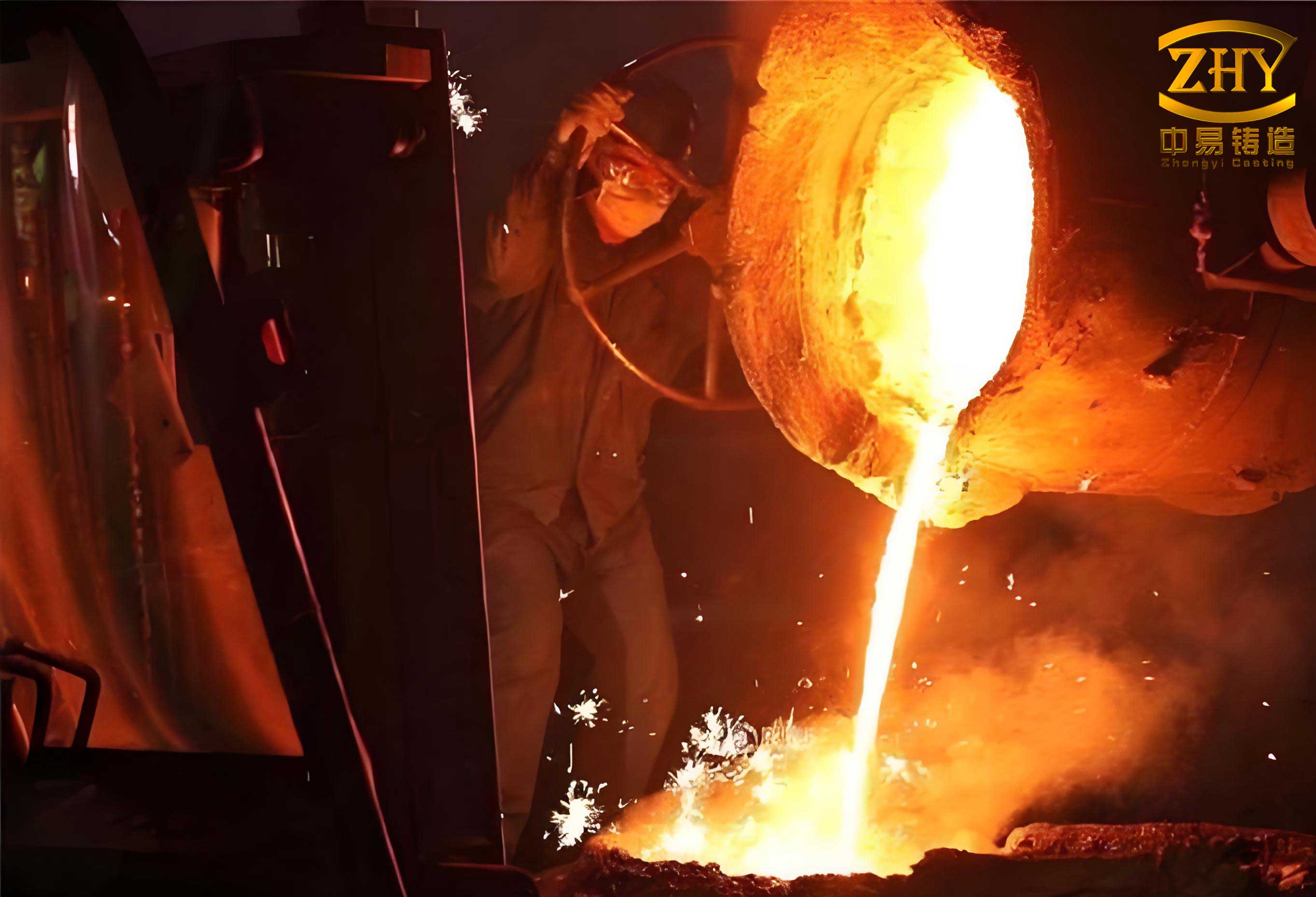
Raw material ZG35 was melted in a 600 kg induction furnace, with aluminum and rare-earth ferrosilicon used for pre-furnace deoxidation. A 6-ton ladle was used for pouring, with a single top-pouring operation. The pouring temperature was controlled between 1540°C and 1560°C, and the pouring time was no less than 20 seconds. The mold was shaken out after more than 10 hours of cooling.
4. Defects Observed in Initial Trial
After machining, several defects were identified:
- Shrinkage porosity at the roots of all four side risers.
- Cracks in the internal cavity at locations where anti-cracking ribs were placed; some castings also showed cracks on the lower annular plane (Φ310–Φ424).
- Sand adhesion on the outer surface and internal cavity of the end flanges, making cleaning difficult.
5. Process Improvements and Solutions
The flexibility of manual sand casting foundry lies in the low cost of molds, allowing easy modification. We could drill holes, add chills, adjust pouring parameters, and optimize exhaust conditions to develop a suitable process through iterative trials.
5.1 Addressing Shrinkage at Riser Roots
The shrinkage at the roots of side risers was mainly due to the large thermal node at those locations. The side risers further increased the thermal interference. To eliminate the defect, we considered two options: enlarging the riser or using insulating side risers. However, enlarging would be constrained by flask dimensions and would reduce yield. We concluded that an open top riser would be more effective. Therefore, we replaced the four blind side risers with four blind top risers. The modified riser design eliminated shrinkage at the roots. However, for mass production, top risers would require four additional cores and increase cutting time. Moreover, the blind top risers would sit on machined surfaces, complicating cleaning. Following directional solidification principles, we explored using a “pad” (feeding pad) to shift shrinkage into the pad. This approach was feasible given the local geometry, because it simplified machining and avoided non-machined surfaces. The result was satisfactory: no shrinkage defects were observed.
5.2 Eliminating Hot Cracks
Metallographic analysis confirmed that the cracks were hot tears. Hot tears arise from the combined effect of steel properties, casting geometry, and restraint from the mold or core during solidification shrinkage. Despite adding anti-cracking ribs and external chills, cracks persisted. We also observed localized bulging deformation. Therefore, we suspected inadequate core collapsibility. During core making, workers often inconsistently left collapsible holes – some large, some small, and sometimes none at all. Castings with larger collapsible holes showed no cracks, while those with small or no holes exhibited cracking. Hence, achieving a collapsible core with strict adherence to core-making procedures was critical. We replaced the original resin sand core with a tung oil-based sand core that had better collapsibility, and enforced a maximum sand thickness of 35 mm around the collapsible holes.
For the cracks on the lower annular plane (Φ310–Φ424), we added a circular anti-cracking rib at that location.
5.3 Resolving Sand Adhesion
Sand adhesion on the end flanges was mitigated by improving the coating technique and adjusting the pouring temperature to reduce thermal attack on the sand.
6. Results After Process Optimization
After the improvements, we achieved castings with excellent surface quality, free from shrinkage cavities, cracks, and sand adhesion. Over 500 parts were produced and machined without any defects. Hydraulic pressure tests showed no leakage. Furthermore, each casting saved 40 kg of liquid steel, increasing the casting yield from 55% to 75% – a 20% improvement, yielding substantial economic benefits.
| Parameter | Original Process | Improved Process |
|---|---|---|
| Riser type at side flanges | Blind side riser | Blind top riser (later replaced by feeding pad) |
| Core material | Resin-bonded sand | Tung oil-based sand (better collapsibility) |
| Collapsible holes in core | Inconsistent (often small or none) | Strictly controlled: sand thickness ≤ 35 mm |
| Anti-cracking measures | Ribs and chills only | Added circular rib on lower plane + improved core collapsibility |
| Pouring temperature (°C) | 1540–1560 | 1540–1560 (optimized) |
| Casting yield (%) | 55 | 75 |
| Defects observed | Shrinkage, hot cracks, sand adhesion | None |
7. Discussion: The Role of Sand Casting Foundry in Process Development
This case demonstrates that manual sand casting foundry is an invaluable tool for developing and optimizing casting processes for complex steel components. The low cost of sand molds and cores allows rapid iteration without significant financial risk. By systematically analyzing defects and modifying the gating, risering, core design, and cooling conditions, we were able to transform a problematic process into a highly productive and reliable one. The key lessons learned include:
- Thermal analysis using modulus calculations is essential for proper riser placement.
- Core collapsibility is critical for avoiding hot tears in steel castings with complex internal cavities.
- Feeding pads can be a cost-effective alternative to multiple risers when geometry permits.
- Strict adherence to core-making procedures (such as collapsible hole dimensions) is necessary for consistent quality.
In the sand casting foundry industry, the combination of theoretical design and empirical adjustment remains the most practical approach for achieving defect-free castings. The final process we developed for the JT6120 rear axle housing has been successfully used in mass production, confirming that sand casting foundry is not only economical but also capable of meeting the highest quality standards for critical automotive components.
8. Conclusion
Manual sand casting foundry provides an effective means for trial production to determine a sound casting process. The theoretical design of cores, risers, and gating must be continuously modified based on actual manufacturing defects. By systematically analyzing defects and implementing targeted improvements, we established a mature technique for producing low-carbon steel rear axle housings. The final process yielded a casting yield of 75%, defect-free parts, and passed all quality tests. Compared to other casting methods, sand casting foundry remains the most versatile and cost-effective choice, especially for complex steel castings where process development is needed before scaling up.
In summary, the sand casting foundry method, with its low tooling cost and adaptability, continues to play an irreplaceable role in the development of heavy-duty vehicle components.