
Virtual simulation technology, as a representative of 21st-century information technology, offers interactivity and realism that promise to revolutionise traditional teaching methods. In the field of mechanical engineering, especially in the training of metal forming processes, the sand casting foundry is a fundamental yet challenging topic. Students must understand the complex sequence of steps, from mould preparation to casting solidification, and the influence of process parameters on final quality. Traditional hands-on training in a real foundry is often limited by safety concerns, high costs, and the inability to experiment with multiple mould designs. To address these limitations, I developed a virtual simulation experimental teaching platform for sand casting foundry processes. This platform allows students to interact with a three-dimensional virtual environment, guiding them through each step of sand casting while providing immediate feedback on quality. In this article, I present the architecture, operation, innovations, and evaluation of the platform, emphasising its role in enhancing learning outcomes in sand casting foundry education.
Platform Architecture
The virtual simulation platform was built using Unity3D, a powerful engine for creating interactive 3D experiences. The architecture is designed to support multiple mould (part) selections, process parameter choices, and step-by-step execution. The core workflow is: select a part from the library → choose the gating system and parting surface → execute the sand casting foundry steps → obtain a virtual casting → analyse its quality → iterate if necessary. The system dynamically simulates the filling, solidification, and defect formation based on the chosen parameters. Students can immediately see how different choices affect the final casting, reinforcing theoretical knowledge. The platform runs on standard personal computers and does not require specialised hardware, making it accessible for classroom use.
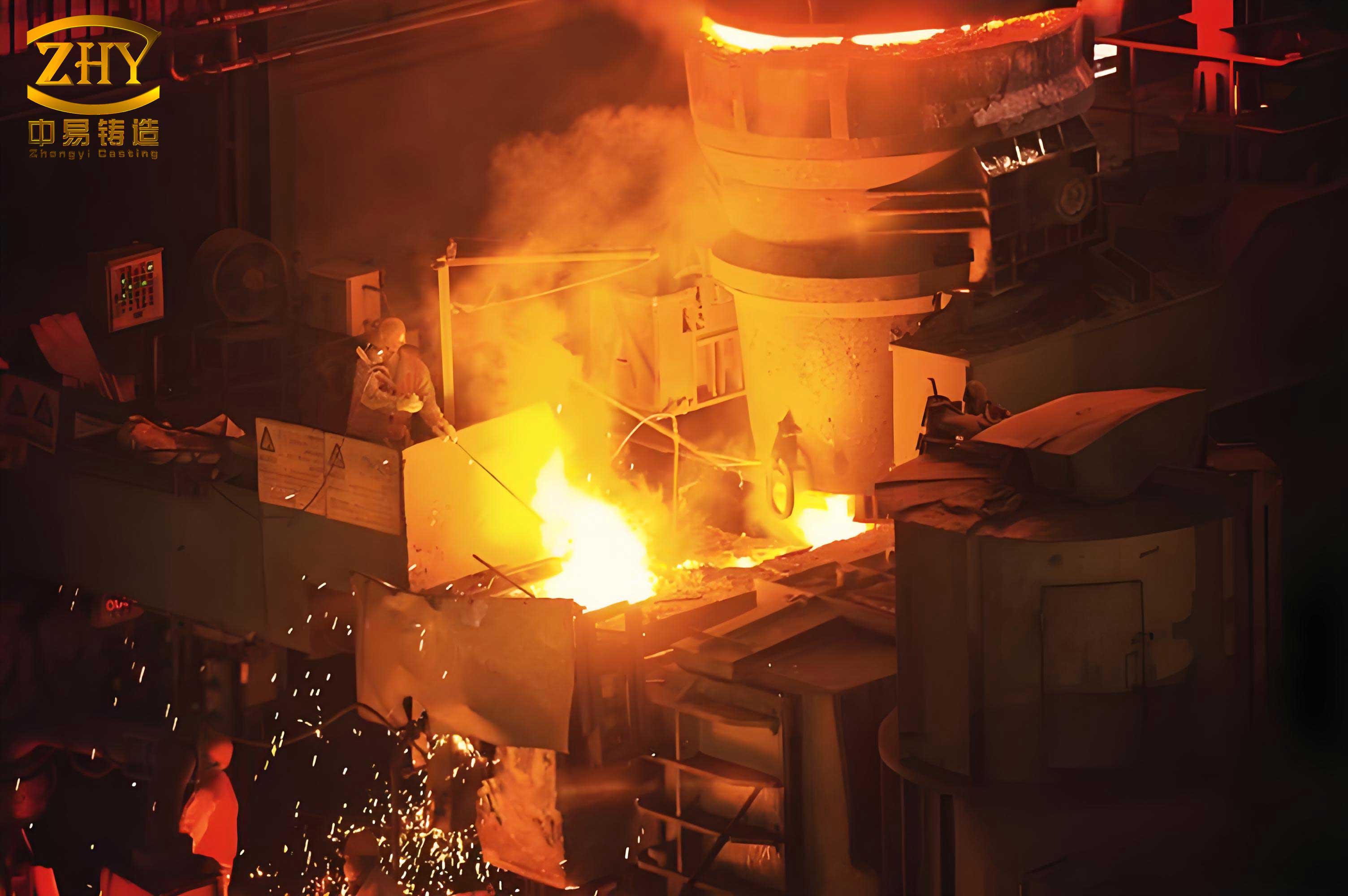
Figure above shows a typical sand casting foundry setup; the virtual platform replicates such an environment with interactive tools. The platform includes a virtual sand box, flasks, rammers, trowels, sprue pins, and other foundry tools. Students use mouse clicks and drags to perform actions such as placing the pattern, filling sand, ramming, striking off, and extracting the pattern. Text prompts guide each step, and a progress indicator shows the current stage. The platform also includes a quality analysis module that evaluates the simulated casting on criteria such as porosity, shrinkage, misrun, and surface finish. Based on these results, the system suggests modifications to the gating system or parting surface.
Operation Steps in the Virtual Sand Casting Foundry
The interactive simulation consists of 13 sequential steps that mirror a real sand casting foundry operation. Each step is illustrated with virtual tools and real-time feedback. Below is a detailed table summarising the steps, the associated tools, and the learning objectives.
| Step | Action | Virtual Tools | Key Learning Points |
|---|---|---|---|
| 1 | Place the pattern (mould) onto the bottom flask | Mouse drag to position pattern | Understanding pattern placement and alignment with flask |
| 2 | Fill the bottom flask with sand and ram it | Virtual shovel, rammer | Proper ramming technique to achieve uniform density |
| 3 | Strike off excess sand and smooth the surface | Trowel, straight edge | Importance of a flat parting surface |
| 4 | Flip the bottom flask over | Rotate flask with mouse | Understanding flask orientation for two‑part moulds |
| 5 | Apply parting sand and smooth the parting surface | Parting sand brush | Role of parting sand in preventing sticking |
| 6 | Place the top flask and insert the sprue pin | Top flask, sprue pin | Correct sprue position relative to pattern |
| 7 | Fill the top flask with sand and ram | Shovel, rammer | Consistency in ramming for both halves |
| 8 | Strike off top surface | Trowel | Ensuring flat cope surface |
| 9 | Create vent holes using a vent rod | Vent rod | Location and depth of vents for gas escape |
| 10 | Remove the sprue pin and separate the flasks | Mouse interaction | Handling of cope and drag separation |
| 11 | Extract the pattern using a draw spike | Draw spike | Pattern removal without damaging cavity |
| 12 | Repair the mould and cut the ingate (runner) | Trowel, runner cutter | Ingate design for smooth metal flow |
| 13 | Close the mould (assemble cope and drag) and pour | Flask handling | Final assembly and simulated pouring |
After completing the steps, the system computes the casting quality. For any defect, the student can go back to the process parameter selection stage and try alternative designs. This iterative learning is crucial in mastering the sand casting foundry process.
Mathematical Model for Casting Quality Prediction
To provide quantitative quality feedback, the platform implements a simplified mathematical model that relates process parameters to common casting defects. Let the quality index \( Q \) be defined as a function of three sub‑indices: porosity \( P \), shrinkage \( S \), and misrun \( M \). Each sub‑index ranges from 0 (worst) to 1 (best). The overall quality is given by:
$$ Q = w_1 P + w_2 S + w_3 M $$
where \( w_1, w_2, w_3 \) are weights determined by the part geometry (e.g., \( w_1 = 0.4, w_2 = 0.4, w_3 = 0.2 \) for a typical sand casting foundry part).
Porosity is influenced by the pouring temperature \( T_p \) and the gas evolution. A simplified relation is:
$$ P = 1 – \frac{(T_p – T_{\text{min}})^2}{(T_{\text{opt}} – T_{\text{min}})^2} $$
where \( T_{\text{min}} \) is the minimum pouring temperature to avoid misrun, and \( T_{\text{opt}} \) is the optimal temperature for minimal porosity. If \( T_p \) deviates from \( T_{\text{opt}} \), porosity increases.
Shrinkage defect depends on the riser design. The effective feeding distance \( L_f \) is compared to the required distance \( L_r \). The shrinkage index is:
$$ S = \min\left(1, \frac{L_f}{L_r}\right) $$
If the riser provides adequate feed, \( S \) approaches 1; otherwise, it drops.
Misrun occurs when the metal solidifies before filling the mould. The misrun index is related to the filling time t and the solidification time t_s:
$$ M = \begin{cases} 1 & \text{if } t < 0.8 t_s \\ \frac{t_s – t}{0.2 t_s} & \text{if } 0.8 t_s \le t \le t_s \\ 0 & \text{if } t > t_s \end{cases} $$
The system computes these indices from the student’s chosen pouring temperature, gating dimensions, and parting surface, and displays the quality index \( Q \) as a percentage. This quantitative approach helps students understand the trade‑offs in sand casting foundry design.
Innovations and Pedagogical Features
The virtual sand casting foundry platform introduces several pedagogical innovations that address traditional shortcomings:
- Integration of theory and practice: Students can perform virtual experiments during lecture hours, eliminating the delay between theory and hands‑on experience. The platform embeds theoretical concepts (e.g., gating ratio, riser design) directly into the interactive steps.
- Flipped classroom enabled: The platform gives students control over their learning pace. They can experiment with multiple mould designs, observe the consequences, and reflect on the underlying principles. This shifts the responsibility from teacher to learner.
- Realistic virtual‑real fusion: Unlike purely virtual simulations that feel disconnected, our platform uses detailed 3D models and physics‑based behaviour. The sense of presence and the ability to “touch” the tools through mouse interaction make the experience more immersive.
- Immediate quality feedback with visualization: After pouring, the platform displays a colour‑coded defect map on the virtual casting. Hot spots, shrinkage cavities, and gas pockets are highlighted. Students can correlate these defects with their process choices, promoting deep learning.
Traditional sand casting foundry teaching in our institution previously relied on the “material forming technology” course and the “metalworking practice” lab. However, the real foundry only allows one or two standard parts per semester, and students cannot explore alternative designs due to time and cost. Our virtual platform overcomes this by offering a library of over 20 different parts, each with multiple feasible gating and parting options. The table below lists some examples.
| Part Name | Geometry Complexity | Available Gating Systems | Number of Parting Surfaces | Typical Defects |
|---|---|---|---|---|
| Connecting rod | Medium | Side, bottom, top | 2 | Shrinkage, misrun |
| Engine block | High | Bottom, multi‑gates | 3 | Porosity, shrinkage |
| Gear blank | Simple | Top, side | 1 | Porosity (if riser small) |
| Pump housing | High | Side, stepped | 2 | Misrun, cold shut |
| Bracket | Low | Top | 1 | None (easy) |
By experimenting with different parts, students gain a broad understanding of how part geometry dictates process parameters in a sand casting foundry.
Implementation and Evaluation
The platform was deployed in the “Material Forming Technology” course and the “Metalworking Practice” lab for second‑ and third‑year undergraduate students majoring in mechanical design, vehicle engineering, mechatronics, and industrial engineering. Prerequisites included engineering drawing and fundamentals of metal processes. Students spent 2–4 hours using the platform during regular class time, and they were required to complete an experimental report after each session.
To assess the effectiveness, I conducted an anonymous survey at the end of the semester. The survey contained five questions, each rated on a 5‑point Likert scale (1 = strongly disagree, 5 = strongly agree). A total of 120 students participated. The results are summarised in the table below.
| Survey Question | Percentage of students rating 4 or 5 | Mean score (1–5) |
|---|---|---|
| 1. The virtual platform helped me quickly understand the workflow of a sand casting foundry. | 83.3% | 4.2 |
| 2. The platform deepened my understanding of metal casting theory. | 75.0% | 4.0 |
| 3. The platform increased my interest in the subject. | 87.5% | 4.4 |
| 4. Using the platform made me more passionate about the course and the profession. | 66.7% | 3.8 |
| 5. The combination of virtual simulation and real‑world practice was effective. | 80.0% | 4.1 |
The survey also included an open‑ended section. Common suggestions were: increasing the number of part models, improving the smoothness of interactions, and providing more detailed defect explanations. Overall, the majority of students found the platform beneficial. Many commented that the ability to see defects immediately after making process choices was particularly enlightening. The platform is now being expanded to include additional part models and faster rendering.
Expanding to Other Casting Processes
Currently, the platform focuses solely on sand casting foundry. However, in industrial practice, other processes such as investment casting (lost‑wax), die casting, centrifugal casting, and permanent mould casting are equally important. These processes involve different mould materials, pressures, and solidification mechanisms. Because real‑world hands‑on experience with these processes is often limited by safety and cost, virtual simulation offers an ideal alternative. I plan to extend the platform to cover investment casting and die casting in the near future. The underlying Unity3D framework is modular, so adding new processes mainly requires new 3D models and physics rules. For example, investment casting would involve wax pattern creation, shell building, dewaxing, and burnout. Die casting would simulate high‑pressure injection and metal flow in steel moulds. Each new module will include its own quality prediction model and interactive steps, ensuring that students can compare different casting methods in a single learning environment. This expansion will make the platform a comprehensive tool for teaching all major metal forming techniques, with sand casting foundry as the foundational module.
Conclusion
The virtual simulation platform for sand casting foundry education has proven to be an effective pedagogical tool. By providing an interactive, risk‑free environment where students can explore multiple process parameters and instantly see the impact on casting quality, the platform bridges the gap between theory and practice. The mathematical quality model, combined with realistic 3D graphics, helps students internalise the complex relationships in a sand casting foundry. Survey results indicate high student satisfaction and improved learning outcomes. Future work will focus on expanding the part library, optimising performance, and incorporating other casting processes. I believe that virtual simulation will play an increasingly central role in engineering education, particularly for high‑risk, high‑cost processes like metal casting. The sand casting foundry module is just the beginning.