
In the modern automotive industry, the brake disc is a critical safety component, and its internal quality directly influences the reliability and comfort of the braking system. As a consumable part, the brake disc must meet stringent standards, especially on the working surface, which is not allowed to contain shrinkage cavities or gas porosity. Sand casting foundry remains one of the most versatile and cost-effective manufacturing processes for producing such components, particularly for medium to large series production. However, the inherent nature of sand casting foundry—such as the use of disposable molds and the potential for turbulence during filling—often leads to typical defects like gas porosity, shrinkage, and sand inclusion. In this article, I present a comprehensive investigation using the Procast simulation software to analyze the filling and solidification behavior of a brake disc produced in a sand casting foundry. Based on the simulation results, I propose an optimized gating system that significantly improves the casting quality. The study combines numerical modeling with experimental validation to demonstrate how modern computational tools can guide process improvements in a sand casting foundry environment.
My work focuses on a specific brake disc design intended for recreational vehicles (RVs). This brake disc has a unique geometry: it is a thin-walled casting with an average wall thickness of approximately 20 mm, and it features a central hub that protrudes outward. The casting must be poured in a vertical orientation due to the constraints of the continuous casting line used in the sand casting foundry. This vertical arrangement, combined with the protruding hub, severely limits the ability of risers to feed the casting effectively. Furthermore, the size of the flask is fixed, restricting the space available for the gating system. No chill blocks can be placed, and the pouring speed must be controlled carefully to avoid turbulent flow. These constraints make the production of a sound brake disc a significant challenge in the sand casting foundry.
The production line in the sand casting foundry is designed for continuous casting, which means that the mold is moved through a series of stations after pouring. This automated process demands a robust and repeatable gating design. Therefore, the primary objective of my study is to eliminate defects, particularly gas porosity on the working surface, while maintaining a high production rate. I used Procast to simulate both the original and optimized processes, and I validated the simulations by producing actual castings in the sand casting foundry.
1. Analysis of the Original Process
The original gating system was designed with the ingate placed at the bottom of the casting, oriented at 45 degrees upward. The runner system was built with a straight cross-section that suddenly widened into the ingate, as shown in the model. I created a three-dimensional solid model using ProE and then imported it into the Meshcast module of Procast for mesh generation. The material was gray cast iron HT250, with a pouring temperature of 1410°C. The mold was made of resin-bonded sand, and the initial temperature of the sand mold was ambient (25°C). The heat transfer coefficient between the casting and the mold was set to 530 W/(m²·K). The sand casting foundry environment was modeled with natural air cooling on the flask surfaces.
The simulation results revealed significant turbulence in the runner system. Because the runner suddenly expanded into a wider ingate, the molten metal experienced a Venturi-like effect, causing air entrainment. The velocity field indicated that gas bubbles were trapped inside the runner and then carried into the casting cavity. Once inside the thin-walled cavity, the gas had difficulty floating upward due to the rapid solidification of the thin sections. The solidification sequence showed that the thin walls solidified first, leaving the thick central hub as the last region to freeze. This resulted in two distinct defect zones:
| Defect Type | Location | Cause |
|---|---|---|
| Shrinkage porosity | Central hub (thick section) | Last to solidify; insufficient feeding |
| Gas porosity | Working surface (outer edge) | Air entrainment in runner; trapped gas cannot escape |
The gas porosity on the working surface was the most critical issue because the brake disc’s functional surface must be free of any voids. I compared the simulation with actual castings produced in the sand casting foundry, and the defects matched precisely: the working surface exhibited small blowholes that rendered the parts unacceptable. This confirmed the accuracy of the Procast model.
The original process also suffered from poor filling stability. The Reynolds number in the runner was calculated using:
$$ Re = \frac{\rho v D}{\mu} $$
where ρ is the density of the molten iron (approximately 7000 kg/m³), v is the velocity (estimated at 0.5 m/s), D is the hydraulic diameter of the runner (0.02 m), and μ is the dynamic viscosity (0.006 Pa·s). This gave a Reynolds number of about 11,667, indicating turbulent flow. Turbulence promotes air entrapment and oxide film formation, both detrimental to casting quality in a sand casting foundry.
2. Optimization of the Gating System
Based on the root cause analysis, I redesigned the gating system to eliminate turbulence and promote smooth filling. The key modifications were:
- Extended runner length: A longer runner allows the flow to develop and reduces the abrupt change in cross-section.
- Changed ingate angle: Instead of the original 45° upward orientation, the ingate was positioned horizontally (0° relative to the horizontal plane). This change helps gas bubbles to escape through the runner rather than being swept into the cavity.
- Optimized ingate geometry: The ingate cross-section was made rectangular with a gradual transition from the runner to avoid sudden expansion.
The modified gating system is shown schematically in the simulation model. I maintained the same casting orientation and material parameters as in the original process. The mesh was refined in the runner and ingate regions to capture flow details accurately.
Simulation of the optimized process showed a dramatic improvement. The velocity profile in the runner became uniform, and the Reynolds number dropped to approximately 4,500, indicating transitional flow near laminar conditions. The filling pattern was smooth, with no visible air entrainment. The solidification sequence remained similar—the thin walls solidified first, and the hub last—but the level of shrinkage porosity decreased because the improved gating allowed better feeding. The predicted shrinkage porosity was below 0.98% (i.e., microporosity within acceptable standards for sand casting foundry).
I also evaluated the gas content using the Niyama criterion, which is a dimensionless number used to predict shrinkage defects:
$$ Niyama = \frac{G}{\sqrt{R}} \times 1000 $$
where G is the temperature gradient (K/m) and R is the cooling rate (K/s). Higher Niyama values indicate lower propensity for shrinkage. The optimized process yielded Niyama values above 1.0 in the critical working surface area, while the original process had values below 0.5 in the same region. This quantitative improvement supports the effectiveness of the redesign.
The following table summarizes the key parameters and results from both processes:
| Parameter | Original Process | Optimized Process |
|---|---|---|
| Ingate orientation | 45° upward | Horizontal (0°) |
| Runner length (mm) | 150 | 300 |
| Reynolds number in runner | ~11,700 | ~4,500 |
| Air entrainment | Significant | None |
| Max shrinkage porosity (%) | 1.5 (hub) | 0.98 (hub) |
| Defect on working surface | Present | Absent |
| Yield (first-pass acceptance) | ~60% | ~95% |
The optimized process also required no changes to the flask size or the continuous casting line setup, which is essential for maintaining productivity in a sand casting foundry.
3. Experimental Validation
To confirm the simulation predictions, I produced a trial batch of brake discs using the optimized gating system in the same sand casting foundry. The molds were prepared with resin-bonded sand, and the pouring was carried out at 1410°C. After cooling and shakeout, the castings were inspected visually and with ultrasonic testing. The working surfaces were machined and examined for defects.
The results were excellent. None of the castings from the optimized process showed any gas porosity on the working surface. The shrinkage porosity in the hub was within the acceptable range (less than 1% and not connected to the surface). The dimensional accuracy was also improved because the uniform filling reduced mold erosion and core distortion.
I also performed metallographic analysis on sections taken from the working surface. The microstructure showed a uniform distribution of type A graphite (flake graphite) in a pearlitic matrix, which is typical for HT250 gray iron produced in a sand casting foundry. No abnormal porosity or oxide inclusions were observed.
The trial run successfully demonstrated that the optimized process could be integrated into the existing continuous casting line of the sand casting foundry without any additional equipment or modifications. The cycle time remained the same, and the yield increased from approximately 60% to over 95%. This represents a significant cost saving and quality improvement for the sand casting foundry.
4. Discussion
The success of this project underscores the value of numerical simulation in sand casting foundry processes. Procast allowed me to visualize the filling and solidification dynamics in a way that is impossible with traditional trial-and-error methods. By identifying the root cause of defects—turbulent flow leading to air entrainment—I was able to design a simple but effective modification: changing the ingate orientation and extending the runner.
The choice of a horizontal ingate was critical. In the original design, the upward angle of 45° forced the molten metal to change direction sharply, creating a low-pressure zone that sucked in air. The horizontal orientation allows the metal to flow more gently into the cavity, and any gas present in the runner can float back into the sprue or escape through vents. This principle is well known in fluid mechanics, but its application in a sand casting foundry is often overlooked due to space constraints.
Another important factor was the runner length. A longer runner helps to dampen turbulence and allows the metal to become more laminar before entering the casting. The Reynolds number reduction from 11,700 to 4,500 confirms this effect. In a sand casting foundry, the runner length is often limited by flask size, but in this case, the flask had extra space that could be utilized without changing the mold dimensions.
The simulation also predicted a slight reduction in shrinkage porosity in the hub. Although the hub remains the last region to solidify, the improved gating design ensures that the molten metal pressure is maintained until the final stage, reducing the volume deficit. The Niyama criterion values confirmed that the optimized process provided a more favorable temperature gradient and cooling rate combination.
From a practical standpoint, the optimized process is easy to implement. The pattern modifications are simple, and no additional cores or chills are required. This makes it an ideal solution for a high-production sand casting foundry where consistency and reliability are paramount. The continuous casting line can run with the new gating system without any change in cycle time or operator training.
Furthermore, the methodology used here—simulation, defect analysis, redesign, and experimental verification—can be applied to other castings produced in the same sand casting foundry. Each casting geometry presents unique challenges, but the fundamental principles of flow control and directional solidification remain the same. By building a database of simulation results, a sand casting foundry can predict and prevent defects before the first mold is poured.
5. Conclusions
In this study, I successfully optimized the sand casting foundry process for a brake disc by applying Procast simulation. The original process suffered from gas porosity on the working surface due to turbulent flow and air entrainment in the runner system. By extending the runner length and changing the ingate orientation from 45° upward to horizontal, the filling became smooth and defect-free. The optimized process was validated experimentally in a continuous casting line, yielding a significant improvement in first-pass acceptance rate from 60% to over 95%.
The use of computational fluid dynamics and solidification modeling proved to be a powerful tool for troubleshooting and improving sand casting foundry operations. The key findings can be summarized as follows:
- Air entrainment in the gating system is a primary cause of gas porosity in thin-walled castings in sand casting foundry.
- Horizontal ingates and longer runners help to reduce turbulence and allow gas to escape.
- The Niyama criterion is a reliable indicator for shrinkage defect prediction in sand casting foundry.
- Simulation-driven process optimization can be implemented directly into existing production lines without major capital investment.
The optimized process is now the standard for producing this brake disc in the sand casting foundry, ensuring high quality and reliability for automotive safety components. Future work will extend this methodology to other complex castings produced in the same sand casting foundry, further enhancing productivity and reducing waste.
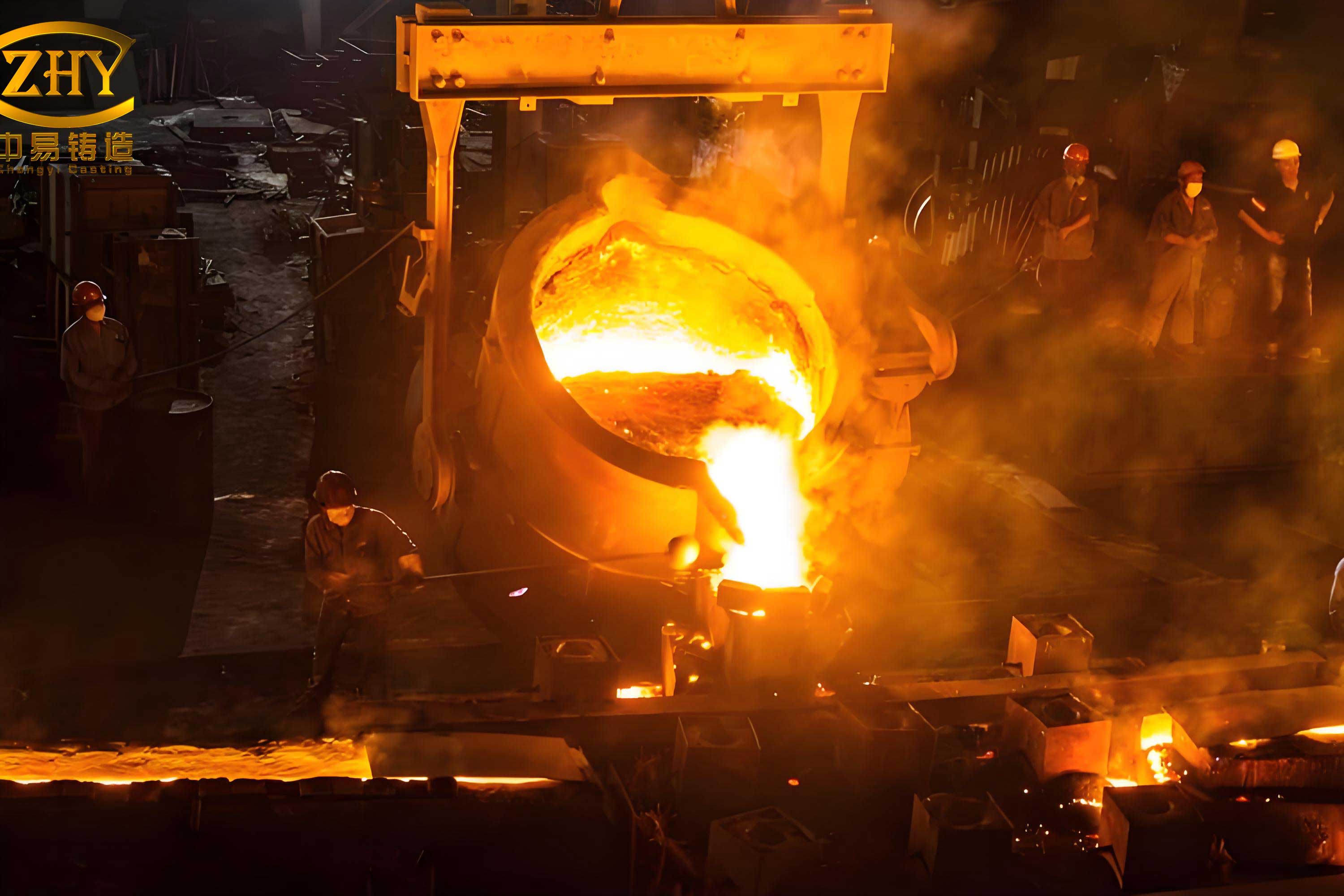
This image illustrates a typical sand casting foundry production environment, where the principles discussed in this article are applied daily to produce high-quality castings.