
In our foundry, we adopted lost foam castings to produce a large motor housing of type 400, as illustrated in the figure below. The casting material is HT200 gray iron. The cylindrical shell has a diameter of 780 mm, a height of 1,260 mm, and a wall thickness of 22 mm. The minimum thickness at the tips of the cooling fins is 6 mm. Inside the cavity, two annular heat sinks are arranged at both ends, and four axial through ventilation channels are evenly distributed along the circumference of the middle section. Lost foam castings offer significant advantages over traditional sand mold processes, including fewer geometric constraints, superior surface quality, and environmental friendliness, making it a green casting technology for the 21st century.
Casting Process Development
We designed and compared two gating systems for these lost foam castings. The first scheme was a bottom-gating configuration with a star-shaped ingate at the bottom of the motor housing and a sprue introduced through the center. The second scheme was a top-gating configuration with 16 ingates at the top of the pattern. The results of the trial runs are summarized in Table 1. After evaluation, we adopted the top-gating (shower-type) system. In top-gating, the cross-section of the runner is the largest, and the molten iron enters the cavity through 16 ingates at the top. This system provides gentle filling, good gas evacuation, and stable mold filling, which helps prevent dross from adhering to the cavity walls and reduces slag inclusion defects.
| Scheme | Test Number | Gating Configuration | Result |
|---|---|---|---|
| Bottom-gating | 1 | 6 ingates | Sand wash on the side opposite the ingates |
| 2 | 8 ingates into cooling fins | Severe cold shuts and burn-on | |
| 3 | 8 ingates into cooling fins | Cold shuts at fin tips, burn-on | |
| Top-gating | 1 | 12 ingates | Partial cold shuts on fins |
| 2 | 16 ingates | Good filling, occasional slag spots on fin tips | |
| 3 | 16 ingates, increased pouring temperature | Excellent filling, no defects |
White Pattern Fabrication
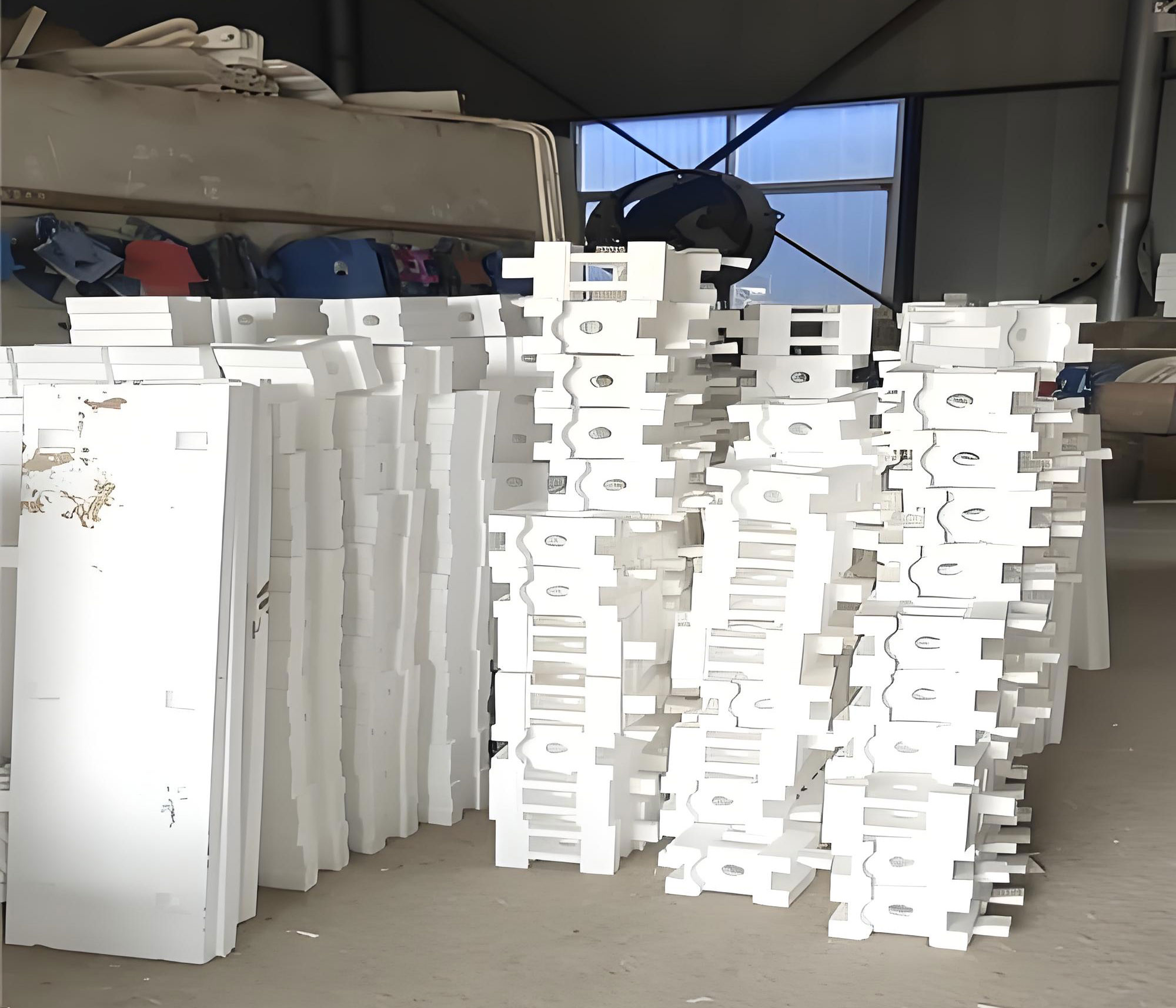
The white pattern (expanded polystyrene foam) for these lost foam castings was produced using a large integral foam molding die. The foam beads had a density of 25–27 g/L. The filled molds were baked at 45–55 °C for 48 h, followed by room temperature aging for 7–10 days. We measured the linear shrinkage of the EPS pattern under these conditions. The shrinkage data are presented in Table 2. The average shrinkage rate was found to be 0.15%, which is significantly lower than the typical value of 0.4–0.5% for beads with a density of 16–17 g/L. The shrinkage rate can be expressed as:
$$
\text{Shrinkage} = \frac{L_{\text{initial}} – L_{\text{final}}}{L_{\text{initial}}} \times 100\%
$$
where \( L_{\text{initial}} \) is the dimension after molding and before aging, and \( L_{\text{final}} \) is the dimension after aging.
| Sample | Pre-aging size / mm | Post-aging size / mm | Shrinkage / % |
|---|---|---|---|
| 1 | 1276.8 | 1275.2 | 0.13 |
| 2 | 1276.7 | 1275.2 | 0.12 |
| 3 | 1276.6 | 1274.6 | 0.16 |
| 4 | 1276.5 | 1274.3 | 0.17 |
| 5 | 1276.5 | 1274.3 | 0.17 |
| 6 | 1276.8 | 1274.9 | 0.15 |
| Average | 1276.65 | 1274.75 | 0.15 |
The foam molding die for these lost foam castings was designed as an integral structure with external dimensions of 2000 mm × 2000 mm × 1700 mm. It comprises an outer mold, a lower mold, and core inserts. The outer mold is a one-piece jacket, requiring a total opening height of up to 2900 mm. The integral pattern improves rigidity and dimensional precision, which is critical for large motor shells. The final white pattern (Figure not shown) had maximum outer dimensions of 1260 mm × 870 mm × 910 mm and a main wall thickness of 12–14 mm.
Coating Formulation
The coating is essential for achieving a smooth surface on the castings. It must possess good permeability, wetting ability, adhesion, and high-temperature strength. We developed a new coating formulation primarily composed of bauxite, quartz powder, potassium feldspar powder, and mica. Bauxite serves as the main refractory, quartz powder provides support and permeability, potassium feldspar enhances high-temperature strength and toughness, and mica improves permeability. The dry mix is prepared as a powder and then mixed with water to form a slurry before application. The typical coating composition (by weight) is:
\begin{aligned}
\text{Bauxite} &: 40\%\text{–}50\% \\
\text{Quartz powder} &: 10\%\text{–}15\% \\
\text{Graphite} &: 15\%\text{–}25\% \\
\text{Bentonite} &: 5\%\text{–}10\% \\
\text{PVA} &: 3\%\text{–}10\% \\
\text{CMC} &: 1\%\text{–}5\%
\end{aligned}
$$
After coating, the dried pattern (now called the yellow pattern) was kept in a drying oven until the moment of molding to maintain coating dryness.
Molding and Pouring
For lost foam castings, we used a cylindrical flask and multi-motor vibration compaction. A bottom sand layer of 300 mm was first vibrated level. The yellow pattern was then placed, and sand was added while vibrating at a frequency of 30–35 Hz. The sand level inside and outside the pattern was kept consistent to prevent deformation during molding. After filling to the pouring cup level, vibration continued for 10–15 seconds.
The final pouring adopted the top-gating system. The pouring temperature was 1470 °C, with good vacuum and a fast pouring rate to ensure complete mold filling. The resulting castings (see Figure above) were sound and dimensionally accurate.
Conclusions
Through this production practice, we successfully manufactured integral foam patterns for large motor housings (type 400 and above) using the lost foam castings process. The integral white patterns improved overall rigidity and dimensional accuracy. We verified the influence of bead density and drying conditions on EPS shrinkage. By comparing bottom and top gating, we determined the optimal top-pouring system that ensures excellent filling behavior. The combination of proper pattern design, coating, molding parameters, and pouring practice allows us to produce high-quality large motor shells via lost foam castings.