
In my research on abrasion-resistant materials, I have focused extensively on high-chromium white cast iron, particularly the 15% chromium variety, which is renowned for its exceptional performance in industrial applications such as mining, cement production, and power generation. White cast iron, characterized by its hard, carbide-rich microstructure, offers superior resistance to wear under severe conditions. This study delves into the crystallization process, carbide morphology, and wear mechanisms of this alloy, aiming to optimize its composition and heat treatment for enhanced durability. Through experimental techniques like liquid quenching and wear testing, I have unraveled how microstructure evolution impacts performance, providing insights that can guide the production of more efficient white cast iron components.
The fundamental properties of white cast iron are governed by its chemical composition, where carbon and chromium play pivotal roles. Chromium, as a strong carbide-forming element, influences the type and distribution of carbides. In high-chromium white cast iron, when chromium content exceeds a critical threshold, the carbides transition from the soft, networked M3C type to the hard, isolated M7C3 type, which significantly enhances wear resistance. My experiments involved varying carbon and chromium levels to establish optimal ranges. For instance, at around 3.0% carbon, chromium content below 10% leads to M3C carbides, while above 15%, M7C3 predominates. A balance is struck at 15–20% chromium to maximize cost-effectiveness and performance. Other elements like molybdenum and manganese are added to improve hardenability, but their amounts must be controlled to avoid detrimental effects. The following table summarizes the influence of key elements on white cast iron properties:
| Element | Role in White Cast Iron | Optimal Range | Effect on Microstructure |
|---|---|---|---|
| Carbon (C) | Primary carbide former | 2.0–3.5% | Determines carbide volume; higher carbon increases hardness but reduces toughness. |
| Chromium (Cr) | Promotes M7C3 carbides | 15–20% | Enhances wear resistance; above 15%, carbides become isolated and harder. |
| Molybdenum (Mo) | Improves hardenability | 0.5–2.0% | Suppresses pearlite formation; excess leads to low-melting eutectics. |
| Manganese (Mn) | Stabilizes austenite | 0.5–1.5% | Increases retained austenite; too high reduces wear resistance. |
| Silicon (Si) | Graphitizing agent | <1.0% | Reduces hardenability; above 1.0% promotes graphite formation. |
To understand the solidification behavior of this white cast iron, I employed liquid quenching combined with differential thermal analysis. The process begins at high temperatures where liquid alloy exhibits inhomogeneous elemental distribution. Upon cooling, primary austenite (γ) nucleates around 1300°C, as described by the following relation for nucleation temperature Tn: $$T_n = T_l – \Delta T,$$ where Tl is the liquidus temperature and ΔT is the undercooling. As temperature drops, the austenite grows, enriching the remaining liquid in carbon and chromium. At approximately 1200°C, the eutectic reaction initiates: $$L \rightarrow \gamma + M_7C_3,$$ forming a mixture of austenite and carbides. This reaction occurs over a range of 1150–1200°C due to chromium’s influence, unlike the sharp eutectic point in simpler alloys. The microstructure evolution can be quantified by the fraction of solid fs as a function of temperature T: $$f_s = \frac{T_l – T}{T_l – T_s},$$ where Ts is the solidus temperature. My observations revealed that in hypoeutectic white cast iron, the carbides are finely distributed along austenite boundaries, while in hypereutectic compositions, primary carbides form first, leading to coarse structures.
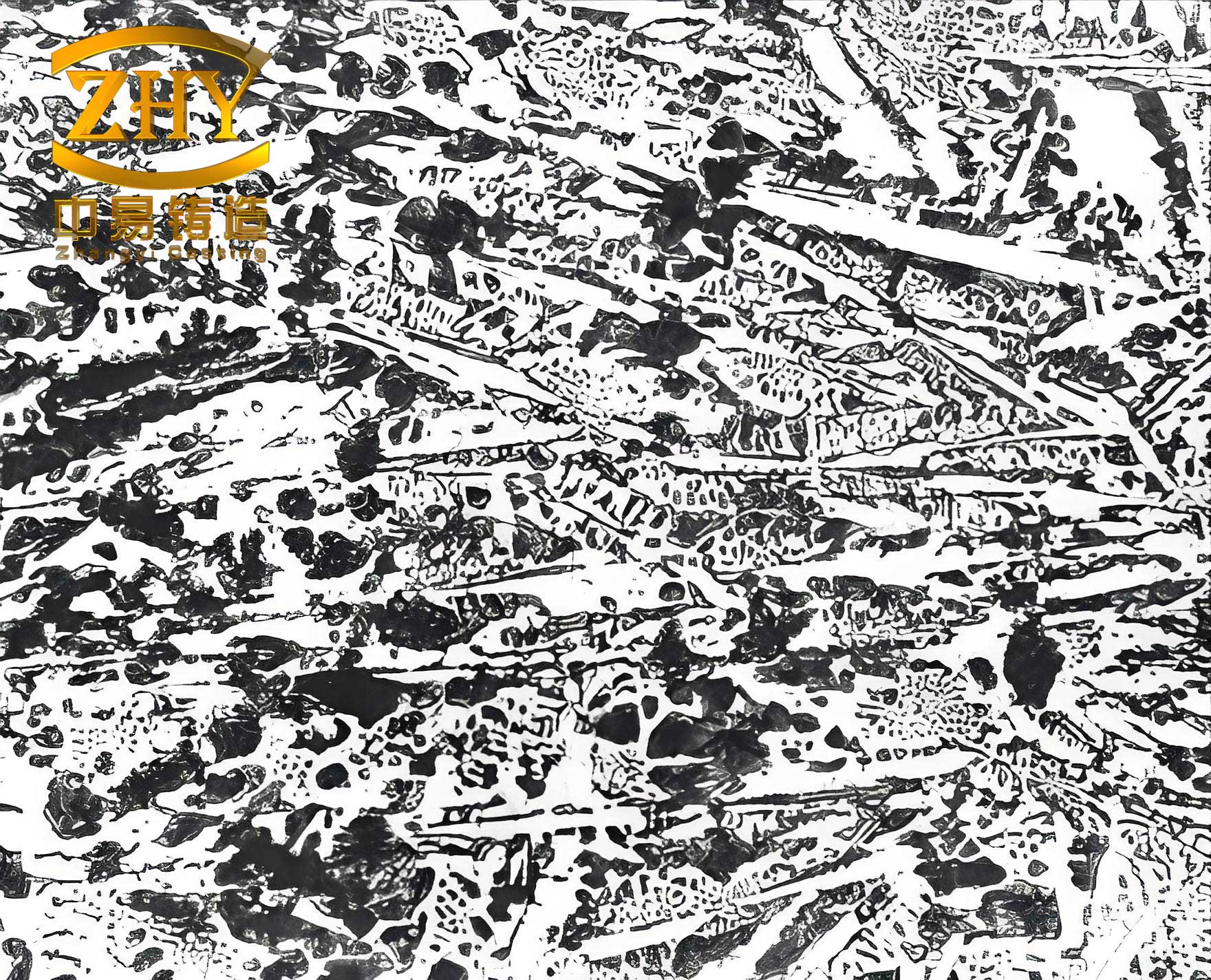
The morphology of carbides is critical to the wear resistance of white cast iron. Using deep etching and scanning electron microscopy, I examined the three-dimensional shapes of carbides in hypoeutectic, eutectic, and hypereutectic variants. In hypoeutectic white cast iron, carbides appear as rod-like or dendritic structures within eutectic colonies, interconnected and embedded in a continuous matrix. This configuration provides strong bonding, reducing the likelihood of carbide pull-out during wear. In contrast, hypereutectic white cast iron features primary carbides with hexagonal prismatic shapes, often containing internal defects that act as stress concentrators. These carbides are more prone to fracture and detachment. The table below compares carbide characteristics across different compositions:
| Composition Type | Carbide Morphology | Carbide Volume Fraction | Defect Density | Bonding with Matrix |
|---|---|---|---|---|
| Hypoeutectic White Cast Iron | Fine rods, dendritic clusters | 20–30% | Low | Strong, embedded |
| Eutectic White Cast Iron | Mixed rods and blocks | 30–40% | Moderate | Moderate |
| Hypereutectic White Cast Iron | Hexagonal prisms, coarse | 40–50% | High | Weak, isolated |
Wear resistance was evaluated through two methods: abrasive wear testing using a reciprocating machine and sand erosion testing with a custom apparatus. In abrasive wear tests, samples were subjected to loads of 50 N against alumina abrasives, with weight loss measured periodically. The sand erosion tests involved rotating samples in a slurry of quartz sand and water, simulating conditions in pumps and mills. The results consistently showed that hypoeutectic white cast iron outperformed both eutectic and hypereutectic versions, despite having lower carbide content. This underscores that wear resistance is not solely a function of hardness or carbide quantity but also depends on carbide morphology and matrix support. The following table presents wear test data, with wear rate W defined as weight loss per unit time: $$W = \frac{\Delta m}{t},$$ where Δm is mass loss and t is time.
| Sample Type (White Cast Iron) | Carbon Content (%) | Hardness (HRC) | Abrasive Wear Rate (mg/h) | Sand Erosion Rate (mg/h) | Relative Wear Resistance (Factor) |
|---|---|---|---|---|---|
| Hypoeutectic | 2.5 | 58–62 | 1.2 | 0.8 | 3.5 |
| Eutectic | 3.0 | 60–64 | 1.8 | 1.2 | 2.3 |
| Hypereutectic | 3.5 | 62–66 | 2.5 | 1.9 | 1.0 |
The relationship between carbide morphology and wear behavior is profound. In hypoeutectic white cast iron, the fine, interconnected carbides are tightly held by the hardened martensitic matrix after heat treatment. During wear, erosion primarily occurs around the carbides, but their embedded nature prevents large-scale脱落. Conversely, in hypereutectic white cast iron, the primary carbides, with their hexagonal shapes and defects, easily detach when the surrounding matrix is worn away, leading to accelerated material loss. This can be modeled using an erosion equation: $$E = k \cdot V_c \cdot \sigma_d,$$ where E is erosion rate, k is a material constant, Vc is carbide volume, and σd is defect density. My analysis confirms that reducing defect density and optimizing carbide distribution are key to enhancing the longevity of white cast iron components.
Processing of high-chromium white cast iron involves careful melting, casting, and heat treatment. Melting can be done in electric arc or induction furnaces, with charges including low-silicon pig iron, steel scrap, ferrochromium, and molybdenum additives. To minimize chromium oxidation, ferrochromium is added late in the melt. The fluidity of this white cast iron is good, allowing pouring at 1400–1450°C for fine grain structure. Casting in dry sand, green sand, or metal molds is feasible, but the alloy has a high tendency for hot cracking and shrinkage, necessitating riser designs similar to steel castings. Heat treatment is crucial: quenching from 950–1050°C followed by air cooling and tempering at 200–300°C produces a hard martensitic matrix. For machinability, annealing at 850–900°C to transform the matrix into spheroidized pearlite is recommended, yielding hardness below 300 HB. The quenching temperature Tq affects hardness H according to: $$H = H_0 + \alpha \cdot (T_q – T_0),$$ where H0 and T0 are baseline values, and α is a coefficient. My trials established an optimal quenching range of 980–1020°C for maximum wear resistance without excessive retained austenite.
Preliminary applications of this white cast iron have demonstrated significant improvements. For instance, in coal briquette presses, pins made from hypoeutectic white cast iron lasted over 300 hours, compared to just 100 hours for conventional 45# steel pins. This translates to a wear resistance increase by a factor of 3 or more. Similarly, in shot blasting machine blades, service life exceeded 1000 hours, showcasing the material’s potential for thin-walled and medium-thickness parts. The success hinges on the alloy’s balanced composition—typically 2.8% C, 15% Cr, 1.5% Mo, and 0.8% Mn—which ensures both toughness and abrasion resistance. Further optimization could involve computational modeling to predict carbide formation during solidification, using equations like the Scheil equation for segregation: $$C_s = k \cdot C_0 \cdot (1 – f_s)^{k-1},$$ where Cs is solid composition, C0 is initial composition, k is partition coefficient, and fs is solid fraction.
In conclusion, my research on high-chromium white cast iron reveals that hypoeutectic compositions offer superior wear resistance due to their favorable carbide morphology and matrix interaction. The crystallization process, involving primary austenite formation followed by eutectic solidification, dictates the final microstructure, which can be controlled through composition and cooling rates. Wear resistance is not merely proportional to hardness but is intricately linked to carbide shape and defect levels. By adhering to optimal chemical ranges and heat treatment protocols, this white cast iron can be tailored for demanding applications, providing economic benefits through extended component life. Future work should explore additive manufacturing of white cast iron to achieve even finer microstructures and enhanced performance. Overall, white cast iron remains a cornerstone material in the fight against abrasion, and ongoing studies will continue to unlock its full potential.