
In recent years, lost foam casting has developed rapidly in the foundry industry worldwide, and many plants have adopted this advanced technology to produce complex castings. Our foundry began to implement lost foam castings for steel parts several years ago, and we have continuously refined the process through trial and error. One of the critical products we undertook was a heavy rail bearing bracket made of ZG230-450 steel. This thin-walled tall steel casting required high strength and dimensional accuracy, and we initially used a conventional lost foam casting process. However, severe defects such as “vacant shell” and sand collapse plagued the production, leading to low yield and high cost. Through systematic analysis and modifications, we successfully improved the lost foam castings quality and productivity. This article describes the problems, the solutions, and the key parameters that contributed to the success.
The heavy rail bearing bracket had a net weight of 580 kg, a main wall thickness of only 20 mm, rib thickness of 20 mm, and a height of 1005 mm. Its structure was complex with a large surface area and a thin main body. The casting was required to be free from sand holes, shrinkage cavities, slag inclusions, and cracks that could impair mechanical properties. Because of its slenderness and thin walls, the casting presented a significant challenge for lost foam castings. The original process design is summarized in the table below.
| Parameter | Original Design |
|---|---|
| Molding orientation | Vertical (upright) |
| Gating system type | Stepped (ladder) pouring with bottom and top in-gates |
| Runner material | All foam (EPS) components |
| Sprue cross-section | 50 mm × 50 mm |
| Bottom runner cross-section | 45 mm × 50 mm (1 layer) |
| Top runner cross-section | 45 mm × 50 mm (1 layer, inclined 30° upward) |
| Bottom in-gates | 4 × (50 mm × 20 mm) |
| Top in-gates | 2 × (50 mm × 20 mm) |
| Top risers | One foam cavity riser 150×310×200 mm + two cavity risers φ200×220 mm |
| Coating type | Water-based, applied by dipping, brushing; thickness 1–1.5 mm |
| Steel tapping temperature | 1680 °C |
| Pouring vacuum | −0.045 to −0.03 MPa |
| Holding time after pour | 5 min; then 8–12 h before shakeout |
During the first trials with this design, many castings exhibited a hollow “vacant shell” region above the top in-gates. In these areas, the foam pattern had gasified but the liquid steel did not fill the cavity, leaving only the coating shell. Moreover, occasional sand collapse (caving) occurred during pouring. The yield of acceptable castings was unacceptably low. After close observation of the pouring process and analysis of the defects, we identified several root causes:
- The stepped gating system caused simultaneous filling through both the bottom and top in-gates. When the metal entered the top gates while the bottom was still filling, the vacuum inside the flask dropped rapidly, and the gas pressure from the decomposed foam could not be evacuated efficiently. This created a pressure gradient that pushed the liquid metal away from the sidewalls, leaving the coating unsupported.
- The all-foam gating components generated excessive gas during pouring, especially at high pouring temperatures, which increased the risk of backpressure and incomplete filling.
- The high pouring temperature (1680 °C) accelerated foam gasification, and the gas generation rate exceeded the evacuation capacity of the coating, leading to pressure buildup and “vacant shell” formation.
- The relatively high negative pressure (−0.045 to −0.03 MPa) drew gas too quickly, but the metal could not follow, causing voids.
To solve these problems, we redesigned the lost foam castings process. The key changes are listed in the comparison table below.
| Parameter | Original | Improved |
|---|---|---|
| Gating type | Stepped (bottom + top) | Bottom-only (full bottom gating) |
| Sprue & runner material | All foam | Refractory ceramic tubes (φ50 mm) for sprue and runner |
| Tapping temperature | 1680 °C | 1640 °C |
| Pouring vacuum | −0.045 to −0.03 MPa | −0.035 to −0.025 MPa |
| Pouring speed | No strict control | “Slow → fast → slow” sequence |
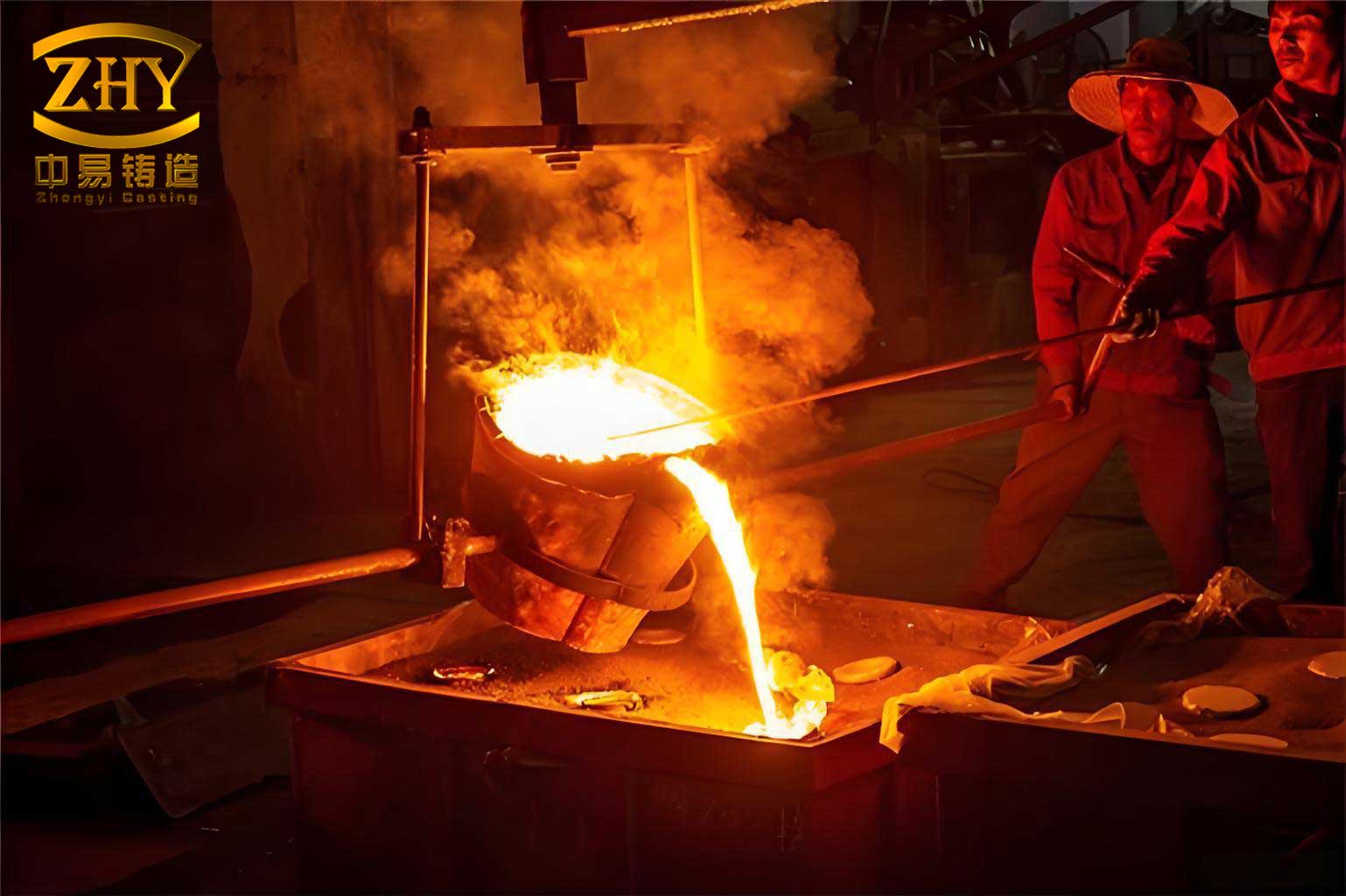
The modified gating system eliminated the top in-gates entirely. All metal entered through a single bottom runner fed by a refractory sprue. The refractory tubes acted as thermal insulators, reducing the cooling of the steel and also eliminating the gas generated by foam decomposition in the gating channels. This change allowed the metal front to rise uniformly from the bottom, pushing the foam degradation products upward and outward in a controlled manner. The result was a stable filling front with minimal turbulence.
We can quantify the effect of vacuum and gas pressure using a simplified model. The pressure in the gas gap between the metal and the foam decomposition zone is determined by the balance of gas generation rate G and evacuation rate through the coating E. For a thin-walled tall casting, the coating area per unit volume is large, so the evacuation capability is high. However, if the generation rate is too high, the pressure difference across the coating may reverse the flow direction. The critical condition for stable filling is that the net pressure gradient should force gas toward the sand rather than toward the metal. The local pressure drop across the coating can be approximated by Darcy’s law:
$$ \Delta p = \frac{\mu L}{k} v $$
where μ is the gas viscosity, L is the coating thickness, k is the coating permeability, and v is the gas velocity. To avoid “vacant shell”, the pressure in the gas gap pgap must be higher than the metal head pressure plus the coating pressure drop, so that gas escapes outward. In the original stepped system, the simultaneous top filling created a low-pressure zone near the upper walls because the gas could not escape fast enough; the metal was sucked away from the wall. By using bottom-only pouring, the gas generated ahead of the advancing metal front was continuously expelled upward and outward through the coating, maintaining a favorable pressure gradient.
Reducing the tapping temperature from 1680 °C to 1640 °C was a critical adjustment. The lower temperature slowed the foam decomposition rate, thereby reducing G. The gas generation rate is approximately exponential with temperature:
$$ G(T) = G_0 \exp\left(-\frac{E_a}{RT}\right) $$
where Ea is the activation energy for polystyrene decomposition (~120–200 kJ/mol), R is the gas constant, and T is the absolute temperature. A 40 °C decrease from 1680 °C to 1640 °C reduces the absolute temperature from 1953 K to 1913 K, which corresponds to a reduction in G of about 15–20% depending on the exact activation energy. This moderation helped align the gasification rate with the metal filling rate.
The vacuum level was also reduced. The original range of −0.045 to −0.03 MPa was too aggressive for such a tall, thin-walled casting. Lowering it to −0.035 to −0.025 MPa decreased the suction force on the gas, preventing the metal from being “starved” in the upper regions. The optimal vacuum was found experimentally to be around −0.03 MPa during the main filling, with a slight increase during the final stage to ensure riser feeding.
Pouring speed control was implemented as a three-phase sequence:
- Slow start – Pour slowly until the sprue is filled and the metal enters the bottom runner. This avoids splashing and allows the first gas to escape.
- Fast main pour – Once the runner is full, increase the pouring rate to keep the sprue full and maintain a steady metal front rising at about 20–30 mm/s. The fast pour minimizes heat loss and ensures the foam degrades continuously.
- Slow finish – When the metal reaches the risers, reduce the pour rate to allow the risers to feed and prevent slag entrapment.
The effectiveness of the improved process was validated by producing a batch of 50 castings. The defect occurrence is summarized in the table below.
| Defect type | Original process (trial batch of 10) | Improved process (batch of 50) |
|---|---|---|
| Vacant shell | 7 out of 10 (70%) | 0 out of 50 (0%) |
| Sand collapse | 3 out of 10 (30%) | 0 out of 50 (0%) |
| Shrinkage cavities | 2 out of 10 (20%) | 1 out of 50 (2%) |
| Other defects (slags, cracks) | 4 out of 10 (40%) | 2 out of 50 (4%) |
| Overall yield | 30% | 94% |
The elimination of “vacant shell” and sand collapse was the most striking improvement. The few remaining defects were minor shrinkage cavities that were addressed by slightly increasing the riser size in later runs. The overall yield rose from 30% to over 94%, drastically reducing rework and scrap costs. Furthermore, the refractory gating system was reusable, lowering consumable costs and improving process consistency.
We also observed that the reduced vacuum and lower pouring temperature improved the surface quality of lost foam castings. The coating integrity was maintained, and no metal penetration occurred. The dimensional accuracy met the specification because the shell did not deform.
In terms of process robustness, the bottom-only refractory gating system required careful assembly and sealing to prevent leaks. However, once standardized, it became a reliable practice. The pouring temperature window was narrowed to 1630–1650 °C, which was easily achievable with our induction furnaces.
To generalize the lessons learned, we propose the following guidelines for similar thin-walled tall lost foam castings:
- Always prefer bottom gating for tall castings to ensure progressive filling and degassing.
- Use refractory or ceramic gating components to reduce gas generation and thermal losses.
- Optimize pouring temperature to balance fluidity and foam degradation rate. For steel, 40–50 °C above the liquidus is often sufficient; excessive superheat is detrimental.
- Adjust vacuum level according to casting height and wall thickness. A lower vacuum (less negative) is better for tall, thin sections to avoid starving the metal.
- Implement controlled pouring speed with a “slow-fast-slow” profile. Avoid interruptions.
- Conduct computational fluid dynamics (CFD) simulations if possible to predict pressure fields and filling behavior. A simple 2D simulation of our original design showed that the pressure at the top wall dropped below the metal head pressure during simultaneous filling, confirming the “vacant shell” mechanism.
The mathematical relationship between filling height h and time t for bottom gating can be described by the continuity equation. Assuming a constant cross-sectional area A of the casting, the filling velocity v is related to the metal flow rate Q:
$$ v = \frac{dh}{dt} = \frac{Q}{A} $$
If the pour is controlled to maintain a constant Q, then h increases linearly with time. In our case, we aimed for a filling time of about 30–35 seconds for the 1005 mm height, giving an average velocity of 30–33 mm/s. This was fast enough to prevent premature cooling but slow enough to allow gas evacuation.
The negative pressure in the sand flask also affects the effective head pressure. The pressure at a given height z from the bottom can be expressed as:
$$ p(z) = \rho g z + p_{\text{top}} $$
where ρ is the steel density (~7800 kg/m³), g is gravity, and ptop is the pressure above the metal (which is influenced by vacuum and gas gap). For the casting to fill completely, the sum of the metal static head and the applied vacuum must overcome the resistance of the coating and the gas gap. In the original design, the ptop at the upper regions was too low (due to high suction), causing the metal to “freeze” in the lower part while the top remained hollow.
We also considered the thermal aspect. The temperature drop of the steel during filling can be estimated using the lumped capacitance model:
$$ \Delta T = \frac{h_{\text{conv}} A_s (T – T_{\text{amb}}) t}{\rho V c_p} $$
where hconv is the convection coefficient, As is the surface area, Tamb is the ambient (sand) temperature, V is the volume, and cp is the specific heat. With a filling time of 30 s and a large surface-to-volume ratio (thin wall), the temperature loss could be 20–30 °C, which was acceptable because the pouring temperature was already reduced. The use of refractory runners helped minimize heat loss in the gating system; the metal entered the mold at essentially the same temperature as in the ladle.
Based on this successful case, our foundry now applies the same principles to other tall, thin-walled lost foam castings. We have standardized the use of ceramic tubes for sprue and runner, and we maintain a rigorous control of vacuum and pouring parameters. The experience has significantly elevated our capability in producing complex steel castings with lost foam technology.
In conclusion, the improvement of the lost foam castings process for the thin-walled tall steel heavy rail bearing bracket involved four fundamental changes: switching from stepped pouring to bottom-only gating, replacing foam gating with refractory tubes, lowering the pouring temperature by 40 °C, and reducing the vacuum level. These modifications eliminated the “vacant shell” and sand collapse defects, raising the yield from 30% to 94%. The success demonstrates that careful attention to the interaction between metal flow, foam decomposition, gas evacuation, and heat transfer is essential for mastering lost foam castings of challenging geometries. The process guidelines and mathematical models presented here can be applied to other tall, thin-walled castings to achieve high quality and productivity.