
In our machine repair plant, the traditional production method for φ40 mm low-chromium grinding balls was metal mold casting with one mold producing eight balls and a quartz sand riser system. With the advancement of casting technology, the advantages of metal mold casting have diminished significantly. The new lost foam casting process offers high precision, excellent product quality, simplified procedures, easy operation, stable process, and low rejection rate. Replacing the existing process with this new technology has become necessary to remain competitive in the market. This paper presents our systematic study on producing φ40 mm low-chromium alloy grinding balls using lost foam castings.
1. Chemical Composition Design
The grinding balls are used in a φ2.3 m × 3.5 m wet ball mill. After optimization, the chemical composition for φ40 mm low-chromium alloy grinding balls was determined as shown in Table 1. The composition ensures proper hardenability, wear resistance, and toughness.
| Element | C | Si | Mn | S, P | Cr | Mo | Re (residual) |
|---|---|---|---|---|---|---|---|
| Range | 3.0 – 3.8 | 1.4 – 2.6 | 0.4 – 0.8 | <0.06 | 1.5 – 2.7 | 0.2 – 0.3 | <0.02 |
The carbon equivalent (CE) is an important parameter controlling the solidification behavior and microstructure. For this alloy, the CE can be calculated by:
$$ CE = \omega(C) + \frac{1}{3} \omega(Si) + \frac{1}{5} \omega(Mn) + \frac{1}{4} \omega(Cr) $$
With the given range, CE typically varies from 3.8% to 5.0%, ensuring a hypoeutectic to eutectic solidification mode suitable for lost foam castings.
2. Molding Process
2.1 Foam Pattern Fabrication
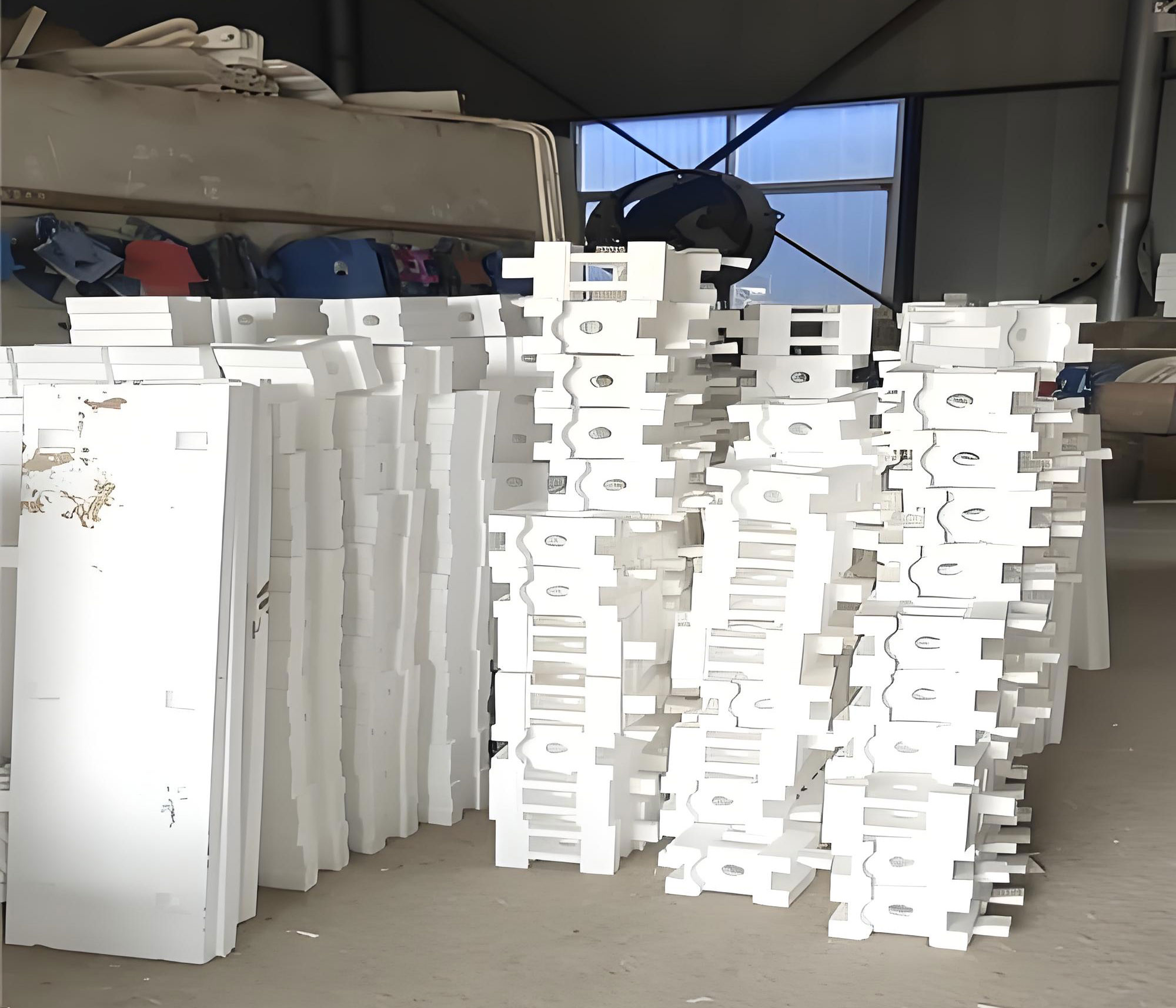
We designed an aluminum alloy mold capable of producing six spherical foam patterns simultaneously. The metal mold was sent to a foam manufacturer for mass production of polystyrene foam patterns. The foam density was controlled between 18–22 kg/m³ to achieve a balance between pattern strength and gas evolution during casting.
2.2 Gating and Riser System Design
Individual foam patterns were assembled into clusters as shown schematically in our design (no figure reference in text). Each cluster consisted of multiple spheres connected by foam runners (40 mm × 40 mm cross-section) in a staggered arrangement. Three layers of clusters were stacked in the flask, and a top pouring system was adopted to ensure smooth filling and directional solidification.
2.3 Coating Technology
The coating process includes preparation, application, and drying. The formulation is given in Table 2.
| Component | Proportion | Mixing time (h) |
|---|---|---|
| CMC (cellulose) + water (1:40) | Pre-dissolved, stand ≥4 h | – |
| CMC solution | – | 1–2 |
| White latex | Add | 0.5–1 |
| Bentonite + Na₂CO₃ + dextrin | Add | 1 |
| Quartz powder | Add final | 2–3 |
The coating was applied by dipping for large areas and brushing for local defects. Drying was performed at 30–40°C, and after drying, 3–4 additional coats were applied to achieve a final coating thickness of 1–1.5 mm. A high-quality coating is critical for lost foam castings to prevent sand adhesion and metal penetration.
2.4 Molding and Pouring
We used a self-made bottom-suction vacuum flask with a diameter of 2720 mm and height of 1500 mm. The molding sand was 20–40 mesh quartz sand. The vacuum pressure was controlled at 0.05 MPa. This vacuum level serves two purposes: (1) suppressing the amount of gaseous products from foam decomposition, and (2) establishing a positive pressure gradient from the pattern to the flask wall, which accelerates the escape of gaseous and liquid decomposition products through the coating and sand. The pouring temperature was maintained between 1480–1500°C, and the pouring time was approximately 140 seconds. The pouring operation was carried out smoothly without defects.
3. Melting Process
We employed a medium-frequency induction furnace for melting. The strong electromagnetic stirring action in the induction furnace promotes temperature fluctuations, concentration fluctuations, and composition homogenization, resulting in clean and uniformly alloyed molten metal. The charge consisted of steel scrap, low-chromium alloy returns, and appropriate ferroalloys to adjust the final composition within the specified ranges.
4. Heat Treatment Process
Two heat treatment routes were investigated: water quenching and air quenching (also referred to as air hardening). The key parameters are described below.
4.1 Water Quenching
After casting, the balls were allowed to cool to a dark red color (600–700°C), then hot-shakeout was performed, and the balls were immediately quenched into water at 20–40°C. This rapid cooling promotes the formation of martensite or bainite, enhancing hardness and wear resistance.
4.2 Air Quenching
Similarly, after cooling to 600–700°C, the balls were hot-shakeout and exposed to ambient air for natural cooling. Air quenching provides a slower cooling rate, resulting in a softer microstructure but with lower residual stresses.
4.3 Quenching Medium Selection
Based on the required cooling rates for achieving the target strength, hardness, and wear resistance, and considering cost efficiency, we selected water and air as quenching media. The quenching tank volume was designed such that the mass of the quenching medium was at least 10 times the mass of the balls, ensuring stable thermal conditions.
5. Experimental Results and Discussion
We produced a large number of φ40 mm low-chromium alloy grinding balls using lost foam castings under controlled conditions. The cast balls exhibited smooth surfaces, round shapes, no flash, no burrs, and no excess material. The performance indices were superior to those of metal-mold-produced balls.
5.1 Chemical Composition Comparison
Table 3 shows the chemical compositions of balls produced by metal mold and lost foam castings (air quenched and water quenched). All compositions fall within the target range. Slight carbon enrichment (about 0.01–0.02%) was observed in lost foam castings due to carbon pickup from foam pyrolysis. This can be compensated by adjusting the charge.
| Method | C | Si | Mn | Cr | Mo | P | S | Re residual |
|---|---|---|---|---|---|---|---|---|
| Metal mold | 3.50 | 1.63 | 0.57 | 2.1 | 0.015 | 0.037 | 0.003 | 0.0153 |
| Lost foam (air) | 3.51 | 1.63 | 0.57 | 2.1 | 0.015 | 0.037 | 0.003 | 0.0153 |
| Lost foam (water) | 3.51 | 1.65 | 0.57 | 2.1 | 0.015 | 0.037 | 0.003 | 0.0153 |
5.2 Hardness Comparison
Table 4 presents the Rockwell hardness (HRC) results. The lost foam air-quenched balls showed slightly lower hardness compared to metal mold balls, while the lost foam water-quenched balls exhibited significantly higher hardness. This is because the cooling rate in air quenching is slower than that in metal mold casting, whereas water quenching provides a much faster cooling rate, promoting a harder microstructure.
| Sample | Metal mold | Lost foam (air) | Lost foam (water) |
|---|---|---|---|
| 1 | 48.57 | 52.0 | 65.5 |
| 2 | 57.5 | 54.5 | 63.0 |
| 3 | 58.0 | 54.0 | 67.5 |
| 4 | 56.5 | 54.5 | 67.5 |
| 5 | 54.0 | 53.0 | 66.0 |
| Average | 54.8 | 53.6 | 65.9 |
The average hardness of lost foam water-quenched balls (65.9 HRC) is 11.1 HRC higher than that of metal mold balls (54.8 HRC). This improvement is attributed to the more efficient heat extraction and the refined microstructure achieved in lost foam castings.
5.3 Density Comparison
Density measurements are given in Table 5. Lost foam castings exhibited higher density (7.22 kg/dm³) compared to metal mold castings (6.85 kg/dm³), indicating better soundness and reduced porosity. This is because the lost foam process promotes directional solidification and a steeper temperature gradient, minimizing shrinkage porosity.
| Sample | Metal mold | Lost foam |
|---|---|---|
| 1 | 6.85 | 7.24 |
| 2 | 6.78 | 7.25 |
| 3 | 6.88 | 7.23 |
| 4 | 6.86 | 7.16 |
| 5 | 6.87 | 7.21 |
| Average | 6.85 | 7.22 |
5.4 Microstructure Analysis
The microstructures of the balls were examined using optical microscopy. The lost foam water-quenched balls showed a fine distribution of carbides in a martensitic matrix, whereas the air-quenched lost foam balls exhibited a mixture of pearlite and bainite. The metal mold balls had a coarser carbide network due to slower solidification. The refined microstructure of lost foam water-quenched balls contributes to their superior hardness and wear resistance.
The relationship between cooling rate and hardness can be approximated by the following empirical formula for low-chromium white cast irons:
$$ HRC = 20 + 0.8 \cdot \omega(C) + 2.5 \cdot \omega(Cr) + k \cdot \log(CR) $$
where CR is the cooling rate in °C/s and k is a material constant (approximately 8 for this alloy). For water quenching, CR can exceed 100°C/s, leading to higher HRC values.
6. Industrial Trial
We conducted an industrial trial by introducing 1000 kg of φ40 mm low-chromium alloy grinding balls produced by lost foam castings (water quenched) into a φ2.1 m × 3.0 m wet ball mill at the concentrator. The balls were compared side-by-side with traditional metal mold balls over a period of more than three months. The results demonstrated the following advantages of lost foam castings:
- Smooth surface finish, free from casting defects such as sand adhesion, sand inclusions, blowholes, and shrinkage cavities.
- High internal quality with excellent wear resistance.
- No spalling, no cracking, and no out-of-roundness during service.
- Expected service life significantly longer than that of metal mold counterparts.
7. Economic Benefit Analysis
The lost foam casting process offers a simplified production flow, reduced manufacturing costs, higher productivity, and lower rejection rates. It also lowers labor costs and improves working conditions, yielding substantial social benefits.
With the hardness increase of 11.1 HRC, the wear resistance is markedly improved. Assuming an annual consumption of 700 tons of φ40 mm low-chromium grinding balls, replacing them with lost foam castings would reduce the required annual consumption to approximately 628 tons, saving 32.4万元 (RMB) per year in grinding media cost. Additionally, the smooth and spherical surface of lost foam castings enhances mill efficiency.
The total cost saving can be expressed as:
$$ \text{Saving} = (m_{\text{old}} – m_{\text{new}}) \times P – \Delta C $$
where \( m_{\text{old}} \) is the annual consumption of metal mold balls (700 t), \( m_{\text{new}} \) is the annual consumption of lost foam castings (628 t), \( P \) is the price per ton, and \( \Delta C \) is the incremental production cost. In our case, the saving was estimated at 32.4万元 annually.
8. Conclusions
Our research on producing φ40 mm low-chromium alloy grinding balls by lost foam castings has successfully demonstrated the following:
- The lost foam casting process produces balls with excellent surface quality and dimensional accuracy.
- Water quenching after hot shakeout significantly increases hardness (average 65.9 HRC) compared to metal mold castings (54.8 HRC).
- The density and soundness of lost foam castings are superior due to improved directional solidification.
- Industrial trials confirm a substantial improvement in wear life, leading to annual cost savings of over 30万元.
- The process is environmentally friendly and operator-friendly, making it an ideal replacement for traditional metal mold casting.
In summary, lost foam castings provide a viable and advantageous route for producing high-quality grinding balls, and we recommend its full-scale adoption in our plant.